

What Is a Quantum Circuit? Components, Examples, and Use Cases

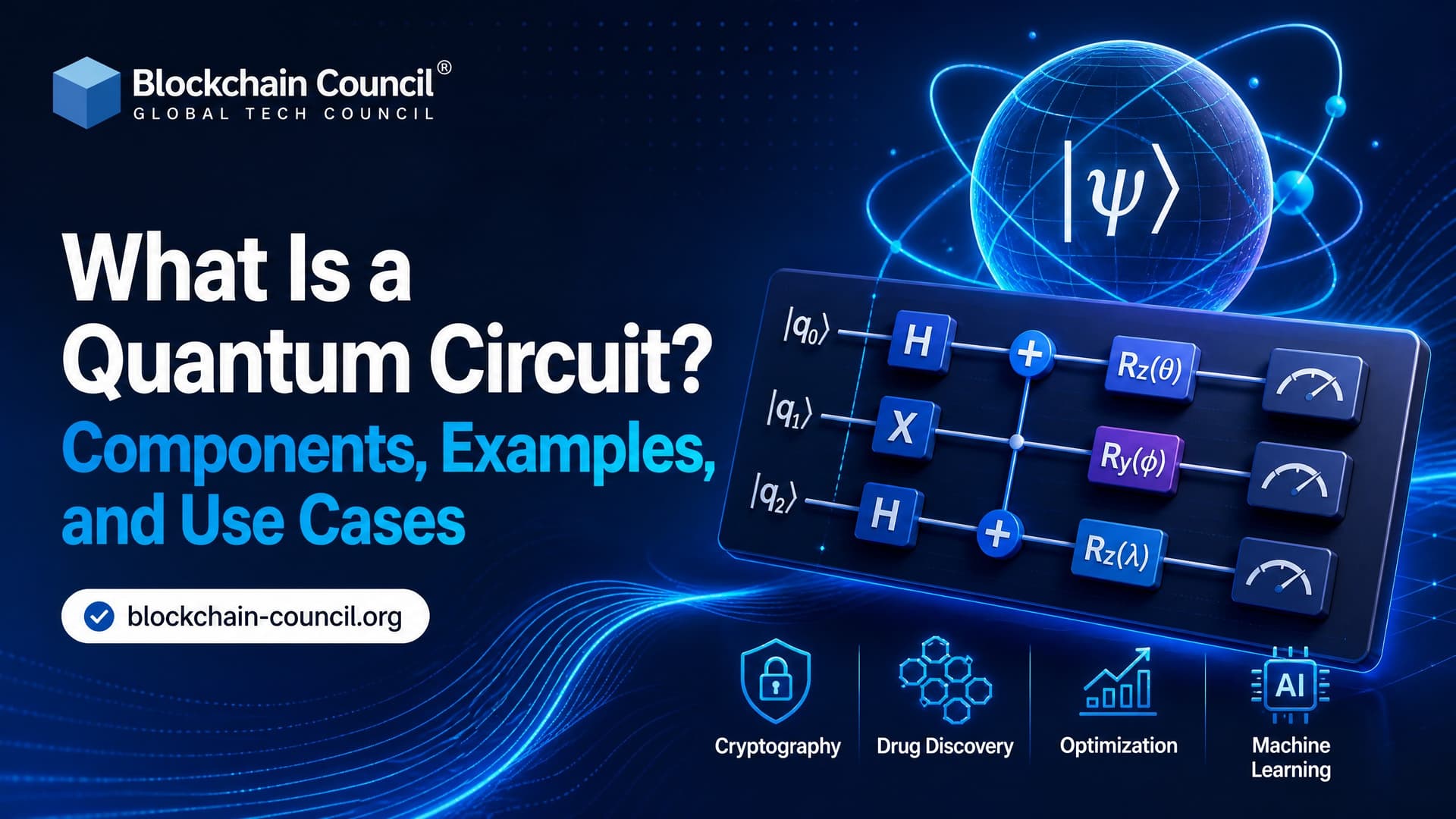
A quantum circuit is the working blueprint of gate based quantum computing. It defines which qubits are used, which quantum gates act on them, in what order those gates run, and how the final quantum state is measured into classical bits. Once you can read circuits, you can follow quantum algorithms, debug experiments, compare hardware claims, and judge whether a use case is realistic.
What Is a Quantum Circuit?
In the standard circuit model, a quantum circuit is a structured sequence of operations applied to qubits. It starts with an initial state, usually all qubits in state 0, applies unitary quantum gates, may include mid-circuit measurements or classical control, and ends with measurement results.

The comparison with classical logic circuits helps, but only so far. A classical circuit moves bits through AND, OR, and NOT gates. A quantum circuit moves quantum states through gates such as Hadamard, Pauli X, CNOT, and controlled phase operations. The output is probabilistic, so you usually run the same circuit many times, called shots, to estimate the distribution of outcomes.
Quantum circuits show up across superconducting qubits, trapped ions, photonic systems, silicon spin qubits, and other hardware. IBM, Quantinuum, Google, IonQ, QuEra, NVIDIA, and many research groups express algorithms through circuits because the abstraction is portable, even when the underlying physics is not.
Core Components of a Quantum Circuit
Qubits
Qubits carry the information in a quantum circuit. Unlike classical bits, qubits can sit in superposition and can become entangled with other qubits. A physical qubit might be a superconducting transmon, a trapped ion, a photon, a silicon spin state, or another quantum system. The circuit diagram can look similar across platforms, but the hardware timing and error behavior differ sharply.
Quantum Gates
Quantum gates are reversible operations represented by unitary matrices. Common single-qubit gates include:
- X gate: Similar to a NOT operation on computational basis states.
- Y and Z gates: Pauli operations that change phase and state orientation.
- Hadamard gate: Creates equal superposition from state 0 or state 1.
- Rotation gates: Parameterized gates such as RX, RY, and RZ.
Multi-qubit gates create correlations and entanglement. The CNOT gate is the classic example. Controlled Z, Toffoli, and controlled rotation gates turn up in algorithms, arithmetic circuits, and error correction routines.
Measurement and Classical Registers
Measurement maps a quantum state to classical bits. That act changes the state, so where you place a measurement matters. Beginner circuits often measure only at the end. More advanced circuits use mid-circuit measurements for adaptive algorithms and quantum error correction.
Classical registers store those measurement results. In dynamic circuits, a classical result can trigger a later operation. This is not just a convenience. Real time feedback is central to syndrome extraction in fault tolerant designs.
Ancilla and Logical Qubits
Ancilla qubits are helper qubits. You use them for temporary storage, arithmetic, uncomputation, and error detection. Logical qubits are a different thing. A logical qubit is encoded across many physical qubits so errors can be detected and corrected. Early fault tolerant circuits depend on logical qubits, not raw physical qubits.
Connectivity and Layout
Hardware connectivity can make or break a circuit. If two qubits cannot interact directly, the compiler may insert SWAP gates. That increases depth and error exposure. In practice, a clean textbook circuit can end up much deeper after transpilation to a specific backend.
One practical warning. If you hand build circuits in Qiskit and accidentally call qc.cx(0, 0), Qiskit raises CircuitError: 'duplicate qubit arguments'. It is a small mistake, but it teaches the real rule: a two-qubit gate needs two distinct qubits, and the compiler is strict about validity.
Key Quantum Circuit Metrics
When someone claims a quantum circuit is large or useful, ask for the numbers.
- Width: The number of qubits used, including data and ancilla qubits.
- Depth: The number of sequential gate layers after parallel gates are grouped.
- Gate count: The total number of gates, especially noisy two-qubit gates.
- Gate type mix: In fault tolerant settings, T gates and Toffoli gates are expensive.
- Fidelity: The probability that operations and measurements behave as intended.
IBM's published quantum roadmap, for example, targets circuits with 7,500 gates on up to three 120-qubit modules in 2026, then 10,000 gates in 2027 and 15,000 gates in 2028. Those numbers matter because deeper circuits are harder to run before noise corrupts the result.
Simple Quantum Circuit Examples
Superposition Circuit
The smallest useful example is a one-qubit circuit with a Hadamard gate. Start with qubit 0 in state 0. Apply H. Measure. Over many shots, you should see roughly half 0 and half 1, assuming low measurement noise.
Bell State Circuit
A Bell state circuit creates entanglement between two qubits. Apply a Hadamard gate to the first qubit, then apply CNOT from the first qubit to the second. The two measurement results become correlated.
from qiskit import QuantumCircuit

qc = QuantumCircuit(2, 2)
qc.h(0)
qc.cx(0, 1)
qc.measure([0, 1], [0, 1])

print(qc)
This circuit is small, but it sits behind quantum teleportation, superdense coding, entanglement benchmarking, and many teaching labs.
Quantum Fourier Transform
The Quantum Fourier Transform, or QFT, converts amplitudes into a Fourier basis. It is central to phase estimation and appears in algorithms related to period finding. You will meet it in serious quantum algorithm courses because it connects circuit design to number theory and chemistry simulation.
Variational Quantum Circuits
Variational circuits use parameterized gates. A classical optimizer adjusts gate angles to minimize a cost function. This pattern shows up in the variational quantum eigensolver, quantum approximate optimization algorithms, and quantum machine learning experiments. My take: variational circuits are useful for learning and pilots, but claims of broad commercial advantage still run ahead of the evidence.
Real World Use Cases of Quantum Circuits
Quantum Chemistry and Materials
Quantum chemistry is one of the strongest near-term candidates for useful quantum circuits. Microsoft and Quantinuum have reported logical-qubit experiments for chemistry simulation, including work involving a 12 logical qubit circuit for the chromium dimer ground state. That is meaningful because molecular electronic structure maps naturally to quantum states.
Potential applications include catalyst design, battery materials, drug discovery workflows, and superconducting materials research. The hard part is not drawing the circuit. It is reducing depth, controlling error, and proving that the quantum method beats the best classical approximation for a specific task.
Cryptography and Quantum Networks
Quantum key distribution uses circuits for state preparation, entanglement generation, basis choice, and measurement. Integrated photonic chips are especially relevant here. Peking University has demonstrated large scale QKD network work using optical quantum chips, while enterprise demonstrations from groups such as Aliro Technologies and Cisco show how entanglement based QKD can operate over network infrastructure.
Optimization and Logistics
Optimization circuits are tested for routing, scheduling, portfolio construction, and resource allocation. Be blunt with stakeholders: most of these are still pilots. Classical solvers are extremely strong. Quantum circuits may help on certain structured problems later, but you should demand benchmarks against modern classical baselines, not toy examples.
Quantum Machine Learning
Quantum machine learning uses circuits as feature maps, kernels, and trainable models. Templates built from rotations, entangling layers, inner products, and Fourier features are common. These circuits are being tested in anomaly detection and small pattern recognition tasks. A clear, repeatable advantage over classical machine learning is not settled yet.
Benchmarking and Hardware Characterization
Some circuits exist mainly to test machines. Quantum volume circuits, random IQP circuits, and randomized benchmarking routines reveal gate fidelity, crosstalk, connectivity limits, and noise behavior. If you work in enterprise evaluation, these benchmarks are often more useful than marketing screenshots of large qubit counts.
Latest Developments Shaping Quantum Circuits
Several 2025 and 2026 developments show where the field is heading. IBM introduced Orbit as a Qiskit function for premium users, combining optimized transpilation, dynamical decoupling, and measurement error mitigation. Riverlane reported 16.32 microsecond real time quantum error correction latency with Deltaflow 2, much faster than the 63 microsecond benchmark associated with Google's Willow work. NVIDIA announced CUDA-Q Logical to connect algorithms, error correction logic, and hardware orchestration.
Photonic and ion trap systems are moving quickly too. QuiX Quantum, NASA, and the University of Twente reported photon distillation work that reduced photon indistinguishability errors by a factor of 2.2. Quantum Art has published simulations suggesting a fault tolerance threshold near 1 percent for a trapped ion multi-qubit gate architecture. QuEra's Tsim simulator targets fast GPU accelerated simulation, including 85-qubit circuit workloads on NVIDIA GH200 hardware.
How to Start Learning Quantum Circuits
If you are new, do not start with Shor's algorithm. Start smaller.
- Build a one-qubit Hadamard circuit and inspect the measurement histogram.
- Create a Bell state and verify correlated outputs.
- Transpile the same circuit for different backends and compare added gates.
- Run a shallow variational circuit and watch how shot noise changes optimization.
- Study QFT only after you are comfortable with controlled gates and phase.
For a structured path, consider Blockchain Council's Certified Quantum Computing Expert™ as a next step. If your work connects quantum computing with secure systems, blockchain, or AI workflows, you can pair it with Certified Cybersecurity Expert™, Certified Blockchain Expert™, or Certified AI Expert™ depending on your role.
Final Takeaway
A quantum circuit is not just a diagram. It is the contract between the algorithm designer, compiler, control system, and quantum hardware. Learn to read width, depth, gate count, connectivity, and error behavior, then build small circuits yourself. Your next step: implement the Bell circuit above, transpile it for a real backend or simulator, and inspect what changed.
Related Articles
View All
Quantum Computing
Quantum Computing in Climate and Energy: Use Cases for a Sustainable Future
Quantum computing in climate and energy is moving from theory to pilots in grids, climate risk, data centers, and materials, with hybrid methods leading today.

Quantum Computing
Quantum Computing in Healthcare: Use Cases, Benefits, and Challenges
Quantum computing in healthcare could support drug discovery, imaging, genomics, and security, but clinical proof remains limited and early stage.

Quantum Computing
Top Quantum AI Use Cases Across Industries
Explore the top Quantum AI use cases in pharma, finance, logistics, energy, cybersecurity, manufacturing, and AI workflows with practical industry examples.
Trending Articles
How Blockchain Secures AI Data
Understand how blockchain technology is being applied to protect the integrity and security of AI training data.
What is AWS? A Beginner's Guide to Cloud Computing
Everything you need to know about Amazon Web Services, cloud computing fundamentals, and career opportunities.

Can DeFi 2.0 Bridge the Gap Between Traditional and Decentralized Finance?
The next generation of DeFi protocols aims to connect traditional banking with decentralized finance ecosystems.