

Top Quantum AI Use Cases Across Industries

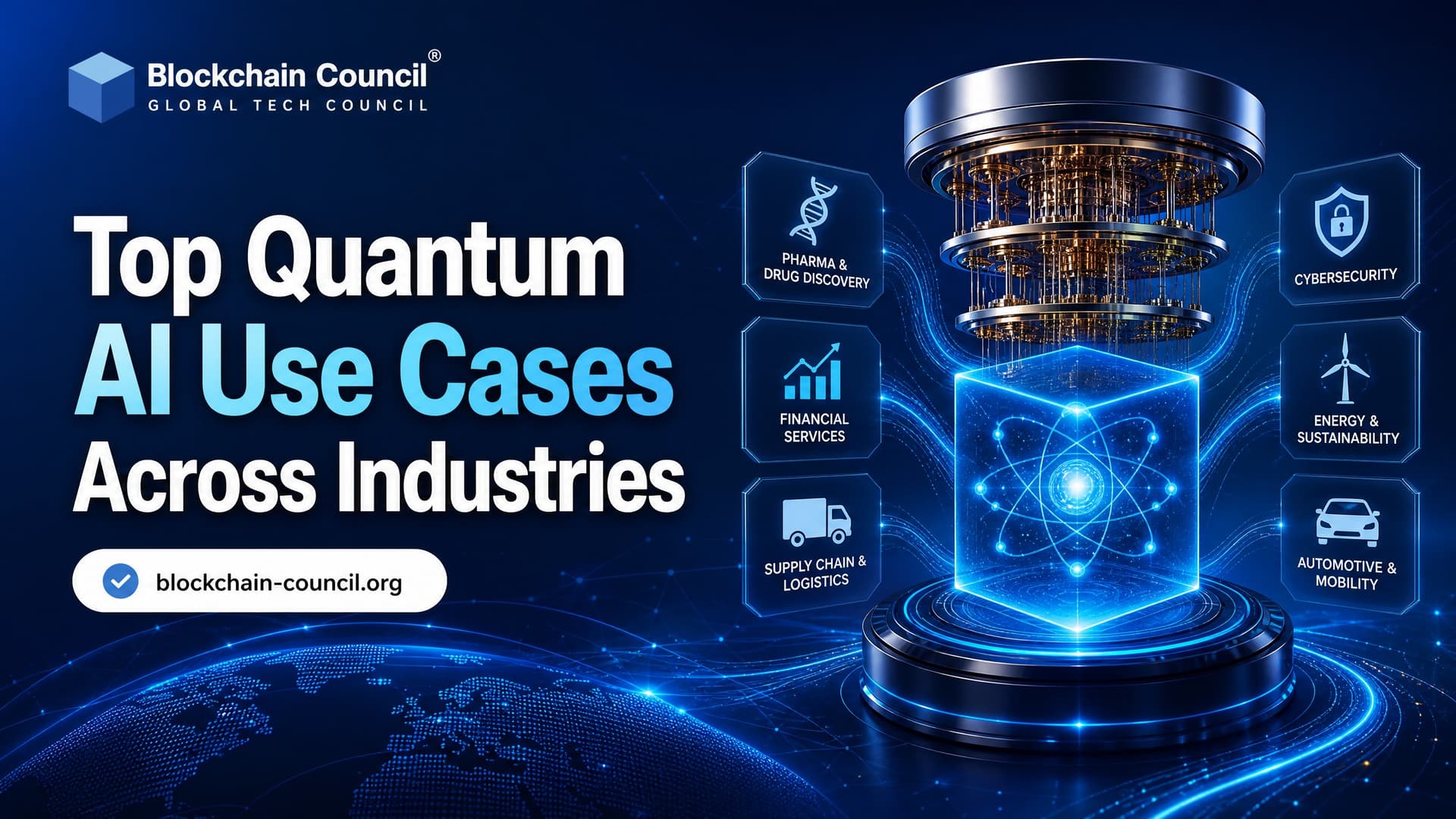
Quantum AI use cases are moving from research slides into working pilots, especially where classical computing hits a wall: molecular simulation, portfolio optimization, routing, grid planning, and cryptography. The near-term story is not quantum computers replacing AI. It is hybrid quantum-classical workflows that help existing AI systems solve narrower, harder problems.
That distinction matters. Current quantum hardware is still in the noisy intermediate-scale quantum stage, often called NISQ. You access most systems through cloud platforms from IBM, Amazon Braket, Microsoft Azure Quantum, Google, D-Wave, IonQ, and Quantinuum. The machines are useful for experiments, but they are not magic accelerators for every model. Pick the wrong use case and you will spend months proving what a GPU could show in an afternoon.

What Quantum AI Means in Practice
Quantum AI usually refers to two related ideas. First, using quantum computers to support AI workloads such as optimization, sampling, linear algebra, and simulation. Second, using AI to improve quantum hardware, calibrate circuits, reduce noise, and search for better algorithms.
McKinsey groups many quantum business applications into four technical archetypes: quantum simulation, quantum linear algebra for AI and machine learning, quantum optimization and search, and quantum factorization. For industry teams, the first three matter most right now.
- Quantum-enhanced optimization: portfolios, routes, factory schedules, energy dispatch, and resource allocation.
- Quantum simulation: molecules, batteries, catalysts, proteins, materials, and climate systems.
- Quantum-assisted machine learning: classification, anomaly detection, generative modeling, time series forecasting, and hyperparameter search.
- Quantum security: post-quantum cryptography, quantum key distribution, and certified quantum randomness.
A practical note if you are building demos: toolchains change fast. In Qiskit 1.0, older examples that use from qiskit import execute can fail with ImportError: cannot import name 'execute' from 'qiskit'. Use the newer primitives such as Sampler and Estimator, or pin the version in your environment. Small details like that burn more lab time than most people admit.
1. Pharmaceuticals and Healthcare
Pharma is one of the strongest candidates for early value because drug discovery depends on quantum chemistry. Molecules are quantum systems. Classical approximations work, but they get expensive fast as molecular complexity grows.
Drug discovery and molecular simulation
Quantum AI can support lead compound screening, protein-ligand interaction analysis, molecular energy estimation, and catalyst design. The aim is not to replace wet labs. It is to cut the number of expensive experiments by improving the quality of candidates before synthesis.
Companies and research groups such as Boehringer Ingelheim, AstraZeneca, Merck KGaA, and ProteinQure have been cited in quantum drug discovery and molecular simulation work. Google has also published widely on quantum algorithms and chemical simulation. Analysts often place meaningful pharma impact in the 5 to 10 year range, assuming better hardware and better error mitigation.
Precision medicine and imaging
Quantum machine learning may also help with genomic analysis, patient stratification, MRI reconstruction, and anomaly detection in medical images. Be careful here. Many claims are still early-stage. If you work in healthcare AI today, a better path is to identify one bottleneck, such as cohort selection for trials or molecular feature generation, then test a hybrid approach against a strong classical baseline.
2. Finance and Insurance
Financial institutions like quantum AI because they already run hard optimization and simulation workloads. A bank can define the objective function. It can also measure whether the new method beats the old one.
Portfolio optimization
Portfolio construction is a classic combinatorial problem. You balance risk, return, liquidity, sector exposure, tax rules, capital requirements, and transaction costs. Quantum optimizers can search large allocation spaces and return several high-quality candidate portfolios, not just one answer.
JPMorgan Chase, Crédit Agricole, and Multiverse Computing are among the names linked to quantum finance pilots. The strongest use cases include portfolio optimization, credit risk modeling, derivatives pricing, fraud detection, and Monte Carlo acceleration.
Fraud and risk modeling
Quantum-assisted machine learning can be tested on high-dimensional transaction data for anomaly detection. The sensible benchmark is not a toy dataset. Use your current fraud model, then compare precision, recall, cost of false positives, training time, and auditability. In regulated finance, a black-box gain that no risk committee can understand is rarely worth it.
3. Logistics, Supply Chain, and Mobility
Route planning sounds simple until you add delivery windows, driver constraints, customs checks, fuel cost, charging stops, weather, traffic, and customer priority. Then it becomes a serious optimization problem.
Quantum AI use cases in logistics include:
- Vehicle routing and last-mile delivery planning
- Shipping network optimization
- Warehouse slotting and picking schedules
- Traffic signal timing and public transport routing
- Fleet planning for electric trucks and charging infrastructure
D-Wave, DHL, and Volkswagen have been associated with quantum logistics, traffic, and shipping optimization studies. This is a good pilot area because you can quantify outcomes quickly: fewer miles, lower fuel use, improved on-time delivery, or better asset utilization.
To be blunt, quantum is the wrong first step if your routing data is messy or late. Fix the data pipeline first. Quantum optimization cannot rescue bad addresses, missing timestamps, or stale inventory feeds.
4. Manufacturing and Industrial Operations
Manufacturing brings together scheduling, robotics, supply flow, maintenance, quality inspection, and energy usage. One delayed machine can ripple across a plant.
Production scheduling
Quantum optimization can assign jobs to machines, sequence tasks, schedule shifts, and reduce downtime under many constraints. IBM has identified manufacturing as a sector where quantum computing could have strong business impact, especially when combined with AI systems used in smart factories.
Defect detection and predictive maintenance
Quantum machine learning may improve anomaly detection in sensor streams and inspection images. The near-term opportunity is hybrid: classical systems handle feature extraction and data cleaning, while quantum routines test specific classification or optimization subproblems.
If your team already uses digital twins, quantum simulation can be tested as a specialized component inside that workflow. Do not rebuild the whole factory analytics stack. Insert the quantum step where classical solvers struggle.
5. Energy, Materials, Batteries, and Climate
Energy is one of the most important categories for quantum AI use cases because it combines physical simulation with market optimization. Batteries, catalysts, power grids, and weather systems all involve difficult math.
Battery and materials discovery
Quantum simulation can help model lithium compounds, solid electrolytes, catalysts, solar cell materials, and high-performance industrial materials. BASF, Bosch, Mercedes-Benz, Volkswagen, and Lockheed Martin have been cited in quantum materials and battery-related work.
Fujitsu has described hybrid quantum-AI applications in material science and time series forecasting. This is where quantum AI feels most natural: use AI to guide the search space, then use quantum methods for physics-heavy calculations that classical approximations handle poorly.
Grid optimization and climate modeling
Utilities need to balance supply and demand while integrating wind, solar, storage, and variable pricing. Quantum optimization and time series forecasting can support grid dispatch, energy trading, and pricing under uncertainty.
Climate modeling is a longer-term bet. Most analysts place broad climate and large-scale AI advantage closer to a 10 to 20 year horizon or beyond. That is realistic. The models are huge, the physics is complex, and quantum hardware must mature before it can shift national-scale forecasting.
6. Cybersecurity and Digital Trust
Quantum computing is both a cybersecurity risk and a defensive tool. Future fault-tolerant quantum computers could break widely used public-key schemes such as RSA and elliptic curve cryptography through Shor's algorithm. That does not mean every encrypted database is doomed tomorrow, but long-lived sensitive data needs attention now.
Key quantum AI and quantum security use cases include:
- Post-quantum cryptography: migration to algorithms designed to resist quantum attacks. NIST has led the standardization process for post-quantum cryptographic algorithms.
- Quantum key distribution: secure key exchange using quantum properties of photons.
- Certified quantum randomness: high-quality random number generation for cryptographic protocols, lotteries, and security systems.
- AI-supported crypto risk assessment: scanning infrastructure for vulnerable algorithms, certificates, and protocols.
IBM, Microsoft, PayPal, and NIST are often referenced in this area. For enterprises, the practical first move is crypto inventory. Know where RSA, ECC, TLS certificates, code signing keys, VPNs, HSMs, and embedded devices are used.
7. AI and Machine Learning Workflows
Quantum AI also targets AI itself. Researchers are testing variational quantum circuits, quantum kernels, quantum generative models, quantum natural language processing, and quantum-enhanced hyperparameter search.
The trade-off is clear. Classical AI is improving very fast, and GPUs are highly optimized. Quantum machine learning must prove advantage on real tasks, not only on carefully chosen academic examples. Still, QML is worth learning if you work with high-dimensional data, sampling-heavy models, anomaly detection, or optimization-heavy AI pipelines.
Organizations such as IBM, Google, D-Wave, IonQ, and Quantinuum continue to experiment with QML and related methods. Expect useful niche applications before general-purpose AI acceleration.
How Professionals Should Prepare
If you are evaluating quantum AI for your organization, start with a narrow business problem. Good candidates share three traits:
- The current classical approach is expensive, slow, or low quality.
- The problem can be written as optimization, simulation, sampling, or structured machine learning.
- You have a measurable baseline and clean data.
For developers, learn Python, linear algebra, optimization, probability, and one quantum SDK. Qiskit is a practical starting point because of its documentation and cloud access. D-Wave Ocean is useful for optimization-focused teams. PennyLane works well if your interest is differentiable programming and QML.
For structured learning, consider Blockchain Council's Certified Quantum Computing Expert™ for quantum foundations. If your role is AI-heavy, pair it with the Certified Artificial Intelligence (AI) Expert™. Security teams should also look at the Certified Cybersecurity Expert™ while planning post-quantum migration. Blockchain professionals working on digital trust can connect these topics with the Certified Blockchain Expert™.
What to Build Next
Quantum AI is not ready to replace your AI stack. It is ready for focused pilots in drug discovery, finance, logistics, manufacturing, energy, cybersecurity, and materials research. The best teams will not ask, Where can we use quantum? They will ask, Which hard problem is costing us money, and can a hybrid quantum-AI method beat our current baseline?
Pick one use case. Define the benchmark. Run a small proof of concept on a cloud quantum platform. Then document what improved, what failed, and what should stay classical. That discipline will matter more than any headline about quantum advantage.
Related Articles
View All
Quantum Computing
Quantum Computing in Climate and Energy: Use Cases for a Sustainable Future
Quantum computing in climate and energy is moving from theory to pilots in grids, climate risk, data centers, and materials, with hybrid methods leading today.

Quantum Computing
Quantum Computing in Healthcare: Use Cases, Benefits, and Challenges
Quantum computing in healthcare could support drug discovery, imaging, genomics, and security, but clinical proof remains limited and early stage.

Quantum Computing
What Is Quantum Machine Learning? Concepts, Models, and Use Cases
Quantum machine learning combines quantum circuits with classical ML workflows for specialized tasks such as optimization, kernels, anomaly detection, and simulation.
Trending Articles
What is AWS? A Beginner's Guide to Cloud Computing
Everything you need to know about Amazon Web Services, cloud computing fundamentals, and career opportunities.

Can DeFi 2.0 Bridge the Gap Between Traditional and Decentralized Finance?
The next generation of DeFi protocols aims to connect traditional banking with decentralized finance ecosystems.
How to Install Claude Code
Learn how to install Claude Code on macOS, Linux, and Windows using the native installer, plus verification, authentication, and troubleshooting tips.