

What Is Quantum Computing? A Beginner-Friendly Guide for 2026

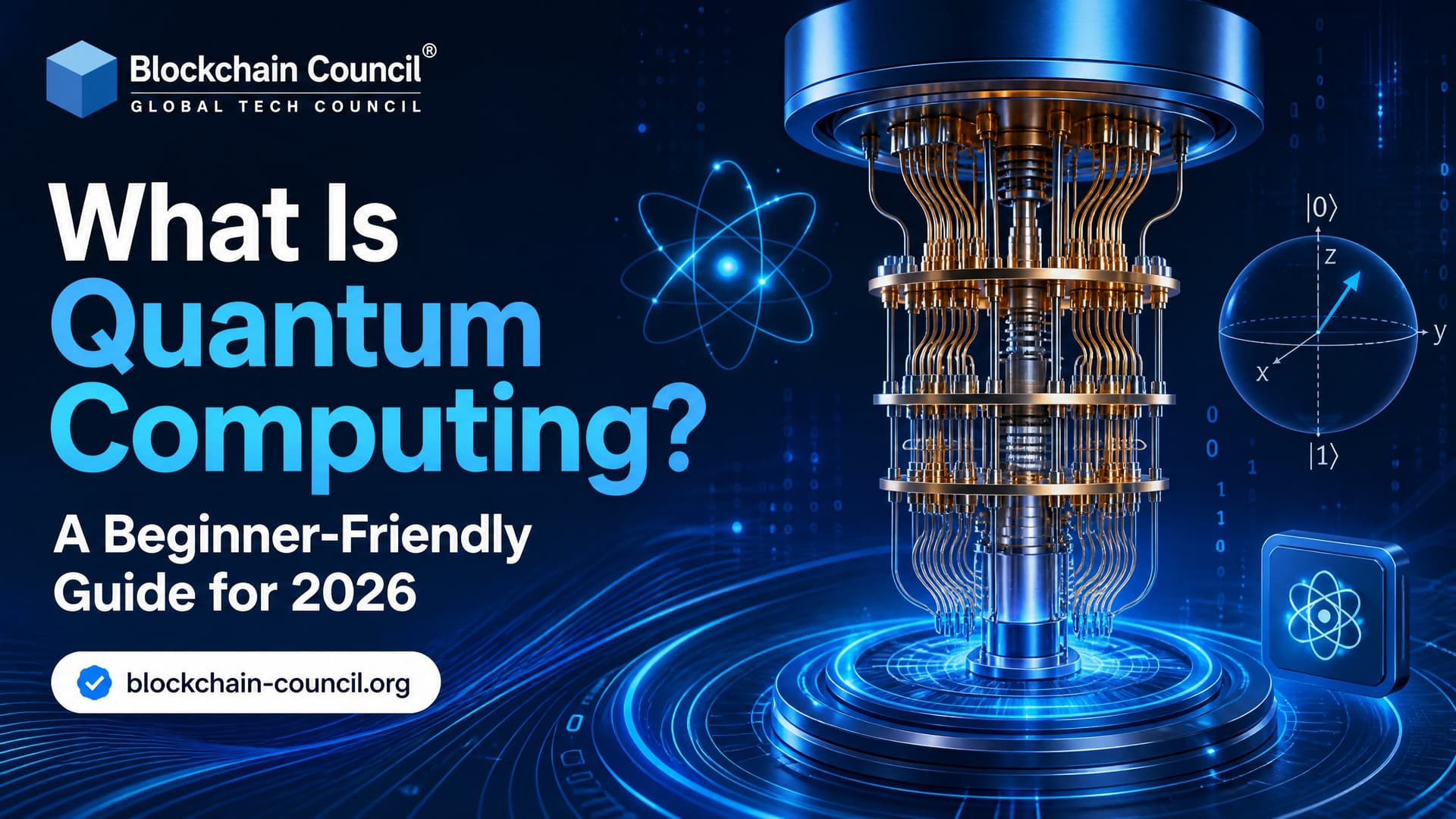
What is quantum computing? It is a way of computing that uses quantum physics to process information in forms ordinary computers cannot directly copy. Instead of relying only on bits that are either 0 or 1, quantum computers use qubits, which can hold richer states and interact through effects such as superposition, entanglement, and interference.
That sounds abstract. It is. But the practical idea is simple: quantum computers are not faster laptops. They are specialized machines built for certain hard problems, especially simulation, optimization, and cryptography-related analysis.

How Quantum Computing Differs From Classical Computing
A classical computer stores information as bits. Every file, smart contract, image, transaction, and AI model parameter is ultimately represented as 0s and 1s. Classical processors manipulate those bits using logic gates.
A quantum computer uses qubits. A qubit can be represented by superconducting circuits, trapped ions, photons, electrons, or other physical systems that follow quantum rules. IBM, Google, IonQ, Quantinuum, D-Wave, and other providers use different hardware approaches, which is one reason the field still feels fragmented.
The difference is not that a qubit is magically both 0 and 1 in a casual sense. More precisely, a qubit can exist in a weighted combination of the 0 and 1 states until measurement. Those weights are called amplitudes, and quantum algorithms manipulate them carefully.
Core Quantum Computing Concepts
Qubits
A qubit is the basic unit of quantum information. When you measure it, you get a classical result, usually 0 or 1. Before measurement, the qubit can carry amplitude information that lets quantum algorithms work in ways classical algorithms do not.
Superposition
Superposition lets a qubit exist in a combination of possible states. With many qubits, the state space grows quickly. Two qubits describe four basis states. Ten qubits describe 1,024 basis states. This does not mean you can read out 1,024 answers at once. Measurement gives limited classical output. The skill is designing the algorithm so the right answer becomes more likely.
Entanglement
Entanglement links qubits so their measurement outcomes are correlated in a way classical bits cannot fully reproduce. This is one of the main sources of quantum advantage in multi-qubit systems. Without entanglement, many quantum circuits become easy to simulate classically.
Interference
Interference is where the algorithm does real work. Quantum states can combine constructively or destructively. A good quantum algorithm raises the probability of useful answers and lowers the probability of bad ones. Grover's search algorithm and phase estimation both depend heavily on this idea.
Measurement and Decoherence
Measurement collapses a quantum state into a classical result. Decoherence is different. It happens when qubits lose their quantum behavior because of noise, heat, vibration, electromagnetic interference, or imperfect control pulses. This is why many quantum processors run at extremely low temperatures and still produce noisy results.
If you test beginner circuits in Qiskit, you will notice this quickly. On a simulator, a Bell state often gives near-perfect correlated results. On real hardware, you may see unexpected bitstrings because gates and readout are imperfect. Another practical gotcha: many old tutorials use from qiskit import Aer, but newer setups often require the separate qiskit-aer package and from qiskit_aer import AerSimulator. Small version changes can break a lab before the physics even starts.
How Does a Quantum Computer Actually Run a Program?
Most gate-based quantum programs are written as circuits. You start with qubits in an initial state, apply quantum gates, then measure the result.
Quantum gates are not the same as classical AND or OR gates. They are mathematical operations that rotate qubit states, flip amplitudes, or create entanglement. Depending on the hardware, these operations are implemented through microwave pulses, lasers, or other physical controls.
A simple workflow looks like this:
- Define the qubits and classical bits.
- Apply gates such as H, X, CNOT, RZ, or controlled rotations.
- Run the circuit on a simulator or quantum processor.
- Measure many times, often called shots.
- Study the output distribution instead of expecting one deterministic answer.
This probabilistic output surprises beginners. It should not. Quantum computing is designed around probability amplitudes, not single-run certainty.
What Is the Current State of Quantum Computing in 2026?
Quantum computing is still in the noisy intermediate-scale quantum era, often called NISQ. Current devices have useful capabilities, but they also have limited qubit counts, short coherence times, and non-trivial error rates.
That does not make them useless. It means you need to pick the right problems. Cloud access to quantum hardware is already available through platforms from IBM, Google, D-Wave, Amazon Braket, Microsoft Azure Quantum, and others. Researchers and enterprises use these systems for pilots in optimization, simulation, and quantum machine learning.
To be blunt, quantum computers are not replacing classical servers soon. For web applications, databases, blockchain nodes, AI inference, or payroll systems, classical computing is the right tool. Quantum computing becomes interesting when the structure of the problem matches quantum mechanics or high-dimensional optimization.
Real-World Use Cases of Quantum Computing
Drug Discovery and Healthcare
Molecules are quantum systems. That makes quantum computing a natural fit for chemistry simulation. Pharmaceutical teams are exploring quantum methods to model molecular energy states, screen candidates, and study complex interactions that are costly to simulate classically. Companies such as Boehringer Ingelheim, Pfizer, Janssen, Google, and IBM have all been connected with quantum research initiatives in this area.
Materials Science and Batteries
Battery chemistry is another strong candidate. Quantum simulation can help researchers study lithium compounds, catalysts, and advanced materials at a more detailed level. BASF and Bosch have been associated with quantum materials research, especially where classical approximation methods become expensive.
Finance and Risk Management
Finance teams test quantum algorithms for portfolio optimization, derivatives pricing, Monte Carlo-style analysis, and fraud detection. Some reported pilots suggest large reductions in problem size for portfolio optimization and better ways to examine risk across many scenarios. Treat those numbers carefully. Pilot results are not the same as production-wide advantage, but they show why banks are paying attention.
Logistics and Supply Chain
Routing and scheduling can become brutally complex. A delivery network with vehicles, depots, fuel costs, traffic, customs delays, and time windows is not a neat spreadsheet problem. DHL, Volkswagen, and D-Wave-related projects have explored quantum and quantum-inspired optimization for routing, traffic flow, and scheduling.
Cybersecurity and Cryptography
This is the area blockchain and security professionals should watch closely. Large fault-tolerant quantum computers could threaten widely used public-key cryptography, including RSA and elliptic curve systems. That does not mean Bitcoin or enterprise PKI breaks tomorrow. It does mean long-term security planning has already started.
Post-quantum cryptography is the practical response. The U.S. National Institute of Standards and Technology has standardized algorithms based on CRYSTALS-Kyber for key establishment (published as ML-KEM, FIPS 203) and CRYSTALS-Dilithium for digital signatures (published as ML-DSA, FIPS 204). Enterprises with data that must stay confidential for decades should begin cryptographic inventory and migration planning now.
Quantum key distribution, or QKD, is another security approach. It uses quantum states to detect eavesdropping during key exchange. QKD is promising for specific high-security links, but it is not a drop-in replacement for internet-scale cryptography. Post-quantum cryptography is the more practical near-term priority for most organizations.
Will Quantum Computing Affect Blockchain?
Yes, but unevenly.
Blockchains rely on cryptographic primitives: hash functions, digital signatures, key pairs, and consensus mechanisms. Quantum computing creates the biggest concern for digital signatures based on elliptic curve cryptography. Hash functions are generally less exposed, though Grover's algorithm can reduce effective security strength, which you can counter by using larger output sizes.
If you work in Web3, your immediate task is not panic. Your task is literacy. Understand which chains use which signature schemes, how key reuse affects exposure, and what post-quantum migration might require at the wallet, protocol, and custody layers. Blockchain Council's blockchain, cybersecurity, and AI certification learning paths can be useful next steps for professionals connecting quantum risk with enterprise systems.
What Should Beginners Learn First?
Do not start with advanced linear algebra proofs unless you enjoy pain. Build a practical base first.
- Computer science basics: algorithms, complexity, probability, and binary logic.
- Math foundations: vectors, matrices, complex numbers, and linear transformations.
- Quantum basics: qubits, gates, measurement, entanglement, and interference.
- Tools: Qiskit, Cirq, PennyLane, Amazon Braket, or D-Wave Ocean depending on your goal.
- Security context: public-key cryptography, post-quantum cryptography, and key management.
If your goal is enterprise strategy, focus on use cases, vendor models, and quantum-safe security planning. If your goal is development, write circuits, run noisy simulations, and compare results against classical baselines. If your goal is blockchain security, study post-quantum signatures and migration trade-offs before chasing exotic quantum algorithms.
The Future of Quantum Computing
The next phase will be hybrid. Classical systems will handle data, orchestration, user interfaces, and most computation. Quantum processors will act as accelerators for carefully selected tasks. This is similar to how GPUs became essential for AI, though not every workload belongs on a GPU.
Expect progress in three areas:
- Better qubits with longer coherence times and lower error rates.
- Error correction that makes larger, fault-tolerant systems possible.
- More useful algorithms for chemistry, optimization, finance, and security analysis.
The hype version says quantum computing will change everything overnight. The practical version is more useful: quantum computing will become a specialized part of high-performance computing, and the professionals who understand its limits will make better decisions than those who only read the headlines.
Your next step is simple. Pick one track. For business and risk roles, study quantum-safe cryptography and enterprise use cases. For developers, install Qiskit or PennyLane and build a two-qubit entanglement circuit. For blockchain and cybersecurity professionals, map where your systems depend on public-key cryptography, then plan how post-quantum migration could work before it becomes urgent.
Related Articles
View All
Quantum Computing
Qiskit Explained: A Beginner's Guide to IBM's Quantum Computing Framework
A beginner-friendly explanation of Qiskit, IBM's open source quantum framework, covering circuits, transpilation, recent updates, use cases, and learning steps.

Quantum Computing
Top Quantum Computing Tools and Frameworks to Learn in 2026
Explore the top quantum computing tools and frameworks to learn in 2026, including Qiskit, Cirq, PennyLane, Braket, Q#, CUDA-Q, TKET, TFQ, and Ocean.

Quantum Computing
Quantum Computing With Python: A Beginner's Guide to Building Quantum Programs
Learn quantum computing with Python using Qiskit, simulators, cloud hardware, and beginner workflows for building real quantum programs.
Trending Articles
What is AWS? A Beginner's Guide to Cloud Computing
Everything you need to know about Amazon Web Services, cloud computing fundamentals, and career opportunities.
Claude AI Tools for Productivity
Discover Claude AI tools for productivity to streamline tasks, manage workflows, and improve efficiency.
How to Install Claude Code
Learn how to install Claude Code on macOS, Linux, and Windows using the native installer, plus verification, authentication, and troubleshooting tips.