

Top Quantum Computing Tools and Frameworks to Learn in 2026

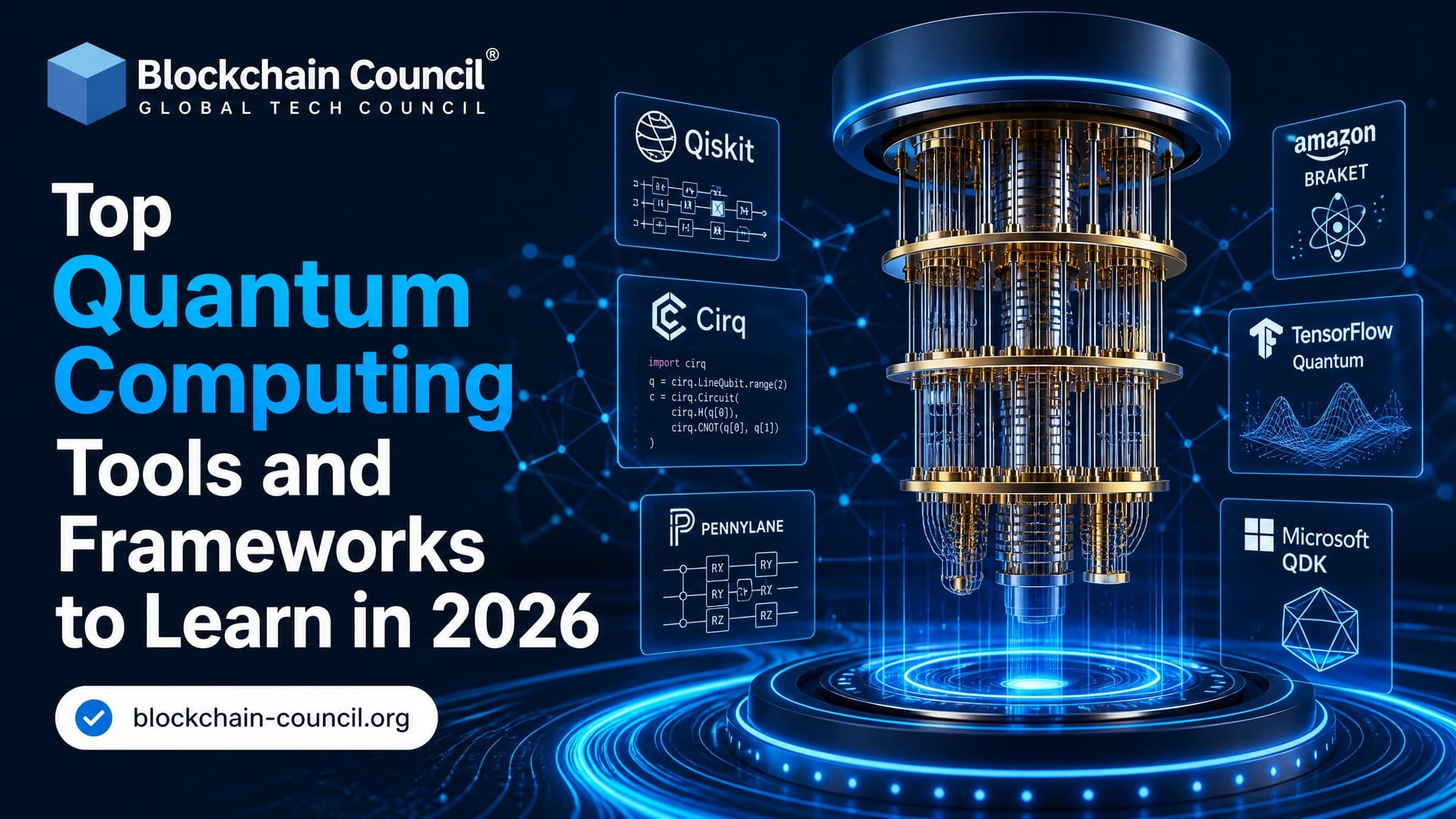
Quantum computing tools and frameworks in 2026 are no longer academic toys. If you want skills that hold up in real work, start with Qiskit, Cirq, PennyLane, the Amazon Braket SDK, the Microsoft Quantum Development Kit with Q#, CUDA-Q, TensorFlow Quantum, TKET/pytket, and the D-Wave Ocean SDK. Between them, they cover gate-based circuits, quantum machine learning, cloud access, GPU simulation, circuit compilation, and annealing-based optimization.
The catch? You should not learn all of them the same way. Qiskit is the best first framework for most people. PennyLane is the better pick if your work sits near AI. Cirq matters when you care about Google-style hardware experiments. Braket and Azure Quantum earn their place for enterprise teams comparing hardware providers. Ocean is a different animal, because quantum annealing is not gate-model quantum computing.

Why Quantum Computing Tools Matter in 2026
Most quantum work in 2026 still lives in the noisy intermediate-scale quantum, or NISQ, phase. Hardware keeps improving, but error rates, limited qubit connectivity, and short coherence times still shape what you can actually run. That is why modern quantum development is usually hybrid: a classical optimizer proposes parameters, a quantum circuit runs, results come back, and the loop repeats.
That workflow makes software choice critical. Your framework decides how circuits are built, simulated, optimized, routed to hardware, and measured. It also decides how easily you can connect quantum circuits to Python, PyTorch, TensorFlow, JAX, AWS, Azure, GPUs, or high performance computing systems.
A practical note from teaching beginners: old Qiskit notebooks often break after a fresh install because examples using from qiskit import execute no longer match the current workflow. The fix is not to randomly downgrade packages. Learn the current primitives, the transpilation flow, and the backend execution model. Version drift is a real skill in quantum software, not an afterthought.
1. Qiskit: Best First Framework for Most Developers
Qiskit is IBM's open source quantum SDK, written mainly for Python users. It remains the most widely adopted general-purpose quantum framework, backed by IBM Quantum hardware, simulators, tutorials, community events, and a large education ecosystem.
Learn Qiskit first if you want one strong foundation for gate-model quantum computing. It gives you:
- Circuit construction and measurement tools
- Transpilation for real hardware constraints
- Aer simulators for local and accelerated testing
- Noise models and error mitigation workflows
- Access to IBM Quantum systems and Runtime services
IBM has also pushed Qiskit toward utility-scale workloads with dynamic circuits, Runtime primitives, and HPC-oriented execution. The company has reported faster transpilation in newer Qiskit SDK releases against selected TKET benchmarks, along with improved dynamic circuit accuracy and lower cost on some error-mitigated workflows. Treat vendor benchmarks with a pinch of salt, but the direction is clear: Qiskit is no longer just a learning library.
If you are mapping a learning path, pair Qiskit practice with Blockchain Council's Certified Quantum Computing Expert™, then add Certified AI Expert™ if you plan to work on quantum machine learning.
2. Cirq: Best for Hardware-Aware NISQ Research
Cirq is Google Quantum AI's Python framework for building and running circuits on NISQ devices and simulators. It gives you more explicit control over device topology, qubit placement, timing, and circuit moments than most beginner-friendly tools.
That precision pays off when hardware behavior matters. Cirq underpinned Google's Sycamore experiments and stays a natural fit for researchers who care about noisy devices, calibration constraints, and low-level circuit structure.
Choose Cirq if you want to:
- Work with Google Quantum AI tooling
- Understand moment-based circuit design
- Study NISQ behavior close to the hardware layer
- Use TensorFlow Quantum, which builds on Cirq circuits
Do not start with Cirq if your only goal is broad beginner coverage. Qiskit has the larger learning base. Cirq is sharper, but narrower.
3. PennyLane: Best for Quantum Machine Learning
PennyLane, developed by Xanadu, is the standout framework for differentiable quantum programming. If your work touches AI, optimization, or variational algorithms, learn it early.
The core idea is simple but powerful: quantum circuits can behave like differentiable layers inside classical machine learning workflows. PennyLane integrates with PyTorch, TensorFlow, JAX, and NumPy-based workflows, which makes gradient-based training practical.
Common PennyLane use cases include:
- Variational quantum eigensolvers, often called VQE
- Quantum approximate optimization algorithms, or QAOA
- Quantum kernels and classifiers
- Portfolio optimization experiments
- Quantum chemistry prototypes
One beginner trap: PennyLane gradients depend on how you define parameters and interfaces. Mix ordinary NumPy arrays into a Torch or JAX workflow and you may get silent non-training rather than a loud error. Always confirm your parameters are trainable before you trust a loss curve.
4. Amazon Braket SDK: Best Multi-Vendor Cloud Entry Point
Amazon Braket is AWS's managed quantum computing service. Its Python SDK lets you build circuits and run them on simulators or hardware from providers such as IonQ and Rigetti, depending on current regional and service availability.
For enterprise teams, Braket's value is not that it replaces Qiskit or PennyLane. It gives you a cloud control layer. You can manage jobs, store results, integrate with other AWS services, and compare hardware options inside one environment.
Learn Braket if your organization already runs on AWS, or if you need to benchmark algorithms across different quantum hardware models without rewriting everything from scratch.
5. Microsoft Quantum Development Kit and Q#
Microsoft's Quantum Development Kit includes Q#, libraries, tooling, simulators, and resource estimation features for Azure Quantum. Q# is a purpose-built quantum programming language, not a Python library.
This matters. Q# is not the fastest way for a Python developer to sketch a circuit, but it is strong for algorithm design, type safety, and resource estimation. Microsoft's Quantum Katas also remain one of the better structured ways to practice fundamentals such as superposition, measurement, phase kickback, and common algorithms.
Choose the QDK and Q# if your team works in the Microsoft ecosystem, needs Azure Quantum access, or wants disciplined algorithm analysis rather than quick notebook experiments.
6. CUDA-Q: Best for GPU-Accelerated Simulation
CUDA-Q from NVIDIA is built for hybrid quantum-classical programming in high performance computing environments. It supports Python and C++ workflows, with simulation backends that can use GPUs for statevector and tensor network workloads.
This is not where most beginners should begin. But if you work in HPC, large-scale simulation, or performance-heavy algorithm testing, CUDA-Q deserves attention. It lets you push larger circuits than a typical CPU-only setup can handle, though simulation still grows brutally with qubit count.
To be blunt, no simulator saves you from exponential scaling. CUDA-Q gives you more room to experiment, not magic.
7. TensorFlow Quantum: Best for TensorFlow-Centric QML Research
TensorFlow Quantum, often shortened to TFQ, connects Cirq circuits with TensorFlow models. It is built for hybrid quantum-classical machine learning research, especially where quantum data or parameterized quantum circuits need to sit inside TensorFlow's computation graph.
Use TFQ when your ML stack is already TensorFlow and your research needs quantum circuit layers. If you are framework-neutral, PennyLane is usually the easier recommendation, since it supports multiple ML interfaces and a broader QML developer workflow.
8. TKET and pytket: Best for Circuit Compilation
TKET, from Quantinuum, is a quantum compiler and optimization toolkit. Its Python package, pytket, focuses on circuit rewriting, routing, and backend-aware optimization.
Compilation is not glamorous, but it decides whether your circuit survives real hardware. A circuit that looks elegant on paper can turn unusable after mapping to a device with limited connectivity. Extra SWAP gates increase depth. Depth increases exposure to noise. Results degrade.
Learn TKET if you care about:
- Reducing circuit depth and gate count
- Routing circuits across different hardware topologies
- Comparing compiler behavior across SDKs
- Building backend-agnostic quantum workflows
Even if you mainly use Qiskit, basic compiler literacy will make your experiments far more credible.
9. D-Wave Ocean SDK: Best for Quantum Annealing
D-Wave's Ocean SDK is the primary Python toolkit for quantum annealing. It targets optimization problems expressed as quadratic unconstrained binary optimization, or QUBO, and related models.
Ocean suits scheduling, routing, resource allocation, and portfolio-style optimization pilots. But do not confuse it with Qiskit or Cirq. D-Wave systems use annealing-based approaches, not the standard gate-model circuit approach used by IBM, Google, IonQ, and many others.
Learn Ocean if your work is optimization-heavy and maps naturally to QUBO. If you want general quantum algorithms such as phase estimation, Grover search, or VQE on gate-model systems, start elsewhere.
Recommended Learning Path for 2026
You do not need nine frameworks at once. Build in layers.
- Start with Qiskit. Learn qubits, gates, measurement, transpilation, simulators, and real backend execution.
- Add PennyLane. Practice variational circuits, gradients, and hybrid quantum-classical optimization.
- Study Cirq. Use it to understand hardware-aware NISQ design and moment-based circuits.
- Learn one cloud layer. Pick Amazon Braket if you use AWS. Pick the QDK and Azure Quantum if your organization runs on Microsoft tooling.
- Add specialization. Choose CUDA-Q for GPU simulation, TKET for compilation, TFQ for TensorFlow-based QML, or Ocean for annealing optimization.
Skills That Matter More Than Tool Names
Frameworks change. The fundamentals travel with you. In 2026, prioritize these skills:
- Noise-aware circuit design: Understand decoherence, readout error, gate error, and why depth matters.
- Transpilation: Know how circuits get rewritten for real hardware connectivity.
- Hybrid optimization: Practice VQE, QAOA, parameter-shift gradients, and classical optimizer behavior.
- Resource estimation: Learn how qubit counts, depth, shots, and error correction assumptions affect feasibility.
- Cloud execution: Understand queues, shots, job costs, result formats, and provider differences.
The best next step is concrete: install Qiskit and PennyLane, reproduce a small VQE or QAOA example, then run the same circuit through a simulator and a real cloud backend if you have access. If you want a structured credential, use Blockchain Council's Certified Quantum Computing Expert™ to lock down the foundations, then branch into AI, cloud, or blockchain certifications based on the systems you plan to build.
Related Articles
View All
Quantum Computing
Top Applications of Quantum Computing in the Real World
Explore the top real-world applications of quantum computing, from drug discovery and finance to cybersecurity, logistics, AI, and energy systems.

Quantum Computing
What Is Quantum Computing? A Beginner-Friendly Guide for 2026
Learn what quantum computing is, how qubits work, where the technology is used today, and why it matters for cybersecurity, AI, blockchain, and enterprise IT.

Quantum Computing
Quantum Machine Learning (QML) in 2026: Practical Applications, Tools, and Industry Adoption
Quantum machine learning (QML) in 2026 is shifting from theory to targeted pilots in drug discovery, finance, logistics, and materials, powered by hybrid tools and cloud hardware.
Trending Articles
The Role of Blockchain in Ethical AI Development
How blockchain technology is being used to promote transparency and accountability in artificial intelligence systems.
AWS Career Roadmap
A step-by-step guide to building a successful career in Amazon Web Services cloud computing.
How to Install Claude Code
Learn how to install Claude Code on macOS, Linux, and Windows using the native installer, plus verification, authentication, and troubleshooting tips.