

Why 5000+ Professionals Have Chosen Us?
 Toshendra Kumar Sharma
Choosing a certification is a career decision, and nobody wants to spend time and money on a program that does not deliver. That is why numbers matter. Today, more than 5000+ Professionals Have Chosen Us to learn blockchain, and our own site now reports an even larger certified community across more than 145 countries. In this guide, we explain in simple language why so many learners, from complete beginners to senior managers, trust Blockchain Council, what you actually learn, and how to pick the right program for your goals. If you are just starting out and want a clear, practical entry point, the Certified Blockchain Expert program is where many learners begin.
Who We Are and the Trust We Have Built
Blockchain Council is a certification and education platform focused on blockchain and other emerging technologies. We have been training professionals since 2016, and our certification pages now state that more than 10,000 professionals are certified globally, with learners from over 145 countries. That means the 5000+ figure in this article's title is a milestone we passed some time ago, and it continues to grow.

Trust is earned through consistent delivery. Our programs are developed and maintained by a panel of industry experts, and our catalog covers everything from fundamentals to security, finance, supply chain, healthcare, law, and digital marketing. Professionals from large organizations, including technology, consulting, and finance firms, have used our courses to build new skills.
What the Numbers Mean for You
Proven demand: A large community of certified professionals shows that learners find real value.
Mature programs: More than a decade of experience means the courses have been refined over time.
Global reach: Learners from many countries bring different industries and perspectives.
Reason 1: Learning Paths That Fit Every Role
The first reason professionals choose us is simple: blockchain is not one job. A business manager, a software engineer, a compliance officer, and a marketer all need different knowledge. We organize our programs by role so you do not waste time on topics you will never use.
For Developers
If you want to write code and build real applications, the Certified Blockchain Developer program covers smart contract programming, decentralized application development, and blockchain integration. It is built for coders and tech enthusiasts who want to move from theory to working projects.
For Business Leaders and Managers
Not everyone needs to write code. Managers, consultants, and entrepreneurs need to understand what blockchain can do, where it fits, and how to guide a team. The expert-level path focuses on fundamentals, business applications, and enterprise strategy.
For Industry Specialists
We also offer programs that connect blockchain with specific fields, such as supply chain, finance, healthcare, law, KYC, human resources, security, and digital marketing. This is helpful if you already have experience in one of those areas and want to add blockchain knowledge on top.
Reason 2: Beginner Friendly, Yet Truly In-Depth
Many people hesitate because they think blockchain is too technical. Our programs are designed so that both technical and non-technical learners can follow along. You start with the basics: what a blockchain is, how blocks are linked, and how consensus keeps a network honest. Then you move into real use cases and, where relevant, hands-on practice.
Professionals who have completed our training often describe it as in-depth. One learner, Sundaresan Sethuraman, a Senior Manager of Digital Programs, said he wanted to thank Blockchain Council for such in-depth training on blockchain and felt privileged to be associated with us. Depth matters, because a surface-level course may help you talk about blockchain, but only a thorough one helps you lead a project.
Reason 3: Flexible Learning Formats
Most of our learners are working professionals, so time is limited. We offer self-paced options that let you learn when it suits you. For example, our expert course provides about 10 hours of on-demand content for self-paced learners, while the instructor-led option combines about 6 hours of live training with additional flexible study modules.
This flexibility helps in three ways:
You keep your job and your schedule. Learn in the evening, on weekends, or during a quiet week.
You choose your style. Some people prefer videos at their own speed, while others like a live trainer.
You can repeat topics. Self-paced content lets you revisit hard sections until they make sense.
Reason 4: Credibility That Employers Recognize
A certificate is only useful if it means something to the people who read your resume. Our programs are described as globally recognized, and learners use them to show structured, verified knowledge. Sundaresan Sethuraman put it clearly in his own words: "Getting certified as a Blockchain Expert not only rendered me expertise in Blockchain but has also marked my credibility as a blockchain expert in the international job market."
Credibility helps in practical situations:
Job applications: A certification can help your resume stand out.
Internal promotions: Managers notice people who invest in new skills.
Client trust: Consultants and freelancers can show proof of knowledge.
Confidence: Knowing the fundamentals helps you contribute in meetings.
Reason 5: Skills That Match Real Industry Demand
Blockchain is no longer limited to cryptocurrency. Our course material highlights sectors that are hiring blockchain professionals, including banking, finance, supply chain, healthcare, insurance, real estate, energy, and government services. Each sector uses blockchain differently.
Finance: Faster settlement, fraud reduction, and tokenized assets.
Supply chain: Tracking products from source to shelf.
Healthcare: Protecting data integrity and sharing records securely.
Government: Verifying documents and improving transparency.
Insurance: Automating claims with smart contracts.
When a course reflects real demand, you are learning skills that employers actually need, not just interesting theory.
Reason 6: Real Stories of Career Growth
Numbers are helpful, but people tell the story best. Two examples show how learners have used our training.
Sundaresan Sethuraman: From Conference to Project Lead
Sundaresan Sethuraman, a Senior Manager of Digital Programs at a multinational company, was inspired by a Blockchain Council conference. He saw how blockchain could improve productivity and reduce costs in the IT sector, and he enrolled in our certification soon after. Today, he heads a project on implementing blockchain technology in his company and leads one of its most innovative initiatives.
Tamzidul Matin: Turning Confidence Into Direction
Tamzidul Matin, a Cloud DevOps and MLOps engineer, added blockchain to his skill set through our Certified Blockchain Expert course. In his words: "Thanks to the profound knowledge I gained about blockchain through the Certified Blockchain Expert course, I will now be able to make a positive difference in the blockchain world." He also shared that the certification helped him gain immense confidence and realize his potential.
These stories show a common pattern. Learners start with curiosity, gain structured knowledge, and then apply it with confidence.
Reason 7: Support for Wider Technology Careers
Blockchain rarely works alone. It connects with cloud computing, cybersecurity, data, and artificial intelligence. Many professionals therefore plan a multi-skill path, with blockchain as one part of a broader profile. If you want to explore related fields, the Tech Certification catalog offers programs across several technology areas, which can help you plan complementary learning.
This matters because projects in the real world are rarely pure blockchain. A supply chain system might need blockchain, IoT sensors, and cloud hosting. A healthcare data project may need blockchain, strong security, and privacy compliance. Professionals who understand the connections are more valuable to their teams.
Reason 8: A Learning Community and Events
Learning is easier when you are not alone. Sundaresan Sethuraman's journey began at a blockchain conference we organized, where he heard real discussions about how businesses use the technology. Events, webinars, and a global community give learners a chance to ask questions, see real use cases, and meet others in the field.
Community also keeps you updated. Blockchain changes quickly, with new networks, tools, and regulations appearing regularly. Staying connected helps you keep your knowledge fresh after the course ends.
How to Choose the Right Certification
With many programs available, here is a simple way to decide.
Define your goal. Do you want to build apps, lead projects, work in compliance, or switch careers?
Check your background. Beginners can start with a foundation course. Developers can go straight to a technical path.
Look at your industry. If you work in finance, healthcare, or supply chain, consider a specialized program.
Consider your time. Compare self-paced and instructor-led formats.
Plan the next step. Think about how you will apply what you learn, such as a pilot project or a portfolio piece.
What to Keep in Mind Before You Enroll
We believe in honest guidance, so here are a few reminders.
A certificate is a starting point. It proves learning, but results come from applying the knowledge.
Practice matters. Try a test network, build a small project, or propose a pilot at work.
Check current details. Pricing, course formats, and offers change, so confirm them on our official pages before you decide.
Keep learning. Blockchain evolves, so plan to refresh your skills regularly.
Building Your Voice as a Blockchain Professional
Once you have the skills, the next step is making them visible. Professionals who can explain blockchain clearly, write about it, and present its value to customers or executives often move ahead faster. A credential such as the Marketing Certification can help technical and business professionals strengthen communication, personal branding, and promotion skills, so that their expertise gets noticed.
Conclusion
When we say 5000+ Professionals Have Chosen Us, we mean learners who wanted real skills, credible certification, and clear support for their careers. They chose us for role-based learning paths, beginner-friendly but in-depth content, flexible formats, global recognition, industry-relevant skills, and a community that keeps growing. Stories like those of Sundaresan Sethuraman and Tamzidul Matin show what happens when curiosity meets structured training. If you are ready to begin, review the programs, match one to your goal, and take your first step today.
FAQs
1. What is Blockchain Council?
Blockchain Council is a professional organization focused on blockchain research, use cases, products, and knowledge. It provides educational resources and certification programs for people interested in blockchain technology.
2. Why have 5000+ professionals chosen Blockchain Council?
Professionals may choose Blockchain Council to develop blockchain knowledge, explore industry use cases, and pursue specialized certification programs. The organization's focus on blockchain education is one of the reasons it appeals to learners and working professionals.
3. What does Blockchain Council offer professionals?
Blockchain Council offers blockchain-focused certification programs, educational resources, and industry-oriented learning opportunities. Its programs cover areas such as blockchain technology, cryptocurrency, smart contracts, Web3, and related fields.
4. Are Blockchain Council certifications suitable for working professionals?
Yes. Blockchain-focused certifications can be useful for working professionals who want to add structured learning to their existing technical or business experience. Learners should select a program that matches their current skills and career objectives.
5. Can beginners learn blockchain through Blockchain Council?
Blockchain Council offers programs covering different areas of blockchain technology, including foundational topics. Beginners should review the curriculum and prerequisites of an individual certification before enrolling.
6. What makes blockchain certification useful for professionals?
A certification can provide a structured way to study a specialized technology and demonstrate completion of a learning program. Its value is strongest when combined with practical experience, projects, and relevant professional skills.
7. Does Blockchain Council provide certifications in different blockchain domains?
Yes. Its certification offerings cover multiple blockchain-related areas. Depending on the current catalog, learners can find programs focused on subjects such as blockchain development, smart contracts, cryptocurrency, DeFi, and other Web3 technologies.
8. Can developers benefit from Blockchain Council certifications?
Developers can use blockchain certifications to supplement their programming and software development knowledge with blockchain-specific concepts. Topics such as smart contracts, decentralized applications, blockchain architecture, and security can be relevant to development careers.
9. Can non-technical professionals learn blockchain?
Yes. Blockchain has applications across business, finance, supply chains, compliance, marketing, and other areas, so professionals do not necessarily need to be programmers to study the technology. The appropriate course depends on the learner's background and objectives.
10. How can blockchain knowledge support career development?
Blockchain knowledge can help professionals understand emerging technologies and their potential applications. Combining this knowledge with an existing specialization, such as software development, finance, cybersecurity, or business, can create a more relevant professional skill set.
11. Does Blockchain Council focus only on cryptocurrency?
No. Blockchain technology extends beyond cryptocurrency. Blockchain Council's educational focus also covers areas such as smart contracts, decentralized applications, enterprise blockchain, Web3, and other blockchain-related technologies.
12. Why is blockchain education important for professionals?
Blockchain is used in areas ranging from digital assets and financial services to supply-chain management and decentralized applications. Understanding its underlying concepts can help professionals evaluate where blockchain may be useful and where other technologies may be more appropriate.
13. What types of professionals can benefit from blockchain certification?
Developers, software engineers, IT professionals, business professionals, entrepreneurs, analysts, consultants, finance professionals, and technology enthusiasts may find blockchain education relevant. The ideal certification depends on the learner's existing experience and career goals.
14. Can a blockchain certification replace practical experience?
No. Certification and practical experience serve different purposes. A certification can demonstrate structured learning, while projects and professional experience demonstrate the ability to apply knowledge to real-world situations.
15. How should professionals choose a Blockchain Council certification?
Professionals should first identify their career objective and existing knowledge. They should then compare the certification's curriculum, prerequisites, assessment format, duration, and practical components with their learning requirements.
16. Is Blockchain Council useful for learning emerging blockchain technologies?
Blockchain Council publishes educational material and offers certification programs covering various blockchain-related subjects. Learners interested in emerging areas should review the current course content to ensure that it covers the technologies and concepts they want to study.
17. Can blockchain certification help professionals understand industry use cases?
Yes. Studying blockchain use cases can help professionals understand how distributed ledger technology can be applied in different industries. Practical examples can also make technical concepts easier to connect with real business problems.
18. What should professionals consider before enrolling in a blockchain certification?
They should consider the course's learning objectives, syllabus, prerequisites, assessment method, practical content, certification requirements, and overall relevance to their career goals. It is also important to review the current program information before making a decision.
19. Why is continuous blockchain learning important?
Blockchain technology continues to evolve through developments in smart contracts, scaling, interoperability, digital assets, decentralized applications, and Web3 infrastructure. Continuous learning can help professionals keep their knowledge aligned with changes in the technology landscape.
20. How can I start learning blockchain with Blockchain Council?
Start by identifying the blockchain area you want to learn, such as blockchain fundamentals, development, smart contracts, cryptocurrency, or Web3. Blockchain Council offers topic-specific certification programs, so learners can review the current curriculum and select a program aligned with their learning objectives.
Related Articles
View All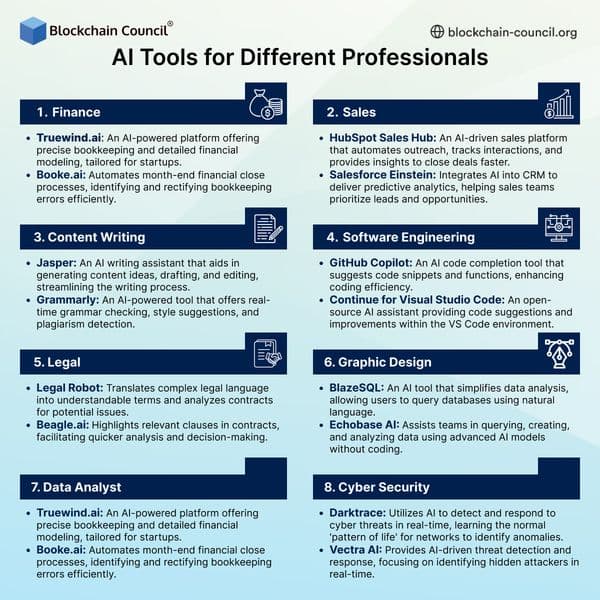
Infographics
AI Tools for Different Professionals
AI tools for professionals help automate tasks, improve productivity, and enhance decision-making across industries.
Infographics
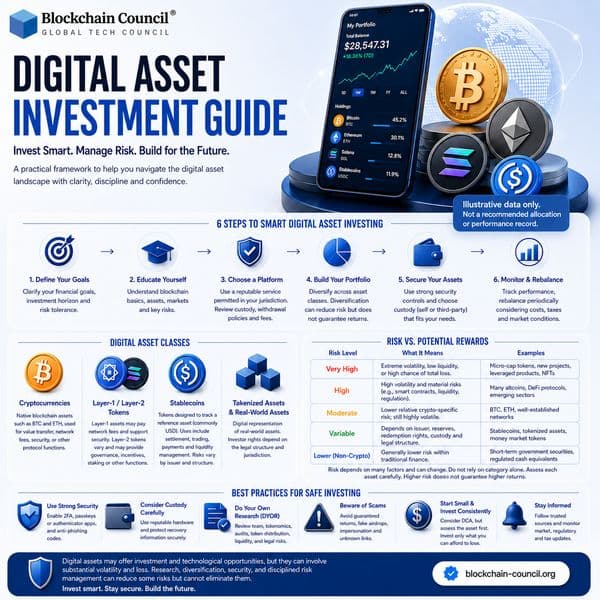
Digital Asset Investment Guide: Build a Smarter Strategy for the Future of Finance
Digital asset investing has become a key part of the modern financial landscape, offering opportunities in cryptocurrencies, tokenized assets, NFTs, and blockchain-based investments. Whether you're a beginner or an experienced investor, understanding market fundamentals, diversification, security, and risk management is essential for building a successful digital asset portfolio. This guide explores the core concepts, investment strategies, and best practices for navigating the digital asset market.
Infographics
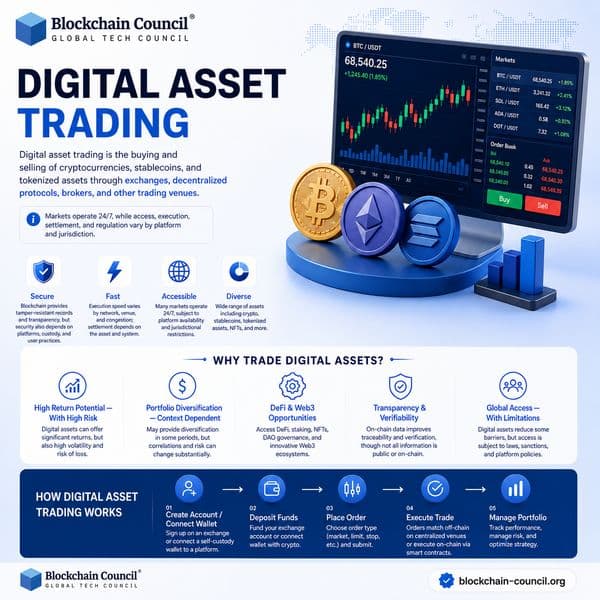
Digital Asset Trading: A Complete Guide to Trading in the Digital Economy
Digital asset trading involves buying, selling, and exchanging cryptocurrencies, tokenized assets, NFTs, and other blockchain-based assets through centralized and decentralized trading platforms. As the digital economy expands, traders rely on market analysis, risk management, and advanced trading tools to navigate volatile markets. This guide explains the fundamentals of digital asset trading, key strategies, security considerations, and emerging trends shaping the future of digital finance.
Trending Articles
Top 5 DeFi Platforms
Explore the leading decentralized finance platforms and what makes each one unique in the evolving DeFi landscape.
What is AWS? A Beginner's Guide to Cloud Computing
Everything you need to know about Amazon Web Services, cloud computing fundamentals, and career opportunities.
Claude AI Tools for Productivity
Discover Claude AI tools for productivity to streamline tasks, manage workflows, and improve efficiency.