

RWA Tokenization vs Cryptocurrency: How Tokenized Assets Are Different
 Suyash Raizada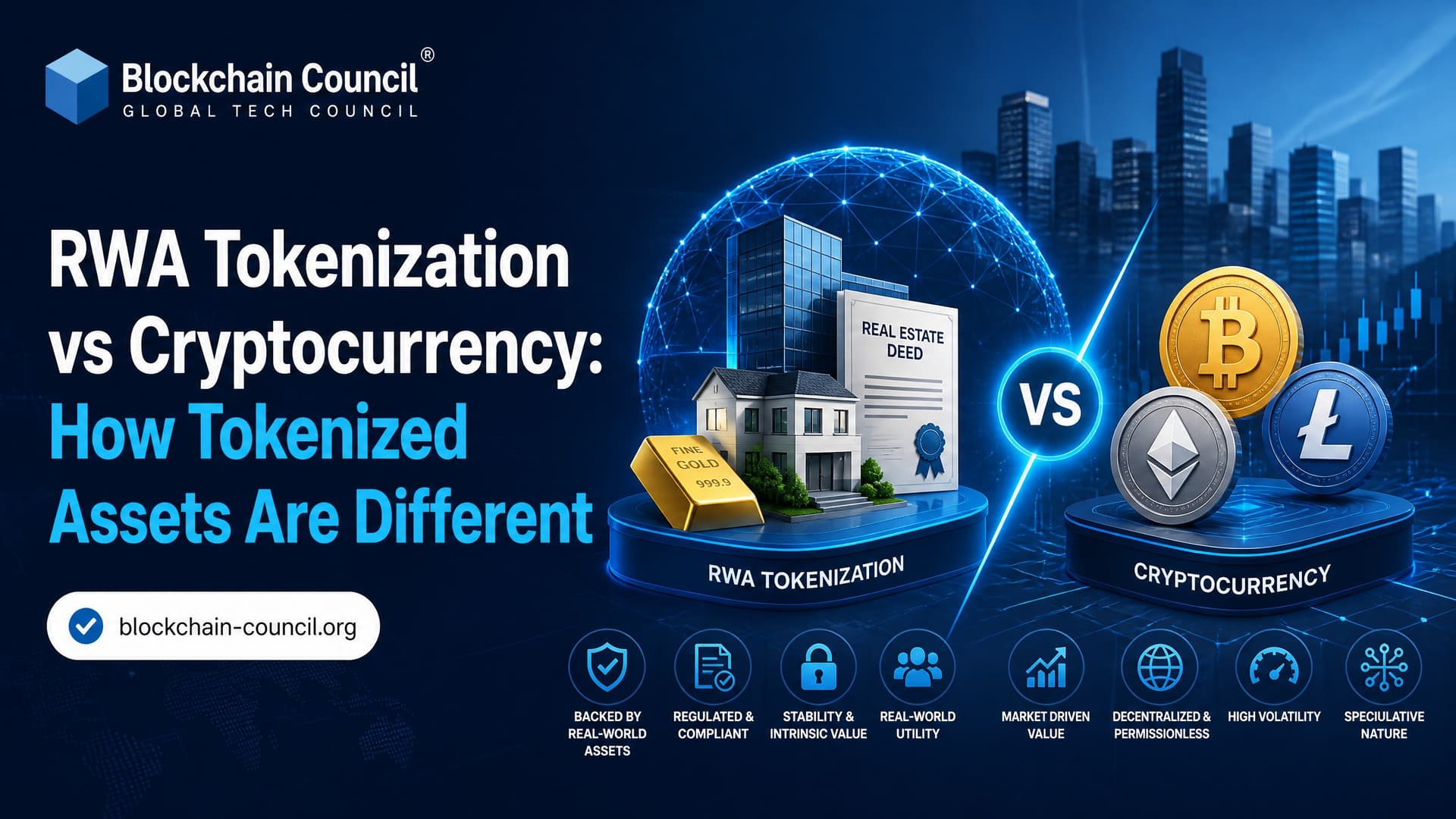
RWA tokenization vs cryptocurrency comes down to one core issue: what the token actually represents. Tokenized real world assets are blockchain records of legal rights to off chain assets, such as fund shares, real estate, loans, Treasury bills, or carbon credits. Cryptocurrencies like Bitcoin and Ether are native digital assets. They exist on chain and usually do not give you a legal claim on a building, a bond, or a loan portfolio. If you want a structured path into the RWA side of this specifically, the Certified RWA Tokenization Expert program is a reasonable place to start.
That difference changes almost everything. Valuation, regulation, liquidity, custody, disclosure, and risk all shift depending on which one you hold. If you work in digital assets, this is not a semantic debate. It affects how you design products, assess compliance, and explain risk to clients or boards.

What Are Tokenized Real World Assets?
Tokenized real world assets, often called tokenized RWAs, are digital tokens that represent rights connected to an existing off chain asset. The asset might be a US Treasury fund, a private credit pool, a property vehicle, an invoice, or a verified carbon credit.
The token is not the asset by itself. A legal structure usually sits behind it: a fund, a trust, a special purpose vehicle, a loan agreement, a custody arrangement, or a registry entry. That structure defines what the holder owns and what they can do with it.
Take BlackRock. It launched the BlackRock USD Institutional Digital Liquidity Fund, known as BUIDL, on Ethereum in March 2024. The fund invests in cash, US Treasury bills, and repurchase agreements. Each token represents a fund share targeting 1 dollar in value, with dividends accrued from the underlying securities. That is very different from holding ETH, which you use for gas, staking, and network activity on Ethereum.
What Are Cryptocurrencies?
Since cryptocurrencies sit at the core of the broader digital asset market that RWA tokens increasingly connect to, it is worth pairing this reading with a Certified Cryptocurrency Expert credential to cover that ground in more depth.
Cryptocurrencies are native blockchain assets. Bitcoin is the clearest example. It is not a claim on gold, cash, a company, or a debt instrument. Its value comes from scarcity, network adoption, monetary expectations, market liquidity, and user belief in the protocol.
Ether is also a native token, though its role is broader. You use ETH to pay gas on Ethereum mainnet, which has chain ID 1. You can stake ETH under Ethereum Proof of Stake. You can use it inside decentralized finance protocols. But ETH is not a tokenized share of the Ethereum Foundation, and it does not provide a legal right to off chain cash flow.
That is the practical split. RWA tokens usually start with a legal claim. Cryptocurrencies start with protocol-native utility or monetary design.
RWA Tokenization vs Cryptocurrency: Key Differences
1. Underlying asset and holder rights
RWA tokens represent something outside the blockchain. You may have a right to income, redemption, property ownership, fund units, or a contractual payment. How strong that right is depends on the legal documents, the jurisdiction, the issuer, the custodian, and the transfer rules.
Cryptocurrencies generally do not provide these claims. Holding BTC means you control Bitcoin private keys. Holding a tokenized Treasury fund means you may hold a regulated security token subject to investor eligibility rules.
2. Valuation
Tokenized assets often track net asset value. A tokenized Treasury or money market fund aims to stay near 1 dollar per token and distribute yield from short term government securities. Tokenized private credit reflects loan performance, default rates, interest payments, and fund fees. Tokenized real estate reflects rent, occupancy, property valuation, debt, and local market conditions.
Cryptocurrencies behave differently. BTC and ETH can move sharply on macro liquidity, ETF flows, regulatory news, token supply, network activity, and plain speculation. There may be fundamental metrics, but there is no simple net asset value anchor.
3. Regulation
Many RWA tokens are regulated financial products. In the European Union, MiCA, Regulation (EU) 2023/1114, became fully applicable on December 30, 2024. It covers many crypto assets, including asset referenced tokens and electronic money tokens. But if a token is a financial instrument, such as a tokenized bond or fund unit, it can fall under MiFID II and related securities rules instead.
In the United States, there is no single RWA tokenization statute. Securities laws, commodities rules, banking rules, state money transmission laws, and private offering exemptions can all matter. BUIDL, for instance, is offered under Rule 506(c) to qualified purchasers. That is not how a typical open cryptocurrency launch works.
IOSCO has argued that tokenized financial assets should stay subject to the same investor protection and market integrity principles that apply to traditional securities. The Bank for International Settlements has reported that many jurisdictions are studying tokenization alongside payment system and central bank digital currency work.
4. Transferability and access
This is where developers feel the difference fast. A normal ERC-20 token can move between wallets if balances and allowances are valid. A permissioned RWA token may check investor identity, jurisdiction, holding limits, and transfer restrictions before it allows any movement.
Here is a real one. Build a proof of concept with a permissioned token standard such as ERC-3643 or an ERC-1400 style security token, and transfers can fail even when the sender has enough balance. The missing piece is usually the identity registry or the whitelist. Beginners test only token balances, then wonder why a transfer reverts. That is a genuine RWA deployment issue, not a cosmetic compliance feature. Developers building out this kind of identity and transfer-restriction logic often reinforce their fundamentals with a general Tech Certification, since the underlying systems and API knowledge applies well beyond any single token standard.
5. Risk profile
A tokenized Treasury fund carries Treasury, fund, issuer, custody, smart contract, and redemption risk. A tokenized private credit product adds borrower default risk and liquidity risk. A tokenized real estate vehicle adds vacancy, valuation, title, and local legal risk.
Cryptocurrency risk is a different animal. You deal with protocol bugs, validator behavior, governance disputes, liquidity cycles, exchange failures, wallet compromise, regulatory action, and market volatility. To be blunt, if your client wants low duration yield with compliance controls, a volatile governance token is the wrong fit. If they want censorship resistant value transfer, a permissioned RWA token is also the wrong fit.
Market Growth: Why RWAs Are Getting Attention
RWA tokenization has moved beyond small pilots. RWA.xyz, RedStone, and Gauntlet reported that the on chain RWA market, excluding stablecoins, grew from about 5 billion dollars in 2022 to more than 24 billion dollars by June 2025. Forbes, citing data providers including Tangem and RWA.xyz, placed tokenized assets near 24 billion dollars in mid 2025 with roughly 205,000 asset holders.
Tokenized US Treasuries have been one of the strongest categories. CoinDesk reported that tokenized Treasury products on public blockchains passed 1 billion dollars in March 2024 after rapid growth from early 2023. Superstate's 2024 market review found that US Treasuries and money market instruments made up a large share of adjusted RWA assets under management.
Private credit is another major segment. Qiro Finance's 2025 report named tokenized private credit as one of the largest RWA categories after stablecoins, with billions of dollars in loans issued across protocols. Apollo also launched a tokenized private credit feeder fund with Securitize in 2025, giving accredited investors on chain exposure to the Apollo Diversified Credit Fund.
Real estate and carbon markets are moving too, though both are harder than Treasury tokenization. Deloitte has projected that tokenized real estate holdings could reach about 4 trillion dollars by 2035. In carbon markets, projects such as tokenized Verra certified credits on Singapore regulated infrastructure show how environmental claims can be represented digitally, provided the verification is credible.
How RWAs and Crypto Work Together
The better framing is not RWA tokenization vs cryptocurrency as enemies. They solve different problems, and they increasingly meet in the same wallets, custodians, and DeFi systems.
RWAs bring off chain yield on chain. Treasury, credit, and fund tokens can become collateral or settlement assets.
Cryptocurrencies provide native infrastructure. ETH pays Ethereum gas. SOL pays Solana fees. Governance tokens can coordinate protocol changes.
Stablecoins bridge both worlds. They are tokenized fiat claims, yet they often function as digital cash inside crypto markets.
DeFi uses both. Protocols can accept tokenized Treasuries as collateral while still relying on smart contracts, oracles, and native crypto assets.
Larry Fink of BlackRock has repeatedly argued that tokenization can modernize stocks, bonds, and funds through faster settlement and fractional ownership. His view is not that every asset becomes Bitcoin. It is that financial instruments can run on better rails.
What Professionals Should Learn Next
If you are evaluating tokenized assets, start with five questions:
What legal claim does the token represent? Read the offering documents, not just the token contract.
Who controls issuance, redemption, and custody? These are your central risk points.
Which regulation applies? MiCA, MiFID II, US securities exemptions, or local rules may change the product design.
Can the token transfer freely? Permissioned tokens often require KYC, allowlists, and jurisdiction controls.
What happens if the issuer, custodian, or oracle fails? On chain transparency does not remove off chain dependency.
For developers, build a small prototype before reading another market forecast. Create an ERC-20 token, then add transfer restrictions, investor allowlisting, and redemption logic. You will quickly see why RWA tokenization is as much about legal workflow as it is about Solidity. Test chain IDs carefully too. EIP-712 signatures include the chainId, so a permit signed for Sepolia, chain ID 11155111, will not validate on Ethereum mainnet, chain ID 1.
For structured learning, consider Blockchain Council programs such as Certified Blockchain Expert™, Certified Blockchain Developer™, Certified Smart Contract Developer™, Certified DeFi Expert™, and Certified Cryptocurrency Expert™. Choose based on your role. Compliance and strategy teams should start with blockchain and crypto fundamentals, while engineers should focus on smart contracts, token standards, custody, and DeFi integration. If part of your role involves explaining these products to investors or the public, a Marketing Certification rounds out that side of the skill set, since even the clearest RWA or crypto thesis still needs to be communicated well to earn adoption.
Final Takeaway
RWA tokens are digitized claims on real assets. Cryptocurrencies are native digital assets. That single distinction explains why tokenized Treasuries behave differently from BTC, why a real estate token needs legal documentation, and why a private credit token cannot be assessed like a meme coin.
Your next step: pick one asset class, such as Treasuries, real estate, or private credit, and map the full lifecycle from issuance to redemption. Then compare it with a native crypto asset. The differences will become obvious, and your risk analysis will get much sharper.
FAQs
1. What is RWA tokenization?
RWA tokenization is the process of representing a real-world asset, ownership interest, or economic right as a digital token on a blockchain. Examples can include real estate, bonds, commodities, private credit, investment funds, and artwork. The token's legal rights depend on the structure behind the issuance.
2. What is cryptocurrency?
Cryptocurrency is a type of digital asset that typically operates natively on a blockchain or decentralized network. Examples include Bitcoin and Ether. Unlike tokenized real-world assets, cryptocurrencies generally do not represent ownership of a physical asset such as a building, gold bar, or corporate bond.
3. What is the main difference between RWA tokenization and cryptocurrency?
The biggest difference is what gives the asset its value and legal meaning. RWA tokens are linked to an underlying real-world asset or financial claim, while cryptocurrencies are generally native digital assets whose value comes from factors such as network utility, scarcity, adoption, and market demand.
4. Are RWA tokens cryptocurrencies?
Not necessarily. An RWA token is a blockchain-based representation of an underlying real-world asset or right, while cryptocurrency is generally a native digital asset. Some RWA tokens may technically use similar blockchain infrastructure, but their economic purpose and legal structure can be very different.
5. How does RWA tokenization work?
RWA tokenization typically involves identifying an asset, establishing its legal ownership or economic rights, creating a suitable legal structure, and issuing digital tokens that represent those rights. Blockchain technology can then record token ownership and facilitate transfers according to applicable rules.
6. What gives a tokenized real-world asset its value?
The value of an RWA token is generally connected to the underlying asset or financial claim. For example, a token representing an interest in a property may derive value from that property and its associated economic rights. The exact relationship depends on the legal and financial structure of the token.
7. What gives cryptocurrency its value?
Cryptocurrency value is generally determined by factors such as market demand, supply and scarcity, network utility, adoption, investor sentiment, liquidity, and broader market conditions. Different cryptocurrencies have different mechanisms and use cases.
8. Are RWA tokens less volatile than cryptocurrencies?
They can be, but this is not guaranteed. Some tokenized assets, such as certain bonds or income-producing assets, may have relatively stable underlying values. However, tokenized equities, commodities, real estate interests, and other RWAs can also fluctuate in value.
9. Are RWA tokens more regulated than cryptocurrencies?
RWA tokens can face significant regulatory requirements because they may represent securities, property interests, debt, or other legally recognized claims. The applicable rules vary by jurisdiction and asset type. Cryptocurrencies also face regulation, but their treatment differs depending on their characteristics and location.
10. Can RWA tokens be traded like cryptocurrency?
Some RWA tokens can be transferred or traded through blockchain-based platforms, but they may have more restrictions than cryptocurrencies. Investor eligibility, securities regulations, transfer rules, custody requirements, and market availability can limit where and how certain tokenized assets can be traded.
11. What types of assets can be tokenized as RWAs?
Many assets can potentially be tokenized, including real estate, government and corporate bonds, commodities, private equity, private credit, investment funds, artwork, collectibles, and intellectual property-related rights. The feasibility depends on legal ownership, asset verification, market demand, and regulatory requirements.
12. Is Bitcoin an RWA token?
No. Bitcoin is generally considered a native cryptocurrency, not a tokenized real-world asset. Bitcoin does not represent ownership of an underlying physical asset or traditional financial instrument.
13. Is tokenized gold an RWA or cryptocurrency?
Tokenized gold is generally considered a tokenized real-world asset when the token represents a legal claim or interest in physical gold. Although the token exists digitally on a blockchain, its underlying value is connected to the physical commodity.
14. Can RWA tokenization provide fractional ownership?
Yes. One major potential advantage of RWA tokenization is fractional ownership. A large asset can potentially be divided into smaller tokenized interests, allowing eligible investors to participate without purchasing the entire asset.
15. Which is more liquid, RWA tokens or cryptocurrency?
Cryptocurrencies often have established digital markets and can be highly liquid, although liquidity varies significantly between assets. RWA tokens may have lower liquidity because they can be subject to investor restrictions, limited marketplaces, transfer requirements, and the liquidity of the underlying asset.
16. What are the risks of RWA tokenization?
RWA tokenization can involve regulatory risk, smart contract risk, custody risk, valuation risk, counterparty risk, liquidity risk, fraud, and uncertainty about the legal rights represented by a token. Investors need to examine both the blockchain infrastructure and the underlying asset.
17. What are the risks of cryptocurrency?
Cryptocurrency risks can include high price volatility, cybersecurity threats, private-key loss, fraud, smart contract vulnerabilities, regulatory changes, and liquidity risk. Some cryptocurrencies may also experience substantial price movements because their markets are influenced heavily by speculation and sentiment.
18. Can RWA tokenization make traditional assets more accessible?
Potentially, yes. Tokenization can enable smaller investment units and digital transaction processes. This may broaden access to certain asset classes, although regulatory restrictions, investor eligibility, minimum investment requirements, and platform availability can still limit participation.
19. Why are financial institutions interested in RWA tokenization instead of only using cryptocurrency?
RWA tokenization allows financial institutions to explore blockchain technology while working with familiar asset classes such as bonds, funds, credit, deposits, and real estate. Potential benefits include faster settlement, improved recordkeeping, automation, and greater operational efficiency.
20. What is the future of RWA tokenization compared with cryptocurrency?
RWA tokenization and cryptocurrency may develop as complementary parts of the digital financial ecosystem. Cryptocurrencies provide native digital forms of value and payment, while RWA tokens can bring traditional assets onto blockchain networks. As regulatory frameworks, custody solutions, interoperability, and institutional adoption develop, the two markets may become increasingly connected.
Related Articles
View All
Digital Assets
RWA Tokenization and DeFi: How Tokenized Assets Power On-Chain Finance
RWA tokenization and DeFi are converging as tokenized Treasuries, funds, and credit products bring collateral, yield, and liquidity on-chain.

Digital Assets
RWA Tokenization and Stablecoins: Connecting Real Assets to Digital Money
RWA tokenization and stablecoins are converging as tokenized Treasuries, real estate, and funds settle through blockchain-based digital money.

Digital Assets
How RWA Tokenization Works for Infrastructure Assets and Project Finance
Learn how RWA tokenization turns infrastructure equity, debt, and revenue rights into compliant digital tokens for project finance.
Trending Articles
What is AWS? A Beginner's Guide to Cloud Computing
Everything you need to know about Amazon Web Services, cloud computing fundamentals, and career opportunities.

Can DeFi 2.0 Bridge the Gap Between Traditional and Decentralized Finance?
The next generation of DeFi protocols aims to connect traditional banking with decentralized finance ecosystems.
Claude AI Tools for Productivity
Discover Claude AI tools for productivity to streamline tasks, manage workflows, and improve efficiency.