

Public vs Private Blockchains for RWA Tokenization: Which Is Better?
 Suyash Raizada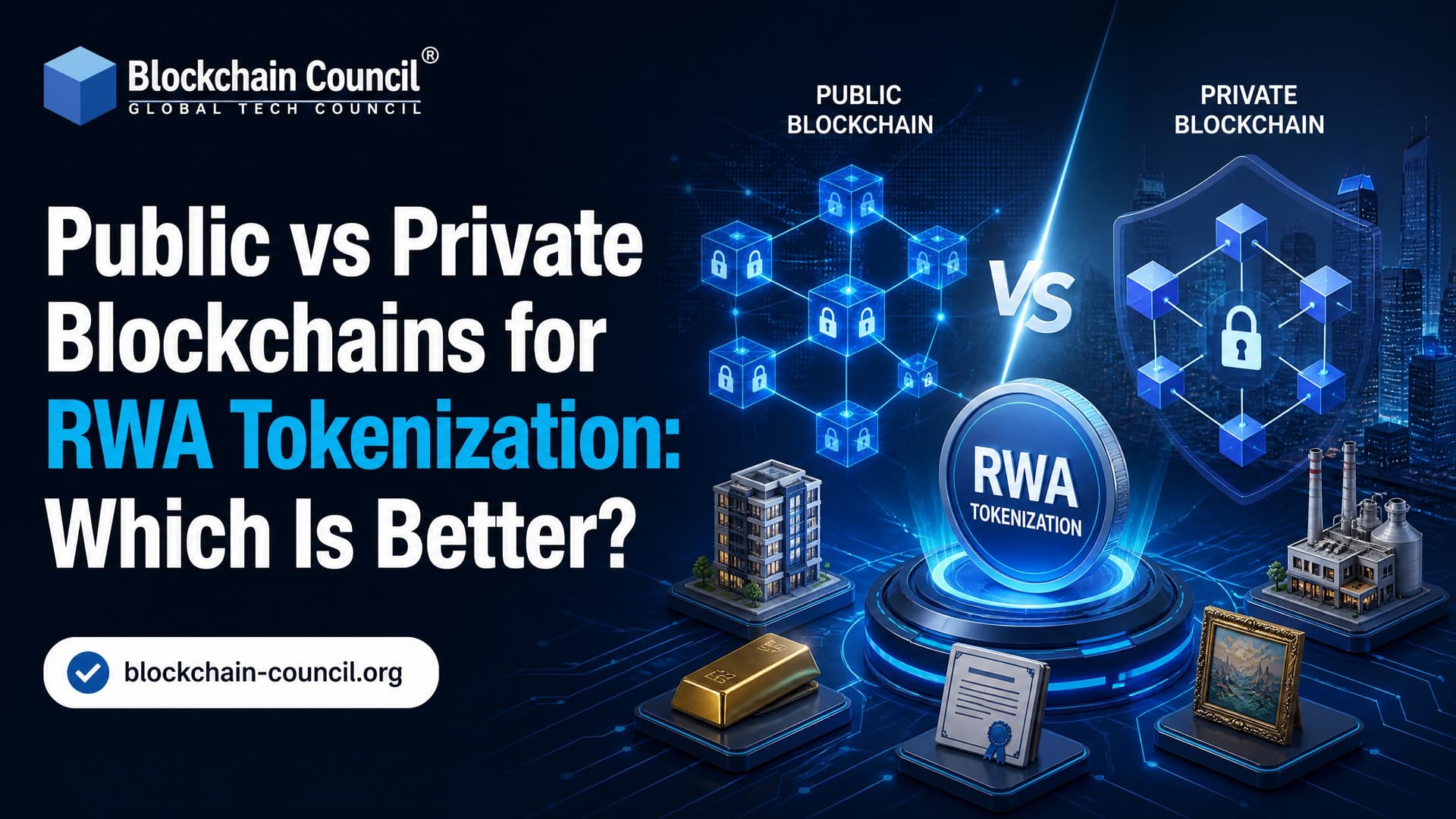
Public vs private blockchains for RWA tokenization is not a winner-takes-all debate. Public networks usually win on liquidity, composability, and market access. Private or permissioned networks win when you need confidentiality, regulated workflows, and tighter institutional governance. For most serious projects, the stronger answer is hybrid. As this decision gets more consequential for institutions, many teams are formalizing their approach through structured programs like the Certified RWA Tokenization Expert, which frames exactly this kind of public-versus-private trade-off as a core skill.
That may sound cautious. It is the reality on the ground. A tokenized Treasury fund, a tokenized stock, and a bank-led settlement network do not share the same technical or legal needs. Choose the chain before you define investor rights, custody, transfer rules, and redemption mechanics, and you are already building backward.

What RWA Tokenization Actually Requires
Real world asset tokenization converts ownership rights or economic claims over assets into blockchain-based tokens. The asset might be real estate, private credit, commodities, bonds, money market funds, invoices, carbon credits, or securities. The token is only one layer.
A credible RWA structure usually needs:
A clear legal wrapper, often a trust, fund, or special purpose vehicle
Custody or servicing for the underlying asset
Defined investor rights, including redemption and transfer terms
KYC, AML, and eligibility controls
Smart contracts that reflect the legal and operational rules
Reporting and audit processes that regulators and investors can understand
Onchain RWA markets, excluding stablecoins, are now measured in the tens of billions of dollars. Industry trackers such as rwa.xyz have shown public-chain RWA value crossing roughly $30 billion, with Ethereum holding the largest share and networks such as Solana, BNB Chain, and Stellar gaining traction. The growth is real. So is the fragmentation.
Public Blockchains for RWA Tokenization
Public blockchains such as Ethereum, Solana, BNB Chain, Polygon, Avalanche, and Stellar are open networks. Anyone can inspect the ledger, submit transactions, and build applications. For RWA tokenization, that openness is the main advantage. Teams new to this space often pair chain research with a broader Certified Digital Assets Expert track, since choosing a public network well requires understanding digital asset custody and market structure, not just smart contract syntax.
Where Public Blockchains Work Best
Use a public blockchain when your project needs broad market access. Tokenized assets on public networks can connect to wallets, exchanges, lending protocols, automated market makers, custody platforms, analytics tools, and DeFi infrastructure without every integration being custom-built.
That matters. A tokenized Treasury product on Ethereum or a layer 2 can be used as collateral, placed into a vault, or monitored in real time by investors and auditors. If the token follows a common standard, other applications can understand it quickly.
Public blockchains offer several clear benefits:
Liquidity: Public networks give RWA tokens access to a wider pool of investors and secondary markets.
Composability: Assets based on ERC-20, ERC-4626, ERC-721, ERC-3643, ERC-1400, and ERC-1404 can connect with existing infrastructure.
Transparency: Token balances, transfers, and smart contract logic can be inspected by anyone.
Security: Mature networks such as Ethereum benefit from large validator sets and years of production testing.
Developer tooling: Hardhat, Foundry, OpenZeppelin Contracts, MetaMask, The Graph, and block explorers make development faster.
To be blunt, if your RWA product needs DeFi liquidity, a purely private chain is usually the wrong starting point.
Public Blockchain Limitations
Public networks are not perfect. Ethereum mainnet has strong security, but gas costs can be painful during congestion. Layer 2 networks such as Arbitrum, Optimism, Base, zkSync, and Polygon reduce fees, but they add bridge, sequencer, and operational considerations.
Privacy is another problem. Public ledgers reveal transaction patterns. You can keep full legal documents offchain and store hashes onchain, but balances and transfer activity may still expose sensitive information. For institutional products, that can be unacceptable.
Compliance also sits mostly at the application layer. The base chain does not know whether an address belongs to an accredited investor, a sanctioned entity, or a restricted jurisdiction. You need identity registries, allowlists, transfer agents, compliance engines, and legal controls.
A practical detail: when testing permissioned transfers, developers often sign EIP-712 messages with the wrong chain ID. Hardhat defaults to chain ID 31337. Ethereum mainnet is chain ID 1. If your compliance approval signature includes the domain separator for chain ID 1 and you test locally on 31337, verification fails even though the signer looks correct. This small mismatch has wasted many debugging hours.
Private and Permissioned Blockchains for RWA Tokenization
Private or permissioned blockchains restrict who can participate. Validators, issuers, custodians, auditors, transfer agents, and investors may need approval before interacting with the network. Hyperledger Fabric, R3 Corda, Quorum-based systems, and consortium ledgers often appear in enterprise environments.
Where Private Blockchains Work Best
Private chains fit regulated institutions that need control over data, participants, and governance. Banks, asset managers, custodians, and market infrastructure providers often prefer permissioned environments for internal settlement, syndicated lending, private fund administration, or controlled data sharing.
The benefits are practical:
Confidentiality: Sensitive client, trade, and portfolio data can be limited to approved parties.
Regulatory control: KYC, AML, sanctions screening, jurisdictional limits, and role-based permissions can be built into the network.
Predictable performance: Fewer validators and known workloads can produce faster settlement and stable costs.
Governance: Network upgrades, participant onboarding, and dispute processes can follow formal institutional rules.
If you are tokenizing bank deposits, private credit records, or internal settlement claims between known financial institutions, a permissioned network may be the safer and more realistic choice.
Private Blockchain Limitations
The trade-off is liquidity. Assets locked inside a consortium network do not naturally connect to public DeFi, retail wallets, or global secondary markets. Every external connection needs integration work, legal review, and risk controls.
There is also a decentralization trade-off. A private chain with a small set of approved validators can be efficient, but trust shifts toward the consortium and its governance documents. That is not necessarily bad. It is just different from public-chain trust assumptions.
Interoperability is another weak point. Moving assets from one permissioned environment to another, or from a private network to Ethereum or Solana, introduces bridging risk and operational friction. Institutional RWA reports have already noted pricing gaps between identical assets across networks and measurable costs when capital moves across chains.
Public vs Private Blockchains for RWA Tokenization: Direct Comparison
Dimension | Public blockchains | Private or permissioned blockchains |
|---|---|---|
Liquidity | High access to DeFi, exchanges, wallets, and global users | Usually limited to approved venues or consortium members |
Compliance | Implemented through token contracts, registries, and offchain controls | Can be embedded at network and participant level |
Privacy | Low by default, with selective privacy through design choices | Strong access controls for sensitive data |
Cost | Varies by chain and congestion, with layer 2s reducing fees | More predictable if infrastructure is well managed |
Composability | Strong, especially on Ethereum and major public ecosystems | Weaker unless bridges and integrations are built |
Governance | Protocol governance plus application-level controls | Formal institutional or consortium governance |
The Case for Hybrid RWA Architectures
The best RWA platforms increasingly combine both models. A public chain can handle token issuance, investor access, and secondary market activity. A permissioned layer can manage identity, reporting, confidential settlement data, and regulated institutional workflows.
This pattern is especially useful when an asset needs public market access but cannot expose every operational detail onchain. A tokenized private credit product might issue ERC-20 or ERC-3643 tokens on Ethereum or a layer 2, while loan-level documentation, borrower information, and servicing data sit in a permissioned environment with cryptographic proofs or document hashes anchored onchain.
For regulated yield products, ERC-4626 vaults can improve composability, but you should wrap deposits and withdrawals with KYC checks. Do not let an unrestricted vault token represent a regulated asset unless the legal team has explicitly approved the transfer model. That mistake is not a technical bug. It is a product risk. Getting this balance right is as much a positioning exercise as an engineering one, which is where a Tech Certification can round out a builder's toolkit, connecting infrastructure decisions with the wider software and data practices these hybrid systems depend on.
Which Blockchain Should You Choose?
Use this decision path before selecting infrastructure:
Define the asset and legal claim. Is the token equity, debt, fund interest, receipt, loyalty claim, commodity interest, or something else?
Identify the investor base. Retail, accredited investors, qualified purchasers, institutions, or internal participants?
Set transfer rules. Can tokens move freely, or must every transfer pass eligibility checks?
Decide privacy needs. What data can be public, what must be restricted, and what can be proven by hash?
Estimate transaction volume. A high-frequency settlement network has different needs from a monthly redemption fund.
Plan interoperability early. Avoid isolated tokens that cannot move or be priced consistently across venues.
Choose a public blockchain when liquidity, transparency, composability, and open investor access matter most. Ethereum is still the institutional default for many RWA products. Layer 2 networks often make more sense when fees and throughput matter. Solana and other high-performance chains fit use cases where speed and user experience are central.
Choose a private or permissioned blockchain when confidentiality, known participants, regulatory reporting, and operational control are the main requirements. This is common for bank consortia, settlement networks, internal books and records, and sensitive institutional assets.
Choose a hybrid model when you need both. For most enterprise-grade RWA projects, this is the path I would recommend.
Skills Needed to Build RWA Tokenization Systems
RWA tokenization sits at the intersection of blockchain engineering, asset servicing, legal design, compliance, and cybersecurity. If you are building expertise in this area, Blockchain Council learning paths can help structure your study. Relevant certifications include Certified Blockchain Expert, Certified Blockchain Developer, Certified Smart Contract Developer, and Certified DeFi Expert.
Start with token standards and smart contract security. Then study custody, identity, oracles, transfer restrictions, and cross-chain messaging. Build a small proof of concept: issue an ERC-20 claim token, add an allowlist, block transfers to non-verified wallets, store a document hash onchain, and test redemption flows. You will learn more from that exercise than from reading architecture diagrams for a week.
Beyond the smart contract layer, launching a regulated tokenized product also means explaining it clearly to investors, custodians, and compliance teams, which is a skill in its own right. A Marketing Certification helps here, giving technical teams a way to communicate custody guarantees, redemption terms, and risk disclosures in language non-technical stakeholders can actually act on.
Building Tech Literacy Early: The World Tech Olympiad
The specialists who will design tomorrow's RWA infrastructure are, in many cases, still in school today, and how they are introduced to technology now shapes that pipeline. The World Tech Olympiad (WTO) is a global technology competition for students from Class 2 to Class 12. Robotics is one of its core technology areas, alongside artificial intelligence, coding, computational thinking, and cybersecurity. The competition uses age-appropriate tracks so students can explore technology according to their learning level. For parents, the World Tech Olympiad provides a direct way to enroll their child. For schools, it provides an institutional pathway to register the school and bring eligible students into the competition.
Final Verdict
Public blockchains are better for RWA tokenization when you want liquidity, open access, transparent markets, and DeFi integration. Private blockchains are better when you need confidentiality, regulatory control, predictable performance, and governance among known institutions.
The smarter design is often neither purely public nor purely private. It is public where markets need openness and permissioned where operations need control. If you are planning an RWA product, map the legal claim, investor base, compliance rules, and data requirements first. Then choose the chain architecture. Not the other way around.
FAQs
1. What is the difference between public and private blockchains for RWA tokenization?
A public blockchain is generally open to broad participation and provides transparent transaction verification, while a private blockchain restricts participation to approved entities. For RWA tokenization, public networks can offer liquidity and interoperability, while private networks can provide greater control, privacy, and compliance flexibility.
2. What is a public blockchain?
A public blockchain is a decentralized network where transactions can generally be viewed and verified by network participants. Examples include Ethereum, Solana, Avalanche, and Polygon. Public blockchains can provide access to established digital asset ecosystems and potentially broader markets.
3. What is a private blockchain?
A private blockchain is a permissioned network controlled by a defined organization or group of organizations. Only approved participants can access specific functions. This structure can be useful for financial institutions that require controlled participation, privacy, and predictable governance.
4. Why are public blockchains used for RWA tokenization?
Public blockchains can provide greater interoperability, transparency, ecosystem access, composability, and potential secondary-market liquidity. Tokenized assets can potentially interact with other decentralized applications and financial infrastructure built on the same network.
5. Why do institutions consider private blockchains for RWA tokenization?
Private blockchains can provide greater control over who participates, who can view information, and who can transfer assets. These characteristics can be valuable for institutions handling sensitive financial data or assets subject to strict regulatory and investor-access requirements.
6. Which is more secure for RWA tokenization: public or private blockchains?
Security depends on the architecture, governance, code quality, validator design, and operational controls. Public blockchains can benefit from large decentralized validator networks, while private blockchains can provide tighter administrative controls. Neither model is automatically more secure in every situation.
7. Which blockchain type provides greater transparency?
Public blockchains generally provide greater transaction transparency because blockchain activity can often be independently inspected. Private blockchains can restrict access to transaction information, which may be preferable when confidentiality and institutional privacy are more important than public visibility.
8. Are public blockchains better for liquidity?
They can be. Public networks may provide access to larger ecosystems of wallets, applications, exchanges, and investors. However, tokenization itself does not guarantee liquidity. Regulatory restrictions, investor eligibility, market demand, and the availability of secondary markets remain important.
9. Are private blockchains better for regulatory compliance?
Private blockchains can make certain compliance requirements easier to implement because network operators can control participant identity, permissions, transaction access, and transfer rules. However, regulatory compliance ultimately depends on the legal and operational structure, not simply on whether the blockchain is private.
10. Which is more scalable for institutional RWA tokenization?
Both public and private networks can scale, but they solve scalability differently. Public blockchains may use upgrades, layer-2 networks, or other scaling solutions, while private systems can be optimized for a specific group of participants and transaction requirements.
11. How do transaction costs compare between public and private blockchains?
Public blockchain transaction fees can fluctuate according to network demand. Private blockchains may provide more predictable costs because the network is controlled by a defined group. However, private infrastructure involves development, maintenance, security, governance, and integration costs that should also be considered.
12. Which blockchain type offers better privacy?
Private blockchains generally provide greater control over transaction visibility and participant access. This can be important when tokenized assets contain confidential financial information, institutional trading data, or sensitive investor details.
13. Can public blockchains support permissioned RWA tokens?
Yes. A token can operate on a public blockchain while still applying restrictions through smart contracts or external compliance systems. For example, an issuer can restrict transfers to verified or approved wallet addresses, combining public blockchain settlement with permissioned asset-level controls.
14. Can private blockchains connect with public blockchains?
Yes. Private networks can potentially connect with public blockchains through interoperability protocols, bridges, APIs, or other infrastructure. This can allow institutions to maintain controlled environments while accessing public liquidity, settlement networks, or broader blockchain ecosystems.
15. Which is better for tokenized real estate?
It depends on the business model. Public blockchains may be attractive when broader investor access, interoperability, and secondary-market activity are priorities. Private or hybrid systems may be preferable when privacy, regulatory controls, and institutional participants are more important.
16. Which is better for tokenized bonds and securities?
Both models can support tokenized securities. Public blockchains may provide broader interoperability, while private networks can offer greater control over investor eligibility, transaction visibility, settlement, and compliance. Hybrid structures can combine advantages from both approaches.
17. What is a hybrid blockchain for RWA tokenization?
A hybrid approach combines public and permissioned infrastructure. For example, an institution could keep sensitive investor and compliance information in controlled systems while using a public blockchain for token settlement, transaction verification, or interoperability.
18. What are the disadvantages of public blockchains for RWA tokenization?
Potential challenges include transaction fee volatility, public transaction visibility, regulatory complexity, scalability limitations on certain networks, and difficulty controlling network-level governance. Asset-level permissioning can address some issues but may add technical complexity.
19. What are the disadvantages of private blockchains for RWA tokenization?
Private networks can face limited liquidity, reduced interoperability, centralized governance risks, higher infrastructure costs, and smaller network effects. If a private blockchain operates in isolation, connecting its tokenized assets with broader financial markets can become more difficult.
20. Public vs private blockchain for RWA tokenization: Which is better?
There is no universally better option. Public blockchains are often stronger when openness, interoperability, ecosystem access, and potential liquidity matter most. Private blockchains can be better when privacy, controlled participation, governance, and institutional compliance are priorities. For many financial applications, a hybrid architecture may provide the most practical balance between public blockchain connectivity and private compliance controls.
Related Articles
View All
Digital Assets
Best Blockchains for RWA Tokenization: Public, Private, and Hybrid Options
Compare the best blockchains for RWA tokenization across public, private, and hybrid models, including Ethereum, Solana, Stellar, Avalanche, and Hyperledger.
Digital Assets
RWA Tokenization for Equities and Private Company Shares
RWA tokenization links equities and private shares to blockchain tokens through legal wrappers, smart contracts, compliance checks, and regulated market infrastructure.

Digital Assets
How RWA Tokenization Works for Private Credit and Debt Markets
Learn how RWA tokenization turns private credit and debt instruments into compliant on-chain tokens with legal claims, servicing logic, and transfer controls.
Trending Articles
AWS Career Roadmap
A step-by-step guide to building a successful career in Amazon Web Services cloud computing.

Top 5 DeFi Platforms
Explore the leading decentralized finance platforms and what makes each one unique in the evolving DeFi landscape.
How Blockchain Secures AI Data
Understand how blockchain technology is being applied to protect the integrity and security of AI training data.