

How Offline CBDC Payments Work: Devices, Security, and Settlement
 Suyash Raizada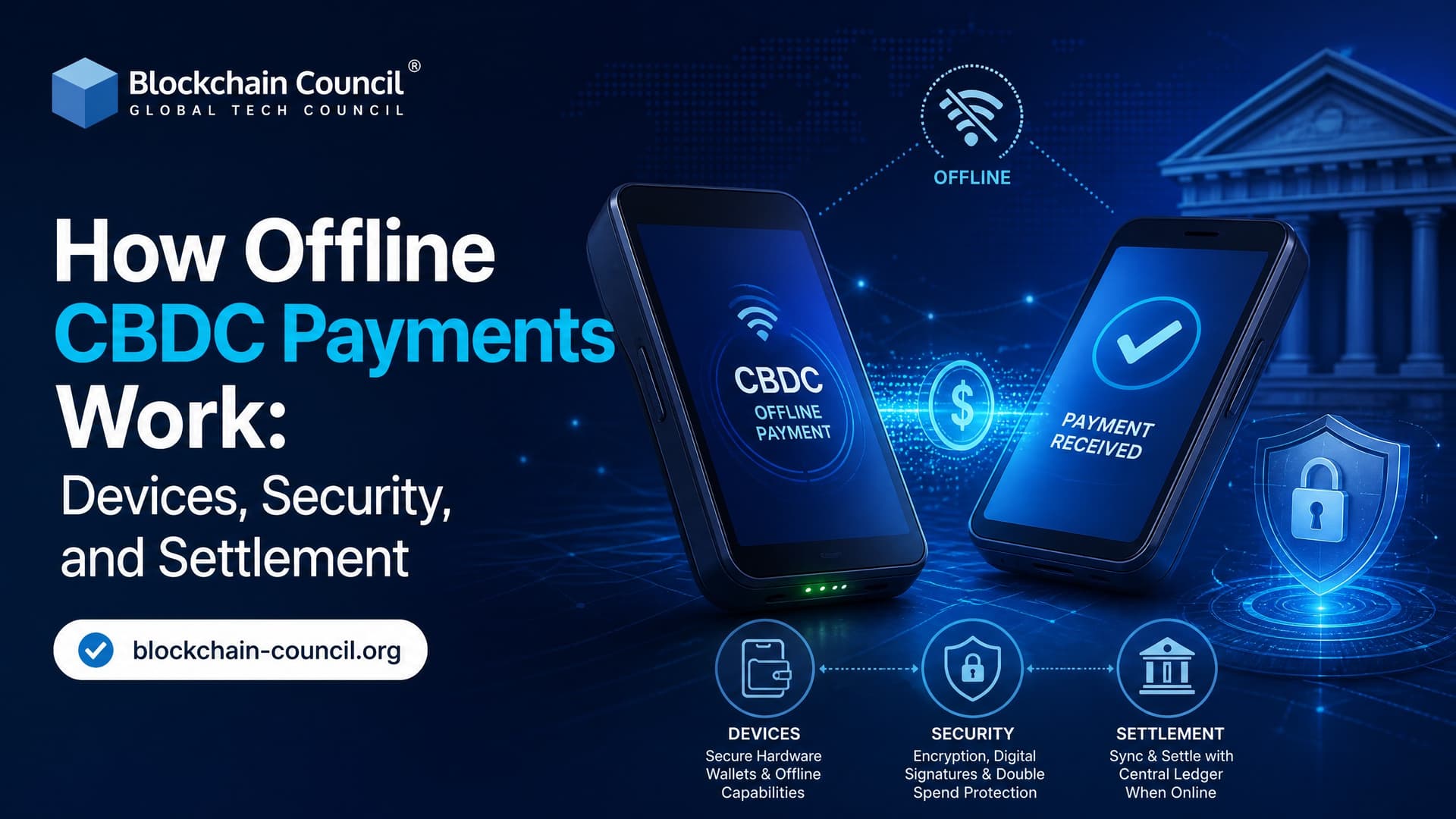
Offline CBDC payments let two users transfer central bank digital currency when neither device can reach the central bank ledger or payment network. Think of it as a digital cash handoff. Your phone, smart card, or purpose-built wallet records the transfer locally, then synchronizes later when connectivity returns. Professionals working through the design trade-offs behind this kind of architecture often start with a structured credential like the Certified Central Bank Digital Currency (CBDC) Expert program, since offline design decisions touch monetary policy, settlement finality, and consumer protection all at once.
This matters because payment systems fail in very ordinary ways. A mobile network drops. A shop loses broadband. A remote village has weak coverage. A flood takes out local infrastructure. Cash still works in those moments. If retail CBDC is meant to sit beside cash and not just card rails, offline capability is not a nice extra. It is part of the core design problem.

What Is an Offline CBDC Payment?
An offline CBDC payment is a device-to-device transfer of retail CBDC value without a live connection to a central ledger. The Bank of England describes this as a transaction where neither payer nor payee can access the CBDC network, usually because there is no internet access. The Bank of Canada frames offline CBDC as a digital complement to bank notes, especially where connectivity is weak or disrupted.
Most designs are also proximity payments. The two devices are near each other and communicate directly using NFC, Bluetooth, QR codes, or a similar local channel. No payment intermediary approves the transaction at that exact moment.
A simple example: you transfer offline digital euros to a friend by holding two phones close together. The ECB has described this type of offline digital euro flow, with payment data staying between the two devices rather than being visible to banks or the Eurosystem during the offline exchange. As offline CBDC design increasingly gets compared against offline-capable stablecoins and other bearer-like digital assets, many professionals pair this grounding with a Certified Digital Assets Expert certification to keep the comparison across instruments accurate rather than treating offline CBDC as a standalone case.
Three Ways Offline CBDC Settlement Can Work
The hard question is not whether two devices can exchange signed data. They can. The hard question is when the payment becomes final, who bears the risk, and what happens if someone tries to spend the same value twice.
1. Fully Offline CBDC
In a fully offline model, value exchange and settlement both happen offline. The payee can immediately re-spend the received CBDC without connecting to the central ledger.
This is the closest model to cash. It is also the riskiest. If a wallet is compromised, the system has less real-time oversight. Central banks would need strong secure hardware, strict wallet certification, and careful liability rules before using this at scale.
2. Intermittently Offline CBDC
Intermittently offline systems let a wallet make a limited number of offline payments, or payments up to a certain value, before it must reconnect. The payee may be able to re-spend funds right away, but only within defined risk limits.
This is likely the practical middle ground for many retail CBDC systems. You get resilience for low-value payments, but the blast radius of fraud stays capped. Limits can be based on value, transaction count, time offline, device risk score, or a mix of all four.
3. Staged Offline CBDC
In staged offline settlement, the payer and payee exchange transaction data offline, but the payee cannot spend the funds until the transaction is later accepted by the online ledger.
This is safer for the issuer but less useful for users. If you are a merchant during a network outage, pending funds are not as helpful as spendable funds. Staged offline payments fit some use cases, but they do not fully replace cash during emergencies.
Devices Used for Offline CBDC Payments
Central bank research has converged on two main device categories: smartphones and dedicated access devices.
Smartphones With Secure Wallet Apps
Smartphones are the obvious first option. They already support NFC, Bluetooth, cameras for QR codes, biometric authentication, and secure storage features. An offline CBDC app can hold a prefunded balance, authenticate the user, sign transactions, and exchange payment messages with another nearby device.
Here is the catch developers learn quickly: Android Host Card Emulation is not the same thing as tamper-resistant storage. HCE can emulate a contactless card, but keys still need protection through a secure element, a trusted execution environment, or a certified hardware-backed keystore. In prototype work, NFC sessions also fail for boring reasons, such as the receiving phone locking mid-flow or the app missing the short tap window. Smart card developers will recognize errors like SW=0x6985, which means conditions of use are not satisfied. Offline payment UX lives or dies on these details. Getting secure elements, trusted execution environments, and NFC session handling right is deep systems engineering work, and a broader Tech Certification from Global Tech Council is a practical way to build the device security, embedded systems, and cryptography foundations that offline wallets depend on.
Smart Cards and Universal Access Devices
Not everyone has a smartphone. That is why the Bank of Canada and the Eurosystem have discussed universal access devices, payment cards, and smart cards for offline CBDC.
The ECB has mentioned battery-powered smart cards and non-powered cards that use a bridge device to communicate. A bridge could be a merchant terminal, a phone, or an ATM-like device that helps the card exchange data without the card having its own internet connection.
This design choice is important for inclusion. If offline CBDC only works on expensive phones, it fails many of the people who still depend most on cash.
Why Offline CBDC Wallets Are Usually Prefunded
Most offline CBDC designs use a prefunding model. You move value from an online CBDC account or bank account into an offline wallet before spending it. The Eurosystem has compared this to withdrawing cash from an ATM: funds leave the connected account and become available in a local wallet on a phone or card.
Prefunding reduces risk because the offline wallet has a bounded balance. If the device is lost, stolen, or tampered with, exposure is limited to the stored offline amount. That is one reason offline CBDC is expected to focus on retail and low-value payments rather than large corporate transfers.
Security: The Main Threats and Controls
Offline CBDC security starts with an uncomfortable fact: the ledger cannot check every transaction in real time. That creates several threats.
Double-spending: A user tries to spend the same offline value more than once.
Counterfeiting: A compromised wallet attempts to create value that was never issued.
Device cloning: Attackers copy wallet credentials to another device.
Wallet theft: A lost device becomes a bearer instrument, like a stolen cash wallet.
Compliance abuse: Criminals exploit offline privacy to dodge AML and CFT controls.
The usual technical answer combines secure hardware and cryptographic controls. Wallets can use secure elements to protect keys, enforce spending limits, maintain transaction counters, and store tamper-resistant logs. Transactions are digitally signed. Devices authenticate each other. Sequence numbers or counters help prove transaction order when records are uploaded later.
Visa has proposed an offline CBDC protocol using point-to-point communication between devices, adapting familiar payment system rules to an offline environment. Academic work also explores privacy-preserving cryptography, where users can transact offline while the system still detects fraud during deposit or synchronization.
Synchronization and Reconciliation
When connectivity returns, offline wallets synchronize with the CBDC ledger or an authorized payment infrastructure. This step is where local history meets the global state.
During synchronization, the system can:
Upload signed offline transaction records.
Check wallet counters and balances.
Detect conflicting spends or suspicious gaps.
Apply offline transaction limits.
Update the central ledger or mark staged payments as settled.
In fully and intermittently offline models, users may already treat funds as final before synchronization. Ledger reconciliation then becomes a fraud detection and risk management layer. In staged models, synchronization is the moment the payee actually receives spendable funds.
The Bank of England reported in 2025 that its digital pound experiments found offline payments could be final and irrevocable from a technology standpoint, with funds immediately available to the payee. Policy design is the harder part. Limits, liability, privacy rules, and operational governance still need careful decisions.
Privacy: Cash-Like, But Not Unlimited
Offline CBDC is one of the strongest privacy arguments for retail CBDC. The ECB has said offline digital euro payments could provide privacy close to cash, where only the payer and payee know the payment details.
That does not mean unlimited anonymous digital money. Central banks still have AML and counter-terrorist-financing obligations. The likely compromise is privacy for small offline payments, combined with controls such as:
Low offline balance limits
Transaction value caps
Maximum time offline before forced synchronization
Device certification and revocation lists
Legal processes for access to specific data in serious investigations
To be blunt, a CBDC with no meaningful offline privacy will struggle to replace cash in everyday use. But a CBDC with unlimited anonymous offline value is unlikely to pass regulatory scrutiny. The credible path sits between those extremes.
Where Central Banks Are Today
The BIS Project Polaris has produced guidance for central banks on offline CBDC design, including devices, risk controls, and high-level architecture. The digital euro project treats offline functionality as a core feature, with smartphones and payment cards both under consideration. The Bank of England has tested offline digital pound architectures. The Bank of Canada has emphasized offline CBDC for remote communities and resilience during outages.
Most systems are still in research, pilot, or preparation phases. That is healthy. Offline CBDC touches hardware security, payment finality, consumer protection, privacy law, and central bank liability. Rushing it would be a mistake.
What Professionals Should Learn Next
If you work in payments, blockchain, digital assets, or public-sector technology, offline CBDC is worth studying now. The concepts overlap with token design, secure wallet architecture, cryptographic signatures, settlement systems, and compliance controls.
For a structured path, consider Blockchain Council programs such as Certified Blockchain Expert™, Certified Blockchain Developer™, and Certified Cryptocurrency Expert™. If your role is technical, build a small prototype next: two local wallets, signed transfers, a transaction counter, and a reconciliation script. You will understand the trade-offs faster than by reading policy papers alone.
Offline CBDC payments will not replace every digital payment method. They work best for low-value, resilient, cash-like transfers when networks are unavailable or privacy matters. Start by learning wallet security and settlement design, because that is where the real engineering work begins. And because offline privacy, limits, and cash-like behavior are the kind of design choices the public will have questions about, teams responsible for explaining offline CBDC to residents and merchants may also want to look at a Marketing Certification from Universal Business Council, since a technically sound offline design still needs a clear explanation of what it does and does not expose.
FAQs
1. What are offline CBDC payments?
Offline CBDC payments are transactions that allow users to transfer Central Bank Digital Currency without an active internet connection or continuous connection to the central CBDC infrastructure. They are designed to provide payment access during network outages, in remote areas, or where connectivity is limited. Offline CBDC systems typically rely on secure devices, stored transaction information, cryptographic protections, and later synchronization with the main payment network.
2. Why are offline CBDC payments important?
Offline CBDC payments improve resilience and financial accessibility by allowing digital money to function when internet services are unavailable. They can support rural communities, emergency situations, disaster recovery, and areas with limited connectivity. Offline functionality is especially important in increasingly digital economies because a payment system that stops working during a network failure is not exactly the definition of reliable infrastructure.
3. How do offline CBDC payments work?
Offline CBDC payments usually involve two users exchanging digital value through secure devices without immediate communication with the central system. The devices verify transaction information locally, record the transfer, and later synchronize with the CBDC network when connectivity returns. The system must prevent problems such as double spending, unauthorized transfers, and fraudulent duplication of digital currency.
4. What devices can support offline CBDC payments?
Offline CBDC payments may operate through various devices, including:
Smartphones with secure hardware
Smart cards
Digital payment cards
Wearable devices
Hardware wallets
Point-of-sale terminals
Specialized offline payment devices
The choice depends on accessibility goals, security requirements, cost, and the target users. A rural farmer and a financial institution will probably not need the same wallet hardware, despite technology designers occasionally pretending everyone does.
5. Can CBDC wallets work without internet access?
Yes, some CBDC wallet designs may support limited offline functionality. Users may store secure digital value or transaction credentials locally and make payments without immediate network access. Once connectivity returns, the wallet synchronizes with the CBDC system to confirm transactions and update records. Offline capabilities usually involve transaction limits because unlimited offline money would create obvious security challenges.
6. How do offline CBDC transactions prevent double spending?
Preventing double spending is one of the biggest technical challenges in offline CBDC payments. Systems may use secure hardware, cryptographic tokens, transaction counters, spending limits, device authentication, and synchronization checks. When devices reconnect, the CBDC network verifies transaction histories and resolves any conflicts. The challenge is making offline payments convenient without accidentally creating a digital version of counterfeit cash.
7. What role does secure hardware play in offline CBDC payments?
Secure hardware protects sensitive information such as transaction credentials and cryptographic keys. Secure elements inside devices can prevent unauthorized copying, tampering, and manipulation of stored CBDC data. Smartphones, smart cards, and dedicated payment devices may use hardware-based security features to support safer offline transactions.
8. How are offline CBDC payments settled?
Offline CBDC payments are usually settled in two stages. First, the transaction occurs locally between users or devices. Later, when connectivity returns, the transaction data is submitted to the CBDC infrastructure for validation and final settlement. This delayed synchronization model allows payments to continue during outages while maintaining central oversight of the monetary system.
9. Are offline CBDC payments final immediately?
Not always. Some offline CBDC systems may provide immediate user confirmation but complete final settlement only after synchronization with the central system. The difference depends on the technology and risk model. Higher-value transactions may require online confirmation, while small-value payments may receive more offline flexibility.
10. How secure are offline CBDC payments?
Offline CBDC security depends on device protection, cryptographic methods, authentication, transaction limits, and fraud-monitoring systems. Because transactions occur without real-time network verification, offline systems require additional safeguards. Security must address device theft, malware, unauthorized duplication, and attempts to manipulate stored transaction data.
11. What happens if a device with offline CBDC funds is lost?
Recovery depends on the CBDC design. Some systems may allow users to restore access through identity verification, backup credentials, or authorized providers. Others may rely on hardware security and predefined recovery mechanisms. Designers must balance easy recovery with fraud prevention because a recovery system that trusts everyone equally is basically an invitation.
12. Can offline CBDC payments improve financial inclusion?
Yes. Offline functionality can help people in regions with unreliable internet access, limited banking infrastructure, or expensive connectivity. Users may be able to make digital payments without constant access to online services. This can extend digital financial services to underserved communities, provided devices, training, and support systems are also available.
13. How do offline CBDC payments support emergency situations?
Offline CBDC systems can help maintain payments during natural disasters, power disruptions, network failures, or communication outages. Emergency workers, communities, and businesses may continue exchanging value even when normal digital payment systems are unavailable. This resilience makes offline capability an important consideration for national payment infrastructure.
14. What are the limitations of offline CBDC payments?
Common limitations include:
Transaction value limits
Device dependency
Security complexity
Delayed settlement
Higher implementation costs
Need for secure hardware
Limited functionality compared with online payments
Offline payments are generally designed as a resilience feature rather than a complete replacement for connected payment systems.
15. How do offline CBDC payments compare with cash?
Offline CBDCs aim to provide some cash-like benefits, such as availability without internet access and usability during outages. However, unlike physical cash, they rely on digital devices and technical infrastructure. CBDCs may offer stronger traceability and security controls, while cash provides simplicity and broad acceptance without technology requirements. The two systems solve different problems.
16. Can merchants accept offline CBDC payments?
Yes. Merchants can accept offline CBDC payments through compatible devices such as payment terminals, smartphones, or smart cards. Transactions may be verified locally and synchronized later. Merchant systems must support security checks, transaction limits, and reconciliation processes to ensure accurate settlement.
17. How do offline CBDC payments handle privacy?
Offline CBDC designs may provide different levels of privacy depending on architecture. Some systems may allow limited-value transactions with reduced data collection, similar to certain cash features. Others may require more identity information for compliance. Privacy protections can include encryption, limited transaction data storage, and controlled access to transaction records.
18. What cybersecurity risks affect offline CBDC systems?
Offline CBDC systems may face risks including device hacking, malware, credential theft, counterfeit digital value attempts, and manipulation of stored transaction data. Strong encryption, secure hardware, software updates, authentication, and monitoring are essential. Offline capability improves resilience, but it also removes one security advantage: immediate communication with the central system.
19. How could offline CBDCs support global payment systems?
Offline CBDCs could improve payment resilience in regions where connectivity varies significantly. They may support humanitarian payments, international aid distribution, and local commerce in areas with weak infrastructure. However, cross-border offline CBDC use would require agreements on security standards, interoperability, identity, and settlement procedures.
20. What is the future of offline CBDC payments?
The future of offline CBDC payments will likely involve a combination of secure hardware, mobile technology, biometric authentication, and advanced cryptographic systems. Offline features may become an important part of resilient digital payment networks, especially as economies become more dependent on electronic transactions. The goal is not to make the internet optional for every payment, but to ensure money still works when technology inevitably decides to have a bad day.
Related Articles
View All
Digital Assets
CBDC vs Mobile Payments: Understanding Wallets, Settlement, and Money Types
CBDC vs mobile payments explained through wallets, settlement, and money types, with real examples from India, China, Nigeria, and the Bahamas.

Digital Assets
CBDC for Smart Cities: Payments, Identity, and Public Service Innovation
CBDC for smart cities can connect payments, identity, and public services, but privacy, inclusion, and governance must shape every design choice.

Digital Assets
CBDC vs Stablecoins: Which Digital Money Model Is Better for Payments?
CBDC vs Stablecoins for payments explained: compare speed, trust, regulation, Web3 use, cross border settlement, and where each model fits best.
Trending Articles
The Role of Blockchain in Ethical AI Development
How blockchain technology is being used to promote transparency and accountability in artificial intelligence systems.

Top 5 DeFi Platforms
Explore the leading decentralized finance platforms and what makes each one unique in the evolving DeFi landscape.
What is AWS? A Beginner's Guide to Cloud Computing
Everything you need to know about Amazon Web Services, cloud computing fundamentals, and career opportunities.