

CBDC Offline Payments Explained: How Digital Cash Can Work Without Internet
 Suyash Raizada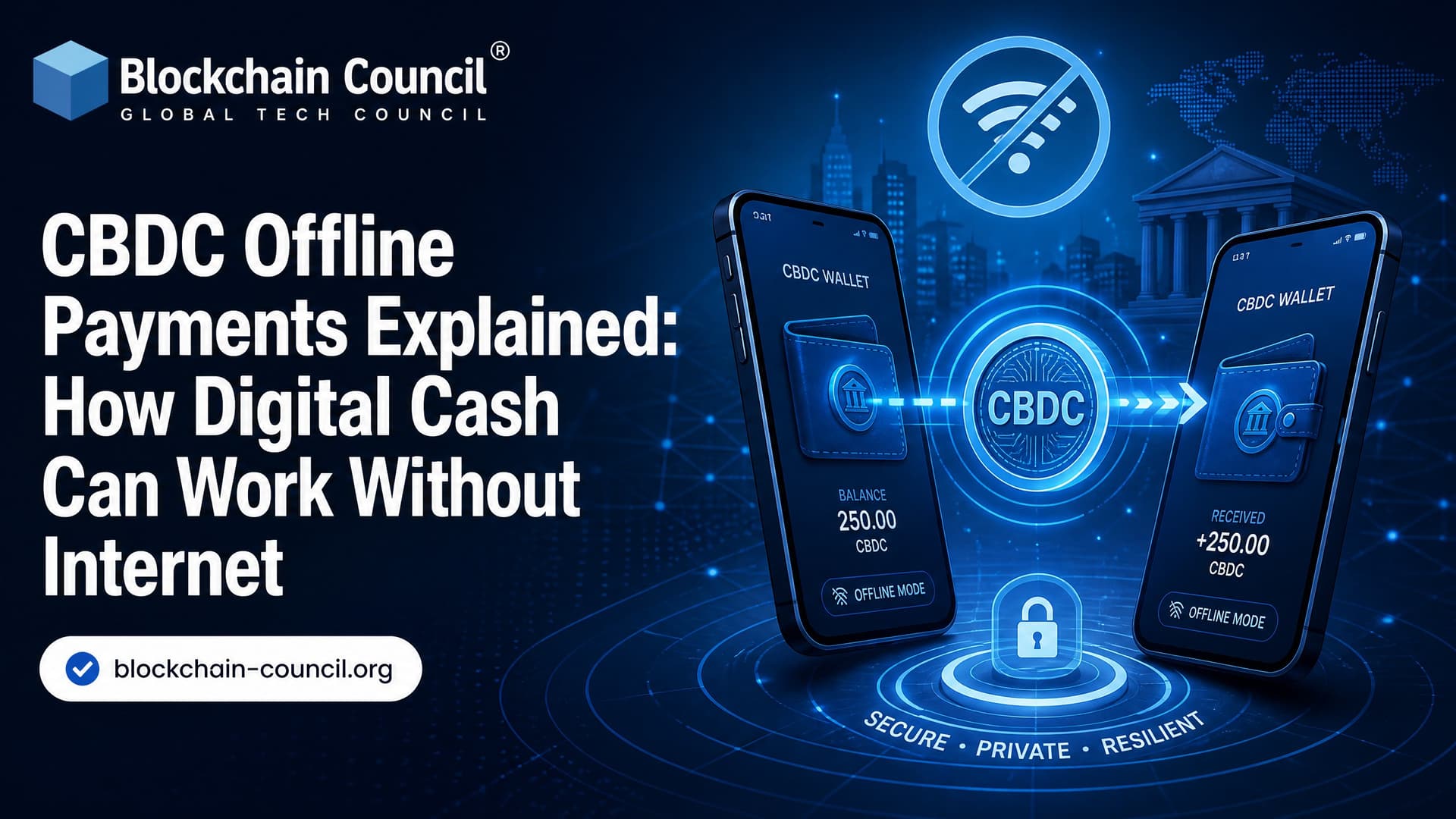
CBDC offline payments let digital cash move between people and merchants even when phones, terminals, or dedicated wallets cannot reach the internet. The core idea is simple: store a limited amount of central bank money on a secure device, transfer it locally through NFC, Bluetooth, or QR codes, then synchronize with the main ledger when connectivity returns. For professionals looking to build deeper knowledge in this area, a Certified Central Bank Digital Currency (CBDC) Expert program can provide a structured foundation around CBDC concepts, technology, and applications.
That sounds easy. It is not. Offline CBDC design sits at the hardest intersection of payments engineering, cryptography, device security, privacy law, and public policy.

What Are CBDC Offline Payments?
Offline CBDC payments are transfers of central bank digital currency where neither the payer nor the payee needs a live connection to the CBDC network at the moment of payment. The Bank of England describes this as a payment made when both parties lack access to the CBDC network, usually because there is no internet connection. The Bank of Canada frames offline CBDC as a digital complement to banknotes, useful when online payments are not available.
In practice, you hold CBDC value in an offline wallet. That wallet may be:
A smartphone app with a secure element or trusted execution environment
A smartcard similar in user experience to a contactless payment card
A purpose-built universal access device for people without smartphones
A merchant terminal that can receive and validate local payments
The payment itself happens over a local channel. Tap by NFC. Scan a QR code. Use Bluetooth for a direct device-to-device session. The payee receives confirmation locally, and in more advanced designs can spend those funds again before reconnecting.
Why Offline Functionality Matters for CBDCs
A CBDC that only works online is not a true cash substitute. Cash works during telecom outages. Cash works in rural areas. Cash works when a bank app is down. If public digital money cannot do the same, it becomes just another online payment rail.
For professionals exploring the broader digital economy surrounding CBDCs, digital assets, and blockchain-based financial systems, a Certified Digital Assets Expert certification can also complement this knowledge by covering concepts connected to digital asset ecosystems and their applications.
Central banks are studying offline payments because they support:
Resilience: Payments can continue during internet outages, disasters, or power disruptions.
Financial inclusion: Users in remote areas or without smartphones can still take part.
Cash-like privacy: Small offline payments can avoid constant real-time monitoring.
Operational continuity: Merchants can keep accepting small payments when networks fail.
The Reserve Bank of India has said the retail Digital Rupee will test offline functionality in areas with poor connectivity, including hilly, rural, and urban environments. That is the right proving ground. A lab demo in a city office tells you little about dust, low battery, weak devices, and patchy networks.
Three Main Models of Offline CBDC Payments
Research from the Bank for International Settlements, the Bank of Canada, and academic groups usually splits offline CBDC into three models.
1. Fully Offline CBDC
In a fully offline model, value is exchanged and settled without contacting the central ledger. The payee can use the received value straight away, even while still offline.
This is the closest model to physical cash. It is also the hardest to secure. The system must stop double spending without asking a central server for help.
2. Intermittently Offline CBDC
Intermittently offline systems are built for short outages. Think of a shopper in an underground station or a merchant whose broadband drops for 20 minutes. Wallets can transact for a limited period, then reconnect and synchronize balances, counters, and transaction logs.
This model is easier to supervise and safer for higher transaction volumes, but it is less useful in long outages.
3. Staged or Extended Offline CBDC
Extended offline systems support longer disconnection periods. They often rely on dedicated hardware and a local store of funds. The Bank of Canada has described this as a distinct offline ecosystem, not just an online wallet with a temporary cache.
This is where policy gets difficult. How long can a device stay offline? How much money can it hold? What happens if it is stolen, cloned, or physically damaged?
How CBDC Offline Payments Work Technically
Most offline CBDC systems combine five parts: secure devices, local value storage, proximity communication, cryptographic verification, and later synchronization.
Secure Wallets and Devices
The wallet must protect keys, counters, and stored value. Some vendors, including IDEMIA, have proposed tamper-resistant hardware chips similar to those used in EMV cards and identity documents. That makes sense. If you let a normal app database hold spendable central bank money without hardware protection, attackers will copy it.
Smartphones can help, but they are uneven. Secure element access differs by operating system, model, and issuer policy. Anyone who has tested NFC prototypes knows the painful part is often not the cryptography. It is an APDU returning status word 6985, meaning conditions of use not satisfied, because a transaction counter, access rule, or secure channel state is wrong. These details decide whether a payment works at a village shop, not the slide deck architecture.
Local Representation of Value
Offline CBDC can represent value as token-like files, denomination units, or secure balance updates. PwC has described a QR-based model where e-currency files of different denominations are stored in an encrypted database on a smartphone. The buyer scans the seller's wallet identifier, selects token files matching the amount, creates a QR code with token details, and the seller's app verifies and stores them locally.
Token-based designs feel cash-like because individual units can be transferred. Balance-based designs may be simpler for users, but they put more pressure on secure counters and reconciliation rules.
Proximity Communication
Offline payments need a local communication path:
NFC: Best for tap-to-pay speed and familiar retail use.
QR codes: Cheap, camera-based, and useful on low-cost phones.
Bluetooth: Better for longer device-to-device range, but pairing and spoofing risks need careful handling.
For small retail payments, NFC is usually the strongest user experience. QR codes are more inclusive because they do not require specialized contactless hardware. Bluetooth is useful, but it is rarely as clean at the checkout counter.
Local Settlement and Synchronization
The Bank of England's 2025 Digital Pound experiment found that several technical solutions could achieve final and irrevocable offline payments from a technology point of view. In those designs, the payee received value with immediate confirmation and could spend it again without first reconnecting.
When devices later reconnect, they submit transaction logs, cryptographic proofs, updated counters, or token histories to the CBDC system. The central ledger then reconciles the wider state of the system. If something looks wrong, such as duplicate token use, the rules must already define liability, penalties, and recovery.
The Double-Spending Problem
Double spending is the central threat. If a payer can copy offline value and spend it twice before reconnection, the system breaks.
Designers use several controls:
Secure hardware that prevents copying keys and stored value
Monotonic counters that cannot roll back after a payment
Digital signatures tied to device identity and transaction state
Limits on offline wallet balances and transaction amounts
Expiry rules that force periodic reconnection
Audit trails submitted when the device returns online
To be blunt, software-only offline CBDC for meaningful values is a bad idea. It may be acceptable for tiny capped payments, but higher limits need hardware-backed protection.
Privacy, AML, and Compliance Trade-offs
Offline CBDC is attractive because it can mimic the privacy of cash. That same feature worries regulators. Anti-money laundering and counter-terrorism financing controls usually depend on monitoring, reporting, and identity checks. Offline payments delay or reduce that visibility.
Common policy tools include:
Tiered wallets: Low-value wallets may need less identity information, while higher limits require stronger KYC.
Transaction caps: Offline payments may be limited to small retail amounts.
Balance caps: A wallet may only store a capped offline balance.
Delayed reporting: Transaction summaries or proofs may be uploaded after reconnection.
Risk-based device rules: Compromised, expired, or long-disconnected wallets may be blocked from further offline use.
The right answer is not full anonymity at every value level. Nor is it total surveillance. For offline CBDC to earn public trust, small payments should have cash-like privacy, while larger or suspicious activity should trigger proportionate controls.
Real Use Cases for CBDC Offline Payments
Remote and Underserved Regions
Offline CBDC can help users where internet access is unreliable or expensive. A universal access device could serve people without bank accounts or modern phones, which is why the Bank of Canada and BIS Project Polaris treat inclusion as a core design goal.
Natural Disasters and Outages
During floods, earthquakes, wildfires, or telecom failures, online payments can fail exactly when people need food, fuel, transport, and medicine. Offline CBDC gives a country a fallback payment layer.
Small Retail and Peer-to-Peer Payments
For small purchases, offline CBDC could work like digital cash: tap, confirm, move on. No card network authorization. No bank app loading screen. No failed checkout because the signal dropped.
Public Money in a Digital Economy
As cash use declines in some countries, central banks want public money to stay usable in daily life. Offline capability is a key part of that goal.
What Professionals Should Learn Next
If you work in payments, fintech, blockchain, cybersecurity, or digital assets, CBDC offline payments are worth studying now. The topic pulls together cryptography, secure hardware, token design, privacy engineering, and regulation.
For professionals who want to expand beyond blockchain and digital assets into broader technology skills, a Tech Certification pathway can help build knowledge across emerging technologies and practical technical domains.
For a structured learning path, consider Blockchain Council's Certified Blockchain Expert if you need a broad grounding in blockchain and digital asset systems. Developers who want to understand wallet architecture, smart contracts, and secure transaction flows can also look at the Certified Blockchain Developer program. If your focus is policy, compliance, or digital currency strategy, pair technical study with CBDC research from BIS Project Polaris, the Bank of England, the Bank of Canada, and the Reserve Bank of India.
Conclusion: Offline CBDC Is Digital Cash's Hard Test
CBDC offline payments are not a small feature to bolt on at the end of a retail CBDC project. They shape the whole design. Devices, caps, privacy rules, security chips, reconciliation logic, and liability models must be planned from the start.
As CBDCs, blockchain, and emerging technologies continue to influence financial services, professionals can also broaden their expertise through a Marketing Certification pathway when they want to understand the marketing and business side of technology-driven industries.
The best next step is practical: map one offline payment journey from wallet loading to local transfer to reconnection. Then ask where double spending, device loss, privacy leakage, or poor connectivity could break it. That exercise will teach you more than any abstract CBDC diagram.
FAQs
1. What are CBDC offline payments?
CBDC offline payments are transactions that allow users to send and receive Central Bank Digital Currency without being connected to the internet or the central payment network at the time of payment. They are designed to provide digital cash-like functionality during connectivity issues, emergencies, or in areas with limited network access. Offline CBDCs combine secure devices, cryptographic protection, and later settlement processes to keep digital money functional outside normal online systems.
2. How can digital cash work without internet?
Digital cash can work offline by storing secure payment information on approved devices such as smartphones, smart cards, or hardware wallets. When two users exchange CBDC offline, their devices verify the transaction locally using security mechanisms built into the system. Once connectivity returns, the transaction details are synchronized with the CBDC network for verification and final settlement. It is essentially cash behavior recreated with technology, because apparently paper money needed a software upgrade.
3. Why are offline CBDC payments needed?
Offline CBDC payments are important because modern economies increasingly depend on digital transactions. Internet outages, natural disasters, rural connectivity challenges, and technical failures can interrupt electronic payments. Offline capability provides resilience by allowing users to continue making payments when online systems are unavailable. It also helps extend digital payment access to communities with limited connectivity.
4. How do offline CBDC transactions work step by step?
A typical offline CBDC transaction involves:
A user stores CBDC value or payment credentials on a secure device.
The sender initiates a payment to another user or merchant.
Devices verify transaction rules locally.
The payment is recorded securely.
When connectivity returns, transaction information is submitted to the CBDC network.
The system validates records and completes settlement.
The exact process depends on the CBDC architecture chosen by the central bank.
5. What devices can be used for offline CBDC payments?
Offline CBDC payments may use:
Smartphones with secure elements
Smart cards
Wearable payment devices
Hardware wallets
Dedicated CBDC payment devices
Merchant terminals
Different devices may serve different users. Consumers may prefer mobile wallets, while regions with limited smartphone access may rely on cards or specialized devices.
6. Can CBDC wallets work without internet access?
Yes, if the CBDC design includes offline functionality. Offline-enabled wallets may store limited transaction capabilities locally and allow payments without continuous network access. However, offline wallets usually operate with restrictions such as transaction limits, balance caps, or delayed verification to reduce security risks.
7. How do offline CBDCs prevent double spending?
Preventing double spending is one of the biggest challenges in offline digital money. CBDC systems may use:
Secure hardware modules
Cryptographic signatures
Unique digital transaction identifiers
Spending limits
Device authentication
Synchronization checks after reconnection
These mechanisms help ensure that the same digital value cannot be spent multiple times.
8. Are offline CBDC payments similar to cash?
Offline CBDCs aim to provide some cash-like features, such as availability without internet access and direct exchange between users. However, they differ from physical cash because they depend on digital devices, security systems, and technical infrastructure. Cash works with no battery, no software update, and no customer support ticket, which remains an annoyingly efficient feature of paper.
9. How are offline CBDC payments settled?
Offline CBDC payments usually involve delayed settlement. The transaction occurs locally between devices, but final confirmation happens when the devices reconnect to the central CBDC infrastructure. The system checks transaction records, verifies authenticity, and updates the official ledger or database.
10. Are offline CBDC payments instantly final?
Not always. Users may receive immediate confirmation that a payment has occurred, but final settlement may happen later after synchronization. Central banks may define different levels of finality depending on transaction size, risk level, and security design. Small everyday payments may receive more offline flexibility than large-value transactions.
11. How secure are offline CBDC payments?
Offline CBDC payments require strong security because transactions occur without continuous connection to central systems. Security measures may include encryption, secure hardware, biometric authentication, transaction limits, fraud detection, and tamper-resistant devices. The challenge is maintaining trust without real-time network verification.
12. What happens if someone loses an offline CBDC device?
Recovery depends on the CBDC design. Some systems may allow users to recover funds through identity verification, backup credentials, or authorized wallet providers. Others may use secure hardware-based recovery methods. Designers must balance convenience and security because making recovery too easy can create opportunities for fraud.
13. Can offline CBDC payments support rural communities?
Yes. Offline CBDC systems can improve payment access in rural and remote areas where internet connectivity is unreliable. Users may be able to transact through mobile devices, smart cards, or local payment networks without constant online access. This can support financial inclusion by reducing dependence on traditional banking infrastructure.
14. How do offline CBDCs help during emergencies?
Offline CBDCs can maintain payment availability during:
Natural disasters
Internet outages
Power disruptions
Cyber incidents
Communication failures
Emergency responders, businesses, and households could continue essential transactions until normal connectivity is restored.
15. What are the limitations of offline CBDC payments?
Offline CBDCs have several limitations, including:
Transaction value restrictions
Device dependency
Security complexity
Delayed settlement
Higher implementation costs
Need for specialized hardware
They are generally designed as a backup and resilience feature rather than a complete replacement for online payments.
16. How do merchants accept offline CBDC payments?
Merchants can accept offline CBDC payments through compatible payment terminals, smartphones, QR systems, or smart cards. The merchant device verifies the transaction locally and stores the payment information until it can reconnect to the CBDC network. Merchant systems must also support reconciliation and fraud checks.
17. Do offline CBDC payments protect privacy?
Offline CBDC privacy depends on the system design. Some models may allow low-value offline transactions with reduced data collection, creating a more cash-like experience. Others may require identity verification and transaction reporting. Privacy protections can include encryption, limited data storage, and restricted access to transaction records.
18. What cybersecurity risks affect offline CBDCs?
Offline CBDC systems face risks such as:
Device hacking
Malware attacks
Credential theft
Counterfeit digital value attempts
Manipulation of stored transaction data
Strong hardware security, software protection, monitoring, and regular updates are necessary to reduce these threats.
19. Can offline CBDCs replace physical cash?
Probably not completely. Offline CBDCs can provide digital alternatives with some cash-like benefits, but physical cash remains valuable for privacy, accessibility, and independence from technology. Many policymakers view offline CBDCs as a way to strengthen digital payment resilience rather than eliminate cash entirely.
20. What is the future of offline CBDC payments?
The future of offline CBDC payments may include advanced secure chips, biometric authentication, smart cards, mobile wallets, and improved cryptographic techniques. As economies become more digital, offline capability may become an essential feature of resilient payment systems. The goal is simple: digital money should continue working even when networks fail, because depending on perfect connectivity is a surprisingly optimistic assumption for a species that still loses Wi-Fi signals in its own homes.
Related Articles
View All
Digital Assets
CBDC vs Stablecoins: Which Digital Money Model Is Better for Payments?
CBDC vs Stablecoins for payments explained: compare speed, trust, regulation, Web3 use, cross border settlement, and where each model fits best.

Digital Assets
CBDC Governance Explained: Standards, Oversight, and Stakeholder Roles
CBDC governance defines how digital central bank money is issued, supervised, secured, and operated across central banks, banks, PSPs, regulators, and users.

Digital Assets
CBDC for Smart Cities: Payments, Identity, and Public Service Innovation
CBDC for smart cities can connect payments, identity, and public services, but privacy, inclusion, and governance must shape every design choice.
Trending Articles
AWS Career Roadmap
A step-by-step guide to building a successful career in Amazon Web Services cloud computing.
What is AWS? A Beginner's Guide to Cloud Computing
Everything you need to know about Amazon Web Services, cloud computing fundamentals, and career opportunities.
How to Create Claude Skills?
Claude Skills are one of the most important features Anthropic has introduced for users who want automation that is structured, consistent and reusable. Instead of giving Claude long instructions ever