

The Future of Stablecoin Payments with AI Automation

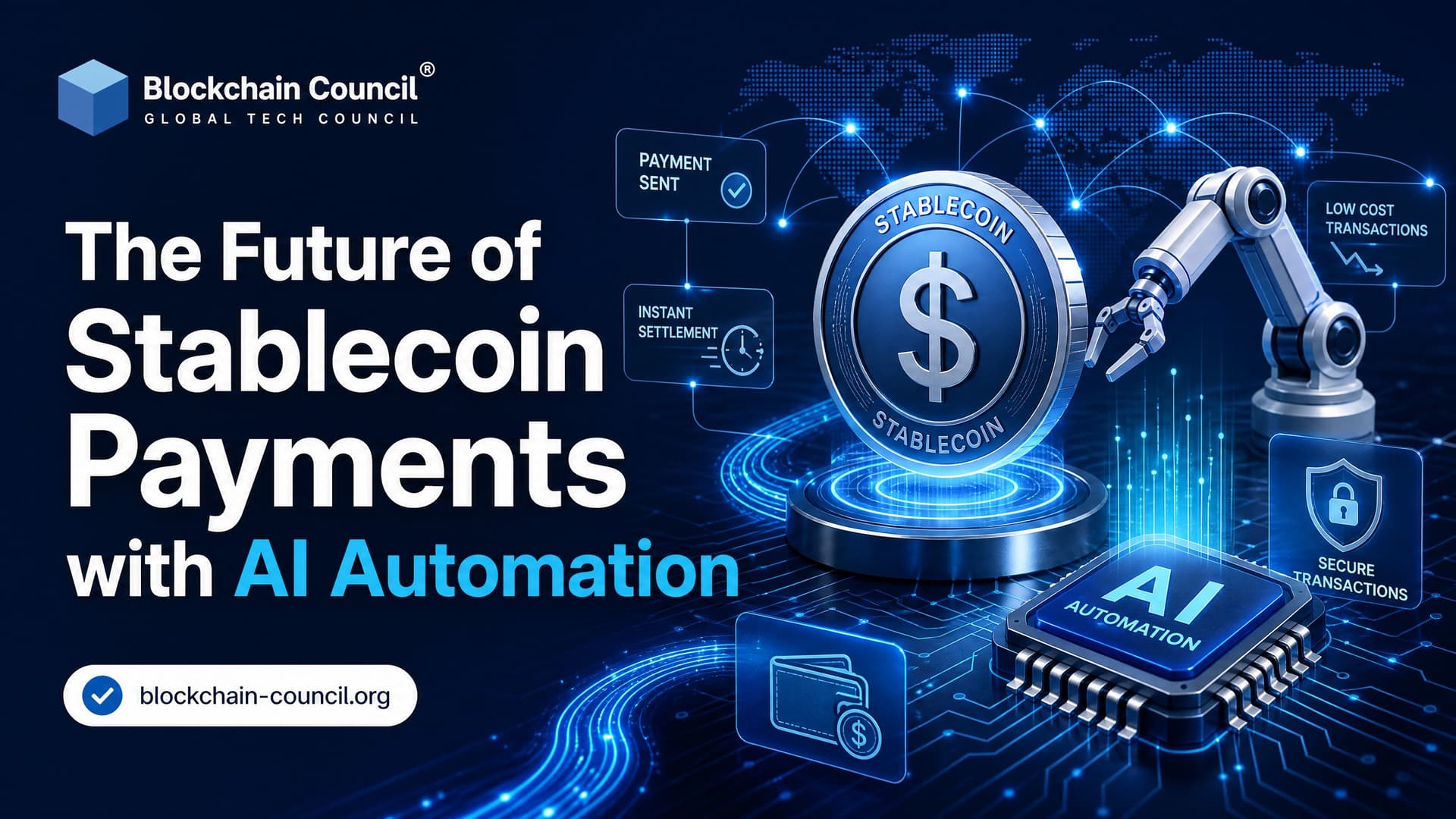
Stablecoin payments with AI automation are moving from crypto trading desks into payment operations, treasury systems, merchant payouts, and agentic software. The short version: dollar-denominated tokens are becoming programmable cash, and AI agents are starting to route, approve, monitor, and trigger those payments under policy controls.
This is not theory anymore. Visa's onchain analytics shows more than 51 trillion dollars in stablecoin transaction volume over a recent 12 month period. McKinsey estimates that stablecoins already support roughly 20 to 30 billion dollars in real onchain payment activity per day, separate from purely speculative flows. TRM Labs has also reported that stablecoins make up about 30 percent of total onchain crypto transaction volume.

Why Stablecoin Payments Are Becoming Serious Payment Rails
Stablecoins began as a way for crypto traders to move in and out of volatile assets without returning to bank accounts. That use case still matters. But the payment story is now bigger.
Stablecoins are being used for:
Cross-border merchant settlements
Remittances and contractor payouts
Exchange and DeFi settlement
Onchain treasury movement
API and digital service payments
Automated escrow and conditional release of funds
Federal Reserve-cited research puts the split at roughly 40 percent of stablecoins used as trading assets, 30 percent idle, and 30 percent moving as transfers and payments. That split matters. Payment utility is already meaningful, and there is plenty of room to grow as enterprises connect stablecoins to ERP, billing, and treasury workflows.
The market is still concentrated. Tether's USDT holds the largest share globally, while Circle's USDC remains heavily used in DeFi and regulated payment integrations. PayPal's PYUSD adds another signal: large consumer payment companies now treat stablecoins as infrastructure, not a side experiment.
Where AI Fits Into Stablecoin Payments
AI does not make stablecoins useful by itself. To be blunt, a payment bot connected to a bad wallet design is just a faster way to lose money. The real value appears when AI systems operate inside strict payment rules: maximum transaction size, approved vendors, allowed chains, risk scoring, sanctions checks, and human approval thresholds.
In practice, AI automation helps with three payment tasks:
Decisioning: choosing when to pay, how much to pay, and which rail to use.
Execution: signing or requesting stablecoin transfers through wallets, APIs, or smart contracts.
Monitoring: checking transaction status, counterparty risk, policy limits, and reconciliation records.
A common example is an AI agent paying for cloud compute or data access. Instead of monthly invoicing, the agent can pay USDC per API call, per dataset, or per compute job. The payment settles onchain, the service contract sees the transfer, and access is granted automatically.
That sounds clean on a slide. In code, small details bite. USDC uses 6 decimals on major networks, not 18 like many ERC-20 examples in tutorials. Send 1 USDC as 1000000000000000000 units instead of 1000000 and you have made a very expensive mistake. Another beginner trap is the classic revert: ERC20: transfer amount exceeds allowance. Your agent may have funds, but the payment contract cannot pull them until allowance is set correctly.
Programmable Stablecoins and Tokenized Deposits
Stablecoin payments with AI automation depend on programmable money. Payment rules can be encoded into smart contracts, bank-led blockchain systems, or API-based controls.
Public Stablecoins
Public stablecoins such as USDC, USDT, and PYUSD are typically used across public blockchains and wallet infrastructure. Circle describes USDC as redeemable 1:1 for US dollars and backed by cash and short-term US Treasuries. PayPal's PYUSD is backed by US dollar deposits and US Treasuries, and PayPal added PYUSD support on Solana in 2024 to support lower-cost, faster consumer transactions.
For developers, this public-chain model is attractive because it is composable. You can build on Ethereum, Solana, Polygon, Arbitrum, or other networks, depending on fees, liquidity, and user needs. You still need to design for chain-specific behavior. Ethereum mainnet uses chain ID 1. Solana does not use EVM gas mechanics. EIP-1559 fee estimation matters on Ethereum and many EVM networks. These details are not optional when real money is moving.
Bank-Led Tokenized Deposits
Institutions may prefer tokenized deposits. J.P. Morgan's JPM Coin and Kinexys platform show how bank-backed deposit tokens can support around-the-clock settlement, conditional transfers, and intraday liquidity movement on permissioned infrastructure.
This is not the same as a retail stablecoin. Deposit tokens sit closer to bank money and institutional settlement. For a multinational treasury team, that may be the better fit. For an open developer marketplace, a public stablecoin may be easier. Pick the rail based on the job, not the headline.
Regulation Is Turning Stablecoins Into Enterprise Infrastructure
Enterprises rarely adopt payment rails at scale without legal clarity. That is why regulation is central to the future of stablecoin payments with AI automation.
United States
The GENIUS Act created a federal framework for payment stablecoins in the United States. Its core ideas include one-for-one backing with US dollars or other low-risk assets, issuer oversight, reserve expectations, and technical capabilities to freeze or burn tokens when legally required.
That last point is controversial in crypto circles, but enterprises care about it. Regulated businesses need sanctions compliance, fraud response, court order handling, and auditability. AI payment systems will need to respect those controls, not route around them.
European Union
The EU's Markets in Crypto-Assets Regulation, known as MiCA, introduced rules for e-money tokens and asset-referenced tokens. Stablecoin provisions started applying in 2024. MiCA requires authorization, governance, capital, and reserve controls for issuers, while crypto asset service providers in the EU must align with compliant instruments.
If you are building payment software for European users, do not treat stablecoin choice as a simple liquidity question. Regulatory eligibility matters.
Japan
Japan moved early with stablecoin rules through amendments to the Payment Services Act and Banking Act. Its framework requires registered issuers and intermediaries, consumer protection controls, identity verification, and strict backing rules for trust-type stablecoins. Japan's model is worth watching because it gives payment firms a clear path without pretending stablecoins sit outside financial regulation.
Practical Use Cases for AI-Automated Stablecoin Payments
Automated Treasury
AI systems can monitor balances, upcoming obligations, FX exposure, and liquidity needs. A treasury agent could sweep excess stablecoin balances into approved accounts, fund margin calls, or trigger settlement when predefined risk thresholds are met. Human approval should remain for large or unusual transactions.
Cross-Border Payouts
Gig platforms, marketplaces, and exporters can use stablecoins to pay workers and suppliers faster than traditional correspondent banking routes. AI can select the stablecoin, network, and timing based on cost, jurisdiction, wallet history, and recipient preference.
AI-Native SaaS Billing
Machine-to-machine commerce is one of the strongest use cases. An AI agent can buy data, pay for model inference, renew software access, or purchase compute in small increments. Cards were not built for thousands of tiny autonomous payments. Stablecoins with programmable limits fit that pattern better.
Compliance Monitoring
AI can scan wallet behavior, sanctions data, transaction graphs, and policy rules before releasing funds. This will not remove compliance teams. It changes their work from manual review of every payment to investigation of flagged cases and model governance.
Security Risks You Should Not Ignore
Giving AI agents payment ability creates new attack paths. The worst design is simple: put a private key in an agent prompt and hope it behaves. Do not do that.
Safer designs include:
Use smart contract wallets with spending limits.
Separate policy approval from transaction signing.
Apply allowlists for vendors and contracts.
Set daily and per-transaction caps.
Require human approval for new counterparties.
Log every agent action for audit review.
Test contracts with tools such as Hardhat or Foundry before deployment.
Also watch allowance risk. Unlimited ERC-20 approvals are convenient, but they are dangerous when an agent interacts with external contracts. Use bounded allowances where possible, and revoke stale approvals.
Skills Professionals Need Next
The future of stablecoin payments with AI automation sits across blockchain engineering, AI systems, compliance, and cybersecurity. If you work in payments, treasury, fintech, or Web3 development, the useful learning path is practical:
Understand stablecoin mechanics, including reserves, redemption, token standards, and chain behavior.
Learn smart contract development with Solidity 0.8.x, ERC-20 integrations, testing, and deployment workflows.
Study AI agent architecture, especially tool permissions, wallet security, and policy-based automation.
Map regulations such as MiCA, the GENIUS Act, and Japan's stablecoin framework to product design.
Build a small payment prototype before touching production funds.
For structured learning, Blockchain Council readers can explore paths such as Certified Blockchain Expert™, Certified Blockchain Developer™, Certified Web3 Expert™, Certified Artificial Intelligence (AI) Expert™, and Certified Cybersecurity Expert™. The right choice depends on your role. Developers should start with smart contracts and wallet flows. Treasury and product leaders should focus on stablecoin architecture, risk, and regulation. Security teams should prioritize agent wallet controls and transaction monitoring.
What Comes Next
Stablecoins are heading toward 24/7 programmable settlement, and AI will become the orchestration layer for many of those flows. Some use cases are overhyped. Your coffee purchase does not need an AI agent and three smart contracts. But cross-border payouts, automated treasury, machine-to-machine billing, and real-time compliance are strong fits.
Your next step: build a controlled testnet workflow where an AI service requests a payment, a policy engine approves or rejects it, and a smart contract wallet sends a small stablecoin transfer. Keep the cap low. Log everything. That small prototype will teach you more than another market prediction.
Related Articles
View All
Digital Assets
How Smart Contracts Manage Tokenized Asset Ownership and Payments
Smart contracts manage tokenized ownership, transfers, compliance, and payouts for real estate, funds, securities, RWAs, and stablecoin payment flows.

Digital Assets
Real-World Asset Tokenization and the Future of Finance
Real-world asset tokenization is moving Treasuries, credit, real estate, and commodities onchain, reshaping liquidity, settlement, and digital finance.

Digital Assets
CBDC for Smart Cities: Payments, Identity, and Public Service Innovation
CBDC for smart cities can connect payments, identity, and public services, but privacy, inclusion, and governance must shape every design choice.
Trending Articles
The Role of Blockchain in Ethical AI Development
How blockchain technology is being used to promote transparency and accountability in artificial intelligence systems.
AWS Career Roadmap
A step-by-step guide to building a successful career in Amazon Web Services cloud computing.
Top 5 DeFi Platforms
Explore the leading decentralized finance platforms and what makes each one unique in the evolving DeFi landscape.