

Digital Assets vs Cryptocurrencies: What Investors and Businesses Should Know
 Suyash Raizada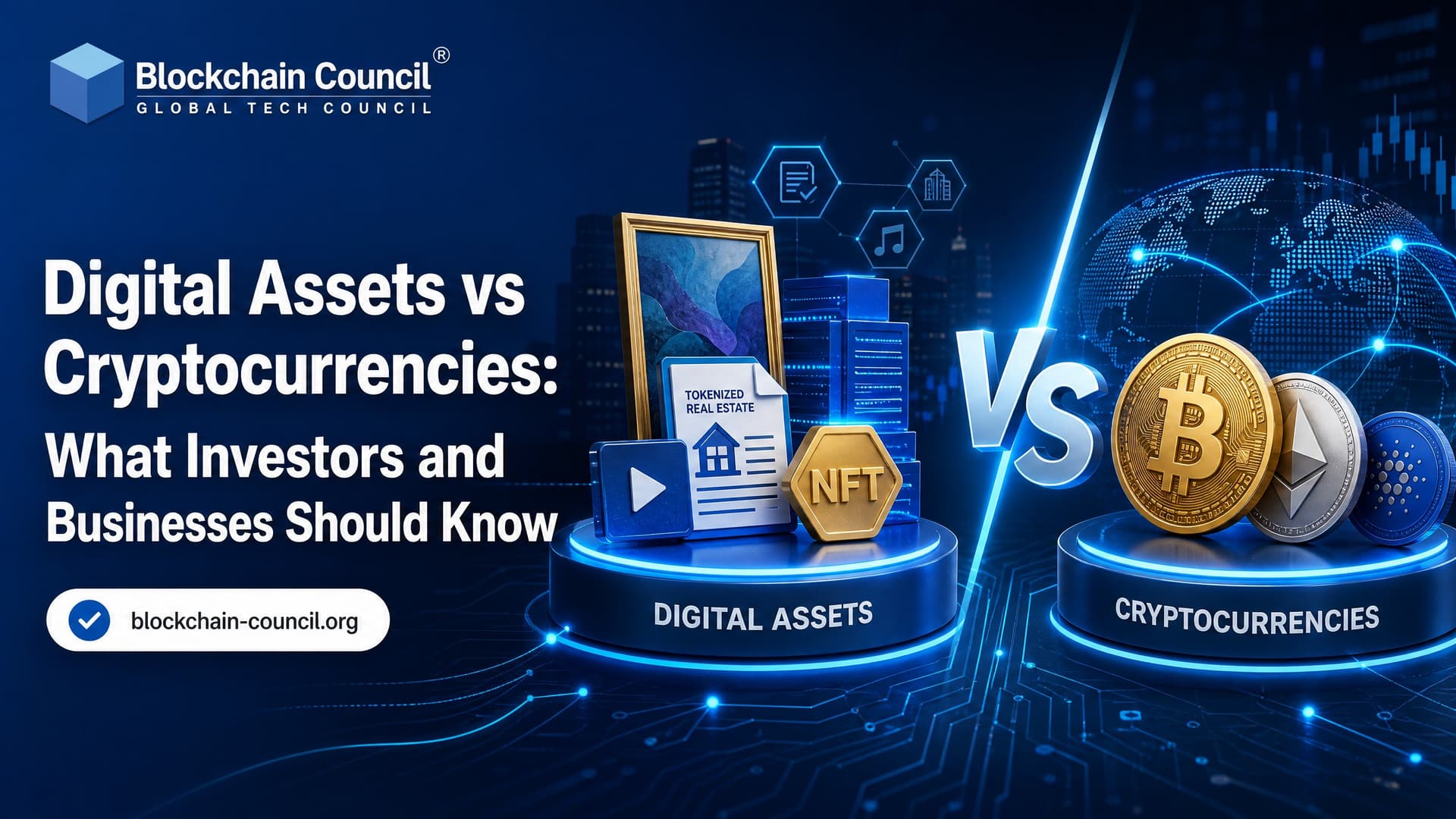
Digital assets vs cryptocurrencies is not just a wording issue. It changes how you assess risk, choose custody, read regulation, build products, and explain strategy to a board. A cryptocurrency is a type of digital asset, but the digital asset category also includes NFTs, tokenized real estate, digital intellectual property, in-game items, tokenized bonds, and some non-blockchain digital records that carry value or rights.
That distinction matters because Bitcoin, an ERC-721 collectible, a tokenized invoice, and a central bank digital currency do not behave the same way. They do not share the same legal treatment either. Put them in one bucket and you will misprice risk.

As blockchain adoption expands across finance and enterprise technology, professionals need a clear understanding of digital asset governance, custody models, tokenization, and regulatory frameworks. A Certified Digital Assets Expert credential helps build these practical skills, enabling individuals to evaluate different categories of digital assets and make informed decisions in rapidly evolving markets.
What Are Digital Assets?
A digital asset is any value-bearing item that exists in digital form and can be owned, stored, transferred, or managed electronically. Some digital assets are recorded on a blockchain. Others are not.
Industry bodies tend to use a wide definition. Digital assets cover cryptocurrencies, NFTs, digital art, music, virtual real estate, and any electronic file or record that holds value or rights. Many of these are tokens that represent ownership of real-world assets.
Common examples include:
Cryptocurrencies, such as Bitcoin and Ether
NFTs, including ERC-721 digital collectibles and tokenized memberships
Tokenized real-world assets, such as real estate, bonds, commodities, or invoices
Digital intellectual property, such as licensed media, databases, software assets, or brand files
Virtual goods, including in-game items and virtual land
Digital currencies, including centrally issued formats such as CBDCs
Here is the clean rule: digital assets are the umbrella. Cryptocurrencies sit under it.
What Are Cryptocurrencies?
A cryptocurrency is a digital asset designed mainly as decentralized digital money or network value. It uses cryptography and blockchain infrastructure to record ownership and transfer value without a central bank or single administrator.
Bitcoin is the clearest example. It is the native asset of the Bitcoin network. Ether is the native asset of Ethereum and is used to pay gas fees, secure the network through staking, and transfer value. SOL plays a similar native role on Solana.
There is a useful line between digital currency and cryptocurrency. Digital currency is any money in digital form. Cryptocurrency is decentralized. A central bank digital currency may be digital, but it is not a cryptocurrency because a central authority issues and controls it.
In practice, cryptocurrencies serve three main functions:
Value transfer, especially across borders
Network utility, such as paying transaction fees
Investment exposure, often treated as an alternative asset allocation
One technical detail trips up many beginners: a cryptocurrency is usually native to its own blockchain, while a token is created on top of an existing chain. ETH is native to Ethereum. USDC on Ethereum is an ERC-20 token. If you deploy an ERC-20 token through Hardhat and your wallet has no ETH for gas, you will hit errors such as insufficient funds for intrinsic transaction cost. The token may be worth something later, but it still needs the chain's native coin to move.
While digital assets encompass a wide range of technologies, understanding cryptocurrencies requires specialized knowledge of blockchain networks, wallet management, market dynamics, trading mechanisms, and digital asset security. A Certified Cryptocurrency Expert credential provides professionals with the practical expertise needed to navigate cryptocurrency ecosystems and understand their role within the broader digital asset landscape.
Digital Assets vs Cryptocurrencies: Key Differences
Scope
Digital assets cover a wide field: cryptocurrencies, NFTs, tokenized securities, tokenized property, digital files, virtual goods, and digital rights. Cryptocurrencies are narrower. They are built for decentralized money, value transfer, and blockchain network incentives.
Technology
Most cryptocurrencies use blockchain and distributed consensus. Bitcoin uses Proof of Work. Ethereum moved to Proof of Stake in September 2022 with the Merge. Digital assets may use blockchain, but they do not have to. A licensed digital media archive or a proprietary software asset can hold value without being on-chain.
Purpose
Cryptocurrencies are mainly monetary or network assets. Digital assets can represent ownership, access, identity, claims, rewards, provenance, or usage rights. An NFT ticket, for example, is less like money and more like a programmable access pass.
Regulation
Regulators do not treat all digital assets alike. In capital markets discussions, crypto assets are often separated from broader digital assets. Many policymakers describe Bitcoin as a crypto asset rather than a currency: not legal tender in the usual sense, but an investment or transferable asset.
For a business, this classification changes everything. A tokenized bond may sit close to securities law. A collectible NFT may raise consumer protection and IP questions. A cryptocurrency payment program may trigger anti-money-laundering, sanctions screening, tax, and custody requirements.
Why Investors Should Care
Investors often say they want crypto exposure when they actually mean digital asset exposure. That is too vague.
If you buy Bitcoin, you are taking exposure to a scarce, decentralized monetary network with high volatility and deep liquidity relative to most tokens. If you buy a governance token, you are taking project and protocol risk. If you buy a tokenized real estate instrument, your risk depends on legal enforceability, asset quality, issuer controls, and secondary market liquidity.
Market size shows why this cannot be ignored. The global cryptocurrency market cap moved past 3 trillion dollars in early 2025, with Bitcoin accounting for a large share. Prices stay violent, but the direction of adoption is clear.
For portfolio work, separate these buckets:
Native cryptocurrencies: Bitcoin, Ether, SOL, and other chain-native assets
Utility and governance tokens: tokens tied to applications, protocols, or voting rights
Asset-backed tokens: tokenized claims on real estate, debt, commodities, or funds
Collectibles and culture assets: NFTs, digital art, gaming assets, and brand collectibles
To be blunt, most investors should not treat all four as the same asset class. Bitcoin risk is not the same as a thinly traded gaming token. An NFT is not a bond just because both are recorded on a chain.
Why Businesses Should Care
Businesses need a sharper vocabulary because product, finance, legal, and security teams will each see different risks.
Use cryptocurrencies when you need decentralized settlement, global value transfer, or blockchain network interaction. Use other digital assets when the business goal is ownership, access, provenance, loyalty, identity, or asset representation.
Practical business use cases include:
Payments: accepting cryptocurrency for cross-border customers, where volatility and tax handling must be planned
Loyalty and membership: issuing tokenized access passes or NFT-based benefits
Supply chain tracking: using tokens or blockchain records to verify origin, authenticity, and movement of goods
Tokenized assets: representing claims on real estate, financial instruments, or invoices
Digital content monetization: using NFTs or licensed digital assets for art, music, sports, and gaming
Cryptocurrencies, NFTs, and tokens have moved beyond experimental status in corporate and financial settings. That does not mean every company needs a token. Many do not. If a normal database solves the problem better, use the database. Blockchain-based digital assets make sense when multiple parties need shared verification, transferability, or programmable ownership without trusting one operator completely.
Risk and Governance Checklist
Before investing in or issuing a digital asset, work through these questions:
What exactly is the asset? Is it a native cryptocurrency, token, NFT, digital right, or off-chain digital file?
What gives it value? Scarcity, cash flow, utility, legal claim, brand demand, or speculation?
Who controls issuance? A decentralized protocol, company, foundation, DAO, or government?
Where is it held? Self-custody wallet, qualified custodian, exchange account, or enterprise key management system?
What regulation applies? Securities, commodities, payment services, tax, AML, data protection, IP, or consumer law?
What can go wrong technically? Smart contract bugs, private key loss, bridge failure, oracle manipulation, phishing, or chain congestion?
Key management deserves special attention. Digital assets can be bearer-like. If a private key is lost or stolen, recovery may be impossible. That risk feels abstract until someone sends an ERC-20 token to the wrong network or signs a malicious approval in MetaMask. Then it becomes very real.
Organizations working with digital assets also rely on expertise in cybersecurity, cloud infrastructure, APIs, enterprise systems, automation, analytics, and secure software development. A Tech Certification helps professionals strengthen these complementary technical skills, supporting the secure deployment, integration, and management of digital asset solutions across modern enterprise environments.
Learning Path for Professionals
If you work in finance, compliance, product, or software, build the taxonomy first. Then study the technology underneath it.
Blockchain Council offers learning paths that map to this topic, including Certified Blockchain Expert™ for blockchain fundamentals, Certified Cryptocurrency Expert™ for crypto markets and monetary design, Certified NFT Expert™ for non-fungible token use cases, and Certified Blockchain Developer™ for professionals who need hands-on smart contract skills.
Choose based on your role. Investors and analysts should start with cryptocurrency and blockchain fundamentals. Product teams should add NFT and tokenization concepts. Developers should build and deploy ERC-20 and ERC-721 contracts on a testnet before touching production funds.
Final Takeaway
Digital assets vs cryptocurrencies comes down to scope and purpose. Digital assets are the broad category of digital value and rights. Cryptocurrencies are the subset built as decentralized money and blockchain-native value.
For investors, the next step is to classify every exposure before judging return potential. For businesses, map the use case first, then decide whether a cryptocurrency, token, NFT, or non-blockchain digital asset is the right tool. If you want a structured foundation, start with the Certified Blockchain Expert™ program and then move into a specialized Blockchain Council certification that matches your role.
As digital assets continue to gain mainstream adoption, organizations must also communicate their benefits, risks, and business applications clearly to customers, investors, regulators, and internal stakeholders. A Marketing Certification helps professionals strengthen strategic communication and stakeholder engagement skills, making complex digital asset concepts easier to explain while supporting informed adoption and business growth.
FAQs
1. What is a digital asset?
A digital asset is any asset that exists in digital form and has identifiable value, ownership, or usage rights. This broad category includes cryptocurrencies, stablecoins, tokenized real-world assets (RWAs), digital securities, NFTs, digital identity credentials, intellectual property, and other electronically stored assets. The legal definition of a digital asset varies by jurisdiction.
2. What is a cryptocurrency?
A cryptocurrency is a blockchain-based digital asset that uses cryptography to secure transactions and control the creation or transfer of units. Cryptocurrencies typically operate on decentralized blockchain networks and may serve as a medium of exchange, a store of value, or a utility within a blockchain ecosystem.
3. What is the difference between digital assets and cryptocurrencies?
Digital assets represent a broad category that includes many types of digital property, both blockchain-based and non-blockchain-based. Cryptocurrencies are a specific subset of digital assets designed primarily for payments, value transfer, or blockchain network operations. In other words, every cryptocurrency is a digital asset, but not every digital asset is a cryptocurrency.
4. What are examples of digital assets besides cryptocurrencies?
Examples include non-fungible tokens (NFTs), stablecoins, tokenized securities, tokenized real-world assets (RWAs), digital artwork, software licenses, digital identity credentials, intellectual property rights, domain names, digital media, cloud-based documents, and blockchain-based governance tokens.
5. What are the main types of cryptocurrencies?
Common cryptocurrency categories include payment cryptocurrencies such as Bitcoin, smart contract platform tokens such as Ether, stablecoins, governance tokens, utility tokens, privacy-focused cryptocurrencies, and ecosystem-specific native tokens. Each category serves different technical and economic purposes.
6. How do digital assets and cryptocurrencies work?
Many digital assets and cryptocurrencies operate on blockchain networks that record ownership and transactions on distributed ledgers. Cryptographic keys, digital wallets, and consensus mechanisms help secure transactions and maintain accurate ownership records across participating network nodes.
7. Why are digital assets broader than cryptocurrencies?
Digital assets encompass any valuable item that exists in digital form, regardless of whether it functions as a currency. For example, tokenized real estate, digital identity credentials, and NFTs are digital assets but are not generally classified as cryptocurrencies because they serve different purposes.
8. How are cryptocurrencies used?
Cryptocurrencies may be used for peer-to-peer payments, decentralized finance (DeFi), cross-border transfers, blockchain transaction fees, staking, governance participation, and as components of decentralized applications (dApps). Their specific use cases depend on the blockchain network and token design.
9. How are businesses using digital assets?
Businesses are exploring digital assets for treasury management, tokenization, cross-border payments, supply chain tracking, customer loyalty programs, digital identity, intellectual property management, asset management, digital securities, and enterprise blockchain applications.
10. What benefits do digital assets offer?
Potential benefits include improved transparency, programmable transactions through smart contracts, operational efficiency, faster settlement, enhanced traceability, automation, and broader access to digital financial services. Actual benefits depend on the technology, governance framework, and regulatory environment.
11. What are the risks of cryptocurrencies?
Cryptocurrencies may involve market volatility, cybersecurity threats, private key loss, fraud, phishing attacks, smart contract vulnerabilities, operational risks, and evolving regulatory requirements. Investors and organizations should understand these risks before participating in cryptocurrency markets.
12. How does AI support digital assets and cryptocurrencies?
Artificial intelligence can assist with fraud detection, blockchain analytics, cybersecurity monitoring, transaction analysis, compliance automation, portfolio analytics, risk management, customer support, and operational forecasting. AI works best alongside strong governance and human oversight.
13. How are digital assets and cryptocurrencies regulated?
Regulatory treatment varies by jurisdiction and asset type. Applicable regulations may include securities laws, anti-money laundering (AML) requirements, know-your-customer (KYC) obligations, taxation, consumer protection, market integrity rules, financial reporting standards, and digital asset custody requirements.
14. What industries are adopting digital assets?
Industries adopting digital assets include banking, financial services, insurance, real estate, healthcare, gaming, entertainment, supply chain management, manufacturing, energy, education, government services, and technology companies seeking to improve operational efficiency and digital innovation.
15. How should businesses evaluate digital asset opportunities?
Businesses should assess strategic objectives, regulatory compliance, cybersecurity requirements, custody solutions, interoperability, technology infrastructure, operational costs, governance, scalability, and integration with existing enterprise systems before adopting digital asset solutions.
16. How should investors distinguish between different digital assets?
Investors should understand each asset's purpose, underlying technology, governance model, legal classification, utility, liquidity, custody requirements, and associated risks. Different digital assets serve different functions, and their characteristics can vary significantly.
17. What trends are shaping digital assets and cryptocurrencies in 2025-2026?
Key trends include institutional adoption of tokenized real-world assets (RWAs), AI-powered blockchain analytics, decentralized identity, stablecoin expansion, blockchain interoperability, enhanced custody infrastructure, programmable financial products, and increasing regulatory clarity across major financial markets.
18. What are best practices for managing digital assets and cryptocurrencies?
Best practices include securing private keys and recovery phrases, using reputable wallet providers, enabling available security features, conducting due diligence, diversifying operational risk where appropriate, monitoring regulatory developments, and maintaining accurate transaction records for compliance and reporting purposes.
19. What should investors and businesses know before participating in digital asset markets?
They should understand that digital assets differ significantly in technology, legal treatment, risk profile, and intended use. Evaluating custody options, governance structures, market liquidity, cybersecurity practices, and applicable regulations is essential before making business or investment decisions. This information is educational and should not be interpreted as financial, investment, legal, or tax advice.
20. What is the future of digital assets and cryptocurrencies?
Digital assets and cryptocurrencies are expected to continue evolving as blockchain technology, tokenization, AI-powered compliance, and institutional adoption mature alongside clearer regulatory frameworks. While cryptocurrencies are likely to remain an important segment of the ecosystem, the broader digital asset landscape is expanding to include tokenized financial products, digital identity, enterprise applications, and real-world asset tokenization. The ecosystem keeps growing, and the glossary seems determined to grow with it, which is excellent news for dictionaries and slightly less excellent for everyone's weekend reading.
Related Articles
View All
Digital Assets
Real-World Assets vs Digital Assets: Key Differences Investors Should Know
Understand Real-World Assets vs Digital Assets, including value, legal rights, regulation, liquidity, yield, and investor due diligence.

Digital Assets
RWA Tokenization and Stablecoins: Connecting Real Assets to Digital Money
RWA tokenization and stablecoins are converging as tokenized Treasuries, real estate, and funds settle through blockchain-based digital money.

Digital Assets
RWA Tokenization Process Explained for Businesses and Investors
Learn the RWA tokenization process for issuers and investors, from legal structuring and custody to smart contracts, compliance, servicing, and liquidity.
Trending Articles

Top 5 DeFi Platforms
Explore the leading decentralized finance platforms and what makes each one unique in the evolving DeFi landscape.
What is AWS? A Beginner's Guide to Cloud Computing
Everything you need to know about Amazon Web Services, cloud computing fundamentals, and career opportunities.

Can DeFi 2.0 Bridge the Gap Between Traditional and Decentralized Finance?
The next generation of DeFi protocols aims to connect traditional banking with decentralized finance ecosystems.