

Digital Asset Wallets: How They Work and How to Choose the Right One
 Suyash Raizada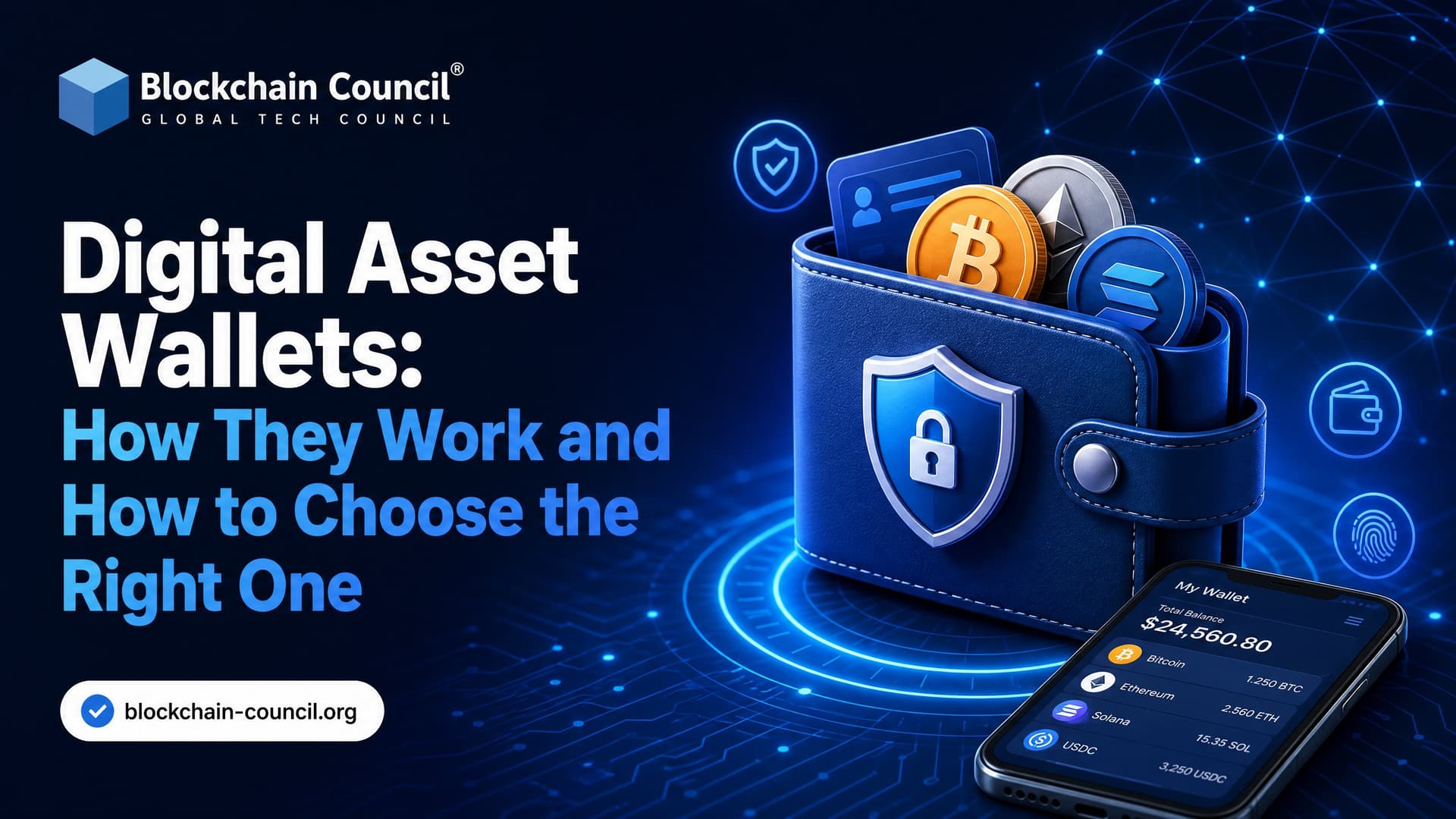
Digital asset wallets are the control layer for crypto, tokens, NFTs, and most Web3 applications. They do not store coins the way a physical wallet holds cash. They store, protect, and use the cryptographic keys that let you prove ownership and authorize activity on a blockchain ledger.
That distinction matters. If you lose the private key or recovery phrase for a non-custodial wallet, the blockchain will not reset your password. If someone else gets that key, they can move your assets. No support ticket reverses a valid on-chain transaction.

As blockchain adoption continues to grow across finance and enterprise applications, understanding wallet security, custody, and digital ownership has become an essential professional skill. A Certified Digital Assets Expert credential helps build practical knowledge of digital asset governance, wallet infrastructure, compliance, and risk management, enabling professionals to make informed decisions about securing blockchain-based assets.
What Is a Digital Asset Wallet?
A digital asset wallet is software, hardware, or a hosted service that manages the public and private keys linked to blockchain-based assets. You may hear it called a crypto wallet, coin wallet, Web3 wallet, or blockchain wallet.
The asset itself stays recorded on the blockchain. Your wallet reads that ledger, shows balances for your addresses, and creates signed transactions when you send assets or interact with smart contracts.
Common wallet formats include:
Mobile wallets for payments, transfers, and quick access.
Desktop wallets for users who prefer local software.
Browser extension wallets such as MetaMask for DeFi and dApps.
Hardware wallets for offline key storage and transaction signing.
Hosted or custodial wallets provided by exchanges, brokers, or institutional custodians.
A payment wallet such as Apple Pay or Google Wallet is a different design. It stores payment credentials and uses card tokenization for purchases. Some payment wallets now support crypto, but their core purpose is not the same as a non-custodial digital asset wallet.
How Digital Asset Wallets Work
Public Keys, Private Keys, and Addresses
Every digital asset wallet is built around key pairs. The public key, or a derived address, can be shared so others can send you assets. The private key must stay secret because it authorizes transactions from that address.
Many modern wallets use hierarchical deterministic key generation based on standards such as BIP-32 and BIP-39. In plain terms, a single recovery phrase can generate many accounts and addresses. That is convenient. It also means the recovery phrase is the master secret. Treat it that way.
A practical warning: beginners often copy an Ethereum address correctly but pick the wrong network in MetaMask. Ethereum mainnet uses chain ID 1. If you send assets on another EVM-compatible network, the address may look identical, but the assets live on a different chain. This is one of the quiet mistakes that causes panic during wallet training labs.
What Happens When You Send Assets?
When you send Bitcoin, ETH, a stablecoin, or an NFT, the wallet follows a clear sequence:
You enter the recipient address, amount, and network.
The wallet builds a transaction message.
The wallet signs that message with your private key.
The signed transaction is broadcast to blockchain nodes.
Validators or miners verify the transaction and include it in a block.
The private key is never broadcast. Only the cryptographic signature is shared. On Ethereum, the wallet also estimates gas. Since EIP-1559, Ethereum transactions commonly include fields such as maxFeePerGas and maxPriorityFeePerGas. If you underfund the account, tools such as Hardhat return the familiar error: insufficient funds for intrinsic transaction cost. It is not a mysterious wallet failure. It usually means the account lacks enough native gas token to pay network fees.
Custodial vs Non-Custodial Wallets
This is the most important choice you will make.
Non-Custodial Wallets
With a non-custodial wallet, you control the private keys. Examples include many browser, mobile, desktop, and hardware wallet setups. This model fits users who want direct control over assets, DeFi access, NFT management, and governance participation.
The trade-off is unforgiving. You are responsible for backups, phishing protection, device security, and recovery phrase storage. If you sign a malicious token approval, the wallet will not always save you.
Custodial Wallets
With a custodial wallet, a third party controls the keys on your behalf. Exchanges and regulated custodians use this model. For institutions, it can be the better option because it supports account recovery, compliance controls, audit trails, role-based approvals, and segregation of duties.
To be blunt, self-custody is not always the right answer. A corporate treasury should not depend on a single employee holding a seed phrase in a notebook. Institutional wallet design needs policy controls, multi-party approval, monitoring, and incident response.
Selecting the right wallet strategy also requires a broader understanding of cryptocurrency markets, blockchain transactions, custody models, exchange operations, and asset management practices. A Certified Cryptocurrency Expert credential equips professionals with the knowledge needed to evaluate different wallet solutions while understanding how they support secure cryptocurrency storage and day-to-day digital asset management.
Hot Wallets, Cold Wallets, and Hardware Wallets
Wallets are also grouped by connection model.
Hot wallets stay connected to the internet or get used frequently online. They suit daily transfers, DeFi, testing, and operational balances.
Cold wallets keep keys offline except during controlled signing. They are better for reserves and long-term holdings.
Hardware wallets store keys inside a physical device and sign transactions without exposing the private key to the computer or phone.
Use both if you hold meaningful value. Keep small working balances in a hot wallet. Store long-term holdings with a hardware wallet or an institutional cold storage process. Convenience and security pull in opposite directions. Pretending otherwise is how people lose funds.
Digital Asset Wallets in DeFi, NFTs, and Web3
Digital asset wallets are not just for sending coins. They are the login, signing, and permission layer for decentralized applications.
With the right wallet, you can:
Swap tokens on decentralized exchanges.
Lend or borrow through DeFi protocols.
Stake assets or take part in network validation where supported.
Mint, buy, sell, or transfer ERC-721 NFTs.
Vote in protocol governance using governance tokens.
Interact with smart contracts built for standards such as ERC-20 and ERC-721.
One detail that trips up new DeFi users is the ERC-20 approval flow. Before a dApp can move a token from your address, you often approve an allowance. Some interfaces request unlimited approval for convenience. That is risky. If the contract or front end is compromised, a large allowance can drain funds. Use limited approvals where possible and review old approvals regularly.
How to Choose the Right Digital Asset Wallet
1. Start With Your Use Case
Pick the wallet around the job, not the logo.
Beginner holding small amounts: a reputable mobile wallet or exchange-hosted wallet may be enough while you learn.
Active DeFi user: choose a non-custodial wallet with strong dApp support and hardware wallet compatibility.
Long-term investor: use a hardware wallet or cold storage process.
Developer: use wallets that work well with testnets, RPC endpoints, Hardhat, Foundry, and WalletConnect.
Enterprise or fund: look for custodial or multi-party computation infrastructure with approval workflows, audit logs, and policy controls.
2. Check Security and Recovery
Ask these questions before depositing funds:
Who controls the private keys?
Can the wallet connect to a hardware signer?
How is the recovery phrase generated and backed up?
Does the wallet warn clearly before smart contract signing?
Has the wallet provider published security audits or incident reports?
Never store a seed phrase in screenshots, cloud notes, email drafts, or messaging apps. Write it offline or use a dedicated backup method. For institutions, replace individual seed phrase handling with controlled key management systems and multi-approval policies.
3. Confirm Asset and Network Support
Not every wallet supports every blockchain. Some are Bitcoin-focused. Some are built for Ethereum and EVM-compatible chains. Others support Solana, Cosmos, Polkadot, or multi-chain portfolios.
If you use NFTs, confirm NFT display and transfer support. If you use stablecoins, check the exact network. USDC on Ethereum is not the same operationally as USDC on another chain, even when the token symbol looks identical.
4. Review Compliance Needs
Individuals may care most about control and privacy. Enterprises need more structure. A regulated business may need KYC, AML monitoring, transaction screening, reporting, approvals, and documented custody procedures.
This is where hosted custody, qualified custodians, or institutional wallet platforms can make sense. They reduce some self-custody risk but introduce counterparty risk. You need to assess both.
Modern wallet platforms also depend on expertise in cybersecurity, cloud infrastructure, APIs, enterprise systems, automation, analytics, and secure software development. A Tech Certification helps professionals strengthen these complementary technical skills, supporting the implementation, integration, and security of digital asset wallet infrastructure across enterprise environments.
5. Test With Small Amounts First
Send a small transaction before moving meaningful value. Verify the address, network, fee, and confirmation status. Do the same when using a new dApp. A two-dollar test transfer is cheap training.
The Future of Digital Asset Wallets
Digital asset wallets are moving toward broader identity and data functions. Payment wallets already combine cards, tickets, bank links, and sometimes crypto. Web3 wallets are adding clearer transaction previews, account abstraction features, social recovery patterns, and better support for multi-chain activity.
For developers, the wallet is becoming part of the application architecture. For enterprises, it is part of governance and risk management. For users, it is the control panel for ownership online.
If you want structured learning, Blockchain Council certifications can help you build the right foundation. Consider Certified Blockchain Expert™ for blockchain fundamentals, Certified Blockchain Developer™ for smart contract and dApp development, Certified Cryptocurrency Expert™ for crypto market and wallet concepts, and Certified DeFi Expert™ if your work involves lending protocols, token swaps, staking, or governance.
Final Takeaway
The right digital asset wallet is the one that matches your risk, custody needs, and actual workflow. Use hot wallets for activity, cold wallets for storage, and institutional custody when governance matters more than personal control. Before you add funds, practice recovery, send a test transaction, and learn exactly what you are signing.
As digital assets become more widely adopted, organizations must also communicate wallet security, custody practices, and blockchain technologies effectively to customers, business leaders, and regulators. A Marketing Certification helps professionals strengthen strategic communication and stakeholder engagement skills, making complex digital asset concepts easier to explain while supporting trust and broader adoption.
FAQs
1. What is a digital asset wallet?
A digital asset wallet is a software application or hardware device that enables users to securely manage cryptographic keys used to access, send, receive, and interact with blockchain-based assets. Wallets can support cryptocurrencies, NFTs, stablecoins, tokenized assets, and decentralized applications (dApps) across one or more blockchain networks.
2. How do digital asset wallets work?
Digital asset wallets generate and manage public and private cryptographic keys. The wallet does not typically store digital assets themselves; instead, it provides secure access to assets recorded on the blockchain by allowing users to authorize transactions with their private keys.
3. What is the difference between a public key and a private key?
A public key, or the wallet address derived from it, is used to receive digital assets and can generally be shared safely. A private key is confidential and authorizes transactions from the wallet. Protecting private keys is essential because anyone with access to them may be able to control the associated assets.
4. What are the main types of digital asset wallets?
The primary wallet categories include hot wallets, cold wallets, custodial wallets, and non-custodial wallets. Hot wallets remain connected to the internet for convenient access, while cold wallets store private keys offline. Custodial wallets are managed by third parties, whereas non-custodial wallets give users direct control over their private keys.
5. What is the difference between custodial and non-custodial wallets?
In a custodial wallet, a service provider manages the private keys on behalf of the user. In a non-custodial wallet, the user retains full control and responsibility for private keys and recovery phrases, offering greater independence but also greater responsibility for security.
6. What are hardware wallets?
Hardware wallets are dedicated physical devices that securely store private keys offline. They are commonly used for long-term storage because they reduce exposure to internet-based threats while allowing users to sign blockchain transactions securely.
7. What are software wallets?
Software wallets include mobile apps, desktop applications, browser extensions, and web-based wallets. They provide convenient access to digital assets and often integrate with decentralized finance (DeFi) platforms, NFT marketplaces, and blockchain applications.
8. What is a wallet address?
A wallet address is a unique identifier derived from a user's public key that allows others to send digital assets to the wallet. Different blockchain networks use different address formats, making it important to verify compatibility before initiating transfers.
9. What is a recovery phrase?
A recovery phrase, often consisting of 12 or 24 words, is a backup that allows users to restore access to a compatible wallet if the original device is lost, damaged, or replaced. Recovery phrases should be stored securely offline and never shared with anyone.
10. How do digital wallets interact with blockchains?
Wallets communicate with blockchain networks by creating, signing, and broadcasting transactions. Once a transaction is digitally signed with the private key, blockchain validators or miners verify it according to the network's consensus mechanism before it is recorded on the blockchain.
11. Can one wallet support multiple blockchains?
Many modern wallets support multiple blockchain networks and a wide variety of digital assets from a single interface. However, supported assets and features vary by wallet provider, so users should verify compatibility before transferring assets.
12. How does AI improve digital asset wallets?
Artificial intelligence can assist with fraud detection, phishing prevention, transaction risk analysis, behavioral monitoring, customer support, wallet analytics, and security alerts. AI should complement established cybersecurity practices and human oversight rather than replace them.
13. What security features should a digital asset wallet offer?
Important security features include encryption, biometric authentication where available, multi-factor authentication for supported services, secure backup and recovery options, hardware wallet compatibility, transaction confirmation protections, and regular software updates. The availability of these features depends on the wallet type.
14. What are the risks of using digital asset wallets?
Potential risks include phishing attacks, malware, device theft, compromised recovery phrases, software vulnerabilities, human error, fake wallet applications, and unauthorized access. Following security best practices can help reduce, but not eliminate, these risks.
15. How do you choose the right digital asset wallet?
The right wallet depends on your intended use, supported blockchain networks, security requirements, transaction frequency, ease of use, backup options, compatibility with decentralized applications, and whether you prefer self-custody or third-party custody. There is no single wallet that is best for every user.
16. How do regulations affect digital wallet providers?
Depending on the jurisdiction, custodial wallet providers may be subject to regulations covering anti-money laundering (AML), know-your-customer (KYC) requirements, cybersecurity, consumer protection, operational resilience, and financial services licensing. Regulatory obligations vary by country and business model.
17. What trends are shaping digital asset wallets in 2025-2026?
Key trends include account abstraction, AI-powered security monitoring, multi-party computation (MPC) wallets, decentralized identity integration, cross-chain compatibility, biometric authentication, smart wallet functionality, and enhanced institutional custody solutions.
18. What are best practices for using a digital asset wallet?
Best practices include safeguarding recovery phrases offline, keeping wallet software updated, enabling available security features, verifying wallet addresses before transactions, using trusted wallet providers, avoiding suspicious links, and reviewing transaction details carefully before approval.
19. What should beginners know before using a wallet?
Beginners should understand that controlling a private key means accepting responsibility for securing digital assets. Learning how blockchain transactions work, practicing with small transfers, maintaining secure backups, and recognizing common scams can help reduce avoidable mistakes. This information is educational and should not be interpreted as financial, legal, or cybersecurity advice.
20. What is the future of digital asset wallets?
Digital asset wallets are expected to become more secure, interoperable, and user-friendly as blockchain technology, AI-powered security, decentralized identity, account abstraction, and regulatory frameworks continue to evolve. Future wallets may simplify asset management while supporting a growing range of tokenized assets, Web3 applications, and cross-chain interactions. The wallet of tomorrow may feel effortless to use, but remembering your recovery phrase will probably remain a timeless test of human organization.
Related Articles
View All
Digital Assets
Tokenized Asset Custody: How Wallets, Trustees, and Institutional Custodians Work
Learn how tokenized asset custody combines wallets, trustees, qualified custodians, key management, and compliance for institutional and retail RWA holders.

Digital Assets
How Asset Tokenization Creates Verifiable Digital Ownership
Asset tokenization turns rights to real world and financial assets into blockchain tokens, giving authorized parties a verifiable record of ownership, provenance, and compliance.
Digital Assets
CBDC Certification Guide: How to Choose the Right Program
A practical CBDC certification guide for policy, engineering, payments, compliance, and strategy professionals choosing the right program in 2026.
Trending Articles
The Role of Blockchain in Ethical AI Development
How blockchain technology is being used to promote transparency and accountability in artificial intelligence systems.
AWS Career Roadmap
A step-by-step guide to building a successful career in Amazon Web Services cloud computing.
How Blockchain Secures AI Data
Understand how blockchain technology is being applied to protect the integrity and security of AI training data.