

CBDC Security Explained: Protecting Digital Currency Against Attacks
 Suyash Raizada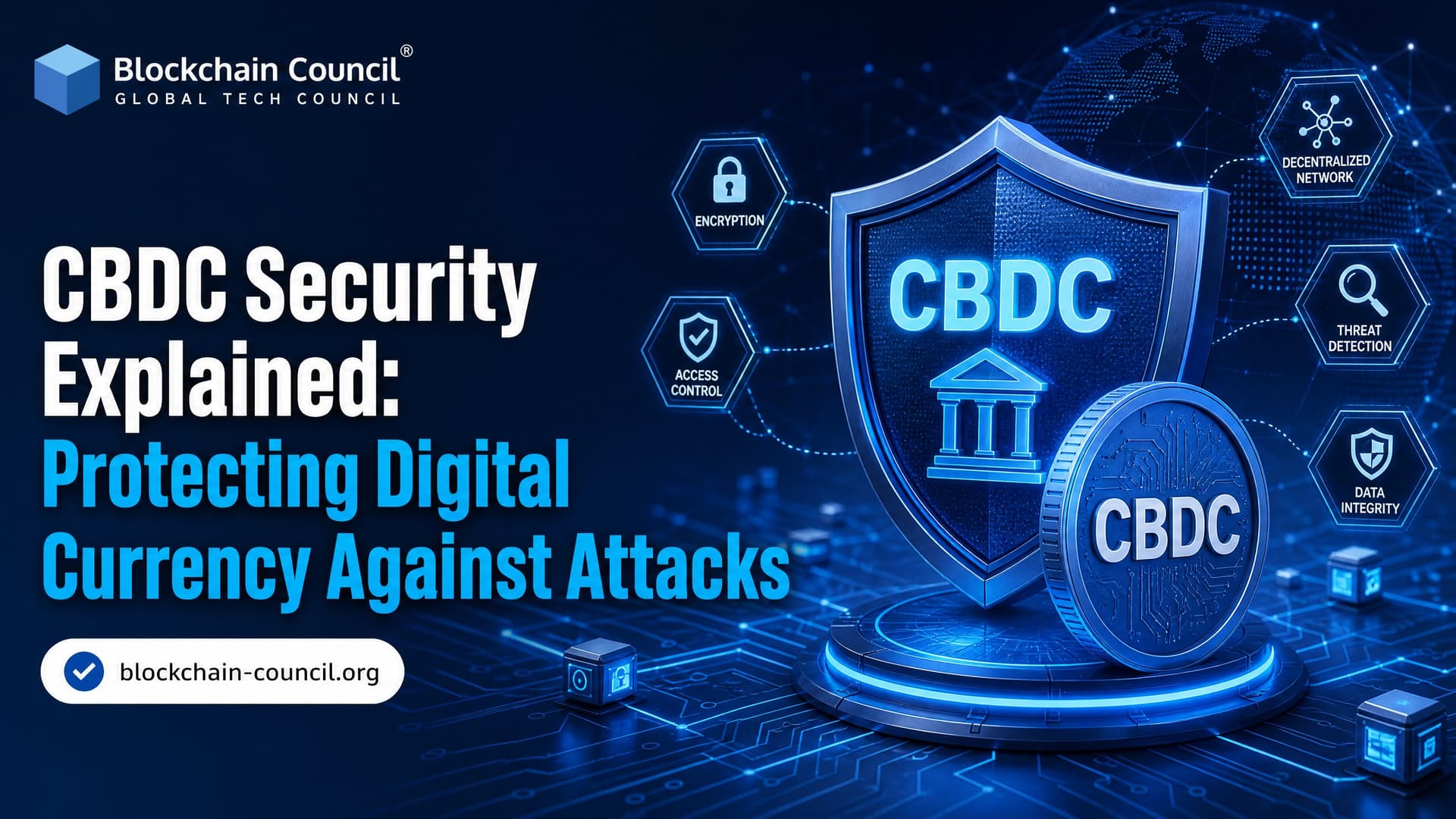
CBDC security is the set of technical, operational, legal, and governance controls that protect a central bank digital currency from fraud, cyberattacks, privacy abuse, and systemic failure. Treat it like critical national infrastructure, not like another mobile payment app. If a CBDC ledger, wallet network, or issuance server fails, public trust in money itself can take a hit. Anyone working toward that level of trust benefits from a grounded understanding of sovereign digital money first, which is exactly what the Certified Central Bank Digital Currency (CBDC) Expert credential is designed to provide.
Central banks, the Bank for International Settlements, the International Monetary Fund, and data protection authorities now treat CBDC security as a core design issue. The hard part is not only stopping hackers. A secure CBDC has to prevent double spending, protect user data, stay available under stress, meet AML and CFT obligations, recover after incidents, and still be usable by ordinary people.

What Makes CBDC Security Different?
A CBDC is central bank issued digital money. That alone changes the risk profile. A breach in a normal payment app can harm users and merchants. A breach in a CBDC system could hit monetary trust, payment continuity, and national security. Since CBDC security increasingly overlaps with the protection of tokenized deposits, stablecoins, and other digital instruments, many professionals build out their range with the Certified Digital Assets Expert program, which frames these different asset types within one coherent risk picture.
CBDCs inherit the usual payment security goals:
Prevent counterfeiting and unauthorized creation of money.
Stop double spending and replayed transactions.
Protect ledger integrity.
Keep payment services available during stress.
Protect sensitive identity and transaction data.
Support fraud controls, AML, CFT, and consumer protection.
They also bring new problems. Retail CBDCs may collect payment data at national scale. Offline payments create synchronization risks. Programmable features can introduce software bugs that move value automatically. And a central bank has to plan for nation state attackers, not just criminal phishing campaigns.
Main CBDC Security Threats
1. Attacks on Core Issuance and Ledger Infrastructure
The core CBDC system handles issuance, redemption, settlement, and ledger updates. If an attacker compromises these systems, the fallout can be severe: unauthorized minting, manipulated balances, disrupted redemption, or inconsistent transaction histories.
This is why BIS and IMF guidance keeps returning to cyber resilience, ledger integrity, segregation of critical functions, and tested recovery procedures. The issuance function should not sit in the same trust zone as customer wallet services. That sounds obvious. In architecture reviews, it is often the first place weak designs show up.
2. Privacy Breaches and Data Misuse
CBDC privacy is not a side topic. It is central to adoption. A retail CBDC could create a highly detailed record of where people spend, when, and with whom. If all of that sits in one central database, it becomes a prime target.
European data protection authorities have warned that concentrating citizens' payment data raises the risk of unlawful access, denial of service, and broad surveillance. The IMF has stressed privacy by design, data minimization, and clear governance over who can access CBDC transaction records.
A defensible CBDC design should separate identity data from transaction data where possible, log every privileged access request, and limit retention. Do not collect data because it might be useful later. That habit ages badly.
3. Wallet, Endpoint, and Credential Attacks
User wallets are usually the softest target. Malware, phishing, SIM swap attacks, fake wallet apps, and stolen recovery credentials all cause direct loss. If intermediaries such as banks or payment service providers run wallets, their controls become part of the CBDC security perimeter.
Key custody is especially tricky. Users dislike complicated recovery flows, but weak recovery creates account takeover risk. Hardware security modules, secure elements on mobile devices, and tamper resistant cards help, but they do not remove the need for clear operating procedures.
A practical detail: offline wallet designs often fail in boring ways. The test case that catches teams is not the first payment. It is the same signed offline payload submitted twice after reconnect, especially when the signature is not bound to a wallet identifier, a currency identifier, a monotonic counter, and an expiry window. Replay protection has to be designed in from the start.
4. Denial of Service and Availability Attacks
Availability matters because money must move. If a CBDC becomes a widely used retail or wholesale payment rail, prolonged downtime could hurt commerce, emergency payments, and confidence in the central bank.
Large distributed denial of service attacks against central infrastructure or key intermediaries are a realistic scenario. So are failures caused by software defects, cloud outages, network splits, and power disruptions. A CBDC platform needs redundancy, failover, backup processing, and tested disaster recovery. Not a PDF plan. Tested recovery.
5. Insider and Governance Risks
Privileged access is dangerous. A malicious insider, a coerced administrator, or a poorly monitored vendor can bypass many external defenses. CBDC operations need least privilege, segregation of duties, dual control for sensitive actions, tamper evident audit logs, and fast privilege revocation.
Governance failure is also a security failure. If no one can explain who is allowed to freeze funds, view identity linked transaction data, rotate keys, or approve emergency changes, the system is not ready for production.
6. Quantum Threats to Cryptography
Most digital asset systems today lean heavily on elliptic curve cryptography for signatures. The IMF and the World Economic Forum have both flagged quantum computing as a future risk to these schemes. A sufficiently powerful quantum computer could threaten exposed public key systems.
This does not mean CBDCs should wait for perfect post-quantum standards before pilot work. It does mean architects need crypto agility: the ability to swap algorithms, rotate keys, support hybrid schemes, and avoid hard-coding cryptographic assumptions into every wallet and interface.
How Secure CBDC Architecture Works
Centralized, DLT Based, Account Based, or Token Based?
There is no single CBDC architecture. Central banks compare account based and token based models, centralized ledgers and distributed ledger technology, direct central bank access and intermediary based models.
My view: DLT is not automatically better for CBDC security. It can help with auditability and shared settlement between authorized parties, especially in wholesale use cases. For a retail CBDC, a permissioned DLT may add operational complexity without solving the hardest problems: endpoint security, privacy governance, identity, and resilience. Choose it only when the trust model actually needs it.
Key Security Controls
A high assurance CBDC security architecture should include:
Segmentation: Separate issuance, ledger processing, analytics, wallet APIs, and administrative systems.
Strong key management: Use hardware security modules for root and signing keys, formal key rotation, and strict ceremony controls.
Multi-factor authentication: Apply it to operators, intermediaries, and high risk user actions.
Least privilege: Give every service and administrator only the access needed for the task.
Continuous monitoring: Detect anomalous transactions, privilege misuse, API abuse, and infrastructure compromise.
Resilience testing: Run penetration tests, red team exercises, failover drills, and disaster recovery tests.
Privacy controls: Minimize data collection, separate identifiers, encrypt sensitive records, and audit access.
Crypto agility: Prepare for post-quantum migration without breaking interoperability.
Security teams working this close to segmentation, key management, and continuous monitoring often support that work with a broader Tech Certification, since these controls draw on general secure infrastructure and systems engineering practice as much as CBDC-specific knowledge.
Privacy Versus Compliance: The Design Tension
Retail CBDCs usually have to support AML, sanctions screening, and lawful investigations. At the same time, they should not become surveillance systems. That tension is real.
Good designs use tiered access. Low value wallets may have simplified identity checks and transaction limits. Higher value wallets may require stronger KYC. Operational staff should not see personal transaction histories by default. Law enforcement access should require legal authorization, and every request should leave an audit trail.
Privacy enhancing technologies can help. Pseudonymization, selective disclosure, zero knowledge proof based compliance checks, and separate data stores all reduce unnecessary exposure. But privacy technology does not fix bad governance. If the access rules are vague, the math will not save you.
Offline CBDC Security
Offline payments are attractive because they support resilience, inclusion, and payments during connectivity failures. They are also hard to secure.
An offline CBDC wallet has to handle:
Double spending attempts while disconnected.
Counterfeit offline tokens.
Lost or stolen devices.
Secure balance limits.
Synchronization back to the main ledger.
Dispute handling when devices disagree.
Most realistic offline designs use transaction limits, secure hardware, short validity windows, and risk based reconciliation. Unlimited offline value is a bad idea. Cash can do that because it is physical. Digital tokens need stricter guardrails.
What Developers and Security Professionals Should Learn
If you work near CBDC infrastructure, you need more than blockchain vocabulary. You need payment security, cryptography, privacy engineering, incident response, and regulatory awareness.
Focus on these skills:
Understand digital signature schemes, key lifecycle management, and hardware security modules.
Study threat modeling for payment systems, including replay, double spending, and privileged access misuse.
Learn secure API design for wallet providers and payment interfaces.
Build familiarity with AML, KYC, sanctions, and data protection requirements.
Practice incident response for high availability financial systems.
Track post-quantum cryptography standards from NIST and related standards bodies.
For structured learning, you can explore pathways such as Certified Blockchain Expert™ for blockchain fundamentals and Certified Blockchain Developer™ for implementation focused skills. If you work on risk, audits, or secure architecture, pair those with Blockchain Council cybersecurity resources, because CBDC security sits across both disciplines.
Future of CBDC Security
Expect CBDC security to move in five directions over the next few years.
More privacy preserving design: Central banks will need stronger proof that retail CBDCs do not expose unnecessary personal data.
Post-quantum planning: New systems will increasingly require migration paths for quantum resistant cryptography.
AI assisted monitoring: Operators will use anomaly detection for cyber and fraud signals, with strict controls to avoid privacy abuse.
Cross border coordination: CBDCs used across jurisdictions will need shared standards for identity, incident response, data access, and cryptography.
Critical infrastructure oversight: Production CBDCs will be treated like national payment infrastructure, with continuous testing and direct regulatory supervision.
Conclusion: Build CBDC Security Before Scale
CBDC security is not a feature you bolt on after a pilot succeeds. It is the condition for public trust. A secure design must protect issuance systems, wallets, ledgers, identity data, cryptographic keys, offline payments, and third party providers. It also has to survive legal scrutiny and real incidents.
If you are preparing for work in CBDC, digital assets, or payment security, start with the fundamentals: threat modeling, cryptography, secure architecture, and privacy engineering. Then build a small wallet or ledger prototype and attack it yourself. For a guided route, begin with the Certified Blockchain Expert™ and move into developer or cybersecurity training based on your role. If part of your responsibility also involves explaining these controls to boards, regulators, or the public, a Marketing Certification can help you translate dense security decisions into language a non-technical audience will actually trust.
FAQs
1. What is CBDC security and why is it important?
CBDC security refers to the technologies, policies, controls, and operational practices used to protect Central Bank Digital Currency systems from fraud, cyberattacks, unauthorized access, data theft, and disruption. Because a CBDC could become critical national payment infrastructure, security failures could affect consumers, businesses, banks, and governments simultaneously. Effective protection therefore needs to cover the central platform, intermediaries, digital wallets, identity systems, APIs, networks, and end-user devices.
2. What are the biggest security threats to CBDCs?
Major CBDC security threats include phishing, malware, credential theft, account takeover, wallet compromise, ransomware, distributed denial-of-service attacks, API exploitation, insider threats, supply-chain attacks, and fraud. Offline payments can introduce additional risks such as double spending and device manipulation. Nation-state attacks may also be relevant for systemically important infrastructure. Security strategies must therefore address both ordinary financial crime and sophisticated attacks against the broader monetary and payment ecosystem.
3. Can hackers steal CBDC funds?
Potentially. Attackers could attempt to steal CBDC funds by compromising wallets, authentication credentials, cryptographic keys, user devices, or intermediary systems. Even if the core CBDC ledger remains secure, weak endpoints can create opportunities for theft. Strong authentication, secure key storage, device binding, transaction monitoring, encryption, and risk-based controls can reduce these risks. Protecting the central ledger while leaving millions of consumer wallets vulnerable would be a rather incomplete interpretation of cybersecurity.
4. How are CBDC digital wallets protected?
CBDC wallets can use PINs, multi-factor authentication, biometrics, device binding, encryption, hardware-backed key storage, transaction limits, and behavioral risk monitoring. Wallet applications should also use secure software-development practices and receive regular security updates. Recovery procedures are equally important because users will inevitably lose phones and credentials. Recovery mechanisms must verify legitimate ownership without creating an easier attack route than the normal authentication process.
5. How does encryption protect a CBDC?
Encryption helps protect CBDC information while it is stored and transmitted. Cryptographic techniques can also provide digital signatures, authentication, transaction integrity, and secure communication between system participants. Effective encryption requires secure key generation, storage, rotation, backup, and revocation. Cryptography is therefore only one part of CBDC security. An exquisitely encrypted system can still be compromised if attackers steal administrator credentials or persuade users to authorize fraudulent transactions.
6. How does multi-factor authentication improve CBDC security?
Multi-factor authentication requires users to provide more than one type of verification before accessing a wallet or approving certain transactions. This might combine a password or PIN with a registered device, biometric factor, or security credential. MFA makes stolen passwords less useful to attackers. Risk-based authentication could require stronger verification for unusual or high-value transactions while keeping routine payments convenient, because requiring ceremonial levels of authentication for every cup of coffee would not exactly encourage adoption.
7. How can CBDCs prevent account takeover attacks?
CBDC systems can reduce account takeover through strong authentication, device recognition, behavioral monitoring, login alerts, transaction limits, and secure recovery procedures. Systems can detect unusual events such as access from a new device followed by an unusually large transfer. High-risk activity may trigger additional verification. Providers should also protect against credential stuffing, SIM swapping, phishing, and social engineering, which frequently target users rather than exploiting the underlying CBDC infrastructure.
8. How can CBDC systems protect against phishing and scams?
CBDC providers can use verified applications, authenticated communications, transaction warnings, anti-phishing controls, secure login procedures, and public education. Users should have straightforward ways to verify official wallet applications and report suspicious messages or websites. Fraud monitoring can also identify unusual transfers following account compromise. This becomes especially important during CBDC launches, when criminals can exploit public uncertainty by creating fake wallets, support services, investment schemes, or government communications.
9. How can central banks secure CBDC infrastructure?
Central banks can use defense-in-depth security combining network segmentation, least-privilege access, strong authentication, encryption, privileged-access management, secure software development, vulnerability management, continuous monitoring, and incident response. Critical systems should have redundancy, backups, disaster recovery, and carefully controlled administrative access. Independent penetration testing and red-team exercises can identify weaknesses. Security should be continuously reassessed rather than treated as a certification exercise completed shortly before launch.
10. What is zero-trust security in a CBDC system?
Zero-trust security assumes that no user, device, application, or network connection should automatically be trusted based solely on its location. Each access request should be authenticated and authorized according to risk and policy. CBDC systems can apply zero-trust principles through least-privilege permissions, network segmentation, device verification, continuous monitoring, and strong identity controls. This can limit attackers' ability to move through the environment after compromising one account or system.
11. How can CBDCs defend against DDoS and service outages?
CBDC infrastructure can reduce distributed denial-of-service risks through traffic filtering, rate limiting, redundant systems, geographic distribution, scalable capacity, and specialized DDoS defenses. Failover mechanisms should allow essential services to continue when individual components become unavailable. Offline payment functionality may provide additional resilience in some circumstances. Because payment availability can become economically critical, CBDC security must focus not only on preventing theft but also on keeping legitimate transactions functioning.
12. How can CBDCs protect against insider threats?
Insider threats can involve malicious employees, compromised administrators, contractors, or accidental misuse of privileged access. Controls can include least-privilege permissions, segregation of duties, privileged-access management, multi-person approval for sensitive actions, monitoring, and tamper-resistant audit logs. Organizations should also manage employee lifecycle access carefully. Critical monetary infrastructure should not depend on one administrator having both extraordinary privileges and an exceptionally good week.
13. How can CBDCs secure APIs and third-party integrations?
APIs connecting central banks, commercial banks, wallet providers, merchants, identity services, and government platforms can become important attack surfaces. Security measures include strong authentication, authorization, encryption, input validation, rate limiting, API gateways, logging, and continuous vulnerability testing. Third-party access should follow least-privilege principles. Providers should also maintain clear versioning and patching processes so outdated integrations do not quietly become permanent vulnerabilities.
14. What security risks are associated with offline CBDC payments?
Offline CBDCs can face double spending, device tampering, credential cloning, counterfeit-value attempts, stolen devices, and delayed fraud detection. Because transactions may occur without immediate access to central infrastructure, some controls must operate locally. Secure hardware, cryptographic protocols, transaction and balance limits, device integrity checks, and later synchronization can reduce risk. Designers must balance these safeguards against usability and financial inclusion, since offline functionality exists specifically for situations where normal connectivity cannot be assumed.
15. How can CBDCs prevent double spending?
Online CBDC systems can maintain an authoritative transaction state that verifies digital value has not already been spent before approving another transaction. Offline payments are more complicated because devices cannot always check central records immediately. Secure hardware, cryptographic protocols, transaction counters, spending limits, and later reconciliation may help control this risk. No offline system is automatically risk-free, so limits can restrict potential losses if preventative mechanisms fail.
16. How can AI improve CBDC security?
Artificial intelligence and machine learning can support fraud detection, behavioral analytics, anomaly detection, threat monitoring, and prioritization of security alerts. Models may identify unusual transaction networks, compromised accounts, or changes in user behavior more quickly than fixed rules alone. However, AI systems can generate false positives and may themselves face adversarial manipulation. Effective use requires model validation, monitoring, explainability where appropriate, strong data governance, and human oversight for consequential decisions.
17. How can CBDCs be protected against future quantum computing threats?
Large-scale quantum computing could eventually threaten some cryptographic algorithms used in today's financial systems. CBDCs can prepare through cryptographic agility, allowing algorithms and keys to be replaced without rebuilding the entire infrastructure. Central banks can inventory cryptographic dependencies and plan migration toward appropriate post-quantum cryptography as standards and threats evolve. Long-lived systems benefit from designing upgradeability early rather than discovering later that the cryptographic foundation has become technologically antique.
18. What should happen if a CBDC system is successfully attacked?
CBDC operators need incident-response plans covering detection, containment, investigation, recovery, communication, and regulatory reporting. Depending on the incident, compromised credentials or keys may need to be revoked, affected services isolated, and backup systems activated. Central banks should coordinate with intermediaries, cybersecurity agencies, technology providers, and law enforcement where appropriate. Regular simulations and recovery exercises are important because an emergency plan that has never been tested is largely a document expressing optimism.
19. How can CBDC systems remain resilient during a major cyberattack?
Resilience requires redundant infrastructure, geographic distribution, backups, network diversity, failover capabilities, disaster recovery, operational continuity plans, and carefully designed offline functionality where appropriate. Operators should identify dependencies on telecommunications, electricity, cloud providers, identity platforms, and other critical services. Recovery-time and recovery-point objectives should reflect the CBDC's economic importance. A resilient system assumes some controls will eventually fail and ensures those failures do not become catastrophic.
20. What is the best approach to securing a CBDC?
The strongest approach is layered security across the entire CBDC lifecycle and ecosystem. Central banks should combine secure architecture, encryption, zero-trust principles, strong authentication, wallet security, fraud monitoring, API protection, supply-chain security, operational resilience, and tested incident response. Privacy and security should be designed into the system rather than bolted on afterward. No CBDC can be guaranteed completely attack-proof, so effective security must focus equally on prevention, rapid detection, containment, recovery, and continuous improvement.
Related Articles
View All
Digital Assets
CBDC for Remittances: How Digital Currency Could Lower Cross-Border Costs
CBDC for remittances could cut cross-border costs by reducing intermediaries, FX spreads, settlement delays, and cash handling, if systems interoperate.

Digital Assets
CBDC vs UPI: Digital Currency Is Not an Instant Payment Rail
CBDC vs UPI explained: CBDC is central bank digital money, while UPI is an instant rail that moves bank deposits. Learn how they differ.

Digital Assets
CBDC Career Roadmap: From Beginner to Digital Currency Specialist
A practical CBDC career roadmap covering skills, roles, certifications, and learning stages from blockchain basics to digital currency specialist work.
Trending Articles
The Role of Blockchain in Ethical AI Development
How blockchain technology is being used to promote transparency and accountability in artificial intelligence systems.
Claude AI Tools for Productivity
Discover Claude AI tools for productivity to streamline tasks, manage workflows, and improve efficiency.
Blockchain in Supply Chain Provenance Tracking
Supply chains are under pressure to prove not just efficiency, but also authenticity, sustainability, and fairness. Customers want to know if their coffee really is fair trade, if the diamonds are con