

CBDC Technology: Blockchain, DLT, and Centralized Systems Explained
 Suyash Raizada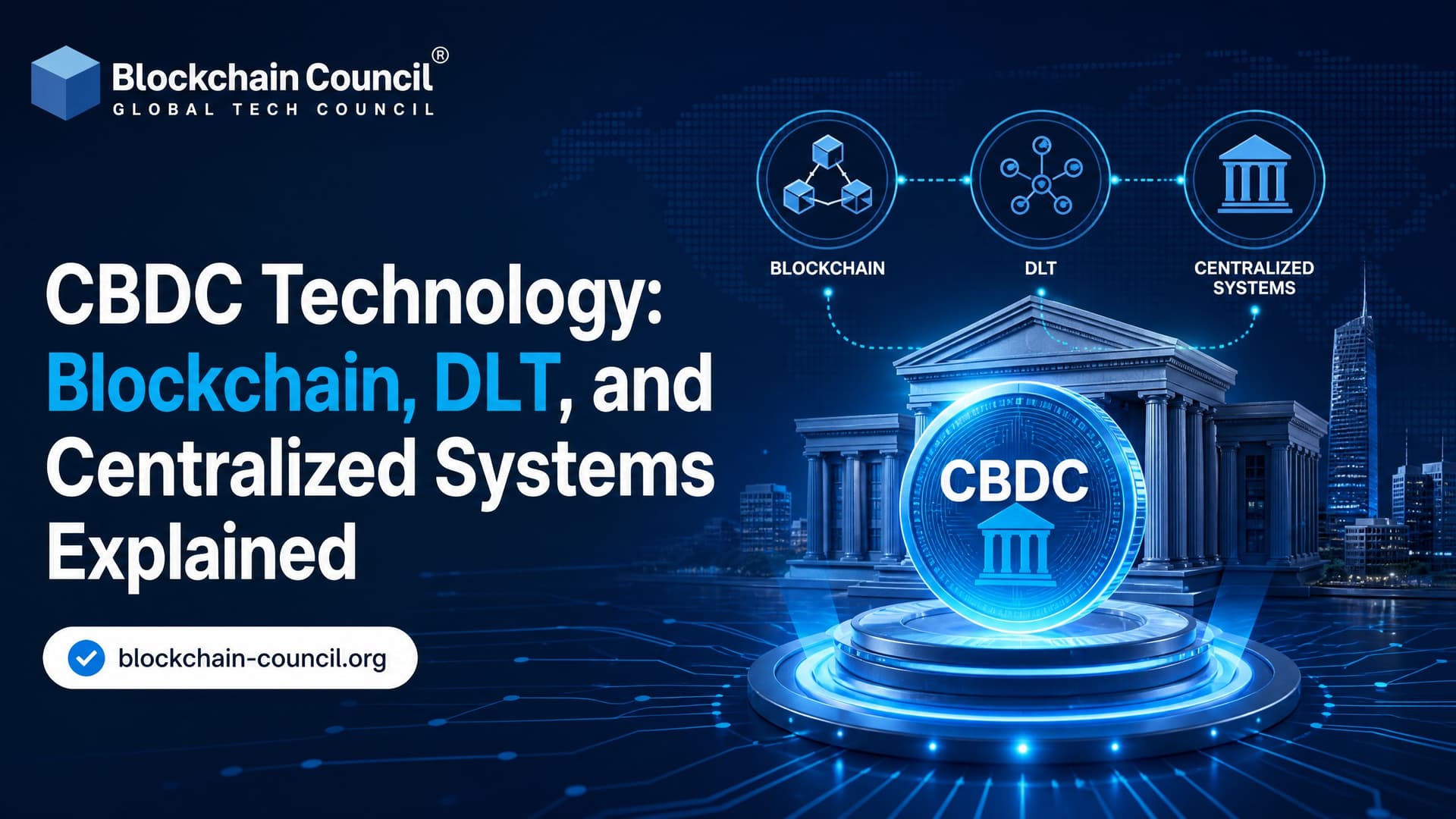
CBDC technology is not one single stack. Central banks are testing three main models: centralized database systems, permissioned distributed ledger technology, and hybrid architectures that combine both. The practical answer is blunt. Most real CBDC designs are not public blockchains. They are tightly governed payment systems built for legal tender, settlement finality, privacy controls, and regulatory oversight. Anyone trying to make sense of these architecture choices in a structured way often starts with a Certified Central Bank Digital Currency (CBDC) Expert credential, which frames ledger models, governance, and settlement design within a formal CBDC context.
A central bank digital currency is digital public money issued as a direct liability of a central bank. The World Bank describes CBDC as central bank money that may be recorded on either centralized or decentralized ledgers, with convertibility into cash and commercial bank money as a core design feature. That definition matters because the ledger technology is only one part of the system. The harder decisions sit around access, governance, identity, privacy, and who is allowed to validate transactions.

What Technology Is Used for CBDCs?
CBDCs usually use one of three technology models:
Centralized ledger systems, where a central bank or appointed operator controls the main transaction database.
Permissioned DLT or blockchain, where known institutions validate transactions under strict rules.
Hybrid architectures, where issuance and redemption sit on a centralized core while other functions use DLT, tokenization, or API-based integrations.
The common pattern is a two-tier architecture. The central bank issues and redeems CBDC at the core. Commercial banks, payment service providers, and other regulated intermediaries handle customer access, wallets, onboarding, and support. This mirrors how much of today's money system already works, which is one reason policymakers keep returning to it. Professionals weighing CBDC technology choices against stablecoins, tokenized deposits, and other digital asset infrastructure often pair this with a Certified Digital Assets Expert credential, since these architecture decisions rarely get made without reference to the broader digital asset landscape a CBDC has to interoperate with.
Centralized Ledger Systems for CBDCs
In a centralized CBDC design, transactions are recorded in a conventional database controlled by one authoritative operator. That operator may run replicated infrastructure across several data centers, but validation authority stays centralized.
This is not old-fashioned by default. For a national retail payment system, a well-engineered centralized ledger can be faster, simpler to audit, and easier to connect to existing banking rails than a distributed ledger. The Bank for International Settlements has noted that retail CBDC infrastructure can be built on conventional centrally controlled databases or on DLT, depending on the policy and operational goals.
Why central banks may prefer centralized systems
Performance: Retail CBDCs may need to process very high transaction volumes with low latency. Centralized systems are usually easier to tune for this.
Clear control: Issuance, redemption, monetary limits, and compliance processes stay under direct central bank authority.
Simpler governance: Fewer validator disputes, fewer node coordination problems, and fewer protocol upgrade headaches.
Compatibility: Existing core banking systems, RTGS platforms, AML controls, and reporting tools are easier to integrate.
The Reserve Bank of India has publicly favored centrally controlled database infrastructure for its digital rupee work, citing concerns around DLT limitations for core issuance and settlement. That is a serious signal. If your first design goal is national-scale retail payments, a centralized database is often the safer technical choice.
Permissioned DLT and Blockchain in CBDCs
DLT stores records across multiple nodes. In CBDC systems, this almost always means permissioned DLT, not an open public chain like Ethereum mainnet. Validator nodes are operated by known entities such as central banks, commercial banks, clearing institutions, or approved payment operators.
The distinction is critical. Public blockchains use open participation and economic incentives. CBDCs require accountable operators, legal finality, compliance controls, and predictable governance. A central bank cannot have settlement depend on probabilistic block confirmations or a chain reorganization.
What a CBDC-grade DLT needs
Immediate finality: Once a CBDC payment settles, it should not be reversed by consensus mechanics.
Byzantine fault tolerance: The network must keep working even if some validators fail or behave incorrectly.
Permissioned identity: Validators and intermediaries must be known, authenticated, and governed by legal agreements.
Privacy controls: Transaction data cannot be visible to every participant in the same way it often is on public chains.
Smart contract support: Useful for conditional payments, delivery versus payment, payment versus payment, and tokenized asset settlement.
From a builder's perspective, permissioned DLT brings real friction. On Hyperledger Fabric v2.x, for example, the chaincode lifecycle requires packaging, installing, approving for each organization, and committing before use. Miss one organization's approval and you will hit an endorsement policy failure, because the signature set did not satisfy policy. That is not a theoretical governance issue. It is the day-to-day reality of multi-party infrastructure.
DLT is strongest when several institutions need to coordinate around the same asset or payment state without giving one commercial party unilateral control. It is weaker when the only goal is raw throughput for millions of small consumer payments.
Hybrid CBDC Architectures
Hybrid CBDC architecture is where most serious designs appear to be heading. The core monetary ledger may stay centralized, while DLT handles specific layers such as wholesale settlement, tokenized securities, cross-border corridors, or programmable payment workflows.
A hybrid model may look like this:
The central bank operates the master issuance and redemption ledger.
Commercial banks distribute CBDC to users through wallets or accounts.
A permissioned DLT network supports tokenized settlement among regulated participants.
APIs connect CBDC services to payment systems, identity systems, and government platforms.
This modular approach avoids a false choice between blockchain and databases. Use a centralized core where legal control and performance matter most. Use DLT where shared validation, programmable settlement, or cross-institution coordination gives a real benefit.
Fnality in the UK is a useful reference point. Its model uses an omnibus account at the central bank along with tokenized settlement logic for payment versus payment and delivery versus payment use cases. That shows how central bank money and tokenized infrastructure can work together without pretending the entire system must be decentralized.
Account-Based, Token-Based, and Hybrid Access Models
The ledger is only half the story. CBDC technology also depends on how users access and hold the digital currency.
Account-based CBDC
In an account-based model, users hold CBDC through accounts maintained by the central bank or regulated intermediaries. Transactions update account balances. This feels familiar because it resembles bank deposits and mobile money systems.
Account-based systems fit compliance-heavy environments. They are easier to connect to identity checks, fraud monitoring, and consumer protection processes. The trade-off is that they may feel less cash-like.
Token-based CBDC
In a token-based model, users hold digital tokens representing central bank liabilities. Access may depend more on cryptographic keys than on traditional account records. This model comes up often for cash-like transfers, offline payments, and peer-to-peer use.
Do not assume token-based always means blockchain. Tokens can exist in centralized systems too. Likewise, an account-style intermediary layer can sit above a DLT settlement layer. Most practical proposals mix these patterns.
Hybrid access
Many CBDC proposals use account-based infrastructure for intermediaries and token-style instruments for end users. Recent CBDC research often points to a two-tier, token-based, DLT-supported model as the most common exploratory design, but that does not make it the only correct answer.
Retail CBDC vs Wholesale CBDC Technology
Retail and wholesale CBDCs have different technical needs.
Retail CBDC
Retail CBDC is for the public. It must support high transaction volumes, strong uptime, consumer protection, and privacy. A retail CBDC may use a centralized database, a permissioned DLT, or a hybrid model.
For mass-market payments, I would not start with DLT unless there is a clear reason. Offline support, wallet recovery, fraud handling, and privacy controls are hard enough on their own. Adding validator governance too early can slow delivery.
Wholesale CBDC
Wholesale CBDC is for banks, financial market infrastructures, and high-value settlement. This is where DLT makes more sense. Multi-party settlement, tokenized bonds, foreign exchange payment versus payment, and delivery versus payment all benefit from shared state and programmable workflows.
Wholesale pilots often focus less on consumer wallets and more on settlement finality, liquidity savings, interoperability, and the legal treatment of tokenized central bank money.
Privacy, Security, and Governance Trade-Offs
The European Data Protection Supervisor has warned that the level of centralization in CBDC transaction management affects data protection, oversight, and accountability. Centralized systems concentrate control and data responsibility. DLT distributes operational roles, but it can make data minimization and access control more complex.
Good CBDC design needs:
Role-based access so intermediaries see only what they need.
Cryptographic controls for transaction integrity and wallet security.
Auditability without mass public exposure of transaction history.
Operational resilience across data centers, validators, or payment service providers.
Clear upgrade governance, because money systems cannot rely on informal protocol changes.
Programmability also needs restraint. A CBDC that supports conditional settlement for securities can be useful. A retail CBDC where every payment is heavily programmable by default may create policy, privacy, and usability problems. Not every payment needs a smart contract.
So, Is CBDC Built on Blockchain?
Sometimes. But CBDC technology is better understood as a spectrum. Blockchain and DLT are important tools, especially for wholesale settlement and multi-party coordination. Centralized databases stay valid, especially for high-volume retail systems. Hybrid designs are likely to dominate because they let central banks keep monetary control while using tokenization and DLT where they add value.
If you work in blockchain, payments, cybersecurity, or digital assets, focus on the architecture rather than the buzzword. Learn permissioned networks, consensus finality, token standards, privacy engineering, API security, and central bank governance. For structured learning, Blockchain Council's Certified Blockchain Expert™, Certified Blockchain Developer™, and Certified Web3 Expert™ connect CBDC concepts with real blockchain and digital asset infrastructure. Engineers working across these layers often round out their skills with a general Tech Certification, since API security, database performance, and operational resilience draw as much on conventional infrastructure engineering as on blockchain-specific design.
Your next step: map one CBDC use case, retail payments or wholesale DvP, then decide which layer truly needs DLT. If the answer is none, use a database. If multiple regulated entities need shared programmable settlement, permissioned DLT earns its place. And once the architecture is set, explaining why a given system uses a database here and a blockchain there is its own challenge; teams responsible for that stakeholder and public communication often turn to a Marketing Certification to translate these technical trade-offs into a message policymakers and the public can actually follow.
FAQs
1. What technology is used to build a CBDC?
A central bank digital currency (CBDC) can be built using several types of technology. There is no requirement that a CBDC use blockchain.
The main architectural choices include:
Centralized systems → traditional databases and centrally managed transaction processing
Distributed Ledger Technology (DLT) → records or processing distributed among authorized participants
Blockchain → a particular type of ledger architecture that can be used within a DLT-based system
Hybrid systems → combinations of centralized and distributed technologies
The correct choice depends on what the central bank is actually trying to accomplish, an unfashionable concept sometimes known as “requirements.”
2. Is CBDC the same as blockchain?
No.
A CBDC is a form of central bank money. Blockchain is a technology that could potentially support it.
Think of it as:
CBDC = financial instrument
Blockchain = possible infrastructure
A central bank can issue CBDC without using blockchain at all.
3. What is a centralized CBDC system?
A centralized CBDC architecture uses centrally controlled infrastructure to maintain authoritative records and process transactions.
A simplified structure might be:
Wallets → Banks/PSPs → Central CBDC Platform
The core platform could use high-performance conventional databases similar in principle to technologies already used throughout financial infrastructure.
4. How does a centralized CBDC transaction work?
Suppose Alice pays a merchant 50 CBDC units.
A simplified process is:
Alice's Wallet → PSP/Bank → Central Platform → Validation → Ledger Update → Merchant Provider → Merchant
The central infrastructure verifies the relevant information and updates the authoritative CBDC records.
The user may receive confirmation almost immediately.
5. What are the advantages of centralized technology?
Potential advantages include:
High transaction throughput
Low latency
Mature database technologies
Straightforward governance
Easier system upgrades
Strong consistency
Simpler operational control
Potentially lower complexity
Centralized systems can also be made highly resilient through replication and multiple data centers.
Centralized does not mean one heroic computer carrying the monetary system on its shoulders.
6. What are the limitations of centralized CBDC systems?
Potential challenges include:
Concentration of operational risk
Attractive central targets for cyberattacks
Dependence on critical central infrastructure
Potential bottlenecks
Large consequences from systemic outages
Concentration of sensitive information
These risks can be mitigated through redundancy, segmentation, replication, failover, and disaster-recovery mechanisms.
7. What is Distributed Ledger Technology?
Distributed Ledger Technology (DLT) allows multiple authorized systems or institutions to maintain synchronized records or participate in transaction validation.
For example:
Central Bank Node ↔ Bank A Node ↔ Bank B Node ↔ PSP Node
Instead of relying entirely on one processing location, selected responsibilities can be distributed among network participants.
8. Is DLT the same as blockchain?
Not exactly.
DLT is the broader concept. Blockchain is one family of distributed-ledger designs.
A DLT system does not necessarily need:
Blocks
Mining
Proof of work
Public validators
Cryptocurrency
This distinction matters because CBDC discussions have an unfortunate tendency to treat every distributed database as Bitcoin wearing a tie.
9. What is blockchain?
Blockchain records transactions in cryptographically linked data structures and allows network participants to maintain a consistent ledger according to predefined rules.
A blockchain can be:
Permissionless → broad participation
or:
Permissioned → participation restricted to approved entities
CBDC proposals involving blockchain would generally be expected to emphasize controlled or permissioned participation rather than Bitcoin-style open validation.
10. What is a permissioned CBDC blockchain?
A permissioned blockchain restricts important network functions to authorized participants.
Participants might include:
Central bank
Commercial banks
Payment service providers
Clearing institutions
Other regulated entities
The central bank or governing authority can determine who participates and what each participant is permitted to do.
11. Does blockchain make CBDC decentralized?
No.
A central bank can use distributed infrastructure while retaining control over:
Currency issuance
Monetary policy
Participation
System rules
Governance
Redemption
Technical standards
Therefore:
Distributed infrastructure ≠ decentralized monetary authority
This is one of the most important distinctions between CBDCs and decentralized cryptocurrencies.
12. How does CBDC blockchain differ from Bitcoin?
Bitcoin uses:
Public blockchain + permissionless participation + proof-of-work consensus
A blockchain-based CBDC could instead use:
Permissioned blockchain + authorized validators + central-bank governance
A CBDC would also represent central bank money, while bitcoin is not a liability of any central institution.
The similarities are therefore mostly technological rather than monetary.
13. Does a CBDC need mining?
No.
Bitcoin uses mining as part of its proof-of-work consensus and issuance mechanism.
A CBDC has an identifiable issuer and authorized infrastructure, so computational mining is generally unnecessary.
A permissioned system can use substantially more efficient transaction-validation mechanisms.
14. What is consensus in a DLT-based CBDC?
Consensus is the process through which distributed participants agree on valid transactions and ledger state.
A permissioned CBDC system could use consensus protocols designed for known institutions.
Important requirements include:
Fast finality
Fault tolerance
High throughput
Predictable performance
Resistance to malicious behavior
The precise mechanism depends on the architecture and trust model.
15. What benefits could DLT provide?
Potential benefits include:
Shared transaction state
Institutional redundancy
Reduced reconciliation
Coordinated settlement
Strong auditability
Atomic transactions
Programmable settlement
Integration with tokenized assets
These advantages become particularly interesting when several financial institutions genuinely need to coordinate records.
16. Why might a central bank avoid DLT?
DLT can introduce additional complexity involving:
Consensus
Node management
Synchronization
Cryptographic keys
Data replication
Software upgrades
Governance
Privacy
Network communications
If one trusted institution can efficiently maintain the authoritative database, distributing that database may provide little additional value.
Technology architecture does not receive bonus points for having more boxes.
17. Which technology is faster?
A well-designed centralized platform can generally achieve extremely high throughput and low latency.
Permissioned DLT can also achieve high performance, but coordination among nodes can introduce additional overhead.
Actual performance depends on:
Transaction volume + network design + hardware + consensus mechanism + data architecture + security controls
Claims about speed should therefore be tested against realistic workloads.
18. Which technology is more scalable?
Centralized databases have mature scaling techniques such as:
Partitioning
Replication
Load balancing
High-availability clusters
Distributed data centers
DLT systems can distribute processing but may require nodes to synchronize or agree on transactions.
Adding more nodes therefore does not automatically increase capacity.
For a retail CBDC processing potentially enormous transaction volumes, this distinction matters considerably.
19. Which architecture is more resilient?
Both can be designed for high resilience.
A centralized system can use:
Data Center A ↔ Data Center B ↔ Disaster-Recovery Site
A DLT system can distribute operations among multiple nodes:
Central Bank ↔ Bank A ↔ Bank B ↔ Bank C
DLT may reduce some concentration risks, while simultaneously introducing synchronization and multi-node failure risks.
Resilience comes from engineering and governance, not vocabulary.
20. Which architecture provides better privacy?
None automatically does.
A centralized CBDC could implement:
Data minimization
Encryption
Pseudonymous identifiers
Separation of identity and transaction records
Strict access controls
DLT systems could use:
Permissioned visibility
Encryption
Confidential transactions
Off-ledger identity information
Privacy-enhancing cryptography
The crucial question is:
Who can see which data, under what circumstances, and for how long?
21. Can CBDCs use smart contracts?
Potentially.
Programmable infrastructure could support:
Conditional payments
Escrow
Delivery versus payment
Payment versus payment
Automated collateral management
Cross-border settlement
Smart-contract functionality does not require blockchain. Conventional software can also implement conditional payment logic.
22. How can CBDC technology support tokenized assets?
CBDC or wholesale central bank money could potentially provide settlement for tokenized securities and other financial assets.
For example:
Tokenized Bond ↔ CBDC
The system could implement delivery versus payment (DvP) so that the asset and payment transfer together.
DLT can be particularly relevant when both assets exist on compatible programmable infrastructures.
23. How does technology affect offline CBDC payments?
Offline CBDC requires additional technology because the device cannot immediately communicate with the central ledger.
A possible flow is:
Payer Device → Secure Local Transfer → Recipient Device → Later Synchronization
Technologies could include:
Secure elements
Trusted hardware
Cryptographic credentials
Local transaction counters
Offline balance limits
Blockchain itself does not solve the offline-payment problem.
24. What is a hybrid CBDC technology architecture?
A hybrid technology architecture combines different technologies for different functions.
For example:
Centralized Core
Issuance → monetary control → authoritative settlement
↓
Permissioned DLT Layer
Banks → wholesale transactions → tokenized assets
↓
API Layer
Interoperability → routing → external systems
↓
Wallet Layer
Consumers → merchants → businesses
↓
Offline Layer
Cards → secure devices → local payments
This avoids forcing one technology to solve every problem.
25. How do centralized systems, DLT, and blockchain compare?
Feature | Centralized System | DLT | Permissioned Blockchain |
|---|---|---|---|
Core control | Central | Distributed functions | Distributed authorized nodes |
Central-bank governance | Yes | Yes possible | Yes |
Shared ledger | Not necessary | Yes/possible | Yes |
Blockchain required | No | No | Yes |
Consensus overhead | Low | Architecture-dependent | Usually present |
Performance | Potentially very high | Design-dependent | Design-dependent |
Complexity | Lower | Higher | Higher |
Reconciliation | May be required | Potentially reduced | Potentially reduced |
Smart contracts | Possible | Possible | Common |
Privacy | Centrally managed | Requires distributed controls | Requires careful design |
Retail suitability | Potentially strong | Use-case dependent | Use-case dependent |
Wholesale/tokenization | Strong | Potentially strong | Potentially strong |
26. Is DLT more useful for wholesale CBDCs?
Potentially.
Wholesale CBDCs involve regulated financial institutions rather than millions of retail users.
DLT may provide useful capabilities for:
Interbank settlement
Tokenized securities
Collateral management
Cross-border transactions
Delivery versus payment
Payment versus payment
These situations involve multiple institutions that may benefit from synchronized shared state.
27. Is centralized technology better for retail CBDCs?
It can be attractive because retail CBDCs may require:
Very high throughput
Low transaction costs
Minimal latency
Simple operations
Strong privacy
Large-scale availability
Mature centralized technology can meet many of these requirements efficiently.
However, architecture should be evaluated against the particular CBDC's requirements rather than treated as universally superior.
28. What cybersecurity risks differ between the architectures?
Centralized systems concentrate critical infrastructure, making the core platform an important attack target.
DLT distributes infrastructure but expands the number of nodes, interfaces, keys, and communication channels requiring protection.
Major risks can include:
Centralized → core-system compromise, privileged-access attacks, concentrated outages
DLT → node compromise, consensus attacks, key theft, synchronization problems
Blockchain → smart-contract vulnerabilities, protocol defects, key-management failures
Every architecture gets cybersecurity problems. Technology is admirably egalitarian in that respect.
29. How should central banks choose CBDC technology?
A sensible process begins with requirements:
1. Define the CBDC's policy objectives
2. Determine transaction-volume requirements
3. Establish privacy requirements
4. Define settlement-finality requirements
5. Determine resilience targets
6. Identify participating institutions
7. Evaluate offline-payment needs
8. Define interoperability requirements
9. Model cybersecurity threats
10. Compare centralized, distributed, and hybrid solutions
Only then should a specific technology be selected.
30. What is the easiest way to understand CBDC technology?
Think of CBDC technology as a spectrum:
Centralized
Wallets → Banks/PSPs → Central CBDC Platform
Best suited when centralized processing provides the required efficiency and governance.
Distributed
Central Bank ↔ Banks ↔ PSPs ↔ Shared Ledger
Useful when multiple authorized institutions genuinely benefit from synchronized state.
Hybrid
Centralized Core + DLT Components + APIs + Offline Technology
Useful when different functions have different technical requirements.
The key lesson is that CBDC is not a technology synonymous with blockchain. It is central bank money that can be implemented using multiple technologies.
The strongest architecture is the one that delivers the required security, privacy, scalability, resilience, interoperability, settlement finality, and cost efficiency with the least unnecessary complexity. Blockchain and DLT deserve consideration when they solve a genuine shared-record or settlement problem. Otherwise, the humble database remains irritatingly competent.
Related Articles
View All
Digital Assets
CBDC Blockchain Developer Skills: DLT, Smart Contracts, APIs, and Security
CBDC blockchain developer skills now span permissioned DLT, smart contracts, financial APIs, security engineering, privacy, and compliance.

Digital Assets
CBDC Governance Explained: Standards, Oversight, and Stakeholder Roles
CBDC governance defines how digital central bank money is issued, supervised, secured, and operated across central banks, banks, PSPs, regulators, and users.

Digital Assets
CBDC Architect Roles and Responsibilities: Designing Secure Digital Currency Systems
Explore CBDC architect roles and responsibilities, from ledger design and cyber resilience to privacy, interoperability, governance, and skills for secure digital currency systems.
Trending Articles
AWS Career Roadmap
A step-by-step guide to building a successful career in Amazon Web Services cloud computing.

Top 5 DeFi Platforms
Explore the leading decentralized finance platforms and what makes each one unique in the evolving DeFi landscape.
What is AWS? A Beginner's Guide to Cloud Computing
Everything you need to know about Amazon Web Services, cloud computing fundamentals, and career opportunities.