

Is Worldcoin Redefining Digital Identity with “Proof of Humanness”?
 Michael Willson
Yes, Worldcoin is trying to redefine digital identity by introducing the idea of “proof of humanness.” At its core, the project wants to solve one problem: in a digital world crowded with bots and AI agents, how can you prove you are a real person? The answer it offers is World ID, a biometric-based digital identity created through iris scans. It is bold, controversial, and potentially game-changing.
For anyone exploring digital identity and crypto more deeply, building your knowledge is a smart step. A Crypto certification helps you understand projects like Worldcoin with clarity so you can separate hype from reality.

What Exactly Is Proof of Humanness?
Worldcoin, now branded as World or World Network, uses a device called the Orb. When you look into the Orb, it scans your iris and creates an encrypted “IrisCode.” That code becomes your World ID, a unique digital identity. The system uses zero-knowledge proofs, which means you can prove you are human without exposing your actual biometric data.
With a World ID, you can log into apps, prove your humanness in online communities, or confirm you are not an AI bot. The idea is that this could become a universal layer for digital trust.
The People Behind Worldcoin
Worldcoin was co-founded by Sam Altman, Alex Blania, and Max Novendstern. Backed by big investors like Andreessen Horowitz and Khosla Ventures, it first launched Orbs in 2023. By 2025, between 12 and 16 million people had registered their iris scans and received a World ID. Users are often rewarded with WLD tokens, creating an incentive to participate.
Stepwise Process to Get Your World ID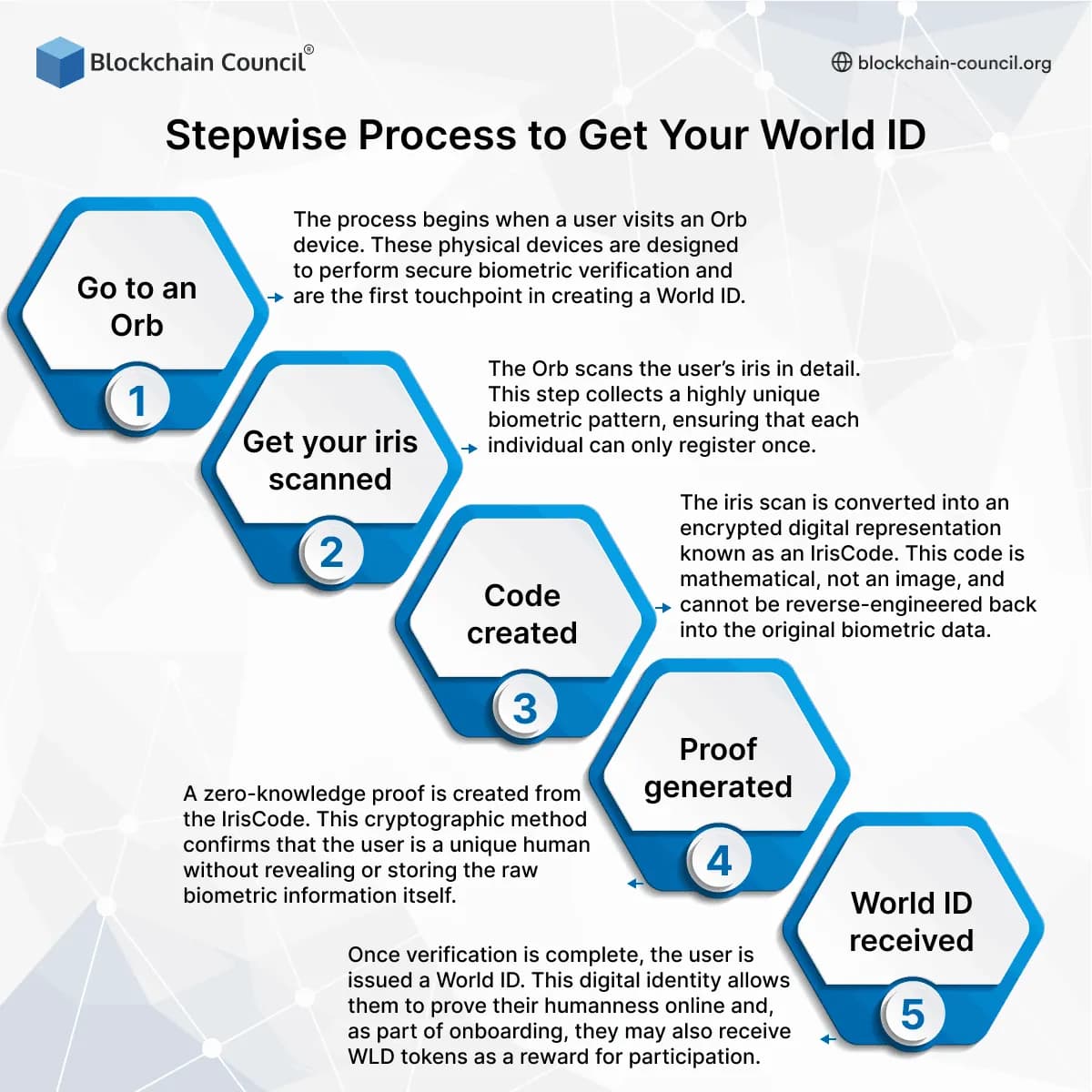
Step: Go to an Orb
Action: The process begins when a user visits an Orb device. These physical devices are designed to perform secure biometric verification and are the first touchpoint in creating a World ID.
Step: Get your iris scanned
Action: The Orb scans the user’s iris in detail. This step collects a highly unique biometric pattern, ensuring that each individual can only register once.
Step: Code created
Action: The iris scan is converted into an encrypted digital representation known as an IrisCode. This code is mathematical, not an image, and cannot be reverse-engineered back into the original biometric data.
Step: Proof generated
Action: A zero-knowledge proof is created from the IrisCode. This cryptographic method confirms that the user is a unique human without revealing or storing the raw biometric information itself.
Step: World ID received
Action: Once verification is complete, the user is issued a World ID. This digital identity allows them to prove their humanness online and, as part of onboarding, they may also receive WLD tokens as a reward for participation.
Why It Matters
Fighting Bots
The rise of generative AI has blurred the line between humans and machines. Proof of humanness could give platforms a reliable way to filter bots and prevent spam, fraud, and manipulation.
Global Digital Identity
In countries where traditional IDs are weak, a portable World ID could help people access finance, healthcare, or even voting systems. That makes it more than just a tech project—it could have real social impact.
Institutional Support
Worldcoin is not just attracting individuals. Institutional investors have bought in as well. Firms like Eightco invested $270 million in WLD, pushing its price higher and showing that identity-driven crypto is on the radar of big players.
The Controversies
Privacy Risks
Worldcoin has faced investigations and bans in countries such as Spain, Portugal, Hong Kong, and Indonesia. Privacy regulators argue that even anonymised iris data can be risky. Spain’s authorities even ordered Worldcoin to delete iris records stored from local users. Critics warn that biometric data, once compromised, cannot be changed like a password.
Adoption Challenges
While millions have signed up, most major apps and platforms still do not accept World ID. Until integration grows, its usefulness remains limited.
Ethical Questions
Worldcoin’s founders also run AI companies, raising an awkward paradox. On one hand, their tools generate AI agents. On the other, Worldcoin aims to verify humans against those very agents. Some critics see this as a conflict of interest.
Surveillance Concerns
Because iris patterns are permanent and unique, sceptics worry that governments or corporations could misuse Worldcoin to track people, even if the project itself promises privacy.
Benefits vs Risks
World ID presents several potential benefits. It could confirm the presence of real humans in online spaces, reducing the impact of bots and fake accounts. By providing IDs to underserved populations, it may expand access to digital and financial systems. Incentives through tokens could encourage adoption, while the use of zero-knowledge proofs offers strong privacy protections. The project has also shown potential to attract institutional funding, which can support growth and innovation.
At the same time, there are notable risks. Privacy laws in some regions could restrict or block the use of biometric verification. Adoption remains very limited, which could limit its effectiveness in the near term. Concentrating control of the system around Orbs creates concerns about centralized power. If biometric data is misused, the consequences could be long-lasting for individuals. Finally, regulators and activists have expressed strong fears of surveillance, which could slow progress or create backlash.
What It Could Mean for the Future
If Worldcoin succeeds, proof of humanness could become a global standard. A single digital ID could simplify how we interact online, how we access services, and how we prove our humanity in an AI-driven world.
But success is not guaranteed. Worldcoin must overcome privacy challenges, gain wider adoption, and earn public trust. Right now, it is more of an experiment than a finished solution.
For those wanting to dig deeper into the technical side, a Data Science Certification helps you explore how identity and data intersect. For leaders exploring the business impact, a Marketing and Business Certification shows how projects like Worldcoin fit into larger digital transformation strategies.
Final Takeaway
So, is Worldcoin redefining digital identity with proof of humanness? It is certainly trying. By linking identity to the iris and protecting privacy with cryptography, it is pioneering a new approach. Yet with that innovation comes heavy risks: privacy concerns, uneven adoption, and ethical debates.
The future of Worldcoin will depend on whether it can deliver trust at scale. If it succeeds, the idea of carrying your most important ID in your eyes may become the new normal. If it fails, it will remain a warning of how not to mix crypto, AI, and biometrics.
Related Articles
View All
Cryptocurrency
The Future of Crypto: Regulation, Institutional Adoption & Digital Assets
Explore the Future of Crypto, from regulation and spot ETFs to stablecoin payments, CBDCs, and tokenised assets. A clear, up-to-date guide for beginners and professionals.

Cryptocurrency
Crypto Explained: From Bitcoin to the Digital Asset Revolution
Crypto Explained in simple terms. Learn what cryptocurrency is, why Bitcoin was created, how coins differ from tokens, how wallets work, and the key benefits and risks.

Cryptocurrency
NFTs Explained: Digital Ownership, Collectibles, and Token Standards
NFTs explained through digital ownership, collectibles, ERC-721, ERC-1155, royalties, legal rights, use cases, and practical risks for Web3 professionals.
Trending Articles

Top 5 DeFi Platforms
Explore the leading decentralized finance platforms and what makes each one unique in the evolving DeFi landscape.
What is AWS? A Beginner's Guide to Cloud Computing
Everything you need to know about Amazon Web Services, cloud computing fundamentals, and career opportunities.

Can DeFi 2.0 Bridge the Gap Between Traditional and Decentralized Finance?
The next generation of DeFi protocols aims to connect traditional banking with decentralized finance ecosystems.