

Types of Cryptocurrencies: Coins, Tokens, Stablecoins, and More
 Suyash Raizada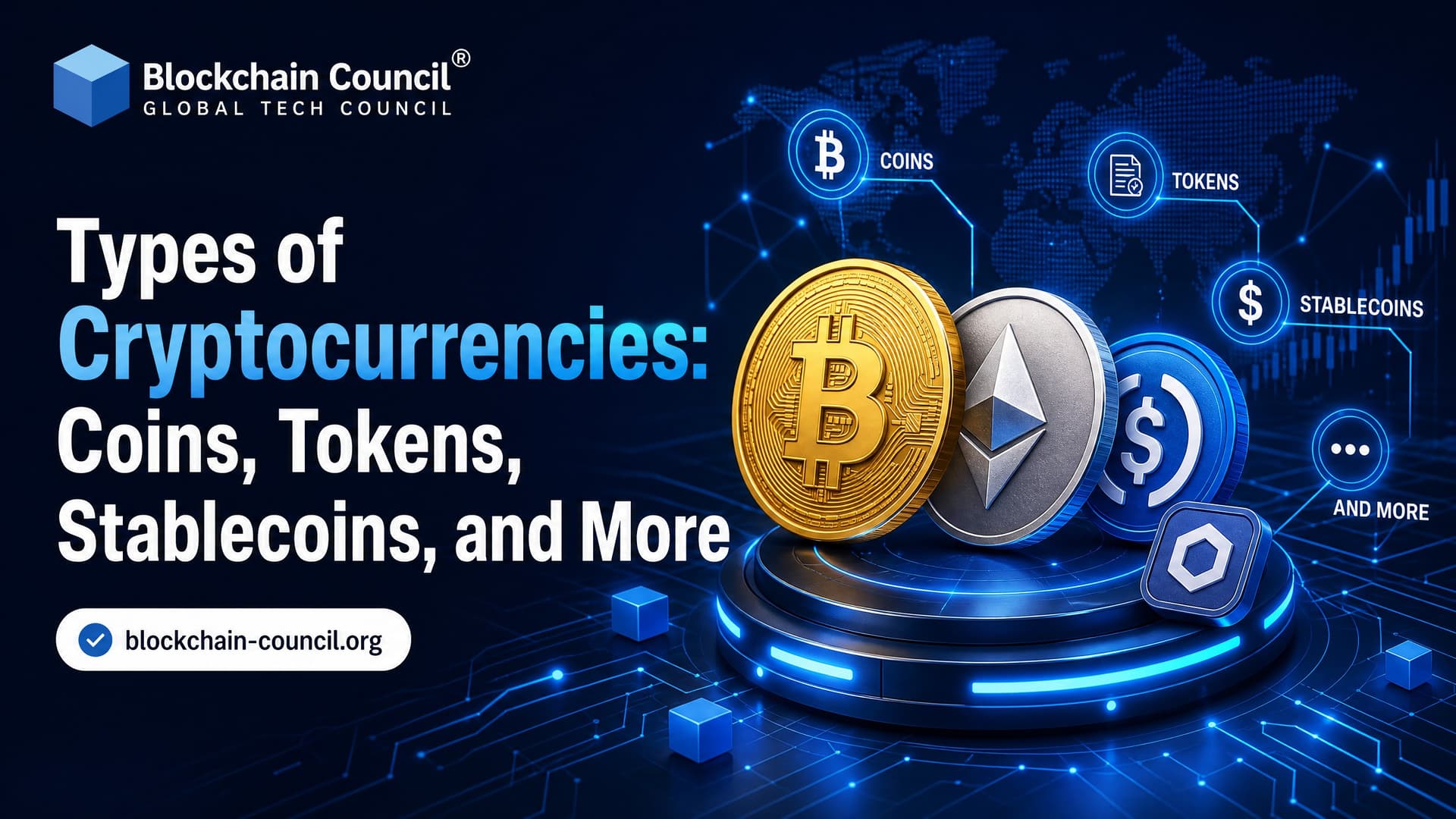
Types of cryptocurrencies are best understood by function and technical design, not by price charts. Bitcoin, an ERC-20 governance token, USDC, a tokenized real estate claim, and an NFT can all sit inside the same broad crypto market, yet they behave very differently in code, in regulation, and in business use.
If you are building, investing, or preparing for a crypto certification, this classification matters. A coin pays gas on its own chain. A token is usually issued through a smart contract. A stablecoin is designed to track another asset. A CBDC is state-issued digital money. Mix those up and you will misjudge the risk.

High-level taxonomy of cryptocurrency assets
Most industry guides group digital assets into four practical buckets: coins, tokens, stablecoins, and central bank digital currencies. Around those sit more specialized categories such as NFTs, DeFi tokens, security tokens, privacy coins, exchange tokens, GameFi tokens, and memecoins.
Coins: Native assets of their own blockchain, such as BTC on Bitcoin or ETH on Ethereum.
Tokens: Assets created on an existing blockchain, commonly through standards such as ERC-20 or ERC-721.
Stablecoins: Crypto assets designed to hold value against a reference asset, usually the U.S. dollar.
CBDCs: Digital forms of fiat currency issued by central banks.
That sounds neat. In practice, the boundaries blur. ETH is a coin, but it also powers DeFi, NFT trading, staking, and smart contract execution. Some tokens start as simple utility assets, then raise regulatory questions later if buyers expect profit from the work of a project team.
Coins: Native assets of blockchains
A coin is the native cryptocurrency of a blockchain protocol. Bitcoin has BTC. Ethereum has ETH. Litecoin has LTC. Cardano has ADA. These assets are built into the network itself, not created by an application running on top of it.
What coins are used for
Coins usually serve one or more of these roles:
Payments: Bitcoin, Litecoin, and XRP are often discussed as payment-focused cryptocurrencies.
Store of value: Bitcoin remains the best-known example and is still the largest cryptocurrency by market capitalization.
Gas and computation: ETH pays transaction fees and executes smart contracts on Ethereum.
Network security: Proof of Stake networks use native coins for staking and validator incentives.
The term altcoin simply means any cryptocurrency other than Bitcoin. Some altcoins are serious infrastructure projects. Others are thinly traded experiments. Treat the term as a broad label, not a quality signal.
Coins are not all the same
Bitcoin is intentionally narrow. It focuses on monetary transfer and security. Ethereum is programmable, which makes ETH the fuel for smart contracts, DeFi, NFTs, and token issuance. Privacy coins such as Monero and Zcash prioritize confidentiality, which can make them useful for private transactions but sensitive from a compliance perspective.
For professionals, this is where the Certified Cryptocurrency Expert™ and Certified Blockchain Expert™ programs help, especially if you need to separate monetary design from blockchain infrastructure.
Tokens: Assets issued on existing blockchains
A token is created on top of an existing blockchain. On Ethereum, the most familiar standards are ERC-20 for fungible tokens and ERC-721 for non-fungible tokens. Tokens are usually deployed as smart contracts, so their behavior is defined in code.
Here is the practical distinction. ETH is native to Ethereum, so it is a coin. An ERC-20 asset deployed on Ethereum is a token, even if users treat it like money inside an application.
A small builder note. If you follow older Solidity tutorials, check the library version. In OpenZeppelin Contracts 5.x, Ownable expects an initialOwner constructor argument. Copying a 4.x-era ERC-20 example can trigger the Solidity error TypeError: No arguments passed to the base constructor. Specify the arguments or mark the contract as abstract. It is a boring issue, but it catches many beginners during token deployment.
Utility tokens
Utility tokens provide access to a product, feature, or network service. They may be used for fee payments, staking, rewards, or premium access. A utility token should have a real purpose inside a system. If the only pitch is price appreciation, be skeptical.
Governance tokens
Governance tokens let holders vote on protocol decisions. Those decisions can cover fee changes, treasury spending, collateral parameters, or smart contract upgrades. In DeFi and DAO systems, governance tokens resemble voting rights, but voting power often concentrates among large holders. That trade-off is not theoretical. It affects who really controls a protocol.
Security tokens and RWA tokens
Security tokens represent investment-like claims and may fall under securities laws. They can carry equity-like rights, revenue claims, debt instruments, or fractional interests in real world assets. RWA tokens, short for real world asset tokens, are commonly linked to assets such as real estate, funds, private credit, or government securities.
Tokenization is promising, but it is not magic. Legal enforceability, custody, transfer restrictions, and investor eligibility matter as much as smart contract design. If your enterprise is exploring this area, pair technical training with compliance review.
DeFi, exchange, GameFi, and Web3 tokens
DeFi tokens: Used in lending, borrowing, trading, liquidity provision, and yield strategies.
Exchange tokens: Issued by trading platforms for fee discounts, rewards, or platform-linked governance.
GameFi tokens: Used as in-game currencies, reward assets, or marketplace units.
Web3 tokens: Reward participation in decentralized networks, content platforms, or community systems.
If you are building these systems, the Certified Smart Contract Developer™ and Certified DeFi Expert™ map directly to the work, because token behavior depends heavily on smart contract design and protocol economics.
NFTs: Non-fungible tokens
Non-fungible tokens, or NFTs, are unique digital records on a blockchain. Unlike ERC-20 tokens, each NFT is distinct. The ERC-721 standard is widely used here, while ERC-1155 supports semi-fungible and multi-token designs.
NFTs show up in digital art, collectibles, music, gaming items, virtual land, tickets, credentials, sports memorabilia, and brand memberships. The important point is ownership representation. An NFT does not automatically mean copyright ownership unless the license says so. This is where many buyers get confused.
For learners focused on this segment, Certified NFT Expert™ is a sensible next step after you understand fungible token standards.
Stablecoins: Crypto assets built for price stability
Stablecoins are designed to hold a steady value relative to a reference asset. Most track the U.S. dollar, which explains why USDT and USDC dominate crypto settlement activity.
Stablecoins are among the most used assets in crypto, largely because they are useful beyond speculation. Traders use them as quote assets. Businesses use them for settlement. Users in high-inflation markets use them for dollar exposure.
Stablecoin infrastructure connects digital assets with payment systems, financial services, and blockchain networks. Organisations working in this space need talent with the right mix of technical, financial, and operational knowledge. HireValid’s candidate assessment platform is worth exploring for teams looking to evaluate role-specific skills during recruitment.
Main types of stablecoins
Fiat-backed stablecoins: Backed by cash, bank deposits, Treasury bills, or similar reserves. Examples include USDT, USDC, PYUSD, GUSD, USDP, TUSD, and EURS.
Crypto-backed stablecoins: Backed by on-chain collateral, often overcollateralized. DAI is a common DeFi example.
Commodity-backed stablecoins: Linked to assets such as gold.
Algorithmic stablecoins: Use programmed supply mechanisms to target a peg. These carry higher risk because confidence can break quickly.
Treasury-backed variants: Primarily backed by short-term government securities.
The bulk of stablecoin market capitalization sits in a handful of issuers, led by Tether and USD Coin. That concentration helps liquidity, but it also creates dependency on a small number of issuers and reserve models.
CBDCs: Central bank digital currencies
Central bank digital currencies are digital versions of sovereign money issued by central banks. They are not speculative cryptocurrencies. They are state-backed payment instruments, usually built for retail payments, wholesale settlement, or monetary infrastructure.
A CBDC may use blockchain or another distributed ledger design, but decentralization is not the goal. Control, compliance, settlement speed, and monetary policy integration usually matter more. Expect CBDCs to interact with stablecoin and banking infrastructure, not replace every private digital asset.
Memecoins, privacy coins, and other specialized categories
Not every crypto asset fits neatly into enterprise use cases. Some categories are highly specialized or purely speculative.
Memecoins: Tokens built around internet culture and communities. They can move fast, but many have little utility and high volatility.
Privacy coins: Assets designed to hide transaction details such as sender, receiver, or amount.
Media and entertainment tokens: Used for fan engagement, access, rewards, or content ownership.
Service tokens: Provide access to a specific decentralized service or network function.
Infrastructure tokens: Support blockchain layers, staking systems, data networks, or middleware.
To be blunt, memecoins are the wrong starting point for professionals who want durable crypto knowledge. Learn coins, tokens, stablecoins, and smart contract standards first. Speculation can wait.
How to evaluate different types of cryptocurrencies
Use a simple checklist before you classify or analyze any asset:
Is it native to its own blockchain? If yes, it is likely a coin.
Is it issued by a smart contract on another chain? If yes, it is likely a token.
Does it target a price peg? If yes, examine the stablecoin mechanism and reserves.
Does it represent an investment claim? If yes, legal classification may matter more than branding.
Does it grant voting power? If yes, study governance concentration and proposal rules.
Is it unique rather than interchangeable? If yes, it may be an NFT.
What professionals should focus on next
The most practical types of cryptocurrencies for the next few years are stablecoins, platform coins, DeFi tokens, security tokens, RWA tokens, and CBDCs. They connect directly to payments, treasury management, smart contracts, tokenized markets, and regulated digital finance.
If you want a structured path, start with Certified Cryptocurrency Expert™ for asset classification, then move to Certified Blockchain Expert™ or Certified Smart Contract Developer™ if you build systems. If your role touches lending, liquidity, or tokenized financial products, add Certified DeFi Expert™. Then build a small ERC-20 token on a testnet and inspect every transaction in a block explorer. You will learn more from that one deployment than from a week of price commentary.
Related Articles
View All
Cryptocurrency
Beyond Bitcoin: DeFi, Stablecoins, NFTs & the Expanding Crypto Ecosystem
Go Beyond Bitcoin and explore DeFi, stablecoins, NFTs, DAOs, tokenisation, and Web3. A clear guide to how the expanding crypto ecosystem works and how its parts connect.

Cryptocurrency
Governance Tokens Explained: Voting Rights in Decentralized Protocols
Governance tokens give holders voting rights over protocol upgrades, treasury spending, fees, and DAO rules. Learn how models, risks, and voting systems work.

Cryptocurrency
Security Tokens Explained: Digital Securities and Compliance Basics
Security tokens are regulated digital securities. Learn how tokenized equity, debt, funds, and real estate rights work with compliance rules.
Trending Articles
The Role of Blockchain in Ethical AI Development
How blockchain technology is being used to promote transparency and accountability in artificial intelligence systems.
AWS Career Roadmap
A step-by-step guide to building a successful career in Amazon Web Services cloud computing.
Claude AI Tools for Productivity
Discover Claude AI tools for productivity to streamline tasks, manage workflows, and improve efficiency.