

Meme Coins Explained: Risks, Rewards, and Real-World Examples

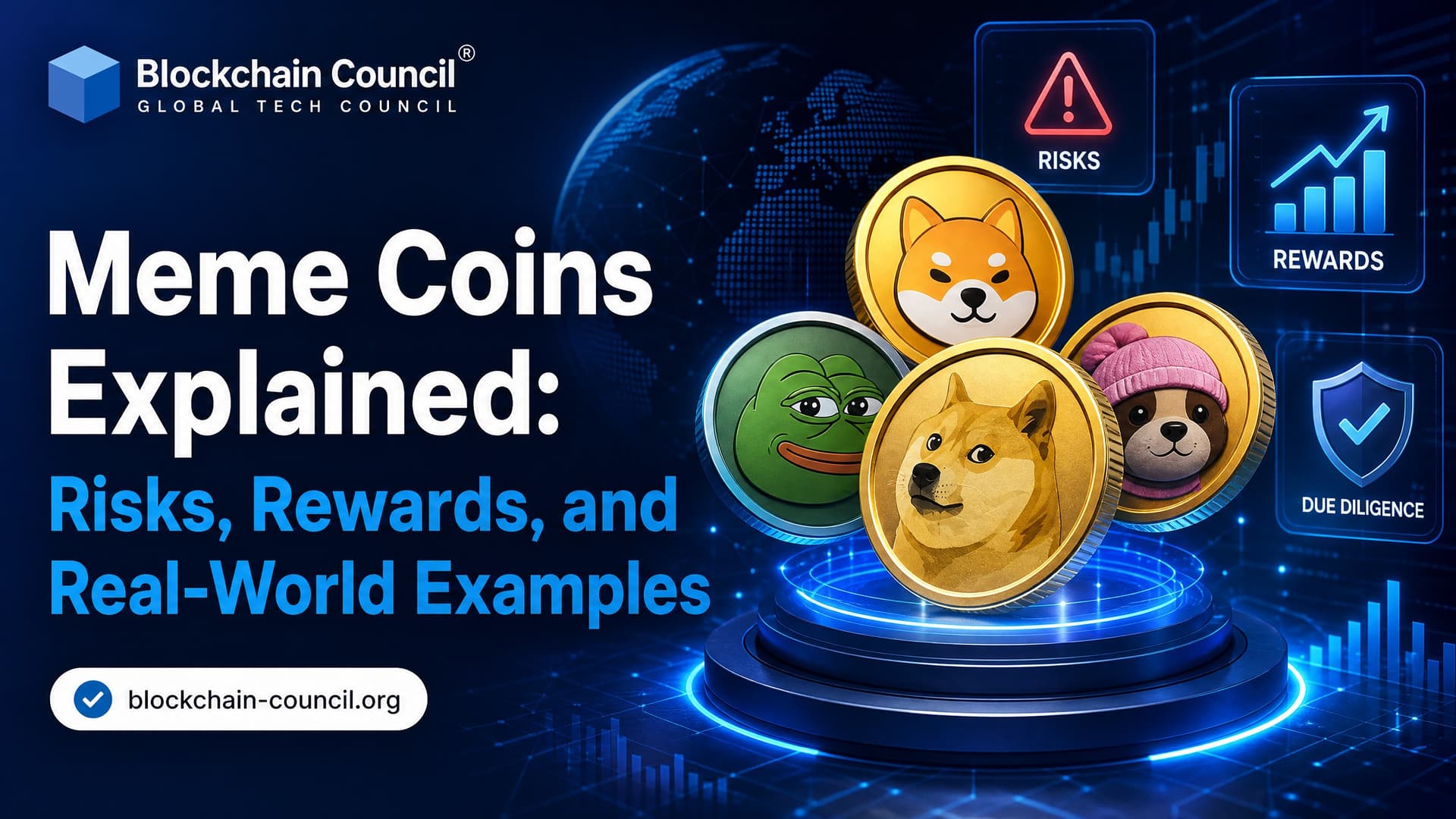
Meme coins are crypto tokens whose price is driven mainly by internet culture, community attention, and speculation. Some become billion-dollar assets. Most do not. If you trade, build around, or advise clients on meme coins, treat them as high-risk instruments first and community assets second.
The category is no longer a small joke inside crypto. Market trackers and sector reports have recently placed total meme coin capitalization somewhere between roughly 39 billion dollars and 48 billion dollars, with daily trading volume often reported between 3.5 billion dollars and 5.6 billion dollars. Those numbers move quickly, but the takeaway holds: meme coins are now a large and volatile part of the cryptocurrency market.

What Are Meme Coins?
Meme coins are cryptocurrencies inspired by internet memes, jokes, animals, celebrities, or pop culture references. They usually launch with large token supplies, low unit prices, and aggressive social media campaigns.
Bitcoin is valued partly for scarcity and network security. Ethereum supports smart contracts and decentralized applications. Meme coins often start with little technical novelty at all. Their value depends on attention. When the community is loud, liquidity is deep, and the market is risk-on, prices can spike. When attention shifts, they can collapse just as fast.
Common traits of meme coins
- Very large token supply and low starting price
- Heavy dependence on X, Telegram, Discord, Reddit, and influencers
- Fast rallies tied to viral narratives
- Limited roadmap or unclear long-term utility
- High risk of copycat tokens, impersonation, and rug pulls
A practical detail worth knowing: if you inspect a new ERC-20 meme token on a block explorer, the contract may be verified, and that still does not make it safe. Check owner permissions, mint functions, blacklist functions, transfer taxes, and liquidity locks. On Uniswap V2 forks, a failed swap that throws TRANSFER_FROM_FAILED can signal an allowance problem, fee-on-transfer behavior, or a contract built to block sells outright. Beginners miss that one constantly.
Why Meme Coins Became So Popular
The appeal is simple. Meme coins turn culture into a tradable asset. That is risky. It is also powerful.
1. Outsized return potential
Dogecoin, Shiba Inu, and PEPE have each delivered extreme gains at different points in their life cycles. Some early buyers saw returns above 1,000 percent. That history fuels fear of missing out every time a new token starts trending.
Be blunt about it. These are the exceptions. For every token that reaches a major exchange, thousands fade into illiquidity. The public remembers the winners and forgets the dead wallets.
2. Community-driven growth
Meme coins often grow through identity. Holders treat the token as a badge, not just an investment. Dogecoin built a long-running tipping culture. BONK gained traction inside the Solana ecosystem. FLOKI, PEPE, and WIF expanded through memes, community campaigns, and exchange visibility.
3. Low barrier to entry
A token priced at a fraction of a cent feels accessible, even when its market capitalization is already large. That psychological effect matters. Plenty of retail traders would rather own a million units of a meme coin than a tiny fraction of Bitcoin, even though unit price on its own says nothing about upside.
4. Optional future utility
Some meme projects add utility after the fact. Shiba Inu expanded into Shibarium, a layer-2 network. BONK became tied to Solana-based trading and launch activity. NFT-linked tokens such as PENGU connect meme speculation with digital IP communities. AI-themed tokens show how fast new narratives get bolted onto meme assets.
Still, utility-lite is not the same as durable product-market fit. A staking page and a game trailer do not justify a multi-billion dollar valuation.
Current Meme Coin Market Trends
Recent sector reviews show meme coins moving in sharp cycles. Reports pointed to the category gaining roughly 15 percent to 23 percent in one strong month before correcting as macro sentiment cooled. Another sector snapshot showed a 14.5 percent market-cap-weighted seven-day gain, ranking meme coins among the best-performing crypto sectors for that week.
Three trends stand out.
Solana is a meme coin factory
Solana has become one of the busiest networks for new meme launches because transaction costs are low and confirmation is fast. Launchpads such as Pump.fun made token creation trivial, which lets retail communities go from joke to tradable market in minutes.
That speed cuts both ways. You can find early liquidity quickly. You can also buy into a token five minutes before insiders exit.
Liquidity matters more than slogans
Traders are rotating toward meme coins with deeper liquidity, high daily volume, and established exchange access. That does not make them safe. It does make slippage, entry, and exit more manageable than with thinly traded tokens.
Meme coins are borrowing AI, DeFi, and NFT narratives
Pure meme tokens still launch every day, but capital increasingly favors projects that bolt on a simple product layer: trading tools, NFT access, AI agents, staking, or gaming. Some of it is useful. Much of it is branding.
Real-World Examples of Meme Coins
Dogecoin (DOGE)
Dogecoin started in 2013 as a joke based on the Doge meme. It became the original large-cap meme coin, supported by tipping, community culture, and repeated waves of social media attention. DOGE remains one of the most watched meme assets and often acts as a sentiment gauge for the whole sector.
Shiba Inu (SHIB)
Shiba Inu began as a Dogecoin-inspired token, then built a broader ecosystem around SHIB, related tokens, decentralized finance, NFTs, and Shibarium. The Shibarium layer-2 effort shows how a meme token can try to grow into infrastructure. Ecosystem disputes and restitution issues also show the governance risk that comes with it.
PEPE and FLOKI
PEPE and FLOKI are clear examples of narrative-driven growth. Their communities, branding, and exchange listings built large markets without the technical foundation of a major layer-1 chain. They can move sharply when retail sentiment returns.
BONK
BONK is closely tied to Solana. It rode Solana's resurgence and the meme trading activity across that ecosystem. One notable development involved BONK.fun revenue interests connected to a Nasdaq-listed company disclosure, including a value transfer split between cash and BONK. That kind of link between meme activity and public markets would have sounded absurd a few years ago. Now it is part of the sector's reality.
Memecoin (MEME)
MEME is unusually direct about its own positioning. Its whitepaper states plainly that there is no roadmap, no promise of ecosystem development, no functions, no utility, and no intrinsic value. Even so, the Memeland ecosystem reports large holder counts, listings across dozens of exchanges, and brand partnerships.
This is the central contradiction of meme coins. A token can say it has no utility and still become economically relevant because people coordinate around it.
Major Meme Coin Risks
Extreme volatility
Daily double-digit moves are normal. Research and exchange data regularly show meme coins gaining 10 percent to 20 percent in a day, then losing similar amounts soon after. Some tokens can fall 50 percent to 90 percent within days.
Scams and impersonation
Fraud is common. Teams often have to warn publicly that no official token exists while scammers launch lookalike assets anyway. In several cases a project has clarified that it never released a token, only for fake listings to appear across trading venues within hours.
Weak tokenomics
Large supply is not automatically bad, but uncontrolled emissions, hidden mint authority, insider-heavy allocations, and unlocked liquidity can crush holders. On Solana, also check mint authority and freeze authority on the token. Many buyers never look.
Regulatory uncertainty
Meme coins pushed aggressively to retail traders can attract more scrutiny from regulators, especially where disclosures are poor or insiders profit from coordinated hype. Public-company links and possible future meme coin ETF structures could bring more formal oversight, not less.
Macro sensitivity
Meme coins usually perform best when Bitcoin is rising and traders want risk. When Bitcoin dominance climbs for defensive reasons, or macro conditions turn risk-off, meme coins tend to sell harder than large-cap crypto assets.
How to Assess a Meme Coin Before You Touch It
- Check liquidity: Look at volume, exchange depth, and slippage, not just market cap.
- Read the contract: Confirm whether ownership is renounced, minting is disabled, and blacklist controls exist.
- Review holders: A handful of wallets controlling most of the supply is a red flag.
- Inspect unlocks: Large upcoming emissions can dilute buyers.
- Verify official links: Use the project's website and verified social channels. Never trust a random contract address in a reply thread.
- Size the position properly: If a 90 percent loss would hurt your finances, the position is too large.
If you are a developer, learn token standards before integrating meme assets into wallets, exchanges, or payment flows. ERC-20, SPL tokens on Solana, and liquidity pool mechanics all behave differently. For structured learning, Blockchain Council's Certified Cryptocurrency Expert™, Certified Blockchain Expert™, and Certified Blockchain Developer™ programs help connect market behavior with technical due diligence.
Are Meme Coins Worth It?
Meme coins can reward timing, community insight, and disciplined risk management. They punish laziness. Buying because a token is trending is not a strategy. Neither is assuming a low unit price means a cheap valuation.
For most professionals, the right stance is selective caution. Study the category because it affects liquidity, retail behavior, exchange listings, and crypto regulation. Trade it only with money you can afford to lose. Build around it only after contract review, compliance checks, and liquidity analysis.
Your next step: pick one major meme coin, such as DOGE, SHIB, PEPE, or BONK, and run a full due diligence worksheet on it. Review token supply, holders, liquidity, exchange access, roadmap claims, and contract controls. If you cannot explain why it should survive the next risk-off cycle, do not treat it as an investment.
Related Articles
View All
Cryptocurrency
Crypto Lending and Borrowing Explained: DeFi Loans, Rates, and Risks
Crypto lending and borrowing lets users earn yield or access liquidity through DeFi loans, but rates, collateral rules, and liquidations matter.
Cryptocurrency
Yield Farming Explained: DeFi Returns, Risks, and Strategies
Yield farming explained for DeFi users: how returns work, why APYs change, key risks, and practical strategies from stablecoin lending to LRTs.

Cryptocurrency
Staking Explained: How to Earn Rewards by Securing Blockchains
Staking explained for professionals: learn how PoS staking rewards work, how validators secure blockchains, and what risks to check before staking crypto.
Trending Articles
The Role of Blockchain in Ethical AI Development
How blockchain technology is being used to promote transparency and accountability in artificial intelligence systems.
What is AWS? A Beginner's Guide to Cloud Computing
Everything you need to know about Amazon Web Services, cloud computing fundamentals, and career opportunities.
Claude AI Tools for Productivity
Discover Claude AI tools for productivity to streamline tasks, manage workflows, and improve efficiency.