

Utility Tokens Explained: Use Cases, Value, and Token Design
 Suyash Raizada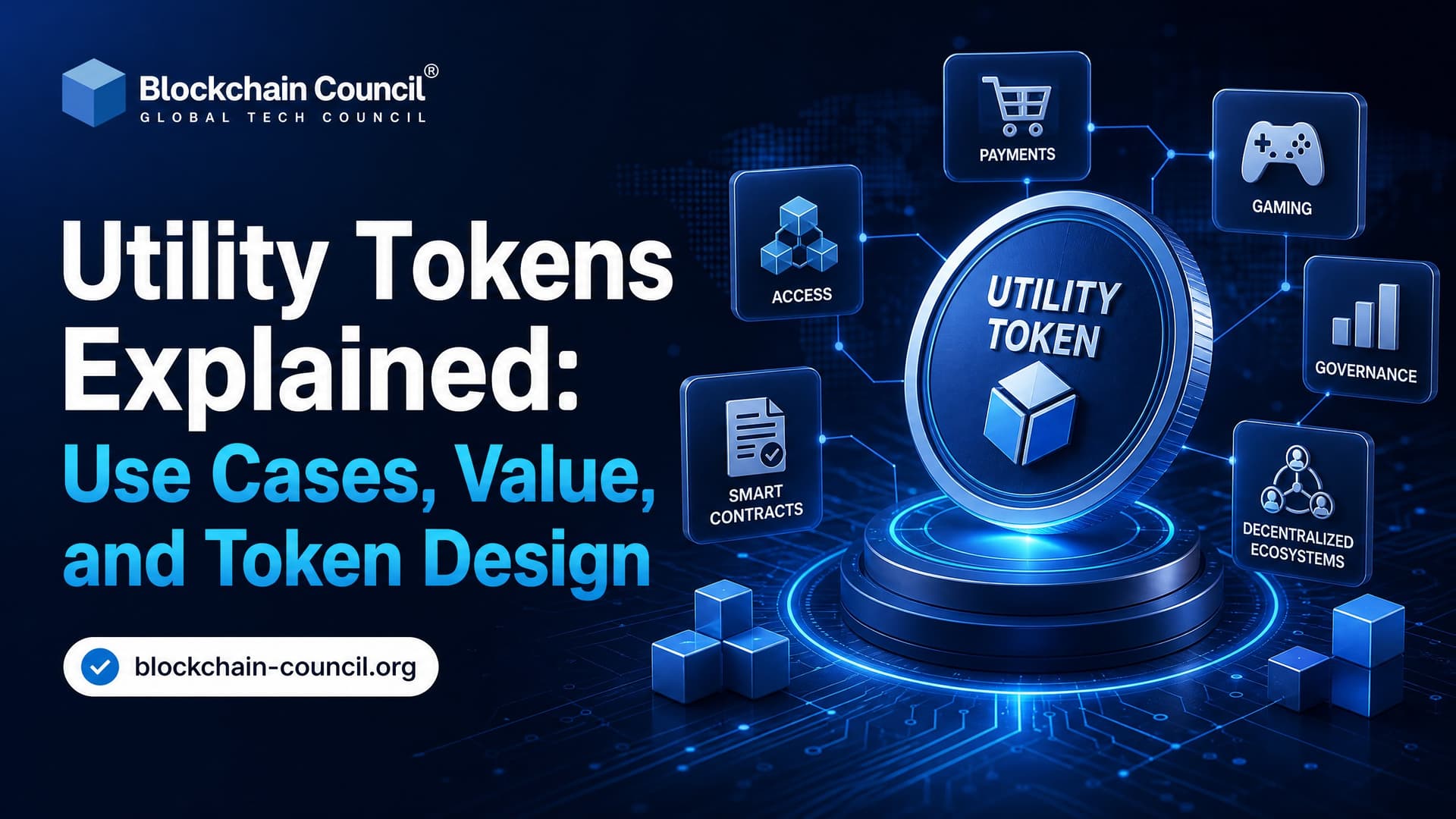
Utility tokens are blockchain-based tokens built for access, functionality, and incentives inside a defined ecosystem. They are not supposed to be a vague fundraising wrapper. A good utility token does real work. It pays for storage, opens premium features, gives users a vote, rewards useful behavior, or helps secure a network through staking.
That distinction matters. Many tokens trade on exchanges, so speculation is hard to avoid. But the design question is simple: if the token disappeared tomorrow, would the product still work just as well? If yes, the token is probably decorative. If no, you may have a genuine utility token model.

What Is a Utility Token?
A utility token is a digital asset that provides a specific operational function within a blockchain network, protocol, or application. It can be a native protocol token or a token issued on an existing blockchain, such as an ERC-20 token on Ethereum.
Utility tokens are often described as app coins or user tokens because they usually represent access to a product or service rather than ownership in a company. Holding a utility token does not automatically give you equity, dividends, or a legal claim on profits. That is one of the main differences between utility tokens and security tokens.
Common characteristics
- Access: Tokens can unlock services, premium features, private communities, or network resources.
- Payment: Users may need the token to pay for products, fees, compute, bandwidth, or storage.
- Governance: Token holders can vote on protocol upgrades, fee changes, or treasury decisions.
- Rewards: Contributors, validators, liquidity providers, or early users may earn tokens for useful participation.
- Staking and security: Tokens can be locked as collateral to discourage bad behavior and support network integrity.
Ethereum itself is a useful reference point. ETH pays gas for transactions and smart contract execution on Ethereum mainnet, whose chain ID is 1. That gas requirement is not cosmetic. Without it, the network would have no native spam cost and no direct payment mechanism for validators.
Utility Tokens vs Other Crypto Assets
Not every crypto asset is a utility token. The categories overlap in practice, but the intent and rights attached to the token are different.
- Cryptocurrencies: Often used as money-like assets or stores of value, with Bitcoin as the best-known example.
- Security tokens: Represent investment rights, ownership, revenue share, or claims that may trigger securities regulation.
- Stablecoins: Aim to hold a stable value, usually by referencing fiat currency or other assets.
- Utility tokens: Provide access or functionality inside a defined product, network, or ecosystem.
Regulators do not rely only on labels. They look at marketing, profit expectations, issuer control, and the rights token holders receive. If a project sells a token mainly by promising future price appreciation, calling it a utility token will not fix the problem.
Where Utility Token Value Comes From
The value of a utility token should come from recurring platform activity. To be blunt, a token with no users is just a ticker symbol.
Strong utility token models usually have several value drivers:
- Mandatory usage: The token is required to access a service or pay protocol fees.
- Network effects: More users make the platform more useful, which can increase demand for the token.
- Multi-role utility: The token supports payments, access, governance, incentives, or staking at the same time.
- Lockups and staking: Users hold or stake tokens because doing so gives them security rights, voting power, fee discounts, or rewards.
- Real revenue links: Fees, usage volume, and service demand create measurable token activity.
Speculation can still distort prices. You will see tokens rise before the product has users, then fall when emissions hit the market. That does not invalidate utility tokens as a design pattern, but it does mean you should study usage data, not only market capitalization.
Tokenomics: The Design Layer Behind Utility Tokens
Tokenomics is the rulebook for how a token is issued, distributed, used, rewarded, and sometimes burned. Poor tokenomics can sink even a good product. I have seen teams ship a working dApp, then flood the market with reward emissions so aggressive that users farm the token for two weeks and leave.
Core tokenomics decisions
- Supply model: Is supply capped, inflationary, or dynamically adjusted?
- Issuance schedule: How quickly are new tokens minted, and who receives them?
- Allocation: What goes to the team, investors, community, treasury, validators, and ecosystem rewards?
- Vesting: Are insiders locked long enough to reduce short-term dumping?
- Burning: Are tokens destroyed through fees or other mechanisms?
- Governance: Who can vote, what can they change, and how are proposals executed?
Burning deserves a careful note. Destroying tokens can reduce supply, but it does not create durable value by itself. If usage is weak, a burn mechanism becomes a marketing line. If usage is strong, burns may support better supply discipline.
A practical design test
Before adding a token, ask four questions:
- What user action requires the token? Be specific.
- Who must buy, earn, stake, or spend it?
- What happens if users avoid the token?
- Which metric proves the token is useful? Examples include transactions paid in tokens, governance turnout, staking levels, or storage purchased.
If your answers are vague, do not launch the token yet.
Major Utility Token Use Cases
1. Payments and gas
Some utility tokens pay transaction fees, service charges, or smart contract execution costs. Gas-style tokens also help deter spam by attaching a cost to network activity.
2. Token-gated access
Tokens can unlock premium content, higher usage tiers, private communities, events, data feeds, or software features. This model works best when access is genuinely valuable. A token-gated Discord with no product behind it is not a business model.
3. Governance
Governance tokens let holders vote on protocol parameters, treasury grants, upgrades, or risk settings. In DeFi, this can include collateral ratios, fee levels, or supported assets. Governance is powerful, but voter apathy is common. If only 2 percent of holders vote, governance may be decentralized on paper only.
4. Incentives and rewards
Tokens can reward users for providing liquidity, verifying data, creating content, running nodes, or referring useful participants. Rewards should encourage behavior the network actually needs. Paying users only to click a button creates mercenary activity.
5. Staking and security
Staking asks users or validators to lock tokens as economic collateral. Honest behavior earns rewards. Bad behavior may trigger penalties, depending on protocol design. This ties financial incentives to system security.
6. DeFi utility
In decentralized finance, utility tokens can support fee payments, liquidity incentives, governance, staking, and protocol risk management. They are common in decentralized exchanges, lending protocols, and yield markets.
7. Enterprise and infrastructure workflows
Utility tokens can also coordinate business networks. Examples include usage-based billing for decentralized storage, automated service-level agreements, reputation systems, and data marketplaces where contributors are paid for verified inputs.
Real-World Example: Filecoin
Filecoin is one of the clearest utility token examples. Users pay FIL to store data on a decentralized storage network. Storage providers earn FIL for supplying capacity and proving that data is stored correctly. The token handles payment, incentives, and collateral at once.
This is the kind of design that makes sense. The token sits inside the workflow. Users need storage. Providers need compensation. The network needs a way to reward reliability and penalize failure.
Building Utility Tokens: A Developer Note
Most application-level utility tokens on Ethereum-compatible chains start as ERC-20 tokens. Developers often use OpenZeppelin Contracts because the implementation is audited and widely reviewed. One detail that catches beginners: OpenZeppelin Contracts 5.x changed internal token hooks. If you learned on 4.x tutorials that override _beforeTokenTransfer, that pattern breaks in 5.x because transfer logic now centers on _update.
Another common beginner failure is not in Solidity at all. It is deployment funding. Hardhat throws errors such as insufficient funds for intrinsic transaction cost when the deployer wallet has no testnet ETH for gas. The contract may be fine. Your wallet is just empty.
If you design tokens professionally, pair smart contract skills with economic design. Blockchain Council's Certified Blockchain Developer™, Certified Blockchain Expert™, Certified Cryptocurrency Expert™, and Certified DeFi Expert™ are natural learning paths for readers who want structured coverage of blockchain architecture, token standards, DeFi mechanics, and crypto asset analysis.
What Makes a Utility Token Design Strong?
A strong utility token is not defined by a long whitepaper. It is defined by product fit.
- The token is necessary: The system works worse without it.
- Utility is measurable: You can track payments, active wallets, governance votes, fees, staking, or service usage.
- Distribution is fair enough: Team and investor allocations do not crush community trust.
- Emissions are sustainable: Rewards attract contributors without creating endless sell pressure.
- Governance has limits: Voters can influence meaningful parameters without causing constant operational chaos.
- Compliance is considered early: The project avoids marketing the token as a profit promise.
The wrong approach is bolting on a token after the product is already complete just because fundraising seems easier. Users can feel that. Regulators can too.
Future Outlook for Utility Tokens
Utility tokens are moving toward more disciplined designs. The market is less patient with vague claims and more interested in usage metrics: transaction volume, fee revenue, liquidity depth, governance participation, staking levels, and retention.
Expect more multi-utility tokens that combine access, payment, governance, rewards, and staking. Also expect deeper use in infrastructure, gaming, decentralized storage, AI data networks, and enterprise blockchain systems. The best designs will tie token demand to repeat product usage, not campaign-driven hype.
If you want to evaluate or build utility tokens, start with one exercise: map every token action to a real user need. Then model supply, emissions, and incentives before writing the smart contract. For a structured path, study token standards and tokenomics alongside blockchain fundamentals through Blockchain Council's Certified Cryptocurrency Expert™ or Certified Blockchain Developer™, then build a small ERC-20 prototype and test whether the token is truly needed.
Related Articles
View All
Cryptocurrency
DeFi Explained: Decentralized Finance, Protocols, and Use Cases
DeFi explained for professionals: learn how decentralized finance works, key protocols, real use cases, risks, and what to study next.

Cryptocurrency
NFTs Explained: Digital Ownership, Collectibles, and Token Standards
NFTs explained through digital ownership, collectibles, ERC-721, ERC-1155, royalties, legal rights, use cases, and practical risks for Web3 professionals.

Cryptocurrency
Tokenomics Explained: Supply, Demand, Vesting, and Crypto Value
Tokenomics explained through supply, demand, vesting, FDV, emissions, burns, and value accrual so you can evaluate crypto tokens with more confidence.
Trending Articles

Top 5 DeFi Platforms
Explore the leading decentralized finance platforms and what makes each one unique in the evolving DeFi landscape.
How Blockchain Secures AI Data
Understand how blockchain technology is being applied to protect the integrity and security of AI training data.

Can DeFi 2.0 Bridge the Gap Between Traditional and Decentralized Finance?
The next generation of DeFi protocols aims to connect traditional banking with decentralized finance ecosystems.