

Is Tokenization of Real-World Assets (RWA) the Future of Finance?
 Michael Willson
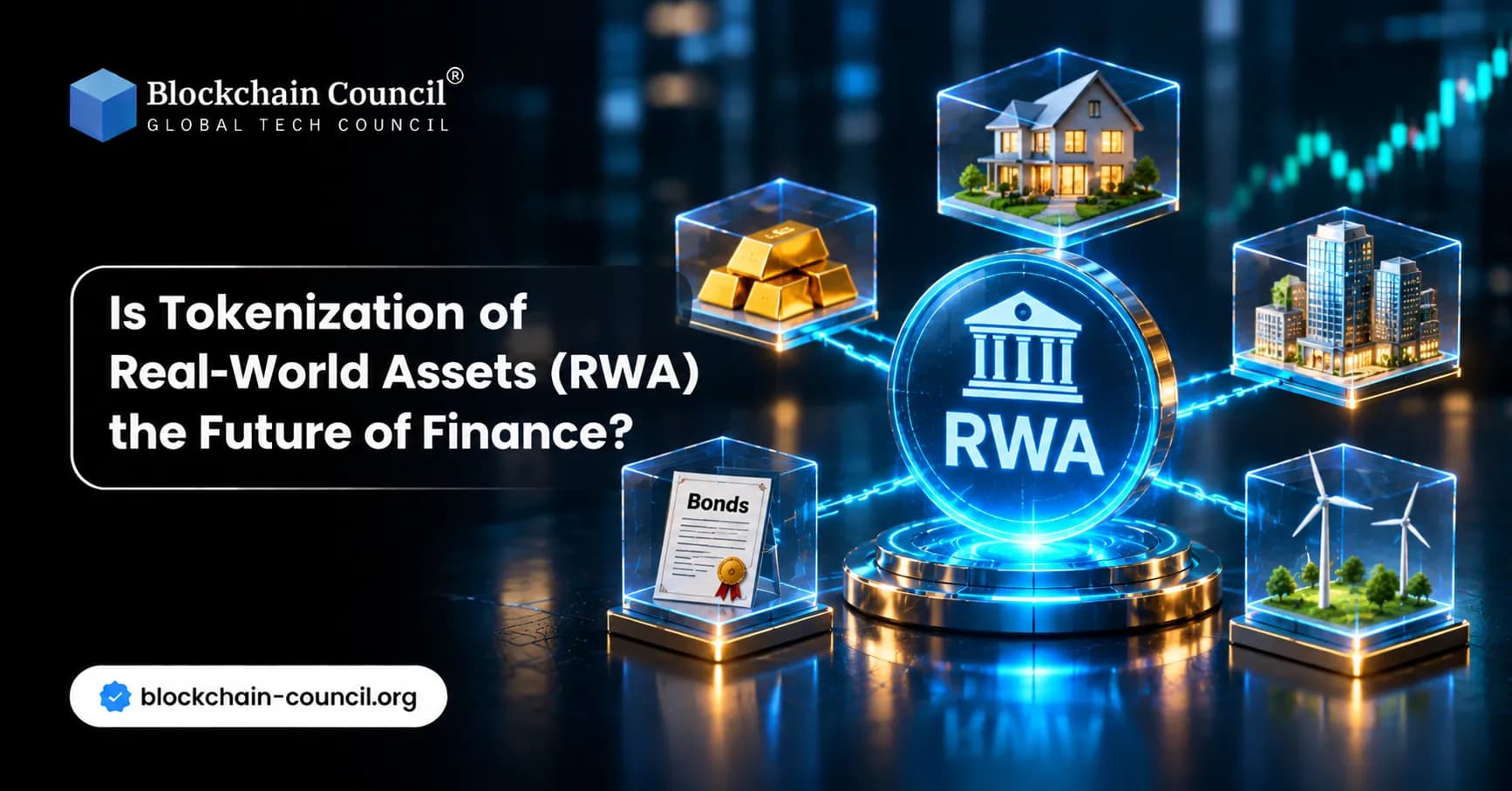
Yes, tokenization of real-world assets is rapidly becoming a key trend in modern finance. It turns physical or traditional assets like real estate, private credit, or government bonds into digital tokens that can be traded and managed more easily. This makes investing more open, transparent, and flexible for both large institutions and everyday people. If you are exploring future skills in this space, blockchain technology courses are a smart way to start.
What is Tokenization of Real-World Assets
Tokenization means representing ownership of a real-world asset with digital tokens on a blockchain. Each token acts like proof of ownership. For example, instead of needing to buy an entire property, you could own just a small fraction through tokens.

This approach makes expensive or illiquid assets available to more people. It also creates new ways to trade, track, and manage investments without relying on slow or outdated systems.
Market Growth and Projections
The market for tokenized assets is growing quickly. In 2022, it was worth about 5 billion dollars. By mid-2025, it had already grown to nearly 24 billion dollars. Forecasts suggest this number could rise into the trillions by the end of the decade, depending on regulation and adoption.
Real estate stands out as a big opportunity. Deloitte projects that tokenized real estate in the United States could reach 4 trillion dollars by 2035. Private credit and tokenized U.S. treasuries are also among the leading categories right now.
Why Tokenization is Attracting Attention
Several drivers explain why tokenization has become so important:
Institutional adoption
Banks and asset managers are already experimenting with tokenized money market funds and treasuries. Big players like Goldman Sachs and BNY Mellon are taking part.
Regulatory progress
Some governments are offering clearer rules or regulatory sandboxes that reduce legal risk for businesses.
Better technology
Advances in blockchain, smart contracts, custody, and interoperability are making tokenization more practical.
Liquidity and accessibility
Investors can buy fractions of assets, making them more accessible. Asset owners can also unlock capital that was tied up.
Transparency and efficiency
Transactions are recorded on the blockchain, providing traceability. Settlement can be faster and cheaper with fewer intermediaries.
Challenges and Barriers
Even with rapid growth, tokenization faces hurdles:
Liquidity: Secondary markets for tokenized assets are still thin. Many tokens are held long-term rather than traded often.
Regulation: Laws vary by region, and the legal status of tokenized assets is not always clear.
Valuation: It is not simple to assign fair value to tokenized assets, especially when markets move quickly.
Complexity: Handling custody, fractional ownership, and compliance adds operational challenges.
Trust: Investors need certainty that tokens are legally enforceable and compliant with rules like KYC and AML.
Real-World Use Cases
For tokenized real-world assets to function reliably, blockchain networks need accurate information about the physical assets they represent. Understanding how oracles feed real-world data to tokenized assets helps explain this connection. Blockchain oracles bring external information, such as property valuations, market prices, interest rates, and asset performance data, into smart contracts. This allows tokenized assets to reflect relevant real-world conditions and supports automated processes such as valuation updates, interest payments, and compliance checks.
Here are some of the most active areas for tokenization today:
U.S. Treasuries and cash equivalents: More than 7 billion dollars are tokenized and held on public blockchains.
Private credit: Around 14 billion dollars in value comes from private credit instruments.
Real estate: From houses to commercial properties, real estate is one of the fastest-growing areas.
Corporate activity: Companies such as China’s Seazen Group are exploring tokenization of property income streams.
Institutional funds: Large financial firms are rolling out tokenized funds for their clients.
Securities: Nasdaq recently filed a proposal to enable trading of tokenized securities on its main market.
Another growing application of asset tokenization is tokenized debt. It involves representing debt instruments, such as corporate bonds, loans, and private credit agreements, as digital tokens on a blockchain. This can improve transparency, simplify ownership tracking, and support more efficient interest payments and settlement processes. For businesses and investors, tokenized debt offers another way to explore digital financial markets, although regulatory compliance, credit risk, and investor protection remain essential considerations.
Comparing Traditional Assets and Tokenized Assets
Here’s a table that helps explain how tokenization changes the picture for investors and institutions:
Traditional Assets vs Tokenized Assets
Aspect | Tokenized Assets |
Ownership | Fractional, anyone can buy a share |
Accessibility | Global, 24/7 digital access |
Liquidity | Potentially higher with active markets |
Transparency | On-chain, visible to all |
Settlement speed | Minutes or hours instead of days |
Intermediaries | Reduced or sometimes removed |
Cost efficiency | Lower transaction and management costs |
Security | Based on blockchain and custody solutions |
Compliance | Depends on clear regulation |
Market outlook | Expected to reach trillions by 2030s |
What the Future Could Look Like
Many experts believe tokenization will integrate with both traditional finance and decentralized finance. Institutions will use it to issue and trade assets in a more efficient way, while individuals gain new access to markets that were once out of reach.
The biggest question is how regulation and secondary markets evolve. Liquidity will determine if tokenization is a real revolution or just a niche. If standards, trust, and global rules catch up, then tokenization could reshape finance at scale.
Why This Matters for You
If you are in finance, marketing, or technology, tokenization is not just theory. It is already happening with bonds, credit, and real estate. This makes it important to upskill and learn how to apply these tools in practice.
For people interested in careers at the intersection of finance and AI, the Data Science Certification is useful to understand how data powers tokenized markets. If you are aiming to lead in business transformation, the Marketing and Business Certification will help you learn how to drive adoption of new technologies.
Conclusion
Tokenization of real-world assets is not a distant future. It is already here and growing fast. From treasuries to real estate, billions of dollars in value are now tokenized and traded. The benefits are clear: more access, faster settlement, and greater transparency. The challenges are also real: regulation, trust, and liquidity.
Whether tokenization becomes the backbone of finance will depend on how quickly these hurdles are addressed. But all signs point to a future where assets live on blockchain and are easier for everyone to own and trade.
FAQs
1. What is Real-World Asset (RWA) tokenization?
Real-World Asset (RWA) tokenization is the process of representing ownership rights or financial interests in physical and traditional financial assets as digital tokens on a blockchain. Examples include real estate, government bonds, gold, commodities, and private credit.
2. Why is RWA tokenization considered the future of finance?
RWA tokenization could transform financial markets by improving transaction efficiency, enabling fractional ownership, automating processes through smart contracts, and connecting traditional assets with blockchain-based financial infrastructure. However, widespread adoption will depend on regulation, interoperability, security, and investor confidence.
3. How does real-world asset tokenization work?
The process generally involves:
Identifying and evaluating the underlying asset.
Establishing its legal ownership and rights.
Creating a suitable tokenization structure.
Issuing digital tokens through blockchain infrastructure.
Recording and managing transactions using smart contracts.
Providing mechanisms for custody, redemption, and asset reporting.
The token must be legally connected to the underlying asset or financial claim.
4. Which real-world assets can be tokenized?
Several asset categories can be represented through blockchain tokens, including:
Real estate and commercial properties.
Gold, silver, and other commodities.
Government and corporate bonds.
Private credit and investment funds.
Art, collectibles, and luxury goods.
Infrastructure and renewable energy assets.
The legal and technical requirements differ for each asset class.
5. What are the main benefits of RWA tokenization?
Major benefits include fractional ownership, potentially faster settlement, improved transparency, automated asset management, and broader access to certain investment opportunities. Tokenization can also reduce administrative processes by connecting asset records and transaction rules through shared digital infrastructure.
6. How does RWA tokenization enable fractional ownership?
Tokenization can divide an asset's ownership interest or economic rights into smaller digital units. For example, a property valued at ₹1 crore could theoretically be represented by 10,000 tokens worth ₹1,000 each. This may lower investment entry barriers, although actual rights and minimum investment amounts depend on the legal structure.
7. How is blockchain changing traditional financial markets through tokenization?
Blockchain can bring asset issuance, ownership records, trading, and settlement onto programmable digital infrastructure. Smart contracts can automate activities such as interest payments, collateral transfers, and compliance checks. This may reduce reconciliation requirements and improve coordination between financial institutions.
8. What role do smart contracts play in RWA tokenization?
Smart contracts automate predefined rules associated with tokenized assets. They can manage token issuance, transfers, payment schedules, distribution of returns, and eligibility restrictions. Their effectiveness depends on secure programming, accurate external data, and legally enforceable agreements.
9. How does RWA tokenization improve liquidity?
Tokenization can make certain traditionally illiquid assets easier to divide and transfer. It may expand the potential investor base and support digital marketplaces. However, creating tokens does not automatically guarantee liquidity; active buyers, sellers, market infrastructure, and regulatory approval are also necessary.
10. What role does RWA tokenization play in decentralized finance (DeFi)?
RWA tokenization connects traditional financial assets with decentralized finance applications. Tokenized assets may be used as collateral, traded through supported platforms, or integrated into lending protocols. This creates opportunities for traditional and decentralized financial markets to interact, although it also introduces additional smart contract and counterparty risks.
11. How does tokenization improve transparency in asset management?
Blockchain provides a shared transaction record that authorized participants can verify. This can improve visibility into token issuance, transfers, and certain asset-related activities. However, blockchain transparency does not automatically verify the physical asset, legal ownership, or accuracy of information entered into the system.
12. What are the biggest challenges facing RWA tokenization?
Key challenges include:
Regulatory uncertainty across jurisdictions.
Legal recognition of tokenized ownership rights.
Interoperability between blockchain networks.
Asset custody and valuation.
Smart contract and cybersecurity vulnerabilities.
Limited secondary-market liquidity.
Reliable settlement infrastructure.
Addressing these challenges is essential for institutional adoption.
13. Is RWA tokenization safe for investors?
RWA tokenization can offer useful investment structures, but it is not risk-free. Investors may face legal ownership disputes, inaccurate valuations, issuer defaults, custody failures, smart contract exploits, and limited liquidity. They should examine the underlying asset, issuer, legal agreements, and redemption conditions before investing.
14. What role do financial institutions play in RWA tokenization?
Banks, asset managers, custodians, exchanges, and financial market infrastructure providers can support the issuance, custody, settlement, and distribution of tokenized assets. Their involvement can help connect blockchain systems with established financial markets and regulatory frameworks.
15. How are governments and regulators responding to RWA tokenization?
Regulators are examining how existing securities, banking, payments, custody, and investor protection rules apply to tokenized assets. Their priorities include legal certainty, financial stability, cybersecurity, settlement finality, and transparency. Regulatory approaches differ across countries.
16. What is the difference between traditional assets and tokenized real-world assets?
Traditional assets are generally issued, recorded, and transferred through established financial or legal systems. Tokenized real-world assets represent associated ownership interests or financial claims through blockchain-based digital tokens. The underlying asset may remain physically held or legally recorded through traditional institutions.
17. What is the current state of RWA tokenization adoption?
RWA tokenization is moving beyond experimentation, with growing interest from banks, asset managers, fintech companies, and blockchain platforms. However, adoption remains relatively small and fragmented compared with traditional financial markets. The IMF's October 2026 analysis identifies legal certainty, regulatory clarity, interoperability, and reliable settlement assets as major conditions for further growth.
18. Can RWA tokenization transform cross-border investments?
Potentially, yes. Blockchain-based infrastructure can support digital asset transfers and settlement across geographical boundaries. Tokenization may reduce certain administrative barriers and enable broader investor participation. However, cross-border investments still require compliance with local securities laws, tax rules, foreign exchange regulations, and ownership requirements.
19. What is the future of RWA tokenization in India?
India could explore RWA tokenization across financial securities, government bonds, real estate-related investments, commodities, and other asset categories. Growth will depend on regulatory clarity, suitable market infrastructure, investor protection, and integration with existing financial systems. Tokenized assets must comply with applicable Indian laws and regulatory requirements.
20. Will RWA tokenization replace traditional finance?
RWA tokenization is more likely to transform and integrate with traditional finance than completely replace it. Banks, asset managers, custodians, regulators, and financial institutions may continue operating while adopting blockchain infrastructure for issuance, settlement, and asset management. Its long-term role will depend on whether it delivers measurable improvements in efficiency, accessibility, and security.
Related Articles
View All
Cryptocurrency
The Future of Crypto: Regulation, Institutional Adoption & Digital Assets
Explore the Future of Crypto, from regulation and spot ETFs to stablecoin payments, CBDCs, and tokenised assets. A clear, up-to-date guide for beginners and professionals.

Cryptocurrency
DeFi Explained: Decentralized Finance, Protocols, and Use Cases
DeFi explained for professionals: learn how decentralized finance works, key protocols, real use cases, risks, and what to study next.

Cryptocurrency
Cryptocurrency Wallets Explained: How to Store and Manage Digital Assets
Learn how cryptocurrency wallets work, including private keys, hot and cold storage, custodial options, MPC, account abstraction, and security best practices.
Trending Articles
The Role of Blockchain in Ethical AI Development
How blockchain technology is being used to promote transparency and accountability in artificial intelligence systems.
AWS Career Roadmap
A step-by-step guide to building a successful career in Amazon Web Services cloud computing.
Top 5 DeFi Platforms
Explore the leading decentralized finance platforms and what makes each one unique in the evolving DeFi landscape.