

99% Support Solana’s Alpenglow Upgrade for 150ms Finality
 Michael Willson
Solana is on the brink of its most ambitious upgrade yet. The Alpenglow proposal has received 99% validator approval, promising to slash transaction finality from nearly 13 seconds to just 150 milliseconds. If adopted as expected, this change could push Solana ahead of rival blockchains and even position it alongside traditional payment giants like Visa and Mastercard.
For anyone following the crypto space, this is more than a technical tweak. It is a glimpse into how blockchain networks are evolving to match real-world demands. If you are keen to deepen your understanding of crypto systems, a crypto certification can give you the skills to make sense of changes like this.

Why Finality Matters
Finality is the time it takes for a blockchain transaction to be considered permanent. In Solana’s case, that figure has been about 12.8 seconds—already competitive compared to many networks but still far behind real-time financial systems.
With Alpenglow, Solana will bring finality down to 150ms, essentially the blink of an eye. That means faster settlement for payments, instant confirmation for traders, and smoother experiences for applications in gaming, DeFi, and social media.
It also raises the stakes in Solana’s long-running push to brand itself as the blockchain built for speed and scale.
The Vote Breakdown
The governance process shows overwhelming support. By the time quorum was reached, more than 99% of validators had voted in favour of Alpenglow. The minimum threshold of 33% participation was achieved quickly, and the vote will formally conclude at epoch 842.
With such a strong mandate, the upgrade is not only likely to pass but to be implemented with wide community backing.
How Alpenglow Works
Alpenglow isn’t just about cranking up the speed dial. It introduces two major innovations that change how Solana reaches consensus.
Votor
Votor is a new consensus mechanism that replaces TowerBFT, Solana’s existing Byzantine fault tolerance system. With Votor, a block can be finalized in just one round if 80% of stake votes, or in two rounds if 60% responds. This ensures rapid agreement without sacrificing security.
Rotor
Rotor is a new way of sharing data across the network. Instead of relying on proof-of-history’s multi-hop relays, Rotor uses a streamlined one-layer relay system. This cuts down on delays and ensures the entire network agrees on the state much faster.
Together, Votor and Rotor create the technical foundation for achieving 150ms finality.
Beyond Speed: Resilience and Scale
Speed is only one part of the story. Alpenglow also promises stronger resilience. It introduces a 20+20 validator model, which means the network could tolerate up to 40% downtime among validators without halting.
On throughput, Solana is targeting more than 65,000 transactions per second (TPS), a figure that puts it in direct comparison with mainstream payment rails.
There are also proposals for Validator Admission Tickets (VATs) and improved staking economics. These aim to make participation more balanced while giving validators clear incentives.
Solana’s Alpenglow Upgrade Explained
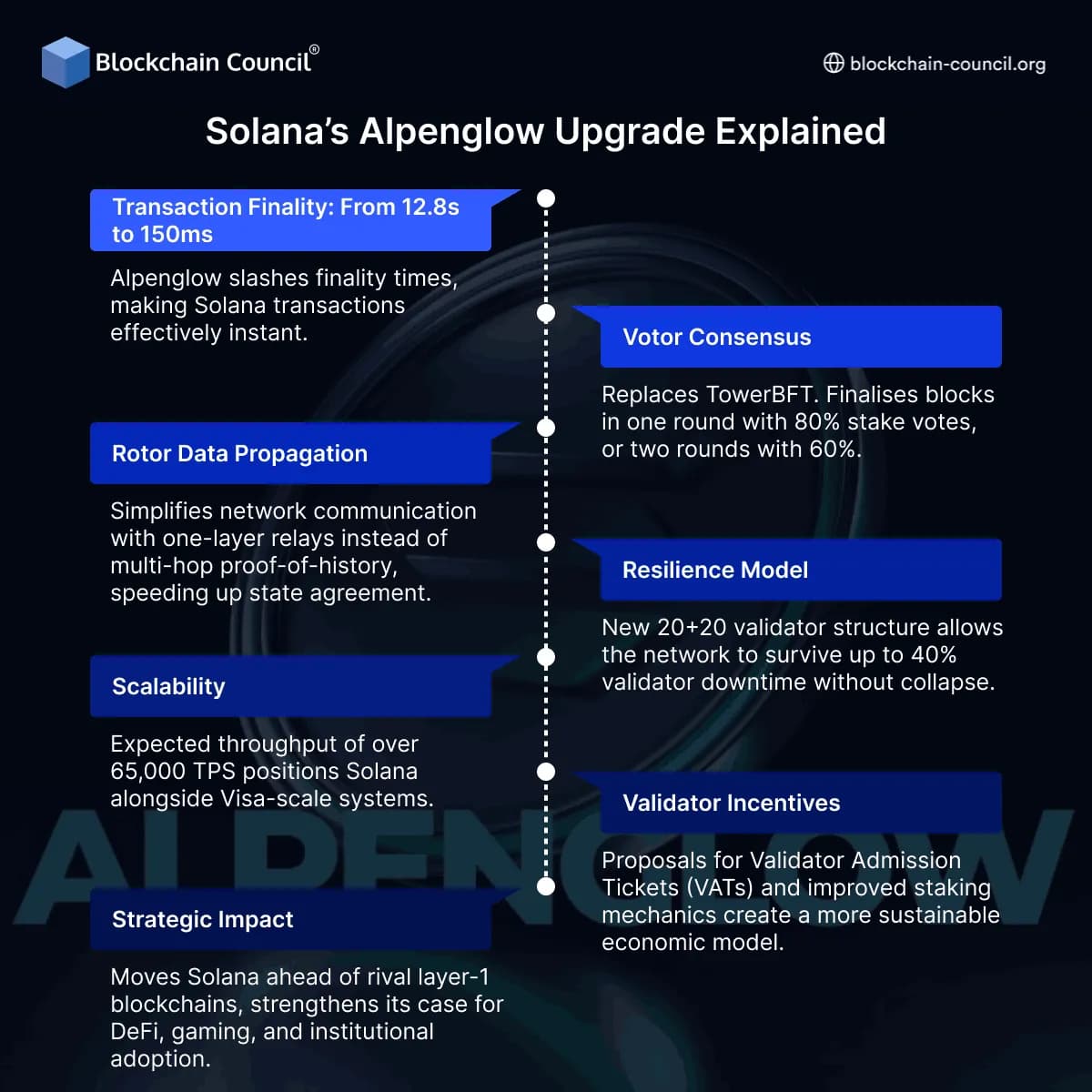
- Transaction Finality: From 12.8s to 150ms
Alpenglow slashes finality times, making Solana transactions effectively instant. - Votor Consensus
Replaces TowerBFT. Finalises blocks in one round with 80% stake votes, or two rounds with 60%. - Rotor Data Propagation
Simplifies network communication with one-layer relays instead of multi-hop proof-of-history, speeding up state agreement. - Resilience Model
New 20+20 validator structure allows the network to survive up to 40% validator downtime without collapse. - Scalability
Expected throughput of over 65,000 TPS positions Solana alongside Visa-scale systems. - Validator Incentives
Proposals for Validator Admission Tickets (VATs) and improved staking mechanics create a more sustainable economic model. - Strategic Impact
Moves Solana ahead of rival layer-1 blockchains, strengthens its case for DeFi, gaming, and institutional adoption.
Remaining Challenges
Even with Alpenglow, Solana still faces hurdles. The network has a history of outages, many of which stem from relying on a single client implementation called Agave. Critics note that until client diversity improves, risks remain.
The planned launch of Firedancer, a new validator client expected later in 2025, should help. By introducing redundancy and optimisation, Firedancer could make Solana more robust while complementing Alpenglow’s speed gains.
What This Means for Solana
If successfully deployed, Alpenglow could transform Solana’s reputation. No longer would it just be the “fast” blockchain—it could become the benchmark for transaction speed across the industry.
This has direct implications:
- DeFi applications could offer near-instant swaps and lending transactions.
- Gaming platforms could build experiences indistinguishable from Web2 apps.
- institutios might finally see blockchains as reliable enough for real-time settlement.
Combined with Firedancer and improved staking economics, Solana’s roadmap is about more than speed. It is about building trust with users, developers, and enterprises.
Investor and Developer Sentiment
The vote’s overwhelming support shows that validators and the wider Solana community believe in the direction. Developers are particularly excited about the potential to eliminate user friction. Investors see it as a competitive edge that could drive adoption and token demand.
However, some remain cautious. Outages, regulatory uncertainty, and competition from Ethereum, Sui, and other high-performance chains are still in play.
Building Skills Around Emerging Tech
The Alpenglow upgrade highlights how quickly blockchain technology evolves. For those aiming to stay ahead, learning how to interpret these changes is essential. A Data Science Certification can help you analyse blockchain performance and adoption metrics. For leaders guiding strategy, a Marketing and Business Certification can prepare you to translate these upgrades into real-world opportunities.
Conclusion
With 99% validator support, Solana’s Alpenglow upgrade is set to redefine what blockchain finality looks like. Cutting transaction settlement to 150 milliseconds is not just a technical milestone. It is a statement of intent—that Solana aims to rival payment networks, lead in speed, and open the door to entirely new categories of applications.
Whether it lives up to this promise will depend on execution, resilience, and adoption. But for now, Alpenglow represents one of the most significant blockchain upgrades of 2025.
Related Articles
View All
Cryptocurrency
The Future of Crypto: Regulation, Institutional Adoption & Digital Assets
Explore the Future of Crypto, from regulation and spot ETFs to stablecoin payments, CBDCs, and tokenised assets. A clear, up-to-date guide for beginners and professionals.

Cryptocurrency
Beyond Bitcoin: DeFi, Stablecoins, NFTs & the Expanding Crypto Ecosystem
Go Beyond Bitcoin and explore DeFi, stablecoins, NFTs, DAOs, tokenisation, and Web3. A clear guide to how the expanding crypto ecosystem works and how its parts connect.

Cryptocurrency
Understanding the Crypto Market: Prices, Volatility & What Moves Crypto
Understanding the Crypto Market made simple. Learn how crypto prices are set, what market cap and liquidity mean, why volatility happens, and which factors move prices.
Trending Articles
AWS Career Roadmap
A step-by-step guide to building a successful career in Amazon Web Services cloud computing.

Top 5 DeFi Platforms
Explore the leading decentralized finance platforms and what makes each one unique in the evolving DeFi landscape.
How Blockchain Secures AI Data
Understand how blockchain technology is being applied to protect the integrity and security of AI training data.