

DeFi Due Diligence Checklist: Smart Contract Risk, Liquidity Risk, and Protocol Governance
 Suyash Raizada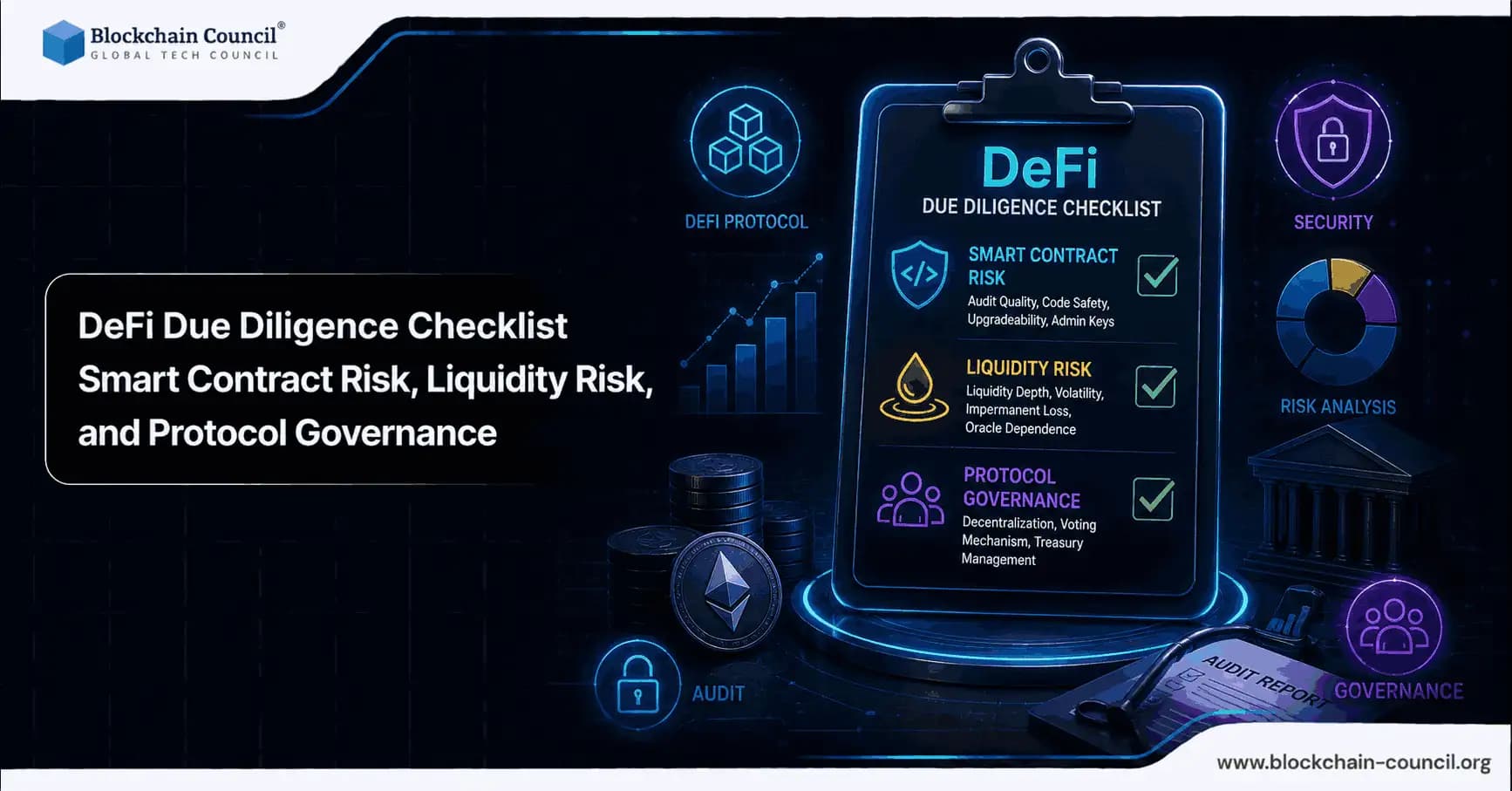
DeFi due diligence checklist processes are no longer optional for anyone interacting with decentralized finance. As of mid-2025, DeFi total value locked stands at approximately $150 billion across chains such as Ethereum, Solana, and Base, according to DefiLlama data. That scale attracts innovation, but it also attracts attackers and amplifies the consequences of poor risk controls. Security incidents continue to stem from smart contract vulnerabilities, liquidity failures, and governance breakdowns, with smart contract exploits alone accounting for $1.7 billion in losses in 2024 according to PeckShield reporting. Learn how to perform DeFi due diligence by evaluating smart contract vulnerabilities, liquidity risks, tokenomics, and governance structures before investing or integrating with protocols by building expertise through a Cryptocurrency Expert, analyzing on-chain risk indicators and protocol data using a Python certification, and applying DeFi insights to strategic decision-making with a Digital marketing course.
This article provides an actionable DeFi due diligence checklist focused on smart contract risk, liquidity risk, and protocol governance. It is designed for professionals, developers, and enterprises that need a repeatable process to screen protocols before depositing funds, integrating a DeFi primitive, or approving a treasury allocation.

How to Use This DeFi Due Diligence Checklist
Before diving into category-specific checks, establish a consistent scoring method so teams can make reliable decisions under time pressure.
Score each category 1-10: smart contract risk, liquidity risk, and protocol governance risk.
Set a minimum threshold: many risk teams reject protocols scoring below 7 in any single category.
Document evidence: links to verified contracts, audit reports, governance proposals, and on-chain dashboards.
Re-check after material changes: upgrades, parameter changes, bridge expansions, and oracle migrations all warrant a fresh review.
Teams building capabilities in this area often pair checklist work with structured training - Blockchain Council certifications such as Certified Blockchain Expert, Certified Smart Contract Developer, and Certified Cryptocurrency Expert provide shared technical vocabulary and consistent review standards across teams.
1. Smart Contract Risk Checks
Smart contract risk is often the highest-severity failure mode in DeFi because contracts are immutable or difficult to change safely, publicly visible, and continuously exposed to adversarial testing. CertiK has highlighted that a significant portion of exploits target post-audit changes or forks that did not receive a fresh review, making change management a core component of due diligence.
Code Verification and Provenance
Verify source code against deployed bytecode using the relevant block explorer (such as Etherscan or chain-specific equivalents). Avoid interacting with unverified contracts.
Identify forks and measure divergence. If a protocol is a fork of an existing codebase, review exactly what changed. Reject forks that lack re-audits of their modifications.
Check deployment addresses and ownership links. Confirm that official documentation, verified social channels, and on-chain deployment history are consistent.
Audit Quality, Recency, and Scope
Confirm audits within the last 12 months from reputable firms such as OpenZeppelin, Trail of Bits, and Certora.
Read the full report, not just the logo. Ensure all Critical and High severity findings were resolved and that remediations were independently verified.
Prefer multiple independent audits for high-TVL systems or protocols involving bridges, leverage, or complex tokenomics.
Look for formal verification where appropriate. Formal methods can reduce categories of logic errors that manual review may miss, particularly in core accounting modules.
Access Control, Upgrades, and Emergency Powers
Many losses stem not from novel bugs but from unsafe admin design. Upgradeable contract patterns can be safe, but only when governance and operational controls are robust.
Reject single-key control for critical functions. Avoid designs where one externally owned account can upgrade implementations, pause withdrawals, or mint assets.
Require multisig plus timelock for upgrades and sensitive parameter changes. A timelock window of at least 48 hours gives users sufficient time to exit.
Confirm role-based access control rather than simplistic ownership patterns. Ensure roles are limited, documented, and monitored.
Check for safe pausing mechanisms. Pausing can protect users during incidents, but centralized pause controls can also enable censorship or rug scenarios.
Known Exploit Classes and Protocol-Specific Pitfalls
Reentrancy defenses: verify standard patterns such as Checks-Effects-Interactions and appropriate guards in external call paths.
Oracle manipulation resistance: confirm price feeds are robust and cannot be trivially manipulated via low-liquidity pools.
Bridge risk awareness: cross-chain bridges are frequent targets. Historical cases such as Ronin and Orbit Chain illustrate validator and key-management weaknesses that due diligence must explicitly address.
Chain-specific assumptions: understand differences in execution, composability, and MEV dynamics across Ethereum and high-throughput chains.
Ongoing Monitoring and Change Detection
Monitor contract upgrades and admin actions using on-chain alerts and risk tooling such as TRM Labs dashboards.
Track new deployments: attackers may deploy lookalike contracts with similar names and interfaces to deceive users.
Review incident response readiness: public postmortems, active bug bounty programs, and accessible security contacts are positive indicators.
2. Liquidity Risk Checks
Liquidity risk is the probability that you cannot enter or exit a position at expected prices, or that a protocol becomes insolvent during periods of volatility. Analysis from Dune Analytics dashboards shows a significant portion of DEX participants experience losses during volatile periods, while Chainalysis reporting highlights that flash loans and oracle swings can cascade into liquidations and bad debt accumulation.
Pool Health and Market Structure
Check TVL and concentration: as a practical baseline, look for pools with more than $10 million TVL and avoid pools dominated by a single large liquidity provider.
Evaluate trading activity: a 7-day volume-to-TVL ratio above 0.5 can indicate healthier market activity and lower manipulation risk.
Assess asset quality: avoid pools built on thinly traded or newly issued tokens with unclear price discovery mechanisms.
Impermanent Loss and Incentive Sustainability
Model impermanent loss scenarios across realistic volatility ranges rather than steady-state assumptions alone.
Scrutinize fixed APY claims: unusually high fixed yields (such as those above 100%) frequently indicate unsustainable token emissions or structurally unsound incentive designs.
Review emissions schedules: identify cliffs, unlock events, and incentive programs that may expire and trigger liquidity withdrawals.
Oracle Integrity and Liquidation Safety
Prefer decentralized oracle designs such as Chainlink where appropriate, and avoid sole reliance on a single DEX spot price.
Check staleness controls: ensure the protocol rejects stale oracle data and has clear update frequency requirements.
Review liquidation parameters: understand collateral factors, liquidation bonuses, and circuit breakers designed to handle rapid price movements.
Withdrawal and Redemption Testing
Perform a small deposit and withdrawal test to validate redemption mechanics, time delays, and fees before committing larger amounts.
Stress test assumptions: simulate a scenario where liquidity evaporates and large liquidity providers exit simultaneously.
Confirm reserve transparency for yield strategies and real-world asset-backed positions, including proof-of-reserve reporting where applicable.
Cross-Chain Exposure Controls
DefiLlama bridge data shows cross-chain bridges hold substantial TVL and remain frequent exploit targets. Treat bridging as a distinct risk category rather than a minor implementation detail.
Audit bridge contracts and validator sets: review how messages are validated and what happens during a signer compromise event.
Cap bridge exposure: many institutional risk frameworks limit bridge-related exposure to under 5% of a portfolio given tail risk.
Watch cross-chain price discrepancies: inconsistent liquidity across chains increases opportunities for price manipulation.
3. Protocol Governance Risk Checks
Protocol governance can support decentralization, but it can also introduce centralization through less visible mechanisms. Governance attacks continue to occur, including stake accumulation strategies and flash loan exploits such as the Beanstalk incident. This demonstrates that voting mechanics and proposal execution require the same rigorous scrutiny applied to code.
Token Distribution and Voting Power
Analyze holder concentration: flag protocols where the top 10 holders control more than 30% of supply, particularly when tokens are liquid and easily accumulated.
Check delegation patterns: voting power may be concentrated through delegates even when token holder distribution appears broad.
Prefer protective voting designs: look for quorum requirements, time-weighted voting, and mechanisms that reduce whale dominance.
Timelocks, Proposal Flow, and Execution Safety
Require proposal timelocks of 48 hours or more for sensitive changes, giving users adequate time to exit if a problematic proposal passes.
Review proposal history: look for self-dealing, rushed votes, repeated parameter changes that benefit insiders, or unusual emergency actions.
Inspect execution paths: understand what governance can actually execute on-chain, including upgrades, parameter changes, and treasury movements.
Multisig Signers, Operational Security, and Transparency
Identify multisig signers where disclosed, and assess their independence and operational maturity.
Look for documented controls: security policies, incident response playbooks, and regular audit cadence are positive signals.
Use on-chain monitoring: tools such as TRM Labs or Nansen can help identify anomalous treasury movements or governance token accumulation patterns.
Regulatory and Compliance Posture
Regulatory developments such as MiCA in the EU and legislative proposals in the US increase the importance of disclosure, transparency, and governance clarity. For enterprises, regulatory uncertainty can present a business continuity risk even when the underlying smart contracts are technically sound.
Check jurisdiction and entity structure: understand who operates front ends, who controls admin keys, and where legal exposure may reside.
Review disclosures: risk statements, terms of use, and governance documentation should be accessible and substantive.
Assess compliance signals for real-world assets: verify reserve attestations and oracle designs that support proof-of-reserve updates.
Professional Workflow: A Repeatable DeFi Due Diligence Process
Protocol overview: define the product, the chain or chains involved, the trust assumptions, and the core contracts.
Smart contract review: verified code, audits, admin controls, upgrade paths, and monitoring setup.
Liquidity review: pool TVL, concentration, oracle design, liquidation mechanics, and withdrawal testing.
Governance review: token distribution, timelocks, proposal history, multisig setup, and treasury controls.
Risk scoring: assign a score of 1-10 per category and document supporting evidence.
Decision: approve, approve with limits, or reject. Set position limits and configure monitoring alerts accordingly.
Understand how DeFi professionals assess protocol security, governance risks, treasury management, and liquidity sustainability by mastering blockchain risk analysis through a Certified Blockchain Expert, building DeFi monitoring tools using a Node JS Course, and growing trusted Web3 products using an AI powered marketing course.
Conclusion
A disciplined DeFi due diligence checklist separates informed risk-taking from blind exposure. Smart contract risk remains the dominant driver of losses, liquidity risk determines whether you can exit safely under stress, and protocol governance risk determines whether the rules can change against you. With DeFi TVL near $150 billion and expanding into real-world assets, cross-chain architectures, and more sophisticated audit tooling, the baseline standard for due diligence has risen accordingly.
Use the checklist above to standardize reviews, set category thresholds, and continuously monitor for post-deposit changes. The safest interaction in DeFi is the one you can explain, measure, and re-validate each time the protocol evolves.
FAQs
1. What is a DeFi due diligence checklist?
A DeFi due diligence checklist is a structured process used to evaluate decentralized finance protocols before investing or integrating with them. It focuses on smart contract security, liquidity strength, and governance quality. This helps reduce financial and operational risks.
2. Why is DeFi due diligence important?
DeFi protocols manage billions of dollars and are frequent targets for hackers and exploits. Poor risk assessment can lead to major financial losses. Proper due diligence helps users identify unsafe platforms before committing funds.
3. What is smart contract risk in DeFi?
Smart contract risk refers to vulnerabilities or coding flaws that attackers can exploit. Bugs in contracts may result in stolen funds or protocol failures. Audits and code reviews help reduce these risks.
4. Why should users verify smart contract code?
Verified code allows users to compare deployed contracts with publicly available source code. This helps confirm that the contract has not been secretly altered. Unverified contracts carry a much higher risk.
5. How important are smart contract audits?
Smart contract audits help identify security flaws before attackers can exploit them. Users should check whether reputable firms completed the audits recently. Multiple independent audits usually provide stronger security assurance.
6. What is upgrade risk in DeFi protocols?
Upgrade risk exists when developers can modify protocol contracts after deployment. Unsafe upgrade systems may allow malicious changes or unauthorized access. Strong governance and timelocks help reduce this risk.
7. Why are multisig wallets important in DeFi?
Multisig wallets require approvals from multiple parties before transactions are executed. This prevents a single individual from controlling sensitive protocol functions. It significantly improves operational security.
8. What is liquidity risk in DeFi?
Liquidity risk is the possibility of being unable to buy or sell assets at expected prices. Low liquidity can cause major price swings and withdrawal difficulties. Strong liquidity pools reduce this problem.
9. How can users evaluate liquidity pool health?
Users should review total value locked (TVL), trading activity, and liquidity concentration. Healthy pools usually have consistent trading volume and diversified liquidity providers. This lowers manipulation and insolvency risks.
10. What is impermanent loss in DeFi?
Impermanent loss occurs when the value of pooled assets changes compared to simply holding them. This risk increases during periods of high market volatility. Liquidity providers should model possible loss scenarios carefully.
11. Why are high APY promises risky in DeFi?
Extremely high APYs are often driven by unsustainable token rewards or weak economic models. Once incentives decline, liquidity may disappear quickly. Users should always examine how yields are generated.
12. What role do oracles play in DeFi?
Oracles provide external price data to smart contracts and lending systems. Weak or manipulated oracle feeds can trigger liquidations or pricing errors. Reliable decentralized oracles improve protocol stability.
13. Why should users test withdrawals before large deposits?
Testing withdrawals confirms that redemption systems work properly and without unexpected delays. It also helps users identify hidden fees or restrictions. Small tests reduce the risk of getting trapped in illiquid positions.
14. What are bridge risks in DeFi?
Cross-chain bridges transfer assets between blockchains but are common targets for exploits. Weak validator systems or compromised keys can lead to major losses. Users should limit exposure to risky bridges.
15. What is governance risk in DeFi?
Governance risk occurs when voting systems or token distribution become overly centralized. Large holders may control decisions that benefit themselves over users. Strong governance structures improve fairness and transparency.
16. Why does token distribution matter in governance?
If a small group controls most governance tokens, they can dominate voting outcomes. This increases the risk of unfair proposals or treasury misuse. Balanced distribution supports healthier decentralization.
17. What are governance timelocks in DeFi?
Governance timelocks delay major protocol changes before execution. This gives users time to review proposals and exit if necessary. Timelocks improve transparency and reduce sudden governance attacks.
18. How can users monitor DeFi protocol changes?
Users can track upgrades, governance proposals, and treasury movements through on-chain monitoring tools. Alerts help detect suspicious changes quickly. Continuous monitoring is essential because DeFi protocols evolve rapidly.
19. Why is regulatory compliance important in DeFi?
Regulatory uncertainty can affect the long-term operation of DeFi platforms. Strong compliance practices improve transparency and reduce legal risks. This is especially important for enterprise and institutional users.
20. What is the main goal of DeFi due diligence?
The main goal of DeFi due diligence is to identify and reduce technical, financial, and governance risks. It helps users make informed decisions before interacting with protocols. Careful evaluation improves security and investment confidence.
Related Articles
View All
Cryptocurrency
Smart Contract Exploits Explained: How Hackers Drain DeFi Protocols
Smart contract exploits now target DeFi logic, bridges, governance, oracles, and keys. Learn how attacks work and how teams can reduce protocol risk.

Cryptocurrency
Liquidity Mining Explained: How Crypto Users Earn Protocol Incentives
Liquidity mining lets crypto users supply assets to DeFi pools and earn fees plus token incentives. Learn how it works, where rewards come from, and the risks.

Cryptocurrency
AI and DeFi: How Smart Algorithms Are Reshaping Decentralized Finance
AI and DeFi are converging through agents, risk models, lending automation, and portfolio tools, but smart controls remain essential.
Trending Articles
The Role of Blockchain in Ethical AI Development
How blockchain technology is being used to promote transparency and accountability in artificial intelligence systems.
AWS Career Roadmap
A step-by-step guide to building a successful career in Amazon Web Services cloud computing.
How Blockchain Secures AI Data
Understand how blockchain technology is being applied to protect the integrity and security of AI training data.