

Spot Trading vs Futures Trading: Key Differences, Risks, and Use Cases

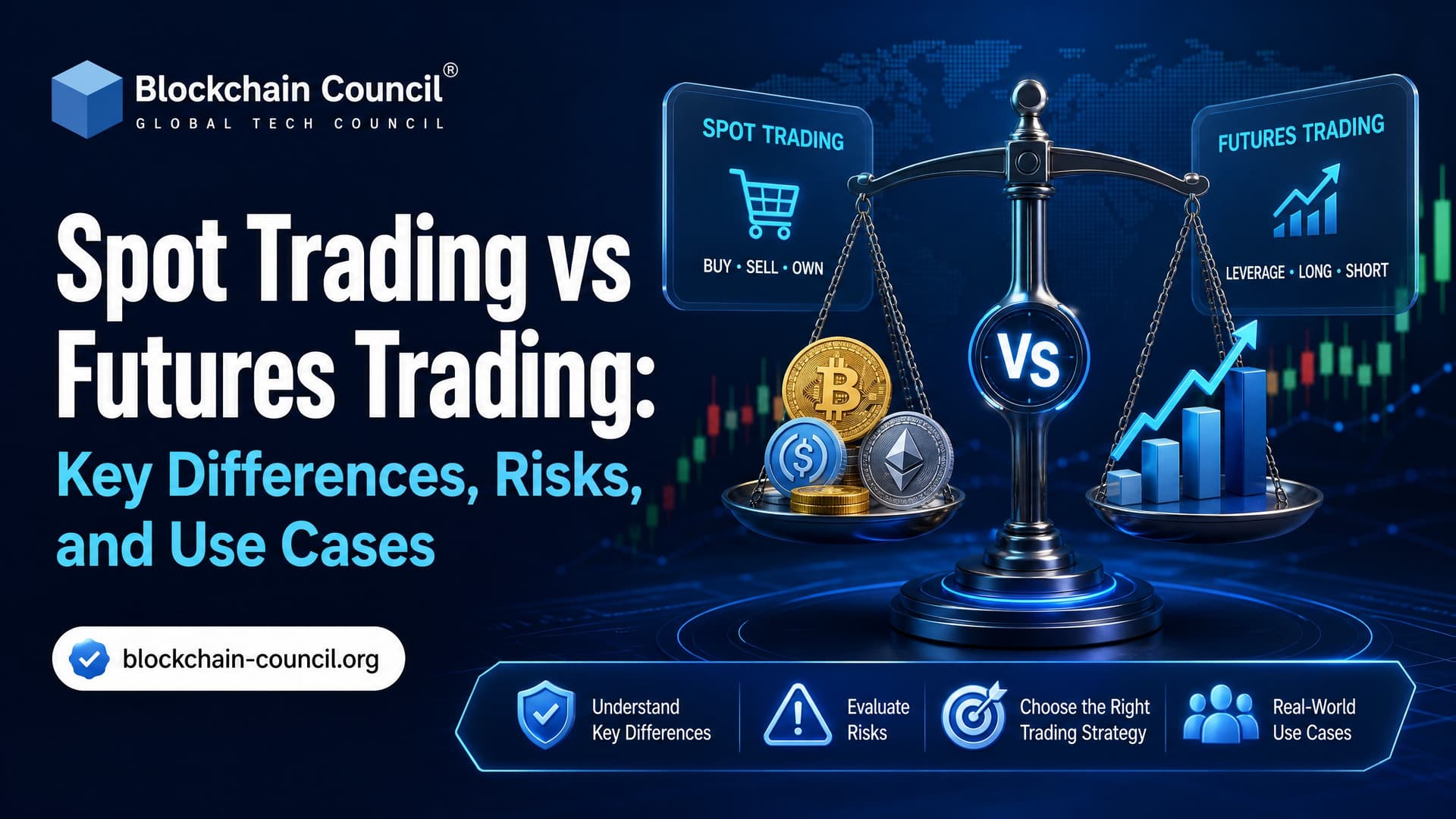
Spot Trading vs Futures Trading comes down to one practical question: do you want to own the asset now, or trade a contract based on where its price may go later? Spot trading is direct and easier to understand. Futures trading is more flexible, but the margin, funding, expiry, and liquidation rules can punish weak risk management fast.
This matters in crypto because most large exchanges place spot and futures markets side by side. One click can move you from buying bitcoin to taking a 20x perpetual futures position. Same chart. Very different risk.

What Is Spot Trading?
Spot trading means buying or selling an asset at the current market price, with settlement happening immediately or within the normal clearing cycle for that market. In crypto, if you buy 1 ETH on a spot market, you own 1 ETH. You can withdraw it to a wallet, use it in DeFi, stake it where supported, or hold it for years.
In equities and many traditional markets, settlement may follow a short clearing cycle. In crypto, the exchange balance usually updates almost instantly, although on-chain withdrawal depends on network confirmation time.
Key features of spot trading
- Direct ownership: You own the underlying asset after purchase.
- Simple pricing: The spot price reflects current supply and demand.
- No expiry: You can hold the asset as long as you want.
- No futures liquidation: If you buy without margin, the position is not force-closed because of maintenance margin.
- Useful for utility: You need spot crypto for transfers, payments, staking, governance, and on-chain activity.
Spot trading is usually the better starting point for beginners. It is also the cleaner choice if your goal is long-term accumulation, treasury holding, or actual use of tokens.
What Is Futures Trading?
Futures trading means buying or selling a standardized contract tied to the future price of an asset. The contract may have a fixed expiry, as in many commodity or index futures, or it may be a perpetual futures contract with no expiry, which is common in crypto.
With futures, you usually do not own the underlying asset. You own a position in a contract. If you buy BTC futures, you are not holding bitcoin in a wallet. You are exposed to bitcoin price movement through a derivative.
Key features of futures trading
- Contract-based exposure: You trade price exposure, not the asset itself.
- Margin: You post collateral instead of paying the full notional value upfront.
- Leverage: A small amount of capital can control a larger position.
- Long and short access: Futures make it easier to profit from falling prices or hedge spot holdings.
- Extra mechanics: You must understand funding rates, expiry, basis, maintenance margin, and liquidation rules.
To be blunt, futures are not just spot trading with bigger numbers. A 10x long position can run into serious trouble after roughly a 10 percent adverse move, sometimes sooner once fees and maintenance margin eat in. On many crypto perpetual markets, funding is charged or paid at set intervals, often every eight hours. Traders who ignore that line item can lose money even when the chart looks flat.
Spot Trading vs Futures Trading: Main Differences
The table below gives a practical view of Spot Trading vs Futures Trading across ownership, settlement, costs, and risk.
| Factor | Spot trading | Futures trading |
|---|---|---|
| Asset ownership | You own the underlying asset | You trade a contract linked to the asset price |
| Settlement | Immediate or near-immediate market exchange | At expiry, by cash settlement, or continuously in perpetual contracts |
| Leverage | Usually none unless using margin | Common and often high |
| Risk | Market price risk | Market risk plus liquidation, funding, basis, and margin risk |
| Best suited for | Beginners, long-term holders, token users | Experienced traders, hedgers, arbitrage desks |
| Typical crypto use | Buying BTC, ETH, or tokens to hold or transfer | Shorting BTC, hedging ETH exposure, trading funding rates |
Risk Profile: Why Futures Can Hurt Faster
Spot trading has risk. If you buy bitcoin at $70,000 and it falls to $50,000, your portfolio takes a large hit. But if you paid in full and did not borrow, you still own the bitcoin.
Futures risk is different. The exchange can close your position if your margin falls below required levels. That forced closure can happen during a fast wick, even if price later rebounds. If you have traded crypto for a while, you have probably seen this: the candle taps a liquidation cluster, positions get wiped, and price snaps back within minutes. Painful. Also common.
Futures risks you must understand
- Liquidation risk: The platform can close your position when margin is insufficient.
- Funding risk: Perpetual futures use funding payments to keep contract prices near spot prices.
- Basis risk: Futures and spot prices can diverge. That gap matters in hedging and arbitrage.
- Rollover risk: Expiring futures may need to be closed or rolled into a later contract.
- Behavioral risk: High leverage often leads traders to oversize positions.
CME Group describes futures as standardized contracts built partly for risk transfer, especially in commodities, rates, and indices. In crypto, the same principle applies, but retail platforms have made derivatives access much easier. Easier access does not mean easier trading.
Pricing: Spot Price, Futures Price, and Basis
The spot price is the current market price. The futures price reflects expectations about future value, plus costs or benefits tied to holding the asset until settlement. In traditional commodities, storage and financing costs matter. In crypto perpetual futures, funding rates play a major role.
When futures trade above spot, the market is often described as being in contango. When futures trade below spot, it is backwardation. Traders watch this spread, called basis, because it can signal sentiment and positioning.
Coinbase educational material and crypto market research commonly point to open interest, funding rates, and futures basis as useful inputs for reading market conditions. You do not need to trade futures to learn from futures data. A spot trader can still use rising open interest and extreme funding as warning signs that a move is crowded.
When Spot Trading Makes More Sense
Choose spot trading when your goal is ownership, simplicity, or actual token use. It is the right choice for most new crypto participants.
Common spot trading use cases
- Long-term accumulation: Buying BTC or ETH over time without managing margin.
- Wallet transfers: Moving assets to self-custody or between exchanges.
- Staking and DeFi: Using tokens in protocols where actual ownership is required.
- Payments: Sending crypto for settlement, remittance, or merchant use.
- Enterprise treasury: Holding digital assets without daily margin management.
If you are learning crypto market structure, start with spot. Pair that with wallet security, order types, and basic technical analysis before touching derivatives.
When Futures Trading Makes More Sense
Futures trading fits traders who already understand risk sizing and want tools beyond simple buying and selling. It is useful, but only when used with discipline.
Common futures trading use cases
- Hedging: If you hold spot ETH, a short ETH futures position can reduce downside exposure.
- Short selling: Futures make bearish trades easier than borrowing the asset.
- Capital-efficient exposure: Margin lets traders control larger notional positions with less upfront capital.
- Basis trades: Traders may buy spot and sell futures when the futures premium is attractive.
- Funding strategies: Advanced traders monitor perpetual funding rates for market imbalance.
Here is the trade-off. Futures are excellent for hedging and tactical exposure. They are a poor choice for beginners who mainly want to win losses back quickly. That mindset turns leverage into a problem.
Spot Trading vs Futures Trading in Crypto Markets
Crypto has made the gap between spot and futures especially important because perpetual contracts dominate activity on many major venues. Perpetual futures have no fixed expiry. Instead, funding payments between long and short traders help keep the contract price close to spot.
For example, when bullish demand is heavy, perpetual futures may trade above spot and longs pay shorts. That does not mean every long trade is bad, but it means the cost of holding the position changes. On a quiet weekend, funding can be the difference between a decent trade and a frustrating one.
Professional traders often use both markets together. They may hold spot bitcoin for long-term exposure, short futures during high-risk events, and watch basis to gauge market stress. This is why Spot Trading vs Futures Trading should not be treated as a beginner-versus-pro label. The better question is: what job are you asking the market instrument to do?
How to Choose Between Spot and Futures
- Define your goal: If you need ownership or long-term exposure, choose spot. If you need hedging or short exposure, futures may fit.
- Check your experience: If terms like maintenance margin, mark price, and funding rate are unclear, do not trade futures yet.
- Limit position size: Never size a futures trade only by available maximum leverage.
- Use stop plans: Know the invalidation point before entering the trade.
- Track fees and funding: Futures costs are not limited to entry and exit fees.
- Practice first: Use small size or a test environment before trading meaningful capital.
A practical learning path is to master spot order books first: market orders, limit orders, slippage, bid-ask spread, and custody. Then study derivatives mechanics. For structured learning, you can explore Blockchain Council resources such as the Certified Cryptocurrency Expert™ (CCE) for crypto market fundamentals, the Certified Blockchain Expert™ (CBE) for blockchain concepts, and the Certified Blockchain Developer™ (CBD) if you want to build systems around digital assets rather than only trade them.
Final Takeaway
Spot Trading vs Futures Trading is not about which one wins in every case. Spot trading is better for ownership, utility, and simpler risk. Futures trading is better for hedging, short exposure, and advanced strategies, but it demands stricter controls.
If you are new, buy spot, learn custody, and track futures data without trading it yet. If you are experienced, treat futures as a risk tool first and a speculation tool second. Your next step: write down one trade plan using spot only, then write a separate hedge plan using futures, including entry, exit, liquidation level, and funding cost. If you cannot calculate those numbers, you are not ready for the futures trade.
Related Articles
View All
Cryptocurrency
DeFi Explained: Decentralized Finance, Protocols, and Use Cases
DeFi explained for professionals: learn how decentralized finance works, key protocols, real use cases, risks, and what to study next.

Cryptocurrency
Crypto Futures Trading Explained: Contracts, Hedging, and Speculation
Crypto futures trading lets you hedge, speculate, and trade crypto price movements without owning coins, but margin and liquidation risk demand discipline.

Cryptocurrency
Spot Trading in Crypto Explained: How Immediate Market Trades Work
Spot trading in crypto means buying or selling actual digital assets at current market prices with near immediate settlement and ownership transfer.
Trending Articles
AWS Career Roadmap
A step-by-step guide to building a successful career in Amazon Web Services cloud computing.
How Blockchain Secures AI Data
Understand how blockchain technology is being applied to protect the integrity and security of AI training data.

Can DeFi 2.0 Bridge the Gap Between Traditional and Decentralized Finance?
The next generation of DeFi protocols aims to connect traditional banking with decentralized finance ecosystems.