

Blockchain Analytics for Investigations: Tools, Techniques, and Use Cases
 Suyash Raizada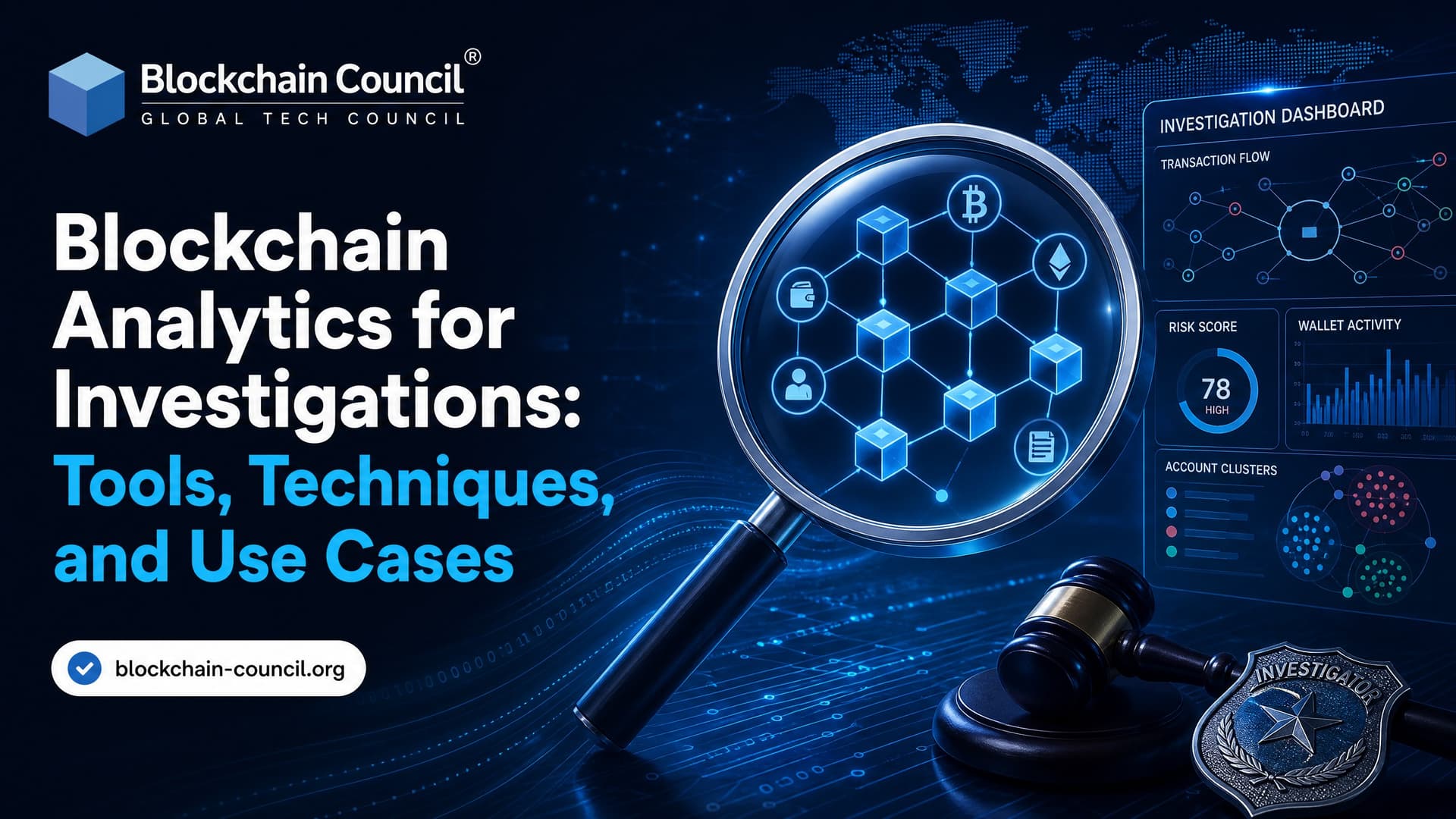
Blockchain analytics for investigations turns public ledger data into usable evidence. You use it to trace funds, connect wallets to known entities, detect laundering patterns, and explain what happened in a way that a compliance officer, regulator, or court can follow.
This is no longer a niche skill. Chainalysis reported illicit cryptocurrency activity of 40.9 billion dollars in 2024 and projected that figure could exceed 51 billion dollars in 2025. The same firm says its intelligence has helped support the seizure of roughly 34 billion dollars in illicit funds worldwide. Those numbers explain why exchanges, banks, law enforcement units, and forensic teams now treat blockchain analytics as core infrastructure.

What Is Blockchain Analytics for Investigations?
Blockchain analytics is the process of examining public blockchain data to understand how funds move and who may control the addresses involved. It combines transaction graphs, address clustering, entity labels, risk scoring, and off-chain intelligence.
For investigations, the goal is practical: follow the money. You may start with a victim deposit address from a phishing case, a ransomware payment, a sanctioned wallet, or a suspicious exchange withdrawal. From there, you trace movement through wallets, exchanges, mixers, bridges, DeFi protocols, and other services.
The work has three layers:
- Tracing: mapping where assets came from and where they went.
- Attribution: linking addresses or clusters to exchanges, services, threat actors, or individuals.
- Interpretation: explaining whether the pattern looks like normal user behavior, fraud, laundering, sanctions exposure, or another risk type.
That last part matters. A graph is not an investigation by itself. You still need judgment.
Core Data Sources Investigators Use
On-chain data
On-chain data includes wallet addresses, transactions, timestamps, token transfers, smart contract calls, block numbers, fees, and event logs. On Bitcoin, you may analyze UTXOs, change outputs, and transaction inputs. On Ethereum, you inspect externally owned accounts, contract addresses, ERC-20 transfers, ERC-721 transfers, and internal calls.
A practical warning: if you only review ERC-20 Transfer events, you can miss native ETH movements triggered inside contracts. For serious Ethereum investigations, you often need traces from clients or APIs that expose call-level execution, such as debug_traceTransaction on an archive-capable node. Beginners miss this all the time, then wonder why their balances do not reconcile.
Off-chain data
Off-chain data adds context. It can include exchange KYC records, subpoenas, IP logs, sanctions lists, regulatory filings, social media posts, dark web marketplace data, scam reports, and seized device evidence.
This is where pseudonymous data becomes useful intelligence. A blockchain address alone rarely proves identity. A blockchain address tied to a KYC account, login trail, Telegram handle, and withdrawal pattern is much stronger.
Key Techniques in Blockchain Investigations
Transaction graph analysis
Transaction graph analysis shows relationships between addresses and services over time. Investigators use graph views to spot hops, funnels, peel chains, cash-out points, and common intermediaries.
A typical workflow looks like this:
- Start with a known address or transaction hash.
- Trace direct inflows and outflows.
- Expand the graph by one or more hops.
- Identify known services, such as exchanges, bridges, mixers, gambling platforms, or darknet markets.
- Document key paths and exclude irrelevant noise.
Be careful with over-expansion. A ten-hop graph can look impressive and still say very little. In most cases, you want the clearest route to a cash-out service, not a spaghetti diagram.
Address clustering and entity attribution
Clustering groups addresses that are likely controlled by the same entity. Bitcoin clustering often uses heuristics such as common input ownership, although CoinJoin and similar privacy techniques can break or weaken that assumption. On account-based chains like Ethereum, clustering relies more on behavior, funding sources, contract interactions, and service labels.
Attribution then connects clusters to known entities. Analytics platforms maintain labels for exchanges, mixers, sanctioned actors, bridges, scam wallets, ransomware wallets, DeFi protocols, and other services. The best tools explain confidence levels. Treat a weak label as a lead, not a fact.
Risk scoring and typology detection
Risk scoring tools evaluate addresses and transactions based on exposure to known threats and suspicious patterns. Common typologies include:
- Funds moving through mixers or privacy services.
- Peel chains that send small amounts forward while returning change.
- Rapid cross-chain movement through bridges after a hack.
- Deposits into exchanges shortly after ransomware payments.
- Interactions with sanctioned wallets or darknet markets.
- Layered transfers through many fresh wallets with no normal activity history.
Risk scores are useful, but they are not a substitute for evidence. If you are writing a Suspicious Activity Report or preparing a legal brief, include the underlying transaction trail.
AI and machine learning
AI is now part of blockchain analytics for investigations, mainly for anomaly detection, entity matching, alert triage, and case summarization. TRM Labs, for example, has introduced an AI agent inside its forensics product, built on its Orion system and trained with input from professional investigators.
Use AI for speed, not final judgment. Ask it to surface possible paths, summarize clusters, or compare typologies. Then verify the transactions yourself. False confidence is expensive in investigations.
Tool Landscape: What to Use and When
Most blockchain analytics tools fall into three categories.
Transaction screening and KYT tools
Know Your Transaction tools screen transfers in near real time. Exchanges, payment processors, custodians, and fintech platforms use them to flag deposits and withdrawals before processing or after execution.
Examples include Chainalysis KYT and Elliptic Navigator. These tools fit compliance operations where you need alerts, risk rules, sanctions exposure checks, and case queues.
Investigation and forensics platforms
Forensics platforms are built for deeper casework. They offer fund-flow tracing, graph visualization, multi-hop analysis, entity attribution, exportable reports, and collaboration features.
Examples include TRM Forensics, Elliptic Investigator, and Chainalysis Reactor. If you are working ransomware, investment fraud, pig butchering scams, darknet flows, or hacked exchange funds, this is the category you need.
Integrated compliance infrastructure
Large institutions often need analytics inside a wider AML stack. That means transaction monitoring, sanctions screening, case management, Travel Rule workflows, reporting, and audit controls in one operating model.
Analytics should extend the AML program an institution already runs, not sit beside it as a disconnected dashboard. That is the right view. If alerts do not feed case management and reporting, investigators waste time copying screenshots.
What Leading Tools Need in 2026
The strongest platforms share four traits:
- Deep attribution: broad, current labels for exchanges, services, threat actors, and high-risk entities.
- Cross-chain coverage: support for Bitcoin, Ethereum, stablecoins, major Layer 2 networks, bridges, DeFi protocols, and chains such as TRON where stablecoin activity is significant.
- Evidence-grade reporting: clear exports, defensible methodology, timestamped trails, and diagrams that auditors or investigators can review.
- AML integration: alert workflows, risk rules, sanctions screening, Travel Rule support, and APIs that fit institutional systems.
Static blacklists are not enough. Criminal funds often move through new wallets, bridges, and DeFi routes before public lists catch up. You need behavior-based detection and fast enrichment.
Common Use Cases
Law enforcement investigations
Law enforcement teams use blockchain analytics to trace stolen assets, identify laundering networks, locate exchange deposit points, and support seizure processes. In many cases, the key moment is finding funds that land at a compliant exchange. That creates a path for legal requests and possible recovery.
AML and sanctions compliance
Compliance teams screen customer wallets, monitor deposits and withdrawals, investigate alerts, and prepare regulatory filings. Blockchain analytics helps document exposure to sanctioned entities, darknet markets, mixers, ransomware wallets, and high-risk services.
Fraud detection
Crypto platforms use analytics to detect account takeover, scam deposits, suspicious withdrawals, wash trading indicators, and connections to known fraud infrastructure. For consumer-facing platforms, speed matters. If your alert comes three hours late, the money is probably gone.
DeFi and bridge incident response
After smart contract exploits, investigators track stolen funds through swaps, bridges, wrapped assets, and liquidity pools. This requires more than address screening. You need to understand contract calls, token approvals, liquidity events, and cross-chain messaging paths.
Market and treasury intelligence
Analytics is also useful outside criminal investigations. Treasury teams study counterparty exposure, liquidity movement, protocol risk, and concentration patterns. This can guide collateral decisions and help avoid risky counterparties.
Skills You Need to Build
If you want to work in blockchain investigations, build both technical and compliance skills. Learn how Bitcoin UTXOs differ from Ethereum accounts. Understand ERC-20 and ERC-721 events. Practice reading block explorers, but do not depend on them alone. Learn AML basics, sanctions concepts, FATF Travel Rule expectations, and evidence handling.
For structured learning, you can explore paths such as Certified Blockchain Expert™, Certified Cryptocurrency Expert™, and smart contract focused training for professionals who need to understand DeFi and token flows. If your role touches incident response or fraud, cybersecurity training is also worth adding.
Limitations and Trade-offs
Blockchain analytics is powerful, but it is not magic.
- Attribution can be wrong: labels change, services share infrastructure, and criminals reuse deposit paths.
- Privacy tools complicate tracing: mixers, CoinJoin, privacy coins, and chain-hopping reduce certainty.
- Cross-chain paths are messy: bridges, wrapped tokens, and liquidity pools can obscure economic ownership.
- AI can hallucinate: always verify outputs against raw transactions.
- Legal standards vary: what satisfies an internal investigation may not satisfy a court.
To be blunt, a colorful graph with weak assumptions is worse than a simple table of verified transactions. Keep your claims narrow and defensible.
Where Blockchain Analytics Is Heading
The next phase is clear: more cross-chain tracing, deeper DeFi coverage, stronger AI-assisted workflows, and tighter alignment with AML regulation. Investigators will still matter. The tools will get faster, but someone has to decide what the evidence actually means.
If you want to enter this field, start with one chain and one case type. Trace a public exploit, map the wallet flow, identify exchange touchpoints, and write a short evidence memo. Then expand into cross-chain bridges and DeFi. Pair that practice with a recognized credential such as Certified Cryptocurrency Expert™ or Certified Blockchain Expert™ from Blockchain Council, especially if you need to prove capability to employers, clients, or regulators.
Related Articles
View All
Cryptocurrency
Top Crypto Asset Recovery Tools Used in Blockchain Investigations
Explore the top crypto asset recovery tools used in blockchain investigations, from Chainalysis and TRM Labs to Recovery CAT and stablecoin freezes.

Cryptocurrency
DeFi Explained: Decentralized Finance, Protocols, and Use Cases
DeFi explained for professionals: learn how decentralized finance works, key protocols, real use cases, risks, and what to study next.
Cryptocurrency
Utility Tokens Explained: Use Cases, Value, and Token Design
Utility tokens provide access, payments, governance, rewards, and staking inside blockchain ecosystems. Learn how value and tokenomics really work.
Trending Articles
The Role of Blockchain in Ethical AI Development
How blockchain technology is being used to promote transparency and accountability in artificial intelligence systems.

Top 5 DeFi Platforms
Explore the leading decentralized finance platforms and what makes each one unique in the evolving DeFi landscape.
How to Install Claude Code
Learn how to install Claude Code on macOS, Linux, and Windows using the native installer, plus verification, authentication, and troubleshooting tips.