

Public Key vs Private Key: Crypto Keys Explained for Beginners

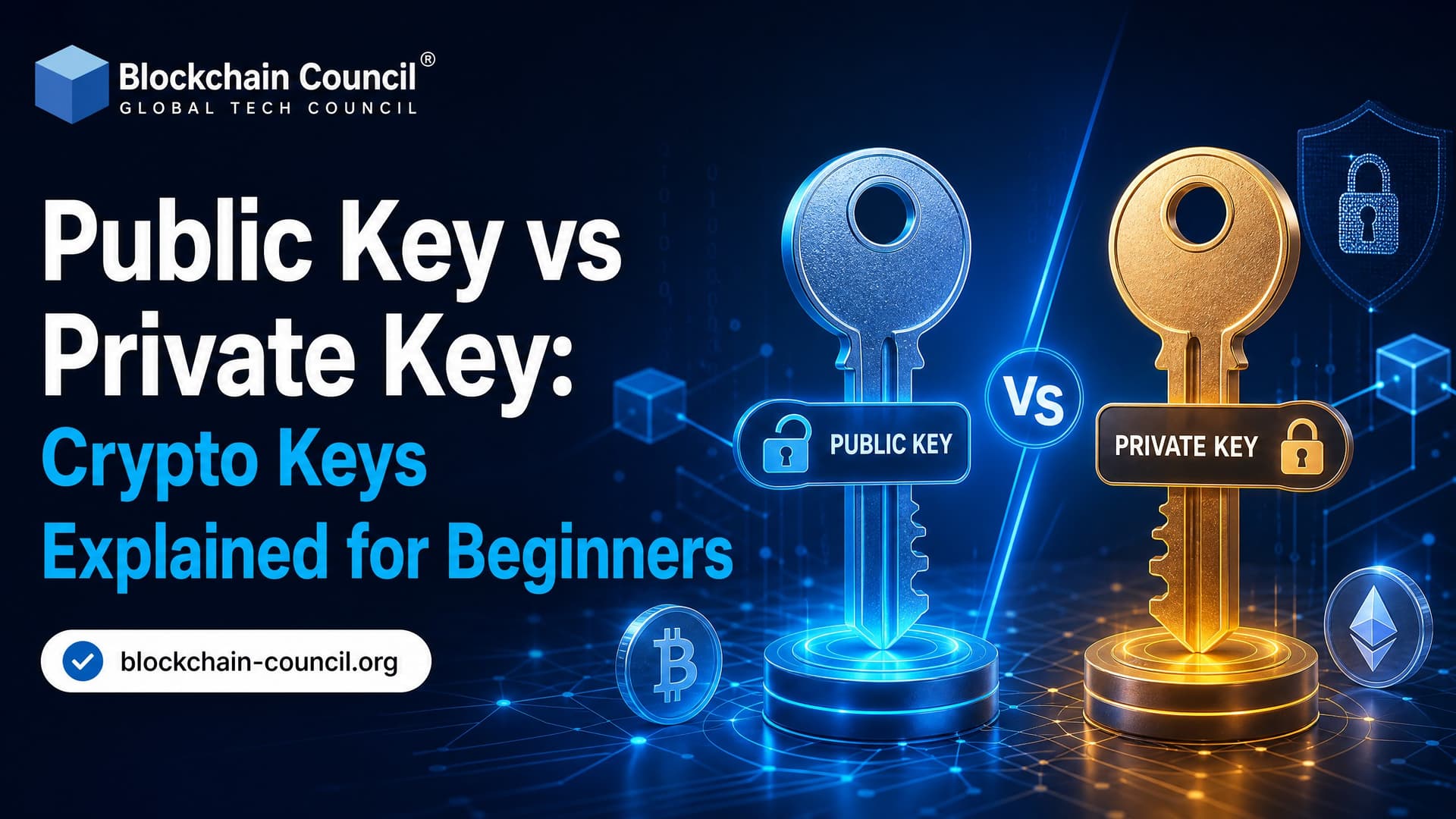
Public key vs private key is the first security concept you need to understand before using Bitcoin, Ethereum, or any self-custody crypto wallet. A public key is safe to share. A private key is not. If someone gets your private key, they can sign transactions and move your funds. The blockchain will treat those transactions as valid because cryptography, not customer support, decides ownership.
That sounds harsh. It is. But once you understand how crypto keys work, wallet security stops being a mystery.

What Are Crypto Keys?
Crypto keys are long pieces of data used in public key cryptography, also called asymmetric cryptography. Instead of one shared password, the system creates a pair of mathematically linked keys:
- Public key: A shareable key used to receive funds, create wallet addresses, encrypt data, and verify digital signatures.
- Private key: A secret key used to sign transactions, prove ownership, and decrypt data.
When you say you own crypto, what you actually control is the private key that can spend it. Everything else follows from that.
Your wallet may hide the raw key from you, especially if it uses a seed phrase. The private key is still what matters under the hood.
Public Key vs Private Key: The Core Difference
The simplest rule is this: public keys are for sharing, private keys are for secrecy.
| Aspect | Public key | Private key |
|---|---|---|
| Purpose | Receive funds and verify signatures | Sign transactions and control funds |
| Visibility | Can be shared | Must stay secret |
| Crypto use | Helps create wallet addresses | Authorizes spending |
| If exposed | Usually not dangerous by itself | Funds may be stolen |
| Recovery | Can often be regenerated from the private key | If lost without backup, funds are usually unrecoverable |
A public key is like a mailbox slot. People can drop things in. A private key is the only key that opens the mailbox. Share the slot, not the key.
How Public Key Cryptography Works
Public key cryptography uses one-way mathematical functions. It is easy for wallet software to create a public key from a private key. Reversing that process and calculating the private key from the public key is computationally infeasible with current technology.
The same model secures HTTPS, where websites use public key cryptography to help browsers set up encrypted sessions. It underpins digital signatures, secure email, and the digital cash systems that came before Bitcoin.
You do not need to memorize the math. You do need to understand the direction of trust:
- Your private key creates proof.
- Your public key lets others verify that proof.
- Your wallet address lets others send funds to you.
How Crypto Wallet Addresses Fit In
A common beginner mistake is thinking the wallet address is the same thing as the public key. It usually is not.
On most blockchains, the address is derived from the public key through hashing and encoding. Ethereum addresses are 20-byte values commonly shown as 42-character hexadecimal strings starting with 0x. Bitcoin uses several formats: legacy P2PKH addresses starting with 1, P2SH addresses starting with 3, and Bech32 addresses starting with bc1.
Here is the flow in plain terms:
- Your wallet creates a private key.
- It derives a public key from that private key.
- It derives one or more addresses from the public key.
- You share the address to receive funds.
- You use the private key to sign transactions when spending funds.
Keep the distinction straight: the public key or address lets people send crypto to you, while the private key gives complete control over the funds.
What Happens When You Send Crypto?
When you send crypto, your wallet does not send your private key to the blockchain. That would be catastrophic. Instead, it uses the private key locally to create a digital signature.
The usual transaction flow looks like this:
- You enter the recipient address and amount.
- The wallet builds a transaction.
- The wallet signs that transaction with your private key.
- The signed transaction is broadcast to the network.
- Nodes verify the signature using public key information.
- If the signature is valid and the funds are available, the transaction can be included in a block.
On Ethereum, a small configuration mistake can surface this fast. If a transaction is signed for the wrong chain ID, such as one that does not match Ethereum mainnet chain ID 1, a node may reject it with an invalid sender error. EIP-155 introduced chain IDs to reduce replay attacks across networks. Beginners often blame gas first, but the signature context can be the real problem.
Encryption vs Digital Signatures
Public and private keys are used in two major ways: encryption and signatures. Crypto wallets mostly focus on signatures. Secure communication systems often use encryption.
Encryption and Decryption
If someone wants to send you an encrypted message, they can encrypt it with your public key. Only your matching private key can decrypt it. Secure messaging and enterprise file-sharing systems rely on this pattern.
It protects confidentiality. The sender does not need your secret. They only need your public key.
Digital Signatures and Verification
For cryptocurrency transactions, the main job is signing. Your private key signs a transaction. Other participants verify the signature using your public key or related address data.
A valid signature proves two things:
- The transaction was approved by the holder of the private key.
- The transaction data was not changed after signing.
This is why blockchains can operate without a bank confirming every payment. The network checks the cryptographic proof.
Seed Phrases, Private Keys, and Wallet Backups
Most modern wallets show you a seed phrase, often 12 or 24 words, instead of asking you to copy raw private keys. That phrase is a human-readable backup that can recreate your wallet keys.
Do not treat it casually. Your seed phrase is effectively the master secret for your wallet.
A practical warning: in MetaMask, the Secret Recovery Phrase restores accounts generated from that phrase. Accounts you import with a separate private key are not automatically covered by that phrase. This catches people during laptop migrations. Check your wallet documentation before assuming one backup covers everything.
What Happens If You Lose a Private Key?
If you lose a private key and have no seed phrase or backup, the funds are usually gone. Not locked for a week. Not pending review. Gone from your control.
Wallet providers all repeat the same warning for a reason: recovery is nearly impossible once a private key is lost or stolen. Public blockchains do not have a password reset button for self-custody wallets.
If your private key is stolen, the outcome can be just as severe. An attacker can sign a valid transaction moving your funds to their own address. From the network's view, the signature is legitimate.
Private Key Security Best Practices
You do not need institutional infrastructure for every small wallet. You do need discipline. Use these practices:
- Never share your private key or seed phrase. No exchange support agent, airdrop site, or wallet update should ever ask for it.
- Use a hardware wallet for meaningful funds. Devices from established vendors keep signing operations isolated from your laptop or phone.
- Write backups offline. Paper or metal backups reduce exposure to malware and cloud account compromise.
- Test recovery with a small wallet first. Before storing serious value, confirm you can actually restore access.
- Watch for fake approvals. On smart contract chains, signing a transaction is not the only risk. Token approvals can also expose assets.
- Consider multisig for teams. For a treasury, a 2-of-3 or 3-of-5 multisignature wallet is usually safer than one person holding a seed phrase.
To be blunt, screenshots of seed phrases in cloud storage are a common self-inflicted wound. Do not do it.
Where Public and Private Keys Are Used Beyond Crypto
The public key vs private key model is not only a crypto concept. It secures much of the internet.
- HTTPS and TLS: Websites use certificates containing public key information so browsers can establish secure connections.
- Secure email: OpenPGP and S/MIME use key pairs for encryption and signatures.
- Enterprise authentication: Systems use key pairs to identify users, servers, and devices.
- File sharing: Sensitive files can be encrypted so only the intended private key holder can decrypt them.
This is why understanding crypto keys helps developers, cybersecurity professionals, and enterprise architects, not just traders.
Future of Crypto Keys
The basic idea will stay: one shareable key, one secret key. The implementation may change.
Three areas are worth watching:
- Post-quantum cryptography: Researchers are building algorithms designed to resist future quantum attacks.
- Smart contract wallets: Account abstraction can add social recovery, spending rules, and different authentication methods.
- Threshold signatures and multi-party computation: Institutions can split signing power so no single party holds the full secret.
These tools improve key management, but they do not change the core lesson. Control of signing authority equals control of assets.
How to Learn Crypto Key Management Properly
If you are new, start by creating a small test wallet and moving a tiny amount on a low-cost network. Practice receiving, sending, backing up, and restoring. You will learn faster this way than by reading wallet screens passively.
For structured learning, Blockchain Council's Certified Cryptocurrency Expert™ (CCE) gives readers a broader understanding of crypto assets, wallets, and market infrastructure. Developers can connect this topic with the Certified Blockchain Developer™ (CBD), especially when learning how signatures interact with smart contracts and transaction validation. For broader blockchain foundations, consider the Certified Blockchain Expert™ (CBE).
Your next step: write down the difference in one sentence, then open your wallet and identify your address, backup method, and signing flow. If you cannot explain where your private key lives, do not move serious funds yet.
Related Articles
View All
Cryptocurrency
Crypto Wallet Recovery Guide: Seed Phrases, Private Keys, and Common Mistakes
Learn how crypto wallet recovery works, why seed phrases and private keys matter, and which mistakes can permanently lock or expose your funds.

Cryptocurrency
Crypto Explained: From Bitcoin to the Digital Asset Revolution
Crypto Explained in simple terms. Learn what cryptocurrency is, why Bitcoin was created, how coins differ from tokens, how wallets work, and the key benefits and risks.

Cryptocurrency
Crypto Lending and Borrowing Explained: DeFi Loans, Rates, and Risks
Crypto lending and borrowing lets users earn yield or access liquidity through DeFi loans, but rates, collateral rules, and liquidations matter.
Trending Articles

Top 5 DeFi Platforms
Explore the leading decentralized finance platforms and what makes each one unique in the evolving DeFi landscape.
How Blockchain Secures AI Data
Understand how blockchain technology is being applied to protect the integrity and security of AI training data.
How to Install Claude Code
Learn how to install Claude Code on macOS, Linux, and Windows using the native installer, plus verification, authentication, and troubleshooting tips.