

Crypto Wallet Recovery Guide: Seed Phrases, Private Keys, and Common Mistakes

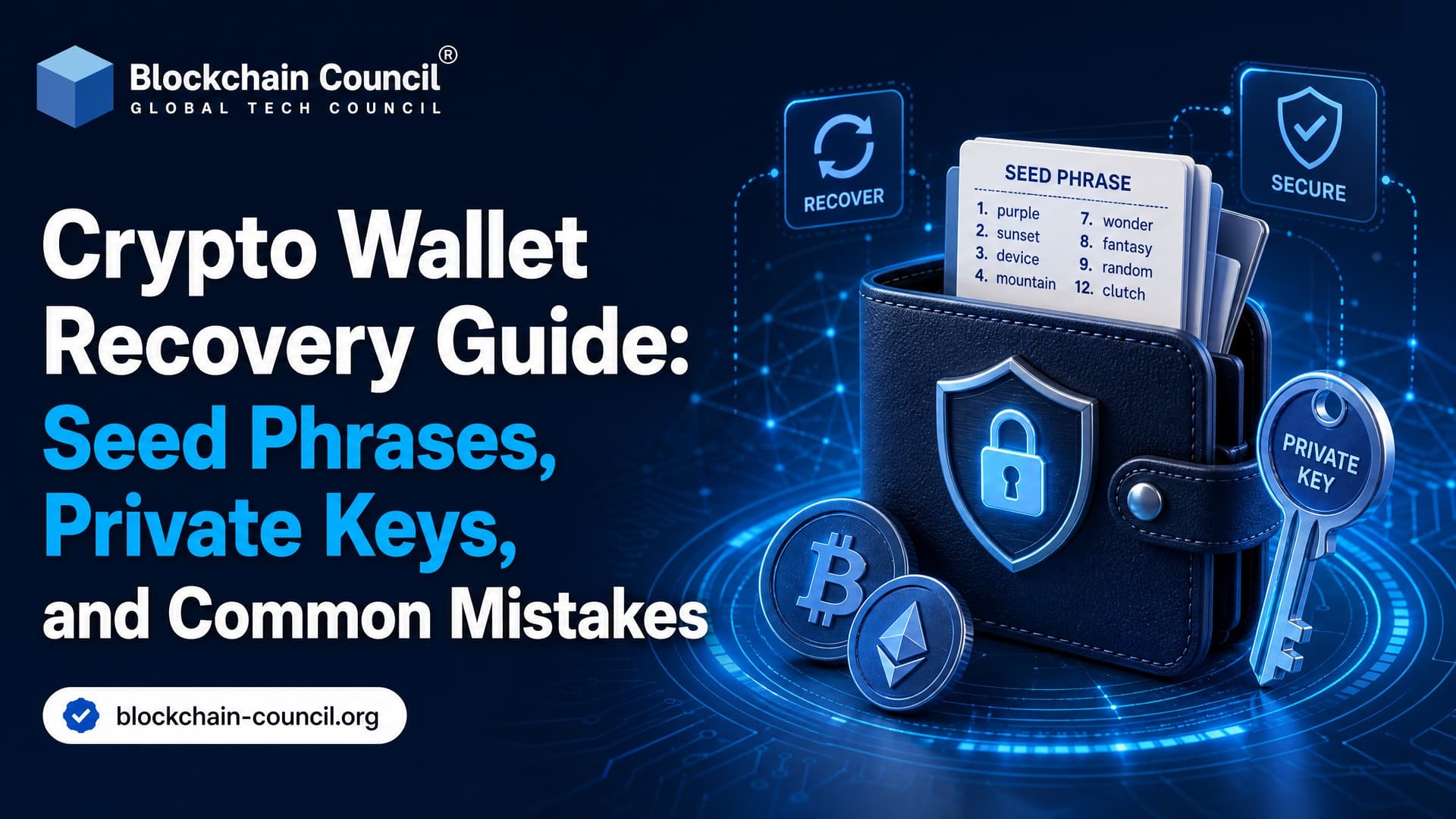
Crypto wallet recovery starts with one uncomfortable fact: if you use a non-custodial wallet, nobody can reset your seed phrase for you. Not MetaMask. Not Coinbase Wallet. Not the blockchain. Your recovery options depend on what you backed up, how accurately you recorded it, and whether you kept it away from attackers.
This guide explains how seed phrases, private keys, derivation paths, hardware wallets, and newer recovery models work in practice. If you manage personal funds, build wallet software, or handle digital assets for an organization, treat recovery as an operating procedure, not a last-minute panic task.

What a Seed Phrase Actually Recovers
A private key is a large random number that lets you sign transactions for a blockchain address. Whoever controls that private key can move the assets at that address. Ownership on-chain is not based on your name, email, device, or exchange account. It is based on valid signatures.
A seed phrase, also called a recovery phrase or Secret Recovery Phrase, is usually 12 or 24 words. In most mainstream wallets, those words follow the BIP39 format, which uses a fixed list of 2048 English words. The seed phrase creates the master secret for a hierarchical deterministic wallet, often called an HD wallet.
That master secret can generate many private keys. This is why one seed phrase can restore multiple Ethereum accounts, Bitcoin addresses, and token accounts in a compatible wallet. You are not backing up each individual private key by hand. You are backing up the root from which those keys are derived.
Seed Phrase vs Private Key
- Seed phrase: Restores the master wallet and all derived accounts, assuming the same derivation paths and optional passphrase are used.
- Private key: Controls one specific address or account.
- Wallet password: Usually protects local access to the wallet app or encrypted file. It does not replace the seed phrase.
This distinction trips up beginners. A MetaMask password can unlock the browser extension on your laptop, but it cannot restore the wallet on a new computer if the Secret Recovery Phrase is lost.
Why Recovery Sometimes Shows a Zero Balance
A correct seed phrase can still restore to an empty-looking wallet. That does not always mean the funds are gone.
Wallets use derivation paths to decide which private keys to generate from the seed. Ethereum wallets commonly use paths such as m/44'/60'/0'/0/0. Bitcoin wallets may use different paths depending on address type, such as legacy, nested SegWit, or native SegWit. Native SegWit addresses often begin with bc1, while older legacy addresses begin with 1.
If you created a Bitcoin wallet in one app and restored it in another, the second app may scan a different address type by default. Result: zero balance. I have seen users panic after restoring a perfectly valid seed into a new wallet because the first visible account was not the one they originally used. The fix was not magic. It was checking the original wallet type, script format, and derivation path.
For Ethereum and EVM chains, you may also need to add the right network. Ethereum mainnet uses chain ID 1. Polygon, BNB Smart Chain, Arbitrum, and other EVM networks will not all appear automatically in every wallet interface.
Common Crypto Wallet Recovery Mistakes
1. Writing the Seed Phrase Incorrectly
One wrong word can break recovery. So can the wrong order. BIP39 includes a checksum, which means many invalid phrases fail immediately. In some wallet interfaces, you may see an error such as Invalid Secret Recovery Phrase when a word is misspelled or out of order.
Do not replace a word with a synonym. If the wallet showed asset, writing property is not close enough. BIP39 words are exact.
2. Storing the Phrase Digitally
Screenshots, cloud notes, email drafts, and phone photos are poor places for seed phrases. Malware and account takeover attacks look for exactly this type of material. If an attacker gets the seed phrase, they do not need your wallet password.
Use offline storage. Paper is better than a photo. A metal backup is better for larger holdings because it can survive fire and water damage more reliably.
3. Trusting Fake Support
No legitimate wallet support team needs your seed phrase or private key. If a website, Telegram account, Discord user, or email asks you to enter your recovery phrase, assume theft. This is one of the most common loss patterns reported by recovery firms and wallet vendors.
4. Keeping Only One Backup
One backup in one drawer is fragile. Fire, flooding, moving house, theft, or simple forgetfulness can erase your only recovery route. Keep at least two verified copies in separate secure locations.
5. Forgetting About the Optional Passphrase
Some wallets support an extra BIP39 passphrase, sometimes described as a 25th word. This is not the same as the app password. If you used one and later forget it, the seed phrase alone may restore a different wallet with different addresses.
Use this feature only if you understand the risk. It is powerful, but unforgiving.
Step-by-Step Crypto Wallet Recovery
Scenario 1: You Have the Seed Phrase
- Identify the original wallet: MetaMask, Coinbase Wallet, Ledger, Trezor, Electrum, Trust Wallet, or another app.
- Count the words. Most phrases are 12 or 24 words.
- Check each word against the BIP39 word list if the wallet uses BIP39.
- Restore using the same wallet or a reputable compatible wallet.
- Enter any additional passphrase if you set one during wallet creation.
- Let the wallet sync or rescan addresses.
- If funds do not appear, check account indexes, networks, token visibility, derivation paths, and address formats.
Start with a clean device if possible. Do not type the phrase into random recovery websites. For hardware wallets, enter the phrase through the device recovery flow, not through a form on your computer.
Scenario 2: You Lost the Hardware Wallet
If your Ledger, Trezor, or other hardware wallet is gone but the seed phrase is safe, you can restore onto a new compatible device. The funds are not stored inside the physical wallet. The device stores keys and signs transactions. The assets remain on the blockchain.
Buy replacement hardware from the manufacturer or an authorized seller. Avoid pre-owned devices. After restoring, verify that the receiving addresses match your records before moving significant value.
Scenario 3: You Have a Partial Seed Phrase
Recovery may be possible if only one or two words are missing and you know at least one address from the wallet. Because BIP39 uses a known word list, specialized tools can test likely combinations and check derived addresses.
But the search space grows fast. Missing many words is usually not practical for ordinary users. If the value is high, a reputable professional recovery service may be worth contacting. Never send them funds upfront without due diligence, and never disclose sensitive material casually over chat.
Scenario 4: You Have Only a Wallet File
Some desktop wallets store encrypted wallet files. If the file still exists on a damaged laptop or drive, data recovery may recover it. You still need the password or enough hints for a password attack. Without the seed phrase, private key, wallet file, or password, recovery is usually infeasible.
Custodial, Non-Custodial, MPC, and Smart Contract Wallets
Recovery depends heavily on wallet type.
- Custodial wallets and exchanges: The provider controls the keys. Recovery usually happens through password reset, identity verification, and account security checks. You avoid seed phrase responsibility, but you accept counterparty risk.
- Non-custodial software wallets: You control the seed phrase. Lose it, and the provider cannot regenerate it.
- Hardware wallets: Keys stay in dedicated hardware. The seed phrase remains the backup.
- MPC wallets: Key material is split across devices or parties, reducing dependence on one seed phrase.
- Smart contract wallets: Recovery can use policies such as guardians, multi-signature approval, or time delays, depending on the chain and wallet design.
MPC and smart contract wallets are useful for teams and high-value accounts, but they are not automatically safer. Bad policies, weak devices, or poorly trained approvers can still cause losses.
Identity-Based Recovery: Useful, but Not Risk-Free
Some hardware wallet providers now offer optional recovery services that encrypt key material, split it into fragments, and store those fragments with separate custodians. Recovery then depends on identity verification.
This helps users who are likely to lose a paper backup. It also adds new trust assumptions. You must consider custodian security, legal requests, identity theft risk, and implementation quality. For small consumer holdings, the convenience may be reasonable. For enterprise treasury operations, I would usually prefer documented multi-approval workflows, hardware security modules, MPC, or smart contract controls with clear governance.
Best Practices Before You Deposit Serious Funds
- Write the seed phrase clearly and in order.
- Do not photograph it.
- Do not store it in cloud drives, password managers, or messaging apps unless your risk model explicitly supports that choice.
- Make at least two offline backups.
- Store backups in separate secure places.
- Run a recovery test on a fresh device or clean wallet installation.
- Send a small test transaction first.
- Record wallet type, network, derivation path, and whether an extra passphrase was used.
The recovery test matters. Do it before meaningful funds arrive. If the restored wallet generates a different first address than expected, stop and investigate. That small inconvenience can save months of stress later.
Guidance for Developers and Enterprises
If you build wallet flows or manage organizational funds, do not treat recovery as a user education footnote. Design for failure.
- Document key generation, backup, rotation, and recovery steps.
- Use role-based approvals for treasury movement.
- Separate signing authority from bookkeeping authority.
- Test disaster recovery on a schedule.
- Keep derivation path and address format records in secure internal documentation.
- Train staff to recognize seed phrase phishing.
Professionals who want structured grounding in these topics can use Blockchain Council resources such as the Certified Cryptocurrency Expert™ (CCE), Certified Blockchain Expert™ (CBE), and Certified Blockchain Developer™ as internal learning paths. Developers working on custody, wallet integrations, or Web3 applications should also understand BIP39, BIP32, EIP-1559 gas mechanics, ERC-20 tokens, and ERC-721 NFTs.
Where Wallet Recovery Is Heading
Seed phrases will not disappear overnight. They are simple, portable, and widely supported. Still, the industry is moving toward recovery models that fit normal human behavior better.
Expect more MPC wallets, account abstraction designs, guardian-based recovery, and identity-linked backup services. The trade-off is clear: fewer catastrophic losses from misplaced paper, but more dependence on software design, policy controls, and third parties.
For now, the best next step is practical: audit your current wallet backups this week. Verify the phrase, confirm the wallet type, document any passphrase or derivation detail, and run a small restore test before you rely on that wallet for serious value.
Related Articles
View All
Cryptocurrency
Seed Phrase Explained: How Recovery Phrases Protect Crypto Wallets
A practical guide to seed phrases, recovery phrases, BIP39, wallet recovery, and the storage mistakes that can expose self-custody crypto funds.
Cryptocurrency
Crypto Wallet Recovery Guide: How to Regain Access Safely
Learn safe crypto wallet recovery steps for seed phrases, hardware wallets, MetaMask, custodial accounts, Lightning backups, MPC, and recovery services.

Cryptocurrency
Top Crypto Asset Recovery Methods for Wallet Hacks, Scams, and Lost Keys
Crypto asset recovery methods can help after hacks, scams, or lost keys, but success depends on speed, evidence, tracing, legal action, and realistic expectations.
Trending Articles
The Role of Blockchain in Ethical AI Development
How blockchain technology is being used to promote transparency and accountability in artificial intelligence systems.

Top 5 DeFi Platforms
Explore the leading decentralized finance platforms and what makes each one unique in the evolving DeFi landscape.
What is AWS? A Beginner's Guide to Cloud Computing
Everything you need to know about Amazon Web Services, cloud computing fundamentals, and career opportunities.