

NFTs Explained: Digital Ownership, Collectibles, and Token Standards

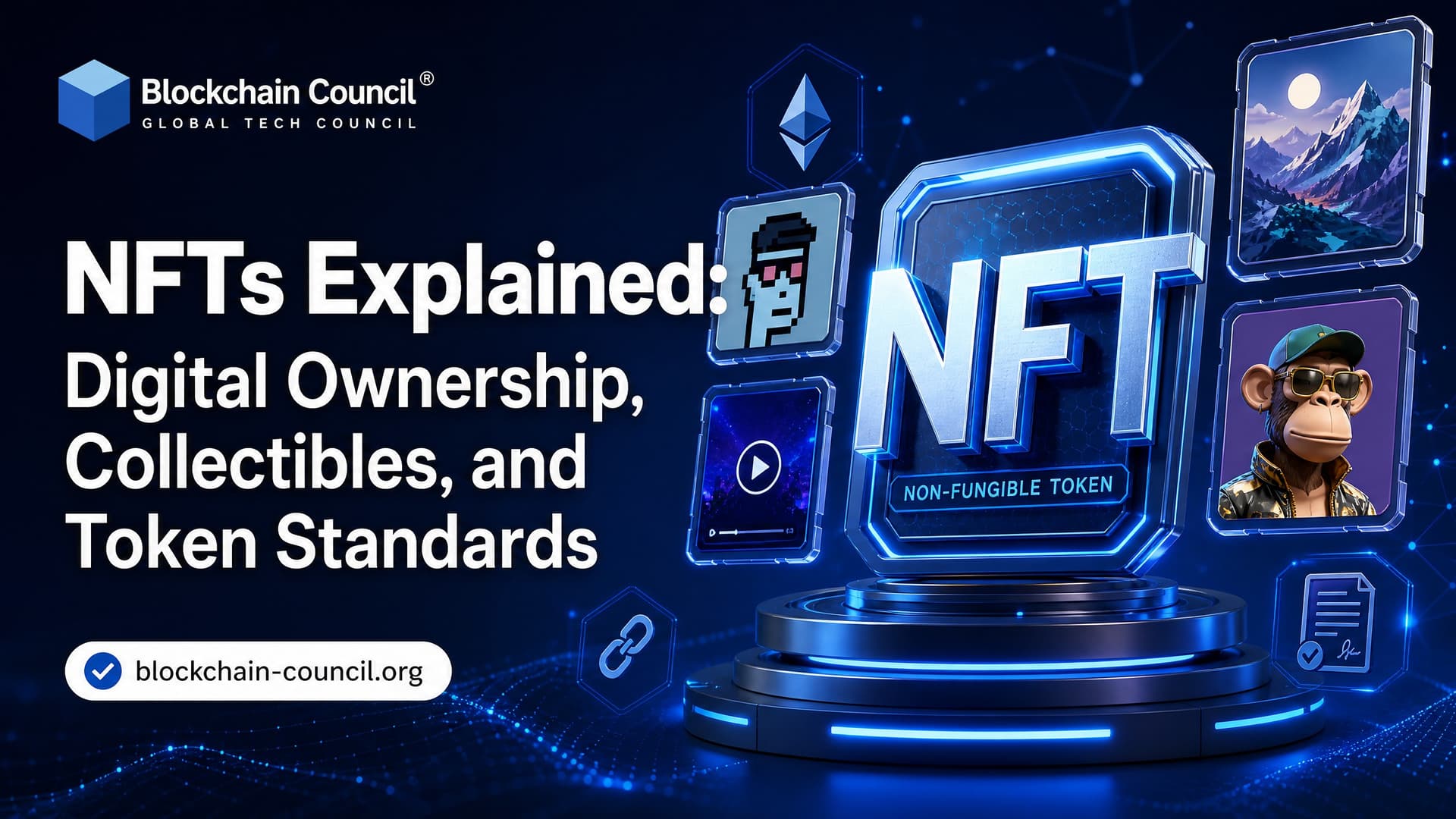
NFTs Explained starts with a simple idea: a blockchain can record that your wallet owns a specific token ID, and that token can point to a digital artwork, game item, ticket, membership pass, or physical collectible. The hard part is everything around that idea. Metadata, licensing, marketplaces, storage, smart contract security, and the gap between owning a token and owning copyright.
NFTs, or non-fungible tokens, are unique cryptographic tokens. Unlike Bitcoin, Ether, or ERC-20 tokens, each NFT is distinct. One token is not automatically equal to another. That uniqueness makes NFTs useful for digital ownership, digital collectibles, provenance, access rights, and tokenized real-world assets.

NFTs Explained: What You Actually Own
When you buy an NFT, you usually receive ownership of a token at a specific blockchain address. On Ethereum, that means a smart contract maps a token ID to your wallet address. Anyone can verify the record through a block explorer such as Etherscan.
That sounds clean. It is not the whole story.
The NFT is not usually the image, song, video, or legal title itself. It is a tokenized record that points to metadata. The metadata may include a name, description, image URI, traits, and sometimes external attributes. The actual media file may sit on IPFS, Arweave, a centralized server, or fully on chain in rare cases.
So what do you own?
- The token: Your wallet controls transfer, sale, or use of that token.
- The provenance record: The mint, transfers, and current owner can be publicly checked.
- Platform access: Some apps, games, or communities may recognize your token as a pass.
- Licensed rights: You may receive commercial or display rights only if the project terms grant them.
To be blunt, buying an NFT does not automatically give you copyright in the underlying art. Copyright usually stays with the creator unless a separate license or legal agreement says otherwise. This point trips up buyers, founders, and even some certification candidates. If you are building an NFT project for an enterprise, put the license terms in plain language before mint day.
Why Digital Ownership Matters
Digital files are easy to copy. Ownership records are not, if they are properly written to a public blockchain. That is the main value behind NFTs.
An NFT can prove that a given wallet owns token ID 814 from a known contract. It can also show the token's transfer history. This creates public provenance, which matters for digital art, luxury goods, event tickets, sports memorabilia, and game assets.
There is a practical benefit here. If a marketplace, wallet, or game supports the same token standard, your asset can move outside a single company database. That does not mean every game item will work in every game. Full interoperability is often overstated. A sword designed for one game will not magically become usable in another without shared design, licensing, and technical integration. Still, the ownership layer is portable in a way traditional in-app items are not.
Digital Collectibles: The First Major NFT Market
Digital collectibles made NFTs visible to the mainstream. The 2020-2021 surge brought profile picture collections, generative art, trading cards, and brand-linked drops into public discussion. Some collections produced serious cultural value. Others were thin speculation with nicer artwork.
Profile Pictures and Generative Art
Profile picture collections, often called PFP projects, use traits such as background, clothing, facial expression, and rarity levels. CryptoPunks, launched by Larva Labs in 2017, includes 10,000 algorithmically generated characters and became one of the best-known early NFT collections. A useful technical footnote: CryptoPunks launched before ERC-721 was finalized, so wrapped versions later helped with marketplace compatibility.
Generative art follows a different logic. The collector may mint an output created from code, randomness, and a defined visual system. In strong projects, the algorithm is the artwork. In weak projects, randomness is just a rarity machine.
Physical Twin Collectibles
NFTs are also used as digital twins for physical objects. Think sneakers, watches, wine bottles, art prints, or sports memorabilia. The NFT can serve as a provenance record and authenticity certificate.
This model makes sense where fraud is expensive. Luxury goods and ticketing are good examples. But the token must be tied to a real verification process. If anyone can mint a token that claims to represent a watch, the NFT does not solve the authenticity problem. It only creates a new place for false claims.
Creator Royalties
NFT smart contracts can include royalty information, and standards such as ERC-2981 define a common royalty interface. The idea is simple: creators can receive a percentage when tokens resell.
Here is the catch. Royalties are not automatically enforced at the base ERC-721 or ERC-1155 transfer level. Marketplaces must honor the royalty logic or use systems that enforce it through transfer restrictions or marketplace rules. Do not promise automatic lifetime royalties unless you understand how enforcement works on the target chain and marketplace.
NFT Token Standards: ERC-721 vs ERC-1155
NFT token standards define how wallets, marketplaces, and smart contracts interact with tokens. Without standards, every NFT project would need custom integrations. Ethereum's best-known NFT standards are ERC-721 and ERC-1155.
ERC-721: Unique, One-of-One Token IDs
ERC-721 is the foundational Ethereum NFT standard. The EIP-721 specification defines a minimum interface for ownership, transfers, approvals, and token queries. Each token ID is unique and indivisible.
ERC-721 fits:
- One-of-one digital art
- PFP collections
- Unique memberships
- Certificates and identity-linked assets
- Land parcels in virtual worlds
If you are using Solidity 0.8.x with OpenZeppelin Contracts, ERC-721 implementation is straightforward, but version details matter. In OpenZeppelin Contracts 5.x, some older extension patterns and transfer hooks changed. Developers moving from 4.x often hit errors because the old _beforeTokenTransfer hook pattern no longer works the same way. It was replaced by a single _update hook. Another real debugging clue: querying a token that has not been minted may throw a custom error such as ERC721NonexistentToken(1), rather than the older revert string many tutorials still mention.
That small mismatch tells you why current training matters. NFT code copied from a 2021 tutorial may compile badly or behave differently in a modern toolchain.
ERC-1155: Multi-Token Contracts
ERC-1155 is a multi-token standard. One smart contract can manage fungible tokens, semi-fungible items, and unique NFTs. It also supports batch transfers, which can cut transaction overhead when moving many items.
ERC-1155 fits:
- Gaming items such as weapons, skins, consumables, and badges
- Event tickets with multiple seat categories
- Large collectible sets with repeated editions
- Membership tiers
- Projects that need both fungible and non-fungible assets
Choose ERC-721 when every item is truly unique and marketplace simplicity matters. Choose ERC-1155 when you need editions, batches, or many asset types under one contract. For games, ERC-1155 is often the better engineering choice. For high-end one-of-one art, ERC-721 is still easier for collectors to understand.
Other Standards and Chains
Ethereum is not the only NFT ecosystem. Solana uses token programs and metadata conventions, Flow was designed with consumer-scale digital assets in mind, and Tezos has been popular with parts of the art community. Each chain has trade-offs in fees, tooling, wallet support, marketplace access, and long-term ecosystem risk.
On Ethereum and EVM-compatible chains, you may also see standards and patterns such as:
- ERC-2981: Royalty information for NFTs
- ERC-998: Composable NFTs that can own other tokens
- ERC-721A: A gas-aware implementation pattern used for batch minting, originally associated with Azuki
- Soulbound token patterns: Non-transferable tokens for credentials or reputation, inspired by proposals such as EIP-5192
Do not pick a chain only because minting is cheap. Check wallet adoption, indexing support, marketplace liquidity, security record, and whether your users can actually complete a transaction without help.
NFT Use Cases Beyond Collectibles
Collectibles still dominate public attention, but enterprise and developer use cases are broader.
Gaming and Virtual Worlds
Games can use NFTs for skins, characters, weapons, land, and achievements. Decentraland and The Sandbox use NFTs for virtual land. The promise is player-controlled ownership. The challenge is game balance, fraud prevention, user experience, and making assets useful beyond resale speculation.
Ticketing and Access Control
NFT tickets can reduce counterfeiting because each pass has a traceable token ID. Organizers can set transfer rules, add perks, and keep better records of secondary market activity. This is one of the more practical uses, especially for sports, concerts, and conferences.
Membership and Credentials
NFTs can act as membership passes for private communities, content libraries, events, or professional networks. Non-transferable NFTs can also represent credentials, although privacy and revocation need careful design. A public wallet is not always the right place to expose personal achievements.
Real-World Assets and IP
NFTs can represent claims linked to real estate, art, music rights, or luxury goods. This area is promising, but it depends heavily on legal enforceability. A token transfer alone does not update a government land registry. For serious asset tokenization, smart contracts and legal contracts must match.
Risks: Scams, Storage, and Legal Gaps
NFTs carry real risk. Speculative bubbles, wash trading, fake collections, phishing links, and rug pulls have damaged the market. The common wallet-draining flow is painfully simple: a user signs an approval transaction without reading it, and an attacker transfers valuable tokens away.
Use these checks before buying or building:
- Verify the contract address from official project channels.
- Check whether metadata is on IPFS, Arweave, centralized storage, or fully on chain.
- Read the license. Do not assume commercial rights.
- Review mint functions, owner privileges, pause controls, and upgradeability.
- Test on a public testnet before mainnet deployment.
- Use hardware wallets for valuable collections.
Environmental criticism also shaped NFT debate. Ethereum moved from Proof of Work to Proof of Stake during The Merge in September 2022, and Ethereum.org states that this reduced Ethereum's energy consumption by about 99.95 percent. That does not remove every sustainability concern, but it changes the discussion for Ethereum-based NFTs.
How Professionals Should Learn NFTs
If your goal is strategy, start with ownership models, licensing, market structure, and token standards. If your goal is development, write and test ERC-721 and ERC-1155 contracts yourself. No shortcut replaces deploying a contract, reading transaction logs, and fixing a revert.
For structured learning, Blockchain Council programs such as the Certified NFT Expert™, Certified Blockchain Developer™, Certified Cryptocurrency Expert™, and Certified Web3 Expert™ map to different goals. Developers should pair certification study with hands-on work in Hardhat or Foundry, OpenZeppelin Contracts, MetaMask, IPFS, and a block explorer.
Next Step
Build a small NFT project before you judge the technology. Mint one ERC-721 token on a testnet, store metadata on IPFS, verify the contract, and transfer the token between two wallets. Then repeat the exercise with ERC-1155 batch minting. You will understand NFTs explained far better after watching the events, approvals, metadata, and marketplace assumptions work in practice.
Related Articles
View All
Cryptocurrency
Cryptocurrency Wallets Explained: How to Store and Manage Digital Assets
Learn how cryptocurrency wallets work, including private keys, hot and cold storage, custodial options, MPC, account abstraction, and security best practices.

Cryptocurrency
Security Tokens Explained: Digital Securities and Compliance Basics
Security tokens are regulated digital securities. Learn how tokenized equity, debt, funds, and real estate rights work with compliance rules.
Cryptocurrency
Utility Tokens Explained: Use Cases, Value, and Token Design
Utility tokens provide access, payments, governance, rewards, and staking inside blockchain ecosystems. Learn how value and tokenomics really work.
Trending Articles
The Role of Blockchain in Ethical AI Development
How blockchain technology is being used to promote transparency and accountability in artificial intelligence systems.
What is AWS? A Beginner's Guide to Cloud Computing
Everything you need to know about Amazon Web Services, cloud computing fundamentals, and career opportunities.
Blockchain in Supply Chain Provenance Tracking
Supply chains are under pressure to prove not just efficiency, but also authenticity, sustainability, and fairness. Customers want to know if their coffee really is fair trade, if the diamonds are con