

Centralized Exchanges (CEX) Explained: Features, Benefits, and Risks

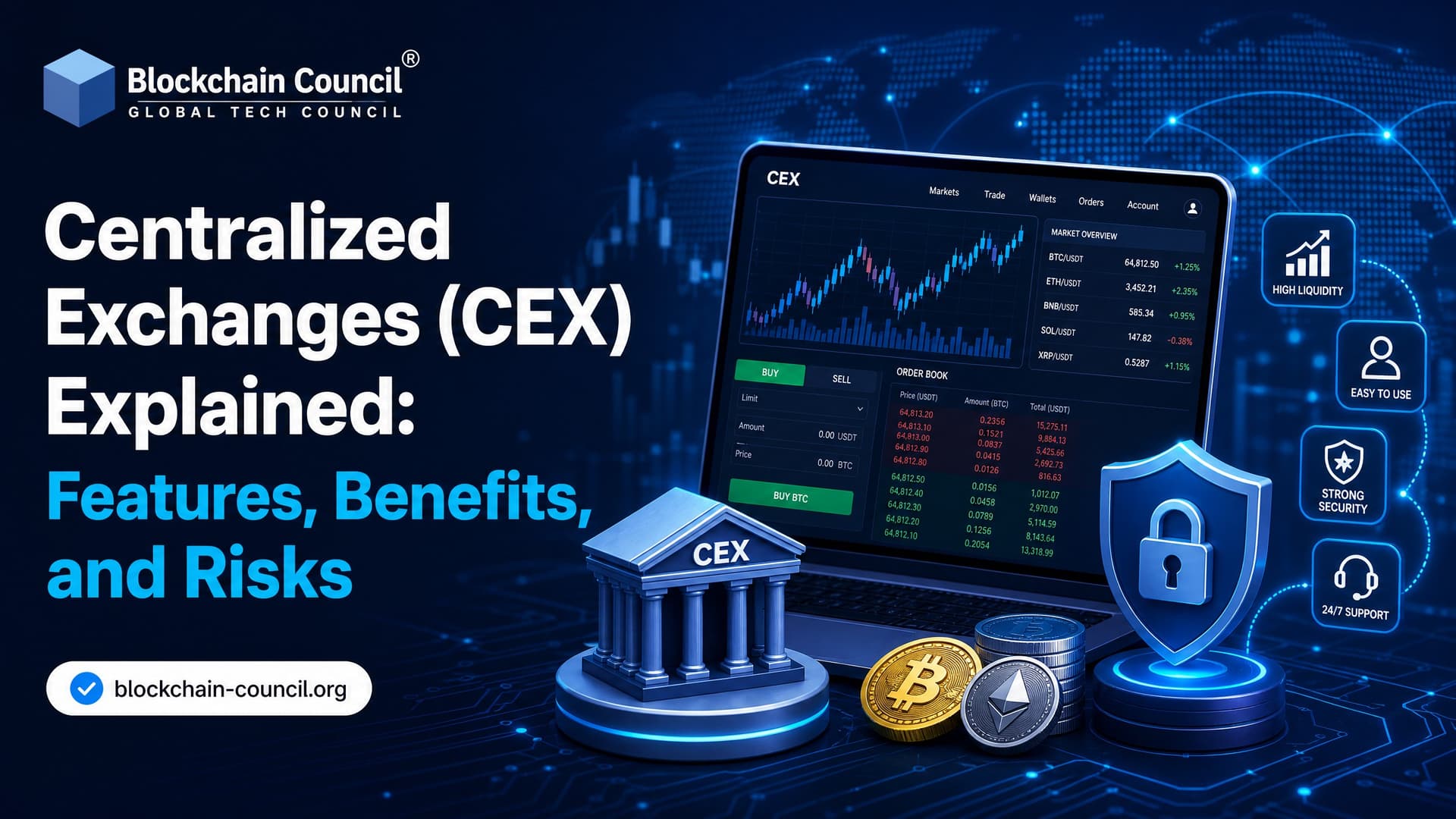
Centralized exchanges, often called CEXs, are company-operated crypto trading platforms that hold user funds, match buy and sell orders, and connect fiat money with digital assets. If you have ever bought Bitcoin with a debit card or moved crypto back to a bank account, you probably used one.
They are convenient. They are also risky. That trade-off is the whole story.

What Is a Centralized Exchange?
A centralized exchange is a crypto marketplace run by a private company or institution. The platform controls the matching engine, sets listing rules, manages user accounts, and usually custodies customer assets in exchange wallets.
On a CEX, you do not trade directly from your own wallet. You deposit funds first. The exchange credits your account balance internally, then its order book matches your trade against another user, a market maker, or available liquidity.
The basic model has four moving parts:
- Central operator: The company decides which assets are listed, what fees apply, and who can access the platform.
- Custody: The exchange controls the private keys for deposited funds, usually across hot and cold wallets.
- Order book: Buy and sell orders are matched by centralized infrastructure for fast execution.
- Fiat rails: Users can often deposit and withdraw USD, EUR, GBP, or other currencies through banks, cards, and wire transfers.
This is very different from a decentralized exchange, where you usually connect a non-custodial wallet and trade through smart contracts. CEXs feel closer to online brokerage accounts. DEXs feel closer to on-chain software.
Why Centralized Exchanges Still Dominate Crypto Trading
Centralized exchanges handle most global crypto trading volume. Industry estimates put CEXs at more than 90 percent of total crypto trading volume. Reported exchange trading volume also climbed sharply through 2024, which tells you traders stuck with these platforms even through heavy market swings.
Liquidity explains much of that dominance. Large CEXs pull retail users, professional traders, market makers, and institutions into the same venue. That creates deep order books and tighter spreads. Binance alone has posted monthly trading volume in the hundreds of billions of dollars, which shows the scale top exchanges can reach.
Centralized exchanges also act as key endpoints where crypto value moves back into the traditional financial system. That matters. A DEX can help you swap tokens on-chain, but it usually cannot send dollars to your bank account.
Core Features of a CEX
Spot Trading
Spot markets let you buy or sell crypto at current market prices. This is the simplest CEX product and the starting point for most users. Bitcoin, Ether, stablecoins, and major altcoins usually trade here.
Margin, Futures, and Options
Many large exchanges offer borrowed funds, perpetual futures, dated futures, and sometimes options. These products are useful for hedging and active trading, but they are not beginner tools. Liquidations happen fast, and a 10x position can be wiped out by a small price move.
Staking and Yield Products
Some platforms provide staking for proof-of-stake assets or packaged yield products. Read the terms carefully. Staking through an exchange may be operationally easy, but you are adding platform risk on top of protocol risk.
API Access and Professional Tools
Professional traders use CEX APIs for algorithmic strategies, market data, and portfolio automation. A small practical note: beginners often hit Binance API error code -1021, which says the timestamp for the request is outside the server time window. It is usually a local clock sync problem, not a trading logic problem. That kind of detail matters when real money is attached to an automated order.
Customer Support and Reporting
CEXs usually provide account dashboards, tax export files, portfolio tracking, and customer support. It sounds basic until something goes wrong. If you send XRP or XLM without the required destination tag or memo, support may be your only path to recovery.
Benefits of Centralized Exchanges
1. High Liquidity
High liquidity helps traders enter and exit positions with less slippage. For institutions or businesses moving large orders, this is not optional. Thin markets can turn a normal trade into a costly execution mistake.
2. Fiat On-Ramps and Off-Ramps
CEXs are still the easiest way to convert fiat into crypto and crypto back into fiat. Bank transfers, debit cards, wires, and local payment methods make onboarding much easier for retail users and enterprises.
3. Familiar User Experience
Most CEX interfaces are built for people who do not want to manage seed phrases on day one. You create an account, verify identity, deposit funds, and trade. That familiarity is one reason CEXs remain the default entry point into crypto.
4. Compliance Infrastructure
Many centralized exchanges implement Know Your Customer and Anti-Money Laundering controls. For institutions, this is often required before any crypto exposure is approved. Compliance-focused firms consistently point to licensing, transaction monitoring, and fiat off-ramp controls as key parts of exchange risk management.
5. Integrated Product Stack
A single CEX account may include spot trading, derivatives, staking, OTC services, API access, and reporting. That saves operational time compared with managing several wallets, DeFi protocols, bridges, and analytics tools.
Risks of Centralized Exchanges
Custodial Risk
The biggest risk is simple: you do not control the private keys. The exchange does. If the platform is hacked, freezes withdrawals, becomes insolvent, or misuses customer assets, you may lose access to your funds.
The phrase not your keys, not your coins is blunt, but it is accurate. Use a CEX for trading and fiat access. Do not treat it as a permanent vault unless you have assessed the platform's custody controls, financial health, and legal protections.
Security Breaches
CEXs are high-value targets. They manage hot wallets, cold storage, internal ledgers, privileged access, and withdrawal systems. One weak control can be expensive. Exchange hacks have drained well over a billion dollars in a single year.
Mt. Gox, Bitfinex, and other exchange hacks shaped today's security practices. Better cold storage, withdrawal whitelists, hardware security modules, and proof-of-reserves efforts came from hard lessons, not theory.
Governance and Fraud Risk
FTX showed that technical security is not enough. Governance, segregation of customer funds, internal controls, and independent audits matter just as much. A platform can have a polished interface and still have poor risk management behind it.
Regulatory and Jurisdictional Risk
CEXs operate within legal systems. If an exchange lacks proper authorization, regulators may restrict services, freeze accounts, or force market exits. This risk is higher when users access platforms outside their local jurisdiction.
The EU's Markets in Crypto-Assets regulation, known as MiCA, and Financial Action Task Force guidance have pushed exchanges toward stricter compliance. Still, rules vary by country. Do not assume one license covers every user in every market.
Privacy Trade-Offs
CEXs collect personal data, identity documents, bank details, IP information, and transaction history. Centralized exchanges are often easier to use, but from a control and privacy standpoint they give up more than a self-custody model does.
Outages and Account Freezes
During extreme volatility, some platforms slow down, halt withdrawals, or experience service interruptions. Since your funds sit inside the platform, an outage can block trading at the exact moment you need access.
CEX vs DEX: Which Should You Use?
Use a centralized exchange when you need fiat access, deep liquidity, customer support, regulated products, or large order execution. It is the practical choice for most first-time buyers and many professional trading desks.
Use a decentralized exchange when self-custody, permissionless access, on-chain transparency, or early access to DeFi assets matters more than fiat support and customer service.
To be blunt, most serious crypto users should understand both. A CEX-only user accepts too much custody risk. A DEX-only user may struggle with fiat movement, tax reporting, and execution depth.
How to Evaluate a Centralized Exchange
Before choosing a CEX, check more than trading fees. Use this list:
- Licensing: Does the platform operate legally in your jurisdiction?
- Security: Does it support two-factor authentication, withdrawal allowlists, cold storage, and account alerts?
- Transparency: Does it publish proof-of-reserves or independent attestations?
- Asset controls: Are customer and company funds clearly segregated?
- Liquidity: Are spreads and order-book depth suitable for your trade size?
- Incident history: How has the exchange handled hacks, outages, or withdrawal stress?
- Support quality: Can you reach a real support channel when deposits or withdrawals fail?
Skills Professionals Need Around CEXs
Centralized exchanges are not just trading apps. They combine market microstructure, wallet security, compliance, treasury operations, and API engineering. If you work in crypto, you should understand how these systems behave under stress.
For structured learning, consider Blockchain Council's Certified Cryptocurrency Expert™ (CCE) if your focus is crypto markets, trading concepts, and digital asset fundamentals. If you need a broader foundation in blockchain systems, the Certified Blockchain Expert™ (CBE) is worth exploring. Developers who plan to connect exchange workflows with on-chain applications should also build comfort with wallets, smart contracts, and transaction monitoring.
Final Takeaway
Centralized exchanges remain core crypto infrastructure because they solve real problems: liquidity, fiat access, fast execution, and a familiar user experience. But the cost is custody risk. You are trusting a company with your assets, identity data, and market access.
Your next step is practical: choose one reputable CEX, enable two-factor authentication, test deposits and withdrawals with small amounts, and move long-term holdings to self-custody when you do not need them for trading. Then study how CEXs and DEXs differ at the protocol, compliance, and security levels before increasing exposure.
Related Articles
View All
Cryptocurrency
Crypto Lending and Borrowing Explained: DeFi Loans, Rates, and Risks
Crypto lending and borrowing lets users earn yield or access liquidity through DeFi loans, but rates, collateral rules, and liquidations matter.

Cryptocurrency
Yield Farming Explained: DeFi Returns, Risks, and Strategies
Yield farming explained for DeFi users: how returns work, why APYs change, key risks, and practical strategies from stablecoin lending to LRTs.

Cryptocurrency
Decentralized Exchanges (DEX) Explained: Peer-to-Peer Crypto Trading
Decentralized exchanges let users trade crypto directly from wallets through smart contracts. Learn how DEXs work, key risks, market trends, and use cases.
Trending Articles

Top 5 DeFi Platforms
Explore the leading decentralized finance platforms and what makes each one unique in the evolving DeFi landscape.
What is AWS? A Beginner's Guide to Cloud Computing
Everything you need to know about Amazon Web Services, cloud computing fundamentals, and career opportunities.

Can DeFi 2.0 Bridge the Gap Between Traditional and Decentralized Finance?
The next generation of DeFi protocols aims to connect traditional banking with decentralized finance ecosystems.