

Yield Farming Explained: DeFi Returns, Risks, and Strategies

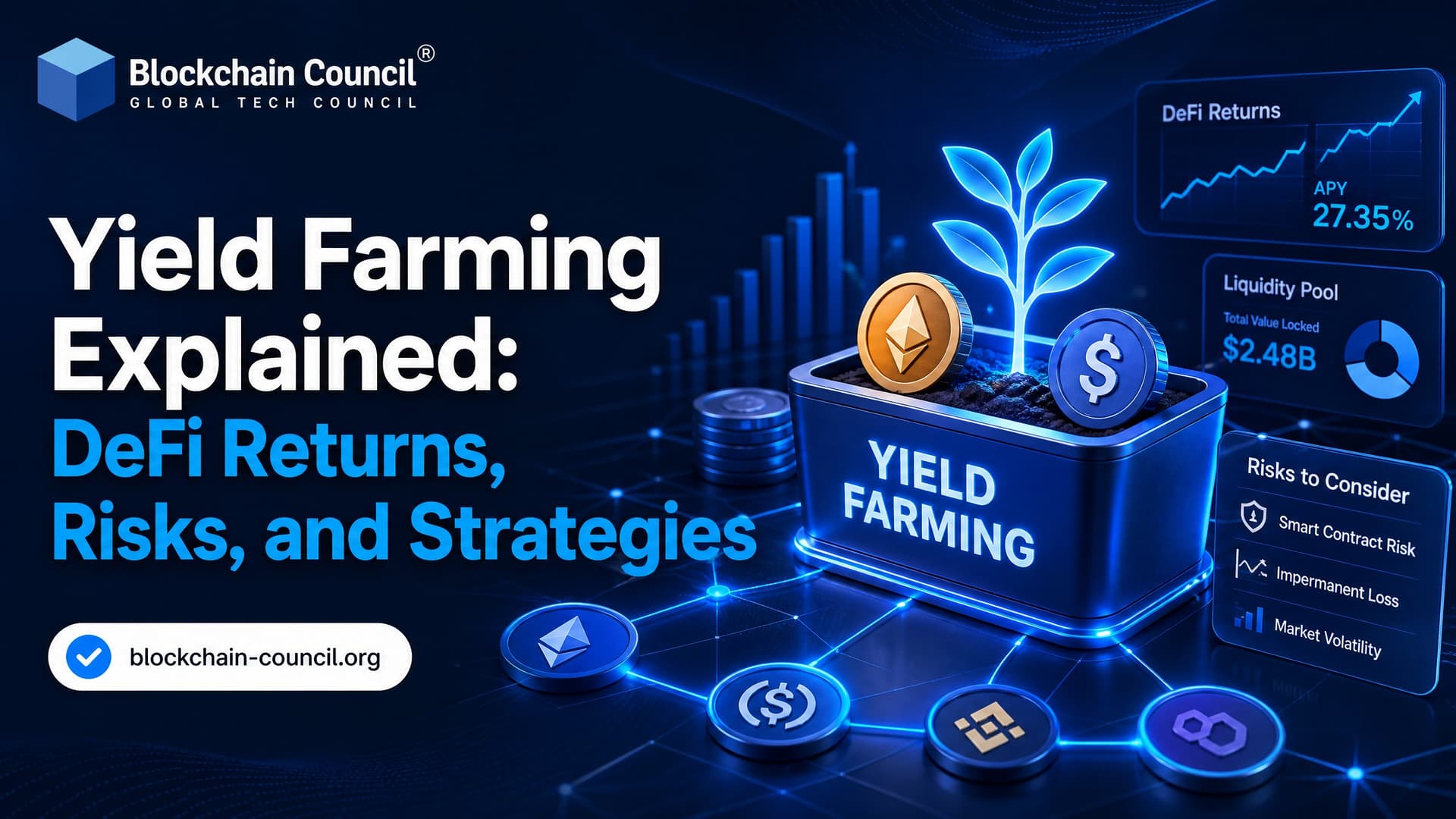
Yield farming is the practice of putting crypto assets into DeFi protocols to earn trading fees, borrower interest, staking rewards, or incentive tokens. It can produce useful returns, but it is not passive income in the traditional sense. You are taking smart contract risk, market risk, liquidity risk, and sometimes regulatory risk all at once.
The short version: conservative strategies often sit in the 2 to 10 percent APY range, while aggressive farms may advertise 100 percent plus APR for a brief window. Those high rates usually fall fast. Sometimes the reward token falls faster.

What Is Yield Farming?
Yield farming means deploying cryptocurrency into onchain protocols that need pooled capital. That capital may support a decentralized exchange, a lending market, a staking system, a restaking protocol, or a yield tokenization platform.
Common sources of yield include:
- Trading fees: You provide liquidity to an automated market maker, such as an ETH/USDC pool, and earn a share of swap fees.
- Borrower interest: You lend assets through a money market such as Aave and earn interest from borrowers.
- Reward tokens: Protocols distribute governance or incentive tokens to attract liquidity.
- Staking and restaking rewards: You earn rewards for helping secure a network or for taking on additional restaking risk.
At its core, yield farming is a DeFi mechanism where smart contracts replace traditional intermediaries. Funds are deposited into contracts, rules are enforced onchain, and yields depend on protocol activity plus incentive design.
How Yield Farming Works in Practice
A basic yield farming flow looks like this:
- You connect a wallet such as MetaMask to a DeFi application.
- You approve a token for use by the protocol contract.
- You deposit tokens into a pool, vault, lending market, or staking contract.
- The protocol issues a receipt token or tracks your share of the pool.
- You earn fees, interest, or rewards over time.
- You withdraw, harvest rewards, or compound them back into the strategy.
A small but real detail: many failed deposits are not protocol failures. They are allowance mistakes. Developers and users often see errors such as ERC20: insufficient allowance when the wallet approved the wrong spender contract or approved less than the deposit amount. USDT can also be awkward because some integrations require setting the allowance to zero before changing it. Boring? Yes. Expensive if you rush? Also yes.
Farmers often move capital between protocols as yields change. Some compound rewards manually. Others use vaults that automate compounding. Advanced users may stack positions, for example by depositing a liquid staking token, receiving a derivative token, then using it in another protocol. That can increase yield. It also ties your risk to several systems at once.
Yield Farming Returns: What APY Is Realistic?
Returns vary by asset, protocol, market demand, and reward emissions. Do not treat a displayed APY as a fixed promise. It is usually a moving estimate.
Conservative Yield Farming
Stablecoin lending and blue-chip stable pools often fall around 2 to 10 percent APY. Some market conditions may support 5 to 15 percent APY, especially when borrower demand is high. Examples include lending USDC on established money markets or using stablecoin pools where assets target the same value.
This is the cleanest starting point for most professionals. You still face smart contract, stablecoin depeg, governance, and chain risk. But you avoid much of the impermanent loss that comes with volatile AMM pairs.
Moderate Yield Farming
Strategies using major volatile assets, such as ETH paired with a stablecoin, can offer 10 to 30 percent APY during active markets. The extra yield comes with price exposure and impermanent loss.
If ETH rallies sharply, an ETH/USDC liquidity provider may end up with less ETH than if they had simply held the asset. If ETH falls, the pool shifts toward more ETH and less USDC. Trading fees can offset this, but not always.
Aggressive Yield Farming
New protocols may advertise triple-digit APRs, and sometimes even higher. These rates are usually driven by reward token emissions, not long-term economic activity. Once early farmers sell rewards, the token price can drop. Your dashboard may show a huge APY while the reward token loses most of its dollar value.
To be blunt, chasing the highest APR on a new farm is usually not a strategy. It is speculation with extra contract risk.
Main Yield Farming Risks
Yield farming has produced billions of dollars in losses since 2020 through exploits, depegs, liquidations, and failed protocol designs. The risk is not theoretical.
Smart Contract Risk
Smart contracts can contain bugs. Audits reduce risk, but they do not remove it. A protocol with a clean interface can still have unsafe upgrade permissions, weak access control, or a pricing bug.
Depeg Risk
Stablecoins, liquid staking tokens, and liquid restaking tokens can trade below their intended value. A stablecoin pool is not low risk if one asset in the pool starts drifting from 1 dollar. LRTs add another layer because their value depends on staking, restaking, redemption assumptions, and secondary market liquidity.
Liquidation Risk
If you borrow against collateral, track your health factor. On Aave, a health factor below 1 can trigger liquidation. Beginners often watch APY and ignore collateral ratios. That is backwards. Your first job is to stay solvent.
Impermanent Loss
Impermanent loss occurs when the price of assets in an AMM pool diverges. You may earn fees but still underperform a simple hold strategy. This matters most in volatile pairs.
Reward Token Depreciation
Liquidity mining rewards can look attractive until emissions hit the market. If everyone is farming the same token and selling it, the real return can shrink quickly.
Oracle, Governance, and Systemic Risk
Bad price feeds can trigger unfair liquidations or mispriced swaps. Governance can change fees, reward schedules, collateral parameters, or upgrade contracts. Systemic contagion is also real. The Terra/Luna collapse in 2022 showed how quickly yield strategies can fail when a core asset or protocol assumption breaks.
Yield Farming Strategies by Experience Level
For Beginners: Stablecoin Lending First
If you are learning, start with established lending markets and small amounts. Stablecoin lending teaches wallet approvals, deposits, withdrawals, interest accrual, and basic protocol risk without adding impermanent loss on day one.
Use this checklist:
- Use protocols with a long operating history and public audits.
- Check total value locked, but do not rely on TVL alone.
- Avoid unaudited forks with anonymous teams.
- Understand withdrawal rules before depositing.
- Keep test transactions small until you know the flow.
For Intermediate Users: Blue-Chip Liquidity Pools
Once you understand lending, try major AMM pools with assets you are willing to hold. ETH/stablecoin pools can make sense if you accept price movement and monitor impermanent loss. Stablecoin pools on platforms designed for low-slippage swaps can also fit this level.
Do not use volatile pools for treasury funds you may need at a specific date. Liquidity provision is not a savings account.
For Advanced Users: LRTs, Pendle, and Stacked Yield
Modern yield farming has moved into liquid restaking tokens, yield tokenization, and structured positions. LRT strategies can stack base staking rewards with restaking incentives and additional DeFi rewards. Pendle-style markets split assets into principal tokens and yield tokens, letting users lock in fixed yields or trade future yield expectations.
These tools are powerful, but they are the wrong place to start. You need to understand redemption liquidity, peg mechanics, maturity dates, contract dependencies, and what happens when incentives disappear.
How to Evaluate a Yield Farm Before Depositing
Before you commit capital, ask practical questions:
- Where does the yield come from? Fees and borrower interest are stronger than pure token emissions.
- What can break? List smart contract, oracle, bridge, depeg, and governance risks.
- Who controls upgrades? Multisig permissions and admin keys matter.
- Can you exit? Check pool depth, withdrawal delays, and slippage.
- Is APY paid in a volatile token? If yes, model a 50 percent or 80 percent price drop.
- Are you using leverage? Set alerts for collateral ratios and liquidation thresholds.
A good rule: if you cannot explain the yield source in two sentences, do not deposit more than you can afford to lose.
Regulatory and Enterprise Considerations
For enterprises, yield farming is mainly a risk governance problem. Treasury teams need position limits, counterparty reviews, wallet controls, accounting treatment, tax analysis, and compliance input. Regulators, including the U.S. Securities and Exchange Commission, may examine some yield farming structures as securities offerings, especially where reward tokens and promotional incentives resemble investment contracts.
Institutions should separate conservative treasury yield from experimental DeFi activity. Mixing them is how small operational errors become board-level incidents.
Learning Path for Professionals
If you want a structured learning path, build the fundamentals first. The Certified Cryptocurrency Expert™ (CCE) from Blockchain Council gives readers stronger grounding in crypto assets, wallets, exchanges, and market mechanics. For protocol design, smart contracts, and DeFi architecture, the Certified Blockchain Expert™ (CBE) and Certified DeFi Expert™ are also worth exploring.
Then build something small. Deposit a tiny amount into a lending market. Track APY changes for a week. Simulate impermanent loss on a volatile pool. Read one audit report. Set a health factor alert if you borrow. These habits matter more than memorizing the highest-yield protocol of the month.
Final Takeaway
Yield farming can turn idle crypto assets into productive onchain capital, but the return is payment for risk. Single-digit yields usually come with fewer moving parts. Double-digit yields need active monitoring. Triple-digit yields should make you suspicious first and interested second.
Your next step: choose one conservative stablecoin strategy, write down every risk before depositing, and size the position so a total loss would be painful but survivable. If you want to go deeper, pair hands-on practice with a formal DeFi certification before attempting LRTs, yield tokenization, or leveraged farming.
Related Articles
View All
Cryptocurrency
Crypto Lending and Borrowing Explained: DeFi Loans, Rates, and Risks
Crypto lending and borrowing lets users earn yield or access liquidity through DeFi loans, but rates, collateral rules, and liquidations matter.

Cryptocurrency
DeFi Explained: Decentralized Finance, Protocols, and Use Cases
DeFi explained for professionals: learn how decentralized finance works, key protocols, real use cases, risks, and what to study next.

Cryptocurrency
Centralized Exchanges (CEX) Explained: Features, Benefits, and Risks
Centralized exchanges make crypto trading easier through liquidity, fiat access, and support, but they also introduce custody, security, and regulatory risks.
Trending Articles
How Blockchain Secures AI Data
Understand how blockchain technology is being applied to protect the integrity and security of AI training data.

Can DeFi 2.0 Bridge the Gap Between Traditional and Decentralized Finance?
The next generation of DeFi protocols aims to connect traditional banking with decentralized finance ecosystems.
Claude AI Tools for Productivity
Discover Claude AI tools for productivity to streamline tasks, manage workflows, and improve efficiency.