

How to Build a Crypto Portfolio: A Beginner's Step-by-Step Guide

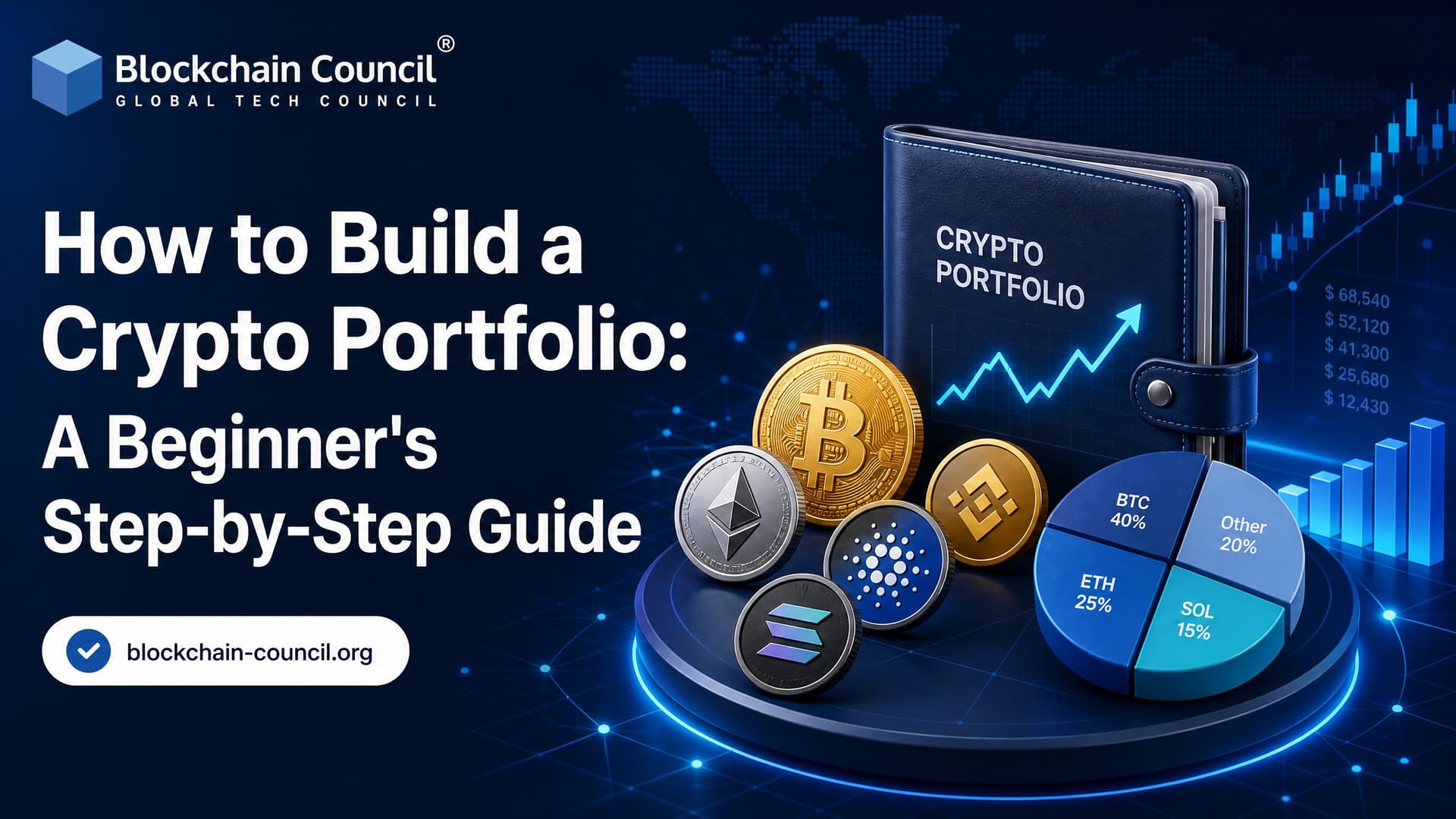
To build a crypto portfolio, start with your risk limit, not with a coin list. Most beginners do best with a simple mix: Bitcoin and Ethereum as core holdings, a small number of researched altcoins, some stablecoin liquidity, and a written plan for buying, storage, and rebalancing.
Crypto can move 10 percent in a day without asking your permission. That is why serious investors treat crypto as a high-risk slice of a broader plan, not the whole plan. Here is a practical, beginner-safe way to approach it.

What Is a Crypto Portfolio?
A crypto portfolio is the collection of digital assets you own. It may include Bitcoin (BTC), Ethereum (ETH), altcoins, stablecoins such as USDC or USDT, and sometimes staking or DeFi positions.
The goal is not to buy every coin people talk about online. The goal is to build a crypto portfolio that matches your time horizon, your risk tolerance, and your ability to research what you actually own.
Step 1: Set Your Crypto Risk Budget
Before you buy anything, decide how much of your total investable money belongs in crypto. For many beginners, that is a small satellite allocation, maybe 5 percent or 10 percent of an overall portfolio. The right number depends on your finances, age, debt, emergency fund, and tolerance for drawdowns.
Ask yourself three blunt questions:
- Can I afford to lose this money without affecting rent, bills, or family obligations?
- Will I panic if my portfolio falls 40 percent?
- Am I investing for 3 to 5 years, or am I trying to trade next week?
If the answers feel uncomfortable, reduce the amount. Do not use credit cards, personal loans, or margin to buy crypto. Beginners who start with borrowed money tend to learn risk management the expensive way.
Step 2: Choose a Strategy Before Choosing Coins
Your strategy comes before your asset list. Most beginners should skip active trading at the start. It looks easy on a chart after the move has already happened. Live markets are a different animal.
Dollar Cost Averaging
Dollar cost averaging, or DCA, means investing a fixed amount at regular intervals, weekly or monthly. You buy more when prices are lower and less when prices are higher. It will not remove risk, but it takes away the pressure to guess the perfect entry price.
Long Term Holding
Long-term holding suits investors who believe in the multi-year adoption of crypto networks. This approach usually focuses on stronger, more liquid assets and avoids frequent trading fees, emotional selling, and tax complexity.
Active Trading
Trading can make sense for experienced market participants who understand stop losses, liquidity, order books, and position sizing. For a beginner, it is usually the wrong first step. Build the habit of research and secure storage first.
Step 3: Start With Core Holdings
Most beginner portfolio examples start with Bitcoin and Ethereum. There is a reason. Bitcoin has the longest operating history in crypto and is widely viewed as a digital scarcity asset, with a hard supply cap of 21 million coins. Ethereum is the largest smart contract platform by ecosystem activity and supports tokens, decentralized applications, NFTs, and DeFi protocols.
That does not make either asset risk-free. Bitcoin can still drop sharply. Ethereum carries technical, regulatory, and competition risks. But compared with thinly traded small-cap tokens, BTC and ETH are easier for a beginner to understand, buy, store, and track.
A simple starter allocation could look like this:
- 70 to 80 percent: Bitcoin and Ethereum
- 10 to 20 percent: researched altcoins
- 5 to 10 percent: stablecoins for liquidity
If you want the simplest possible version, use an 80 percent BTC and 20 percent ETH structure. Boring? Maybe. But boring often survives the first market cycle.
Step 4: Add Altcoins Carefully
Altcoins are any crypto assets other than Bitcoin. Some have serious technology and active development. Many do not.
When evaluating an altcoin, check:
- Use case: Does the token solve a real problem?
- Tokenomics: What is the supply schedule, inflation rate, and utility?
- Team and contributors: Are the builders visible and credible?
- Ecosystem traction: Are developers, users, or partners active?
- Liquidity: Can you enter and exit without heavy slippage?
- Security history: Has the project suffered major exploits?
Watch for red flags. Anonymous teams are not always bad, but vague whitepapers, guaranteed return claims, locked community channels, and heavy insider token allocations should make you pause.
Keep the number of holdings manageable. Benjamin Graham's classic diversification idea pointed to roughly 10 to 30 securities for traditional stocks, but most beginners should stay near the lower end in crypto. If you cannot explain why you hold a token in two sentences, you probably should not own it.
Step 5: Use Stablecoins for Liquidity, Not Growth
Stablecoins are designed to track the value of fiat currencies, usually the US dollar. They help you keep dry powder for buying during market drops or moving between exchanges.
Do not treat stablecoins as risk-free cash. They carry issuer, reserve, regulatory, smart contract, and depeg risks. TerraUSD collapsed in 2022 and wiped out billions, so the difference between a fiat-backed stablecoin and an experimental algorithmic one is not academic.
A beginner allocation might hold 5 percent in stablecoins. That is enough to act when prices drop without forcing you to sell Bitcoin or Ethereum at the wrong moment.
Step 6: Pick a Reputable Exchange
Choose an exchange with strong security practices, good liquidity, clear fees, and availability in your jurisdiction. Complete identity verification, connect your bank account, and start with a small purchase.
Fees matter, but security matters more. Check withdrawal fees and supported networks too. A cheap trade is not helpful if the platform makes withdrawals difficult or only supports a network you do not understand.
Step 7: Set Up Wallet Security
For small amounts, leaving assets on a major exchange can be convenient while you learn. For larger long-term holdings, use a non-custodial wallet or hardware wallet.
There are two main wallet types:
- Hot wallets: Internet-connected wallets such as browser or mobile wallets. Convenient, but more exposed.
- Cold wallets: Offline hardware wallets used for longer-term storage.
Write your seed phrase on paper or metal and store it offline. Never type it into a website. Never send it in a message. Support staff will never ask for it.
One practical detail beginners miss: network fees. If you send ETH or an ERC-20 token from MetaMask, you need ETH in that same wallet to pay gas. The error often reads insufficient funds for gas * price + value. It is not a mystery bug. It means you do not have enough ETH to cover the transaction cost.
Always test with a small transfer first. And confirm the network. Sending funds on the wrong chain can turn into a painful support ticket, and sometimes there is no recovery path at all.
Step 8: Build Your Allocation
Here are three beginner-friendly models. Treat them as examples, not personal financial advice.
Conservative Crypto Portfolio
- 60 percent Bitcoin
- 30 percent Ethereum
- 5 percent selected altcoins
- 5 percent stablecoins
Balanced Crypto Portfolio
- 50 percent Bitcoin
- 30 percent Ethereum
- 15 percent mid-cap altcoins
- 5 percent stablecoins
Aggressive Crypto Portfolio
- 40 percent Bitcoin and Ethereum
- 30 percent mid-cap altcoins
- 25 percent small-cap assets
- 5 percent stablecoins
Be cautious with the aggressive version. Small-cap tokens can fall 80 percent and still not be cheap. If you are still learning how wallets, exchanges, and taxes work, keep the portfolio simple.
Step 9: Rebalance on a Schedule
A portfolio drifts. If one coin rises sharply, it can become too large relative to your plan. Rebalancing means adjusting back to your target allocation.
You can rebalance quarterly, or whenever an asset moves more than about 5 percentage points away from its target. For example, if Ethereum was meant to be 30 percent but grows to 40 percent, you might trim some ETH or direct new purchases toward other assets.
Rebalancing forces discipline. It also stops you from becoming accidentally overexposed to one coin after a strong rally.
Step 10: Track Taxes, Security, and Learning
Keep records of purchases, sales, transfers, fees, and wallet addresses. Tax rules differ by jurisdiction, but many countries treat crypto disposals as taxable events. Good records save real stress later.
Keep learning as the market changes. If you want structured education, consider Blockchain Council's Certified Cryptocurrency Expert™ (CCE) for crypto fundamentals, Certified Blockchain Expert™ (CBE) for blockchain concepts, or Certified Blockchain Developer™ (CBD) if you plan to build applications and smart contracts.
Common Beginner Mistakes to Avoid
- Buying only because a token is trending on social media
- Holding too many coins to research properly
- Ignoring wallet backups and seed phrase security
- Sending assets without checking the network
- Going all in after a price spike
- Using leverage before understanding spot markets
- Assuming stablecoins have no risk
Final Takeaway
The best way to build a crypto portfolio as a beginner is to keep it small, written, and repeatable. Start with a risk budget. Use DCA. Make Bitcoin and Ethereum the core if you want a simpler path. Add altcoins only after real research. Keep stablecoins for liquidity, secure your wallet, and rebalance when the portfolio drifts.
Your next step: write a one-page crypto investment policy for yourself. Include your maximum crypto allocation, target percentages, DCA schedule, wallet plan, and rebalancing rule. If you cannot write that plan yet, study the fundamentals first through a structured course such as the Certified Cryptocurrency Expert™ (CCE).
Related Articles
View All
Cryptocurrency
What Is Crypto Asset Recovery? A Complete Beginner's Guide
Learn what crypto asset recovery means, how blockchain forensics and legal tools work, and how to avoid fake recovery services after theft or wallet loss.

Cryptocurrency
Crypto Asset Recovery After a Phishing Attack: Step-by-Step Guide for Investors
A practical incident response guide for investors hit by crypto phishing, covering containment, evidence, tracing, exchange reports, legal action, and scam warnings.

Cryptocurrency
Public Key vs Private Key: Crypto Keys Explained for Beginners
Public key vs private key explained for crypto beginners, including wallet addresses, transaction signing, seed phrases, and private key security basics.
Trending Articles
The Role of Blockchain in Ethical AI Development
How blockchain technology is being used to promote transparency and accountability in artificial intelligence systems.
AWS Career Roadmap
A step-by-step guide to building a successful career in Amazon Web Services cloud computing.

Top 5 DeFi Platforms
Explore the leading decentralized finance platforms and what makes each one unique in the evolving DeFi landscape.