

From CEX to DEX: Auditing Wallet Activity, Slippage, MEV, and Fees to Improve Trading Performance
 Suyash Raizada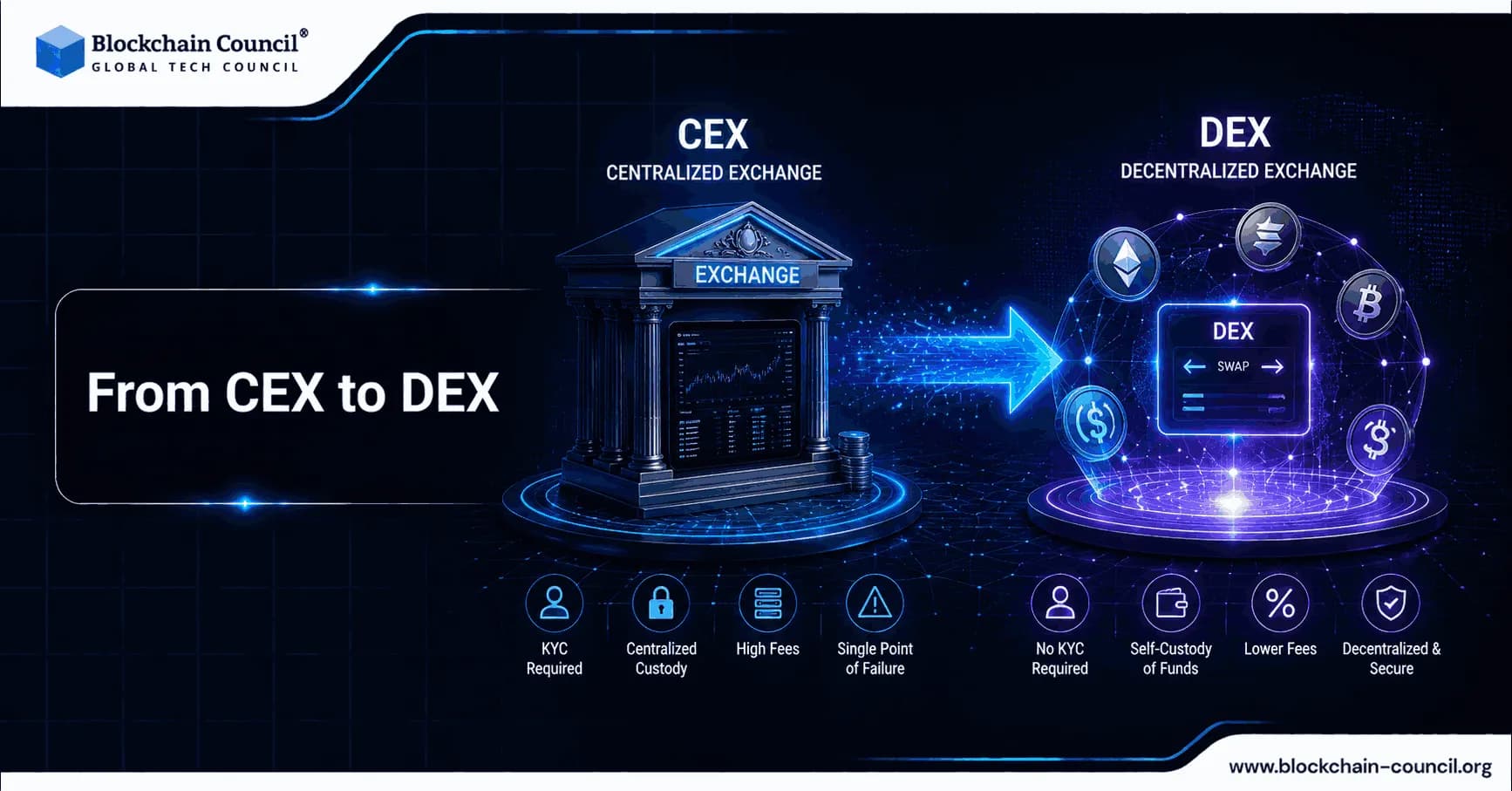
From CEX to DEX trading performance often improves only after traders measure what actually happens at execution. The visible fee line item is rarely the full story. On decentralized exchanges (DEXs), gas, price impact, and MEV can quietly add multiple percentage points of cost. On centralized exchanges (CEXs), spreads, order book depth, and venue routing can create meaningful slippage even when taker fees look low.
This guide explains how to audit wallet activity end-to-end, quantify slippage and MEV, and compare all-in costs across CEX and DEX routing so you can improve trading performance with evidence instead of guesswork.

As digital asset markets continue to evolve, understanding execution quality, liquidity, and trading infrastructure has become an essential skill for market participants. A Certified Cryptocurrency Expert credential helps professionals build practical knowledge of cryptocurrency ecosystems, blockchain markets, and trading mechanics, providing a stronger foundation for evaluating both centralized and decentralized trading environments.
CEX vs DEX: Where the Hidden Trading Costs Come From
DEXs have grown large enough to matter for professional best-execution decisions. Industry estimates place DEX spot volume at roughly 12-15% of total spot crypto trading, with Uniswap v3 processing around USD 1-2 billion per day across Ethereum mainnet and L2s, and Curve often handling hundreds of millions per day in stablecoin swaps. Structural differences remain, however: DEX execution is block-based and typically exposed to public mempools, while CEX execution is order book-based with private order flow.
Understanding how execution quality changes across trading venues is a valuable skill for active market participants. A Certified Cryptocurrency Trader (CCT) credential helps professionals develop practical expertise in market structure, order execution, technical analysis, and risk management, enabling them to make more informed trading decisions across both CEX and DEX platforms.
Slippage Is the Cost of Immediacy
Slippage is the difference between the expected price when you submit an order and the price you actually receive. It represents a cost paid to get filled immediately rather than waiting for better liquidity. In 2024, aggregate slippage costs across venues were estimated in the billions of USD and rising year-on-year, driven by volatility and the growth of on-chain activity.
On Uniswap v3, typical outcomes vary dramatically by liquidity:
High-liquidity pairs like ETH/USDC can show average transaction costs (including slippage) around 0.22% under normal conditions.
Long-tail pairs like PEPE/ETH have been observed around 1.4% on average, roughly a 6x difference.
During memecoin pumps and thin liquidity, 5-10% slippage on a single swap is common if trade size is large relative to pool depth.
MEV Is Slippage You Do Not See on the Receipt
Maximal Extractable Value (MEV) is profit captured by validators, block builders, or searchers by reordering or inserting transactions. For traders, MEV often shows up as worse execution without any explicit fee line. Public mempools allow adversaries to observe your swap and react before it is finalized.
Real-world impacts reported across DeFi research and datasets include:
Retail DEX users can effectively pay an invisible tax on the order of 0.5% to 2% due to MEV under certain conditions.
For larger trades, extraction has been observed in the 1% to 3% range in high-risk scenarios.
One 30-day dataset reported tens of thousands of sandwich attacks on Ethereum and meaningful value extracted from users, including extreme single-trade losses in high-value swaps.
An academic analysis of CEX-DEX arbitrage measured roughly USD 233.8 million extracted over a multi-month period by a small set of major searchers, with heavy concentration among the top few actors.
Gas and Failure Costs Change the Economics of Small Trades
On-chain execution adds a cost dimension that CEX traders do not face: gas. Gas can represent 1-10% of notional value for small trades during congested conditions on Ethereum L1. An often-overlooked cost is that gas can still be charged even when a transaction reverts due to a slippage tolerance breach. This means your worst trades can be both unfilled and expensive.
Auditing Wallet Activity: A Practical Framework for DEX Performance
To improve outcomes when moving from CEX to DEX, start with measurement. A wallet audit reconstructs every swap and related transaction, normalizes costs, and attributes performance to specific drivers: fees, slippage, MEV, and gas.
What to Capture for Each Trade
For a robust wallet-level trading audit, log the following fields per transaction:
Trade direction and size
Tokens in and out, plus block time and transaction index.Effective execution price
Compute realized price from amounts in and out, then compare to a timestamp-aligned mid-market benchmark from a reliable market data source.Explicit fees
DEX pool fee tier (for example, Uniswap v3 0.01% to 0.3%), aggregator fees if applicable, and CEX maker-taker fees for cross-venue comparison.Gas costs
Gas used multiplied by gas price, converted to USD equivalent at execution time. Include approvals, wraps/unwraps, and any failed attempts.Routing and pool details
Protocol, pool address, and whether the swap was multi-hop or aggregator-routed, which can increase total impact.Outcome classification
Filled vs reverted for DEX; filled, partial, or canceled for CEX.Venue metadata
CEX order type (market, limit, TWAP, RFQ) and DEX protection method (public mempool vs private relay vs RFQ or intent-based).
Tooling That Helps, and What It Misses
Most professionals combine multiple layers of tooling:
Block explorers (Etherscan, Blockscout, Solscan) for raw logs and event verification.
Portfolio trackers (DeBank, Zerion, Zapper, Rotki) for high-level visibility, with the caveat that they rarely attribute MEV explicitly.
Analytics platforms (Dune, Flipside, Footprint) to query swap events, pool states, and build custom cost models.
MEV datasets and tooling (including Flashbots-related data and independent MEV research archives) to tag suspected sandwiching and bundle inclusion patterns.
For enterprises, the best practice is an internal trade repository that reconciles on-chain transaction hashes with CEX execution reports and normalizes all activity into consistent profit-and-loss and cost metrics expressed in USD and basis points.
Quantifying Slippage Across CEXs and DEXs
How Slippage Works on a CEX
On a CEX, slippage is primarily an order book phenomenon: market orders walk the book, and thin depth forces fills at progressively worse prices. Latency, stale quotes in illiquid pairs, and internal routing also affect realized execution quality.
A commonly used measurement is:
Slippage (bps) = [(VWAP execution price - mid price at order arrival) / mid price] x 10,000
How Slippage Works on a DEX
On a DEX, slippage has multiple components:
AMM price impact from the curve and liquidity distribution.
Market movement between submission and block inclusion.
MEV-induced deterioration from adversarial reordering such as sandwiching.
Slippage tolerance is a user-controlled parameter, often set around 0.3% to 0.5% for liquid pairs, but it creates a trade-off. A setting that is too tight produces reverts while still consuming gas. A setting that is too wide makes your transaction a more attractive target for sandwich attacks.
Detecting MEV in Your Wallet: Practical Heuristics
Because MEV is not itemized in transaction receipts, detection is probabilistic. A useful MEV attribution layer can still be built for performance analysis using the methods below.
Method 1: Price Deviation After Known Fees
Compute the following:
Expected price from your quote or a mid-market benchmark at the relevant timestamp.
Subtract known protocol fees and aggregator fees.
Compare the remainder to realized execution.
If you repeatedly observe execution that is meaningfully worse than expected, for example 2-3% worse on trades that should have low price impact, especially during volatile periods, MEV is a plausible driver.
Method 2: Bundle and Sandwich Pattern Analysis
Many sandwich attacks have a recognizable structure: a trade immediately before yours, your trade, then a trade immediately after, often routed similarly and clustered in the same block. MEV-aware analytics can sometimes identify whether your transaction was included in a bundle or positioned adjacent to known searcher activity.
Method 3: Risk Scoring Based on Trade Characteristics
Flag trades for elevated MEV risk when they combine:
Long-tail or highly volatile tokens
Large size relative to pool liquidity
High slippage tolerance (above 2%, for example)
High-urgency gas bidding
Measuring execution quality at scale also requires knowledge of blockchain analytics, software tools, automation, and data infrastructure. A Tech Certification helps professionals strengthen these technical capabilities, making it easier to build reliable monitoring systems and analyze trading performance across multiple blockchain networks and exchanges.
All-In Cost Comparison: What Matters More Than Fee Schedules
Professional execution decisions should be based on all-in cost, not just maker-taker fees or AMM fee tiers.
CEX Cost Components
Explicit fees: taker fees often range from about 0.02% to 0.1% for high-volume tiers and higher for retail accounts.
Implicit costs: spread, order book impact, and latency.
Other costs: withdrawal fees and, where relevant, fiat on-ramp fees that can reach several percent for card purchases in some jurisdictions.
DEX Cost Components
Protocol fees: commonly 0.01% to 0.3% for major AMMs.
Gas: variable by chain, L2, and network congestion.
Slippage and MEV: often the dominant hidden drivers during volatile market conditions.
Published case comparisons show how quickly DEX costs can escalate: a nominal 0.3% AMM fee can become multiple percent all-in once typical slippage, MEV, and gas are included, particularly for small swaps during periods of congestion.
Techniques to Improve Trading Performance When Moving from CEX to DEX
For Individual and Professional Traders
Use tight, realistic slippage settings: for liquid pairs, 0.3% to 0.5% is a common baseline; stablecoin pairs often justify tighter settings.
Prefer aggregators and RFQ: routing across multiple liquidity sources can reduce price impact; RFQ systems secure quotes off-chain and settle on-chain, reducing public mempool exposure.
Use private order flow for MEV protection: private RPCs and MEV-protection services reduce the chance of mempool-based sandwiching.
Trade on L2s when appropriate: lower gas reduces both direct costs and the penalty of reverts.
Split large orders: clip sizing and time-slicing reduce price impact and can lower MEV attractiveness.
Audit continuously: tag trades by venue, token liquidity, volatility regime, and protection method to identify what actually works.
For Institutional and Algorithmic Desks
Institutions increasingly invest in smart order routing and MEV-resistant execution. Industry reporting includes examples of desks saving hundreds of thousands of USD per month through proprietary routing and protection strategies. At this level, performance improvement typically comes from:
Real-time cost models that forecast gas, slippage, and MEV risk per venue.
MEV-aware infrastructure using private relays, bundles, and execution policies that reduce exposure.
Compliance-aware reporting that reconciles on-chain activity with transaction reporting and transfer requirements in relevant jurisdictions.
For teams building these capabilities, internal skill development matters. Blockchain Council offers certifications such as Certified Cryptocurrency Trader, Certified Blockchain Expert, and training in DeFi, Certified Smart Contract Developer, and Web3 analytics to strengthen execution, auditing, and risk management workflows.
Future Direction: Intent-Based Trading and Cross-Venue Best Execution
DEX design is trending toward intent-based execution and solver networks, where users specify desired outcomes and solvers compete to deliver best execution while minimizing MEV. Batch auctions and MEV-aware AMM designs also aim to reduce the information advantage held by searchers. Professional tooling is converging in parallel on cross-venue best execution frameworks that treat CEX, DEX, RFQ, and OTC liquidity as interchangeable options selected on a per-trade basis.
As regulation matures, demand for auditable, compliant, and measurable execution will increase, making wallet-level auditing and cost attribution a core operational competency rather than an optional analytics project.
Conclusion
Moving from CEX to DEX can improve access, composability, and liquidity options, but only if you manage the real costs of on-chain execution. The path to better performance is straightforward:
Treat slippage, MEV, and gas as first-class cost components.
Build a rigorous wallet activity audit that reconstructs effective price, explicit fees, gas, and failed transaction costs.
Adopt MEV protection through private order flow, RFQ, aggregators, and intent-based protocols where appropriate.
Use data-driven routing instead of static rules that default to CEX or DEX regardless of conditions.
When you quantify the hidden costs and optimize around them, you can recover meaningful basis points and, in many cases, multiple percentage points of performance over time.
Long-term success in digital asset markets also depends on understanding strategy, communication, and business decision-making alongside technical execution. A Marketing & Business Certification helps professionals strengthen these broader skills, enabling them to evaluate market opportunities more effectively and align trading strategies with organizational or investment objectives.
FAQs
1. What is the difference between a CEX and a DEX?
A Centralized Exchange (CEX) is operated by a company that manages user accounts, order matching, and custody of assets. A Decentralized Exchange (DEX) allows users to trade directly from their crypto wallets through smart contracts without relying on a central intermediary.
2. Why are traders moving from CEXs to DEXs?
Many traders prefer DEXs because they offer self custody, greater transparency, permissionless trading, access to new tokens, and reduced dependence on centralized institutions.
3. What is wallet activity analysis in crypto trading?
Wallet activity analysis involves tracking blockchain transactions, token transfers, trading behavior, liquidity movements, and interactions with decentralized applications to identify market trends and trading opportunities.
4. Why should traders audit their wallet activity?
Auditing wallet activity helps traders understand their trading history, identify profitable strategies, monitor portfolio performance, detect unnecessary fees, and improve overall decision making.
5. What is slippage in cryptocurrency trading?
Slippage is the difference between the expected execution price and the actual price at which a trade is completed. It commonly occurs during periods of high volatility or low market liquidity.
6. What causes slippage on decentralized exchanges?
Slippage can result from:
Low liquidity
Large trade sizes
High market volatility
Delayed transaction confirmation
Rapid price movements
Automated market maker pricing
7. How can traders reduce slippage?
Traders can reduce slippage by trading highly liquid assets, breaking large orders into smaller trades, adjusting slippage tolerance carefully, and avoiding periods of extreme market volatility.
8. What is MEV in blockchain trading?
MEV, or Maximal Extractable Value, refers to the additional profit that validators or block producers can capture by reordering, inserting, or excluding transactions before they are finalized on the blockchain.
9. How does MEV affect DEX traders?
MEV can increase trading costs through sandwich attacks, front running, back running, and delayed transaction execution, reducing the profitability of trades.
10. What is a sandwich attack?
A sandwich attack occurs when an attacker places one transaction before and another after a user's trade to manipulate the token price and profit from the price movement.
11. What is front running in decentralized trading?
Front running happens when someone detects a pending transaction and submits a similar transaction with a higher priority fee so it executes first.
12. How can traders protect themselves from MEV?
Protection strategies include:
Using private transaction relays
Trading during periods of higher liquidity
Reducing slippage tolerance
Splitting large orders
Using MEV protected trading services
13. What fees do traders pay on decentralized exchanges?
DEX traders may pay:
Network gas fees
Liquidity provider fees
Protocol fees
Bridge fees for cross chain transfers
Aggregator service fees
14. Why are gas fees important for trading performance?
High gas fees reduce net trading profits, especially for frequent traders or those executing smaller transactions.
15. How can traders reduce transaction fees?
Fees can often be reduced by choosing lower cost blockchains, trading during periods of lower network congestion, batching transactions, and using Layer 2 networks when available.
16. What is on chain trading analysis?
On chain trading analysis examines blockchain data such as wallet balances, transaction history, token transfers, liquidity movements, and smart contract interactions to evaluate market behavior.
17. Why should traders monitor whale wallets?
Large cryptocurrency holders often influence market sentiment and liquidity. Monitoring whale wallets can provide insights into accumulation, distribution, and potential market trends.
18. What is trade execution quality?
Trade execution quality measures how efficiently a trade is completed based on execution speed, price accuracy, transaction costs, slippage, and overall market impact.
19. What metrics should traders review during a wallet audit?
Useful metrics include:
Win rate
Average trade size
Trading frequency
Total fees paid
Slippage percentage
Gas costs
Portfolio allocation
Profit and loss
Risk exposure
20. What is a DEX aggregator?
A DEX aggregator searches multiple decentralized exchanges to find the best available trading routes, prices, and liquidity for a user's transaction.
21. How does liquidity affect decentralized trading?
Higher liquidity generally results in lower slippage, faster trade execution, and more accurate pricing, while low liquidity increases trading costs and price impact.
22. What is portfolio performance analysis for crypto traders?
Portfolio performance analysis evaluates returns, asset allocation, realized and unrealized gains, trading efficiency, risk levels, and overall investment performance using blockchain transaction data.
23. How often should traders audit their wallet activity?
Active traders should review wallet activity regularly, such as weekly or monthly, while long term investors may benefit from conducting portfolio audits every quarter.
24. Which tools help analyze wallet activity and DEX performance?
Common blockchain analytics tools include wallet explorers, portfolio trackers, DEX analytics platforms, on chain data dashboards, and blockchain intelligence solutions that provide detailed trading insights.
25. What are the best practices for improving DEX trading performance?
Best practices include:
Monitor trading fees
Minimize slippage
Use DEX aggregators
Protect against MEV
Review wallet activity regularly
Diversify liquidity sources
Track portfolio performance
Manage trading risk
26. Why is auditing wallet activity essential for crypto traders?
Regular wallet audits help traders optimize execution quality, reduce unnecessary fees, identify profitable strategies, improve risk management, detect inefficient trading patterns, and make more informed decisions in both centralized and decentralized cryptocurrency markets.
Related Articles
View All
Cryptocurrency
Decentralized Exchanges (DEX) Explained: Peer-to-Peer Crypto Trading
Decentralized exchanges let users trade crypto directly from wallets through smart contracts. Learn how DEXs work, key risks, market trends, and use cases.
Cryptocurrency
Crypto Options Trading: Calls, Puts, and Risk Management
Learn how crypto options trading works through calls, puts, Greeks, hedging strategies, and practical risk management rules for volatile markets.

Cryptocurrency
Crypto Futures Trading Explained: Contracts, Hedging, and Speculation
Crypto futures trading lets you hedge, speculate, and trade crypto price movements without owning coins, but margin and liquidation risk demand discipline.
Trending Articles
The Role of Blockchain in Ethical AI Development
How blockchain technology is being used to promote transparency and accountability in artificial intelligence systems.
AWS Career Roadmap
A step-by-step guide to building a successful career in Amazon Web Services cloud computing.
How Blockchain Secures AI Data
Understand how blockchain technology is being applied to protect the integrity and security of AI training data.