

Crypto Investigation Toolkit
 Suyash Raizada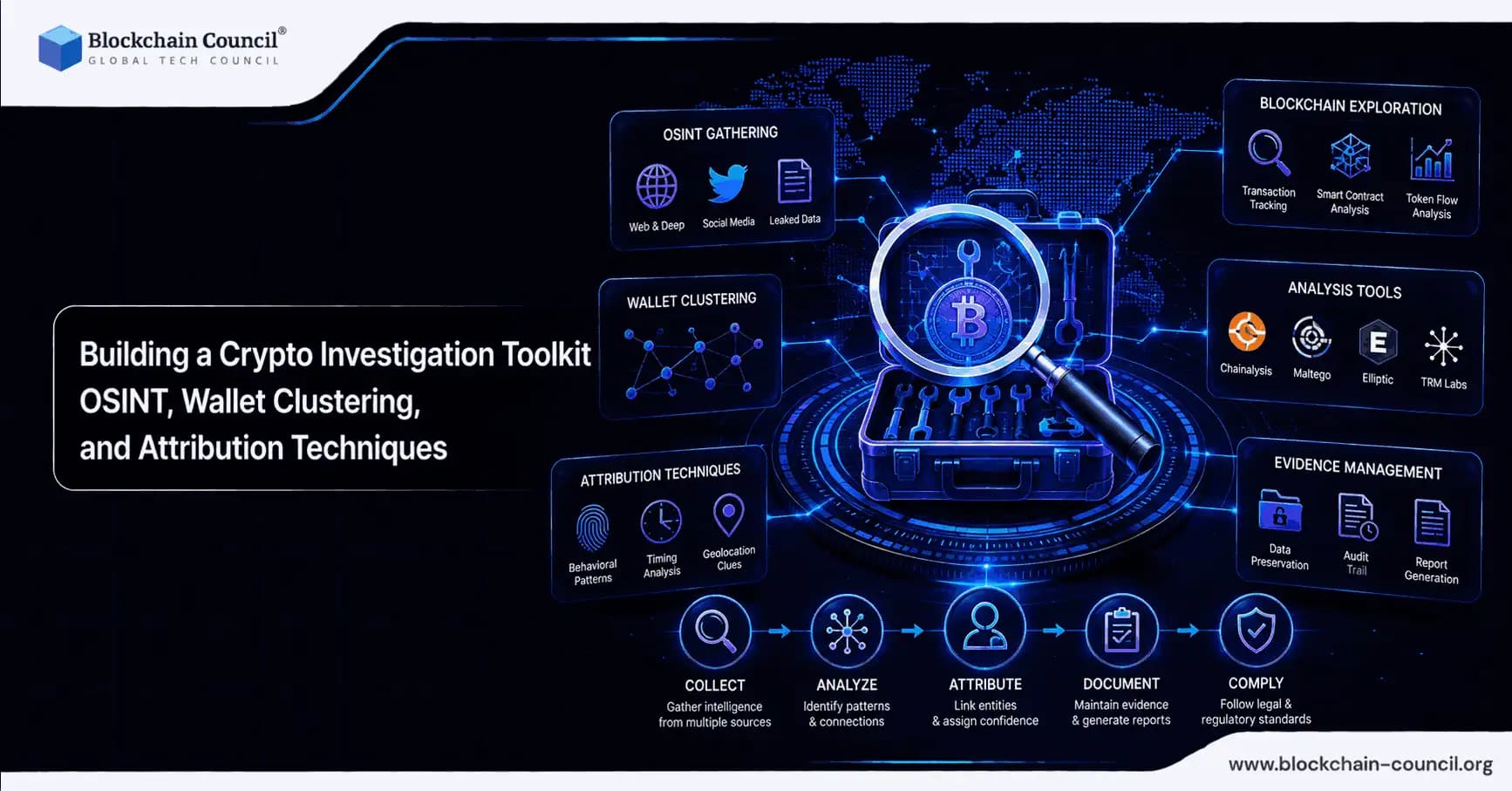
Building a crypto investigation toolkit requires more than a blockchain explorer and an educated guess. Modern investigations combine OSINT (Open Source Intelligence), wallet clustering, and attribution techniques to trace flows across chains, identify entities behind pseudonymous addresses, and document findings in a defensible way. This hybrid approach is necessary because obfuscation tactics - including mixers, chain-hopping, nested exchange deposits, and rapid cross-chain swaps - are now standard in scams, sanctions evasion, and ransomware laundering. Build a professional crypto investigation toolkit using OSINT methods, wallet clustering, attribution analysis, and blockchain tracing techniques by gaining expertise through a Cyber Security Expert, automating blockchain intelligence workflows using a Python certification, and applying investigative insights in security operations with a Digital marketing course.
Industry reporting consistently shows illicit crypto activity represents a small percentage of total volume, yet still accounts for tens of billions of dollars annually. That scale makes repeatable, evidence-based workflows essential for compliance teams, incident responders, investigators, and threat intelligence analysts.

What a Crypto Investigation Toolkit Is (and Is Not)
A crypto investigation toolkit is a structured set of processes, data sources, and tools used to:
Trace funds across addresses, tokens, and networks
Cluster wallets into entity-level groupings
Attribute activity to real-world services or actors using corroborated signals
Produce reports suitable for compliance, legal, or incident response use
It is not a guarantee of identity revelation. Privacy-preserving wallets, advanced mixers, and certain privacy coins can significantly reduce attribution confidence. Academic evaluations indicate attribution success rates can be high against basic obfuscation, but may drop sharply when advanced privacy techniques are employed. The goal is to build a toolkit that combines weak signals into stronger, corroborated conclusions.
Core Pillar 1: OSINT for Crypto Investigations
OSINT turns on-chain traces into real-world leads. Blockchains show where value moved, but OSINT helps explain who likely controlled the endpoints and why the movement occurred.
High-Value OSINT Sources to Integrate
Sanctions and watchlists: Open sanctions datasets and government advisories can validate whether an address or entity is linked to restricted activity.
Scam and abuse databases: Community scam reports, phishing repositories, and victim disclosures often include deposit addresses, transaction IDs, and screenshots.
Social platforms and forums: Announcements, fundraising posts, airdrop scams, and impersonation attempts frequently reuse addresses across campaigns.
Exchange and service documentation: Deposit format hints, chain support notices, and wallet maintenance updates can help interpret timing anomalies.
Breach and threat intelligence context: For ransomware and extortion cases, correlating campaign timelines with wallet activity bursts often reveals operational patterns.
A Repeatable and Auditable OSINT Workflow
Start with a seed: address, ENS name, transaction hash, domain, Telegram handle, or invoice.
Pivot on-chain: identify counterparties, token movements, and likely service interactions.
Pivot off-chain: search for address reuse, screenshots, paste sites, GitHub issues, scam reports, and archived pages.
Corroborate: require at least two independent signals before making an identity claim.
Preserve evidence: archive pages, capture timestamps, and store hashes of key artifacts.
Core Pillar 2: Wallet Clustering (Entity-Level Analysis)
Wallet clustering is the process of grouping addresses that likely belong to the same controlling entity. This moves an investigation from a single address to a full wallet set, and then toward identifying the service or actor behind it.
Common Clustering Heuristics and Their Limits
Shared-input heuristic (UTXO chains like Bitcoin): when multiple inputs are spent together in a single transaction, they are often controlled by one entity. CoinJoin and collaborative spends intentionally break this assumption.
Change address identification (UTXO): change output patterns can reveal the sender's next address. Wallet software and privacy tools reduce reliability here.
Behavioral patterns (UTXO and account-based): timing, transfer sizes, repeated fee behavior, and operational rhythms can indicate common control. This approach is powerful but requires validation to avoid false positives.
Deposit and withdrawal patterns (EVM chains): repeated interactions with the same DEX or router contracts, bridges, and centralized exchange deposit patterns can form entity-level clusters.
Commercial analytics providers combine multiple heuristics with proprietary methods and service tagging. Reported benchmarks commonly cite strong clustering performance on practical datasets, though accuracy varies by chain, wallet type, and adversary sophistication.
What Clustering Output Should Deliver
For investigations, clustering should produce:
Cluster membership: list of addresses, confidence scores, and rationale
Exposure map: connected services such as bridges, exchanges, mixers, and OTC desks
Temporal narrative: when the cluster became active, activity peaks, dormancy periods, and migration events
Risk signals: interactions with sanctioned addresses, known scam infrastructure, or high-risk services
Core Pillar 3: Attribution Techniques (Linking to Services or Actors)
Attribution is where investigations become actionable: linking a cluster to an exchange, merchant processor, ransomware affiliate, scam operator, or sanctioned entity. The strongest results come from combining on-chain signals, OSINT corroboration, and service-specific knowledge.
Exchange and Service Wallet Identification Through Dusting
One widely discussed attribution method is dusting, where an investigator sends a small amount of cryptocurrency to a target deposit address and monitors where that dust ultimately consolidates. If swept into a known hot wallet, it can help attribute the deposit address to a specific exchange or service. Industry methodology reports have claimed high accuracy for certain exchanges when dusting results are validated against known labels and operational patterns.
Important caveats: dusting raises legal, ethical, and policy considerations. Some jurisdictions and organizations restrict proactive probing. Always align with legal counsel, internal policy, and applicable regulations before using this technique.
Cross-Chain Attribution and Chain-Hopping Analysis
Chain-hopping is a common laundering step: move value from one chain to another via bridges, DEX swaps, or centralized services. Toolkits increasingly prioritize multi-chain tracing and visualization, since funds may traverse eight or more blockchains in a single laundering sequence.
Effective cross-chain attribution typically requires:
Bridge identification: determining which bridge or swap service facilitated the hop
Time-window correlation: aligning inbound and outbound events around bridge transactions
Denomination and fee modeling: accounting for gas fees, slippage, and bridge fees
OSINT confirmation: matching to publicly known service wallets, incidents, or sanctions guidance
Attribution Under Privacy Pressure
Advanced mixers and privacy-focused wallets can deliberately create transaction patterns that degrade standard heuristics. Research discussions in 2025 highlighted how fixed-amount outputs and modern address formats can be used to obscure attribution signals. The practical takeaway is to treat attribution as probabilistic, document all assumptions, and rely on multiple independent corroborations rather than any single heuristic.
Recommended Crypto Investigation Toolkit Components
Below is a practical toolkit layout adaptable to different environments, budgets, and case types.
1. Block Explorers and Basic Tracing
Bitcoin explorers: for UTXO transaction structure, inputs, outputs, and scripts
EVM explorers: Etherscan-style explorers for token transfers, internal transactions, and contract interactions
Multi-chain explorers: for chain-hopping visualization and unified cross-chain views
2. Analytics and Clustering Platforms
Entity tagging: labeled services and wallet sets
Clustering engines: UTXO and account-based heuristics combined with behavioral modeling
Risk scoring: exposure to sanctions, scams, mixers, and ransomware typologies
3. OSINT Tooling and Evidence Handling
Archiving tools: preserve pages and social posts that reference addresses
Link analysis: graph tools for mapping identities, domains, handles, and addresses
Collaboration features: modern OSINT toolkits increasingly include AI-assisted workflows to reduce manual triage effort
4. Visualization and Reporting
Transaction graphing: to explain flows to non-technical stakeholders
Case timelines: connecting on-chain events to off-chain incidents
Exportable exhibits: screenshots, CSV exports, and reproducible queries
Real-World Investigation Scenarios
Ransomware and Extortion Tracing
Investigators typically start with a ransom address, cluster related addresses, and identify cash-out points. OSINT then validates whether those endpoints match known exchange deposit formats, reported service tags, or prior campaign infrastructure. Behavioral clustering can highlight operational patterns such as periodic consolidation and timed withdrawals.
Sanctions Evasion and Multi-Chain Laundering
Sanctioned entities may hop across multiple chains and swap assets repeatedly. Multi-chain visualization tools help analysts track the movement narrative, while OSINT adds context through named persons, entities, and known infrastructure. The strongest conclusions come from matching on-chain flows to independently verifiable public records and official advisories.
Scams and Large-Scale Theft Investigations
On-chain investigators frequently combine labeled entity tracking, custom analytics queries for anomalies, and OSINT pivots from social platforms. When victims share deposit addresses or transaction IDs, analysts can cluster collection wallets and identify consolidation routes toward exchanges or OTC services.
Future Outlook: Where Crypto Investigations Are Headed
Between 2027 and 2030, investigations are expected to become more automated and cross-chain by default. Industry forecasts suggest AI will automate a significant portion of clustering and triage, while regulatory frameworks such as EU MiCA and evolving stablecoin policies will continue pushing organizations toward formalized monitoring and analytics. At the same time, privacy tooling - including next-generation CoinJoin variants and broader Layer 2 adoption - will keep raising the bar for reliable attribution, particularly for teams relying on single heuristics rather than hybrid validation methods. Learn how investigators track suspicious crypto activity using wallet attribution, transaction graph analysis, and OSINT correlation by mastering crypto forensics through a Cryptocurrency Expert, developing blockchain investigation tools using a Node JS Course, and growing security-focused blockchain services using an AI powered marketing course.
Conclusion
Building a crypto investigation toolkit is fundamentally about creating a repeatable methodology that stands up to scrutiny. OSINT provides real-world context, wallet clustering delivers entity-level structure, and attribution techniques connect flows to services and actors with documented confidence. The most effective teams invest in multi-chain visibility, robust evidence handling, and clear reporting so their conclusions remain explainable, auditable, and actionable.
For organizations formalizing investigation capability within a compliance, security, or risk function, aligning tooling with structured training and documented processes is essential. A well-designed toolkit is not just software - it is a disciplined workflow.
FAQs
1. What is a crypto investigation toolkit?
A crypto investigation toolkit is a collection of tools, methods, and workflows used to trace blockchain transactions and identify suspicious activities. It helps investigators analyze wallet behavior and document evidence properly.
2. Why are crypto investigation toolkits important?
Crypto investigation toolkits help analysts handle scams, ransomware, fraud, and sanctions evasion more effectively. They provide structured workflows for tracing funds and identifying entities across blockchains.
3. What does OSINT mean in crypto investigations?
OSINT stands for Open Source Intelligence. It involves collecting publicly available information from websites, forums, social media, and databases to support blockchain investigations.
4. How does OSINT help blockchain investigations?
OSINT helps investigators connect blockchain addresses to real-world people, services, or activities. It adds context to on-chain data and improves attribution accuracy.
5. What are common OSINT sources in crypto investigations?
Common OSINT sources include sanctions lists, scam databases, social media posts, phishing reports, and exchange documentation. These sources help investigators verify suspicious activities.
6. What is wallet clustering in blockchain analysis?
Wallet clustering is the process of grouping blockchain addresses that likely belong to the same entity. It helps investigators understand broader transaction networks instead of isolated wallets.
7. Why is wallet clustering important?
Wallet clustering allows analysts to track fund movements more efficiently and identify connected addresses. This improves visibility into suspicious financial activity and laundering patterns.
8. What are clustering heuristics in crypto investigations?
Clustering heuristics are analytical methods used to identify relationships between blockchain addresses. They rely on transaction behavior, timing patterns, and wallet interactions.
9. What is attribution in crypto investigations?
Attribution is the process of linking blockchain activity to real-world individuals, exchanges, or organizations. It helps investigators identify who may control certain wallet addresses.
10. What is chain-hopping in cryptocurrency investigations?
Chain-hopping occurs when funds move across multiple blockchains using bridges or swaps. Criminals often use this method to make tracing more difficult because apparently one blockchain was not chaotic enough.
11. What is dusting in crypto attribution?
Dusting is a technique where small amounts of cryptocurrency are sent to wallets to observe future fund movements. Investigators may use this method to identify exchange or service connections.
12. Why is evidence preservation important in crypto investigations?
Evidence preservation ensures that screenshots, records, and blockchain data remain verifiable and auditable. Proper documentation supports compliance and legal investigations.
13. What tools are commonly included in a crypto investigation toolkit?
Common tools include blockchain explorers, analytics platforms, clustering engines, OSINT software, and visualization tools. These systems help investigators trace and analyze blockchain activity.
14. What role do blockchain explorers play in investigations?
Blockchain explorers allow analysts to inspect transactions, addresses, and smart contract activity directly on-chain. They are often the first step in transaction tracing.
15. How do visualization tools help crypto investigators?
Visualization tools create transaction graphs and timelines that make blockchain activity easier to understand. They help investigators explain complex flows to non-technical stakeholders.
16. What challenges do investigators face with privacy-focused cryptocurrencies?
Privacy-focused cryptocurrencies use advanced techniques to hide transaction details and wallet relationships. This makes attribution and tracing significantly more difficult.
17. How are crypto investigations used in ransomware cases?
Investigators trace ransom payments, identify related wallet clusters, and monitor cash-out points. OSINT and blockchain analysis help connect transactions to known threat actors.
18. Why is multi-chain tracing important in crypto investigations?
Funds frequently move across several blockchains during laundering or fraud activities. Multi-chain tracing helps investigators follow the complete movement path of digital assets.
19. What is the future of crypto investigation technology?
Future investigation tools will rely more on AI automation, cross-chain analytics, and advanced behavioral analysis. Privacy technologies will also continue challenging traditional tracing methods.
20. What makes a strong crypto investigation workflow?
A strong workflow combines OSINT, wallet clustering, attribution techniques, and evidence preservation. The goal is to create findings that are accurate, repeatable, and defensible under scrutiny.
Related Articles
View All
Cryptocurrency
Crypto Lending and Borrowing Explained: DeFi Loans, Rates, and Risks
Crypto lending and borrowing lets users earn yield or access liquidity through DeFi loans, but rates, collateral rules, and liquidations matter.

Cryptocurrency
Liquidity Mining Explained: How Crypto Users Earn Protocol Incentives
Liquidity mining lets crypto users supply assets to DeFi pools and earn fees plus token incentives. Learn how it works, where rewards come from, and the risks.

Cryptocurrency
DCA in Crypto: A Beginner-Friendly Dollar-Cost Averaging Strategy
Learn how DCA in crypto works, when it helps beginners, where it underperforms lump-sum investing, and how to build a practical Bitcoin or Ethereum plan.
Trending Articles
The Role of Blockchain in Ethical AI Development
How blockchain technology is being used to promote transparency and accountability in artificial intelligence systems.
How Blockchain Secures AI Data
Understand how blockchain technology is being applied to protect the integrity and security of AI training data.
How to Install Claude Code
Learn how to install Claude Code on macOS, Linux, and Windows using the native installer, plus verification, authentication, and troubleshooting tips.