

Can Claude, ChatGPT & Gemini Predict Market Trends?
 Suyash Raizada
Investors have always searched for ways to see the future. From technical chart patterns to fundamental company analysis, the quest to predict market movements has shaped financial history. Now artificial intelligence is taking its turn in the spotlight. Tools like ChatGPT and Google’s Gemini are being tested not just for writing or creative tasks but for spotting market signals. The question is simple: can these models actually predict trends in stocks, crypto, or the broader economy? Evidence suggests they can offer an edge in certain conditions, though not without clear limits. For investors hoping to apply these systems responsibly, the AI powered investing certification is a practical way to learn how.
Why AI Feels Like a Game-Changer for Market Forecasting
Markets are driven by information, and information moves faster than ever. Human analysts can only read so many reports in a day, but AI systems like ChatGPT and Gemini can process thousands of articles, filings, and social media posts in seconds. They not only read but also interpret context, tone, and sentiment. That kind of scale is hard to match.

What makes these tools exciting for investors is their ability to handle unstructured data. Traditional financial models work best with numbers-balance sheets, ratios, and historical prices. Large language models, on the other hand, can analyze text, audio transcripts, and even multimodal inputs in the case of Gemini. They don’t just crunch numbers; they pick up on narratives and emotional shifts that drive markets in the short term.
For example, if a CEO uses more cautious language than usual during an earnings call, an AI tool can flag this subtle change as a potential warning. A human analyst might miss it or take hours to catch it, but AI notices immediately. This speed and depth are what investors describe as a “secret weapon.”
Overview of AI in Predicting Market Trends
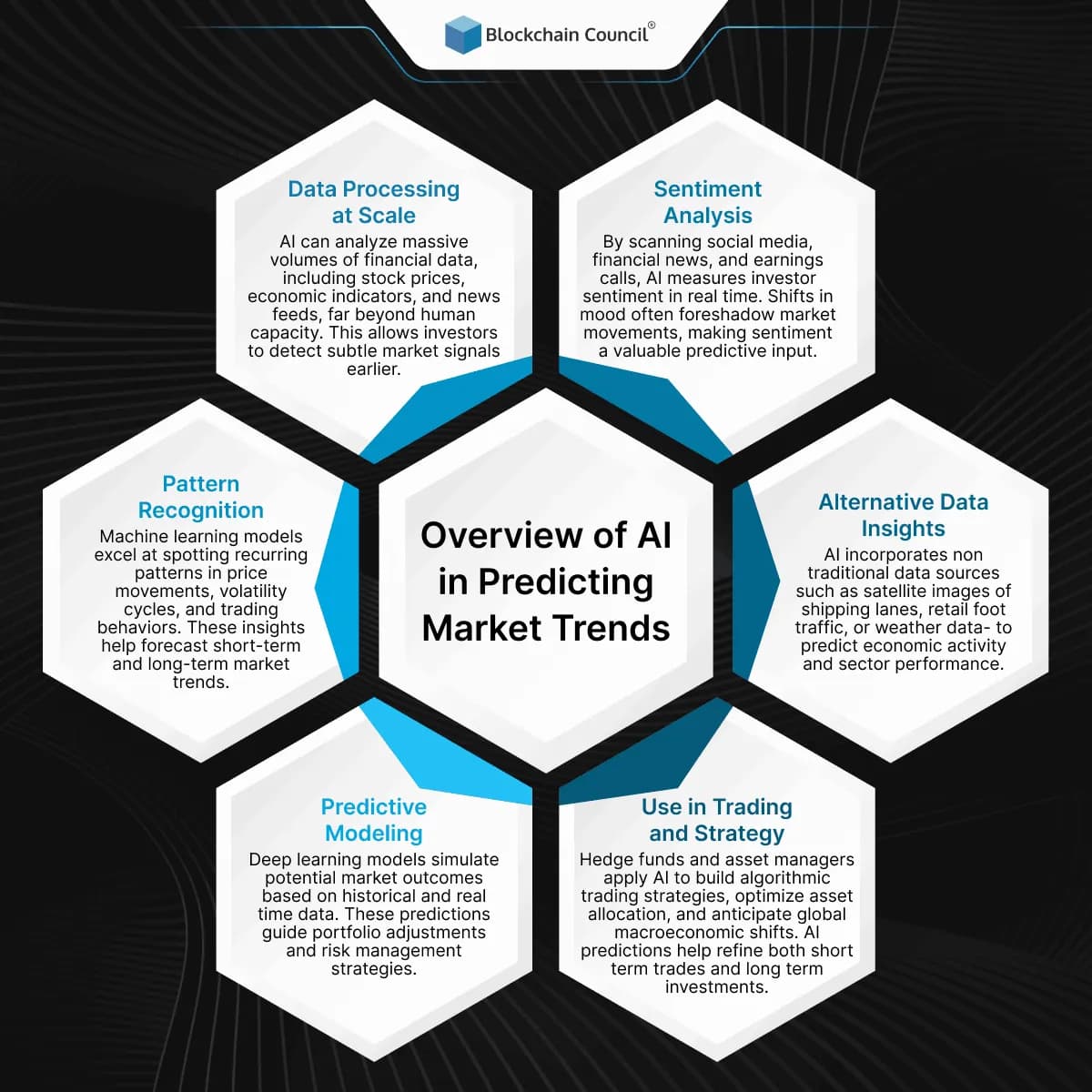
Data Processing at Scale
AI can analyze massive volumes of financial data, including stock prices, economic indicators, and news feeds, far beyond human capacity. This allows investors to detect subtle market signals earlier.
Sentiment Analysis
By scanning social media, financial news, and earnings calls, AI measures investor sentiment in real time. Shifts in mood often foreshadow market movements, making sentiment a valuable predictive input.
Pattern Recognition
Machine learning models excel at spotting recurring patterns in price movements, volatility cycles, and trading behaviors. These insights help forecast short-term and long-term market trends.
Alternative Data Insights
AI incorporates non-traditional data sources-such as satellite images of shipping lanes, retail foot traffic, or weather data-to predict economic activity and sector performance.
Predictive Modeling
Deep learning models simulate potential market outcomes based on historical and real-time data. These predictions guide portfolio adjustments and risk management strategies.
Adaptive Learning
AI systems continuously update their models with new market data. This adaptability makes them more resilient to changing conditions compared to static forecasting methods.
Use in Trading and Strategy
Hedge funds and asset managers apply AI to build algorithmic trading strategies, optimize asset allocation, and anticipate global macroeconomic shifts. AI predictions help refine both short-term trades and long-term investments.
Challenges and Risks
Despite its power, AI forecasting is not foolproof. Biased data, unexpected events, and model overfitting can lead to flawed predictions. Transparency and human oversight remain essential.
What the Research Says About ChatGPT
Academic studies have already tested ChatGPT’s predictive skills. One of the most influential papers, Can ChatGPT Forecast Stock Price Movements?, looked at whether the model could predict daily stock returns based on news headlines. The results were striking. ChatGPT consistently predicted movements with statistical significance, performing especially well on smaller-cap stocks and during negative news cycles.
Another study from 2025 titled ChatGPT and DeepSeek: Can They Predict the Stock Market and Macroeconomy? compared ChatGPT with the Chinese model DeepSeek. Using articles from The Wall Street Journal, researchers found that ChatGPT had predictive power not only for individual stocks but also for broader economic trends. It was particularly effective during periods of high uncertainty, when human analysts typically struggle the most.
These findings don’t mean ChatGPT is a perfect forecaster, but they suggest it can extract signals that humans either overlook or take too long to process.
The Limits of ChatGPT’s Predictive Abilities
Despite the positive evidence, ChatGPT is far from infallible. Another experiment, The Wall Street Neophyte, tested ChatGPT in a zero-shot setting-meaning without any fine-tuning or specialised training. In that case, ChatGPT did not beat traditional models like linear regression. This highlights a key point: context and preparation matter. The same tool can either provide strong insights or average results depending on how it is prompted and paired with data.
ChatGPT also struggles with overconfidence. It may phrase answers in absolute terms, when in reality markets are probabilistic. Investors who treat its output as a guaranteed prediction risk disappointment. The smarter approach is to treat ChatGPT’s signals as one input among many.
What About Google’s Gemini?
Gemini, Google DeepMind’s multimodal model, has attracted attention for its creative and productivity applications. It can handle text, images, and potentially video and audio. While this makes it a versatile tool, there is still little peer-reviewed research on Gemini’s ability to predict market trends specifically.
That said, Gemini’s multimodal capacity could give it an advantage in the future. Imagine a system that not only reads financial statements but also interprets charts, satellite images, and even CEO body language from video footage. This kind of broad input could provide richer market insights than text-only models. The lack of research does not mean Gemini cannot predict trends-it simply means its financial use cases are still emerging.
Why Negative News and Small Stocks Matter
One consistent finding across studies is that ChatGPT performs best when analyzing negative news and smaller companies. This makes sense. Negative news often triggers immediate market reactions, and smaller-cap stocks tend to be less efficiently priced. In both cases, AI has more room to add value by spotting patterns early.
For example, when a news headline signals potential fraud or missed earnings, ChatGPT can flag the likely price drop before retail investors process the story. Similarly, in smaller stocks with less analyst coverage, AI can uncover signals buried in niche reports or local media. These are precisely the areas where traditional market efficiency breaks down.
How AI Predictions Differ From Traditional Models
Traditional financial models rely on clean, structured datasets. Analysts build forecasts using ratios, regressions, and technical chart patterns. AI predictions are different. They blend structured data with narrative-driven inputs like news articles, speeches, or even public mood on social platforms.
This doesn’t mean AI replaces existing tools. Instead, it adds another dimension. For instance, a technical model might indicate a bullish pattern on a stock chart. At the same time, ChatGPT might flag growing negative sentiment in headlines. An investor who sees both signals can make a more informed choice than one who looks at charts alone.
Why AI Works Better in Times of Uncertainty
Interestingly, research shows that ChatGPT performs especially well during volatile or uncertain periods. Human analysts often falter in these conditions because they rely on established frameworks that may not fit new realities. AI models, however, are trained to detect patterns across vast datasets, including rare events.
For example, during a sudden policy shift or unexpected global event, ChatGPT can quickly process how similar past events influenced markets. While no tool can predict every black swan, AI’s ability to provide context faster than humans makes it especially valuable in turbulent times.
The Investor’s Responsibility
The evidence so far suggests that ChatGPT and potentially Gemini can predict market trends under certain conditions. But investors must approach these tools with caution. They are not crystal balls. Instead, they provide probabilities and signals that should be combined with human judgment.
An AI-savvy investor knows to ask: Is this prediction based on strong data, or could it be noise? Does the model explain its reasoning, or is it a black box? By asking these questions, investors avoid the trap of over-reliance and turn AI into a real advantage rather than a liability.
Success Stories of AI Predictions
The potential of ChatGPT and other LLMs in finance is no longer just a theory. Real examples show that these tools can extract value from complex and noisy markets.
One standout case comes from academic testing. In studies using news headlines as inputs, ChatGPT showed it could predict daily stock returns with accuracy above chance. More importantly, it outperformed human analysts in certain niches, like reacting quickly to negative events. If a headline hinted at a missed earnings report, the AI picked up the tone and adjusted its forecast almost instantly, while human analysts often lagged.
Institutions are also testing AI directly. Norway’s sovereign wealth fund, one of the largest pools of capital in the world, adopted AI to reduce trading inefficiencies. Reports suggest the move could save around 400 million dollars a year. These savings act as a boost to returns, proving that AI adds value not just in predicting price direction but also in execution and efficiency.
Chinese fund managers have gone further, adopting DeepSeek as a competitive edge against larger incumbents. By using AI to scan enormous datasets, smaller funds now compete more closely with big players. ChatGPT is not the only tool here, but its success highlights how language models can spot subtle patterns humans often miss.
Cautionary Tales from the Field
Despite the wins, AI predictions in markets come with pitfalls. Retail investors in particular have faced losses when they trusted AI too much. Surveys show that nearly one in five individuals using AI-generated financial advice lost money. The main issue was over-reliance. Some tools produced outdated or generic recommendations, while investors followed them blindly.
Another cautionary story comes from “AI washing.” Some firms marketed their products as AI-powered when in reality they relied on basic algorithms. Regulators have cracked down on these false claims, but the episode highlights a bigger truth: not every product labeled “AI” truly offers advanced capability. Investors who want to benefit must look for transparency and avoid chasing hype.
Even in well-designed models, risks exist. AI often works by training on historical data. If conditions change-say, from a decade of low interest rates to a period of high inflation-models can fail. This fragility is why many professional investors treat AI as a supporting tool rather than the sole decision-maker.
Why Human Judgment Still Matters
Markets are not just numbers. They are human systems influenced by culture, politics, and sudden events. While AI models provide fast insights, they cannot always understand context the way humans can. For example, ChatGPT might flag that regulatory language around a sector has turned negative, but it will take human judgment to assess whether regulators will act harshly or simply issue warnings.
Investors who combine AI with judgment are the ones who see the best results. They use the machine for speed and scale, while applying their own experience to interpret the bigger picture. This is why human-AI collaboration studies often show higher trust and better outcomes than AI alone.
Where ChatGPT and Gemini Shine
The evidence suggests there are specific areas where these tools have a real edge.
They perform well on short-term forecasting, particularly when markets are moving fast. They are skilled at reading negative sentiment, which often signals downturns more reliably than positive news signals growth. They shine in smaller-cap stocks, where fewer analysts cover companies and mispricings are more common. And they are especially useful during periods of uncertainty, when human analysts have fewer playbooks to fall back on.
Gemini’s multimodal ability is still new to financial applications, but it points to future strengths. Imagine combining text analysis with image recognition of shipping flows or satellite data. This broader scope could allow Gemini to not only predict but also explain trends in ways previous tools could not.
Why Education Is the Real Edge
The ability to use AI well depends on understanding how it works. Investors who educate themselves gain an advantage over those who blindly follow recommendations. A Tech Certification equips investors to grasp how models process information, what biases they might contain, and how to evaluate their outputs.
For those interested in digital assets, a Crypto certification provides a foundation for applying AI to crypto markets, where sentiment and volatility matter more than balance sheets.
Professionals who want to understand AI’s role in the bigger picture can benefit from a Marketing and Business Certification. This connects AI-driven consumer behavior with financial market impacts, highlighting how trends in one area often spill into another.
Finally, blockchain technology courses are valuable for understanding how AI and blockchain converge. As decentralized finance grows, the ability to analyze blockchain data with AI will become an increasingly powerful skill.
The Future Outlook for Market Predictions
Looking forward, ChatGPT and Gemini will likely become embedded in the tools investors use every day. Brokerage platforms are already experimenting with AI chat assistants that can answer questions like “What risks are emerging in the tech sector?” or “How does my portfolio compare to benchmarks?”
Regulators are pushing for more explainability, which means future AI tools will not only give predictions but also explain why. This transparency will help investors decide when to trust the output and when to question it.
The long-term vision is not AI replacing investors, but AI and humans working side by side. The machine provides scale and pattern recognition. The human provides context, creativity, and ethical judgment. Together, they create stronger strategies than either could alone.
Real-World Applications of AI in Market Forecasting
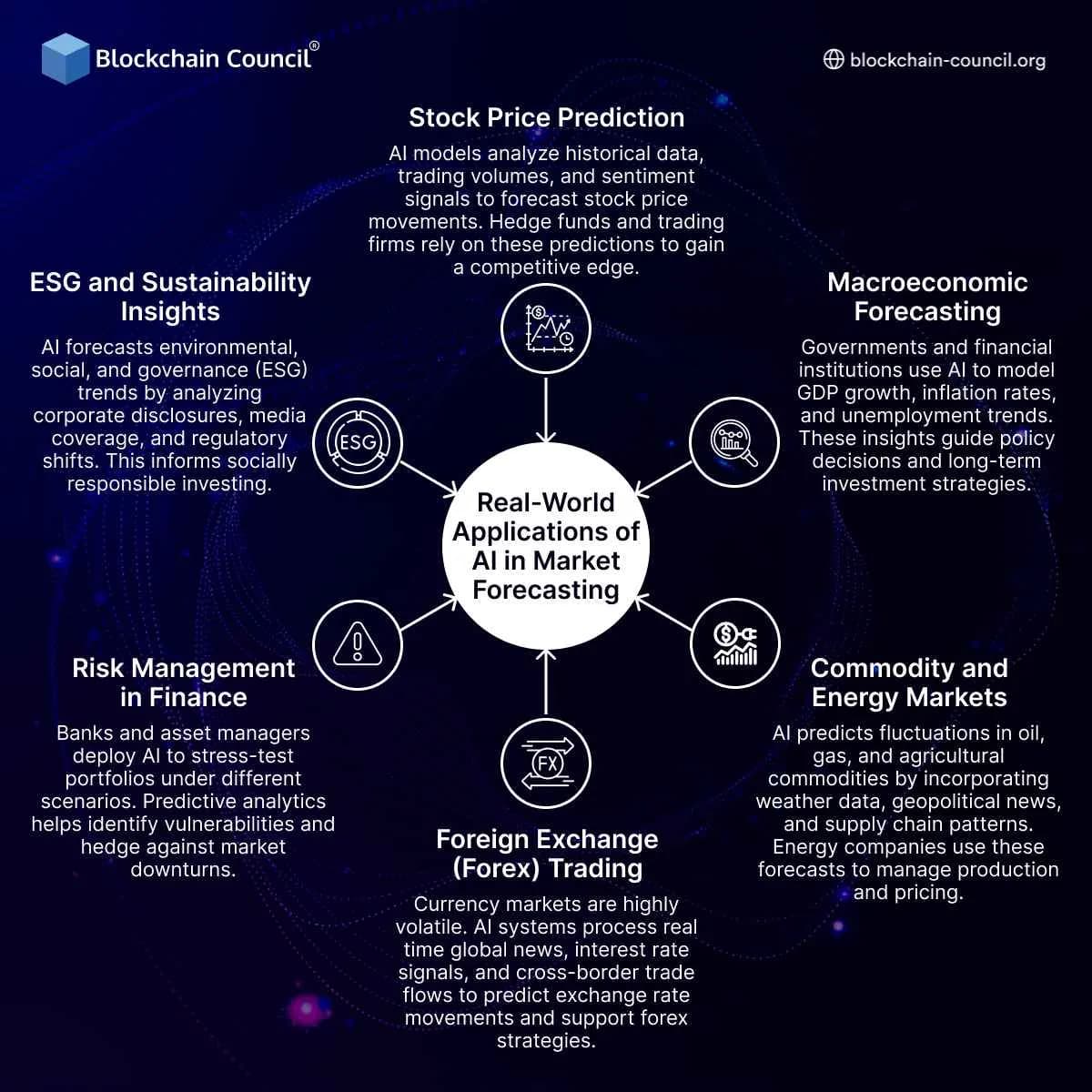
Stock Price Prediction
AI models analyze historical data, trading volumes, and sentiment signals to forecast stock price movements. Hedge funds and trading firms rely on these predictions to gain a competitive edge.
Macroeconomic Forecasting
Governments and financial institutions use AI to model GDP growth, inflation rates, and unemployment trends. These insights guide policy decisions and long-term investment strategies.
Commodity and Energy Markets
AI predicts fluctuations in oil, gas, and agricultural commodities by incorporating weather data, geopolitical news, and supply chain patterns. Energy companies use these forecasts to manage production and pricing.
Foreign Exchange (Forex) Trading
Currency markets are highly volatile. AI systems process real-time global news, interest rate signals, and cross-border trade flows to predict exchange rate movements and support forex strategies.
Retail and Consumer Demand
AI analyzes transaction data, online behavior, and supply trends to forecast consumer demand. This helps retailers and investors anticipate market shifts and adjust portfolios accordingly.
Risk Management in Finance
Banks and asset managers deploy AI to stress-test portfolios under different scenarios. Predictive analytics helps identify vulnerabilities and hedge against market downturns.
Alternative Data Forecasting
Investment firms use satellite images, shipping traffic data, and even weather patterns as inputs for AI models. These unconventional signals provide early warnings about market and sector performance.
ESG and Sustainability Insights
AI forecasts environmental, social, and governance (ESG) trends by analyzing corporate disclosures, media coverage, and regulatory shifts. This informs socially responsible investing.
AI is no longer just an experiment in financial prediction. It is already shaping the way institutions and individuals interact with markets.
Large funds are using AI for trade execution and cost reduction. Norway’s sovereign wealth fund, for example, adopted AI systems to optimize trades. The expected annual savings of hundreds of millions prove that predictive power can mean more than guessing price direction; it can also mean executing decisions more efficiently.
Hedge funds are turning to alternative data streams processed by AI. Satellite imagery, consumer receipts, and shipping manifests are all being scanned for early signals. A surge in retail parking lot activity, for instance, has been used as a proxy for store revenue, helping funds predict quarterly earnings before reports are released. ChatGPT-style models add another layer by contextualizing these signals against news and social sentiment.
Retail investors are also benefiting. Trading apps increasingly offer AI-driven summaries of financial news, real-time portfolio alerts, and scenario analysis tools. An individual investor who once had to read endless news articles can now get a concise AI summary in seconds. This democratizes access to insights that were once limited to Wall Street.
The Behavioral Edge of AI-Savvy Investors
Owning advanced tools is one thing. Using them effectively is another. AI-savvy investors are defined not just by the technology they use but by how they behave.
One key difference is discipline in volatile markets. When markets swing wildly, traditional investors often panic. They may sell in fear, only to miss the rebound. AI-savvy investors lean on models that provide probabilities rather than emotions. If ChatGPT signals that a downturn is likely temporary, these investors hold steady, avoiding costly mistakes.
Another difference is resistance to herd behavior. When a stock goes viral, many investors chase the hype. AI-savvy investors compare the narrative against the data. If the fundamentals and sentiment analysis don’t support the excitement, they stay away. This prevents them from being caught in bubbles that eventually burst.
Finally, they embrace continuous learning. AI-savvy investors treat predictions as feedback. When the model is right, they study why. When it is wrong, they adjust. Over time, this feedback loop makes both the investor and the system sharper.
Why Transparency Matters in AI Forecasting
AI can only be a true ally if investors trust it. That trust comes from transparency.
One major advancement is explainable AI. Instead of simply saying “this stock will fall,” models can highlight the drivers: rising volatility in a related sector, negative tone in recent headlines, or unusual trading volume. This context allows investors to weigh the recommendation critically rather than accept it blindly.
Transparency also guards against AI washing. With AI’s popularity, some firms exaggerate their capabilities to attract investors. Regulators have already issued warnings and penalties for misleading claims. Investors who demand transparency are better protected from hype.
Trust also grows when AI is paired with human review. Studies show that people are more likely to follow investment advice when it comes from an AI system checked by a human. This hybrid approach combines the best of both worlds: AI’s speed and scale with human judgment and accountability.
Where ChatGPT and Gemini Fit in the Future
Looking ahead, both ChatGPT and Gemini are likely to become embedded in everyday financial workflows.
ChatGPT has already shown its ability to read and interpret news, earnings calls, and headlines in ways that can predict short-term movements. As it improves, it may serve as a real-time research assistant, constantly scanning the information firehose for signals.
Gemini, with its multimodal ability, could take things further. Imagine a model that processes not only text but also satellite images of shipping ports, video of executive interviews, and charts of macroeconomic indicators-all in one system. The potential for richer, more holistic forecasting is enormous.
Brokerage platforms are expected to integrate these tools directly, offering investors instant answers to questions like, “What risks does my portfolio face if oil prices rise?” or “Which sectors are gaining momentum globally?” Instead of searching dozens of sources, investors will receive structured, data-backed responses in seconds.
Regulation will likely push for more explainability. In the future, investors may demand to see not just the prediction but the reasoning. This will make models more accountable and investors more confident.
The Balanced Path Forward
The evidence suggests that ChatGPT and, in time, Gemini can indeed predict market trends under certain conditions. They are strongest in short-term forecasting, negative news analysis, smaller stocks, and periods of uncertainty. They add value not only by forecasting but also by summarizing, explaining, and contextualizing information at scale.
But they are not crystal balls. They are tools that provide probabilities, not guarantees. The real secret lies in how investors use them. Those who see AI as a partner, not a replacement, gain the most. They combine machine insights with human judgment, demand transparency, and keep learning to stay ahead.
Conclusion
So, can ChatGPT and Gemini predict market trends? The answer is yes-sometimes, and in the right contexts. They have already shown predictive power in studies and real-world applications. They can process information faster than any human and spot patterns hidden in unstructured data.
However, their true power comes not from replacing human analysts but from working alongside them. Investors who treat AI as an assistant rather than a prophet are the ones who win more. They use AI to filter noise, to highlight risks, and to broaden their understanding of markets.
As AI becomes a standard part of financial tools, the real advantage will belong to those who know how to question it, interpret it, and integrate it responsibly. ChatGPT and Gemini may not see the future perfectly, but they tilt the odds in your favor. In investing, that edge can make all the difference.
Related Articles
View All
Cryptocurrency
The Future of AI Tokens: Opportunities, Risks, and Market Trends in Crypto
AI tokens link crypto assets with AI compute, model access, data markets, and agents. Learn the opportunities, risks, trends, and evaluation steps.

Cryptocurrency
Understanding the Crypto Market: Prices, Volatility & What Moves Crypto
Understanding the Crypto Market made simple. Learn how crypto prices are set, what market cap and liquidity mean, why volatility happens, and which factors move prices.

Cryptocurrency
Spot Trading in Crypto Explained: How Immediate Market Trades Work
Spot trading in crypto means buying or selling actual digital assets at current market prices with near immediate settlement and ownership transfer.
Trending Articles
The Role of Blockchain in Ethical AI Development
How blockchain technology is being used to promote transparency and accountability in artificial intelligence systems.

Top 5 DeFi Platforms
Explore the leading decentralized finance platforms and what makes each one unique in the evolving DeFi landscape.

Can DeFi 2.0 Bridge the Gap Between Traditional and Decentralized Finance?
The next generation of DeFi protocols aims to connect traditional banking with decentralized finance ecosystems.