

Top Use Cases of AI in Cryptocurrency Exchanges and Portfolio Management

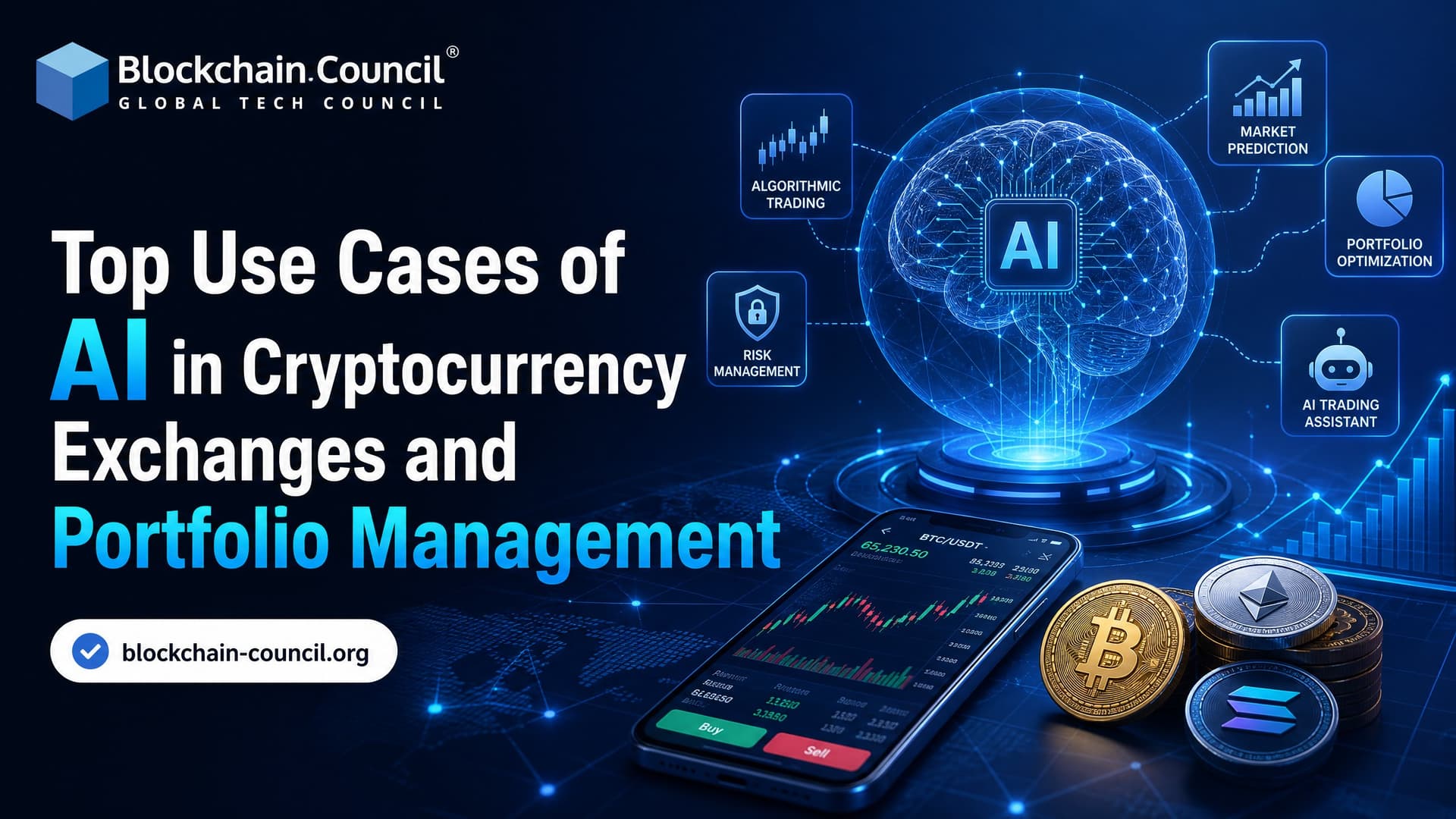
AI in cryptocurrency exchanges is no longer a side experiment. It now sits inside trade execution engines, fraud monitoring tools, portfolio optimizers, support desks, custody workflows, and compliance systems. By 2025, industry estimates suggest AI systems mediate a large share of global trading volume across asset classes, including crypto markets. That shift changes what exchanges need to build and what professionals need to learn.
The best use cases are practical. They reduce latency, flag fraud sooner, improve liquidity, and help portfolio managers test risk before a volatile session exposes it. The weak ones are easy to spot too: black-box bots promising guaranteed returns, strategy marketplaces with no drawdown history, and AI wallets with vague security controls. Treat those with caution.

Why AI Matters in Crypto Market Infrastructure
Crypto markets run 24 hours a day. Prices move across centralized exchanges, decentralized exchanges, perpetual futures venues, OTC desks, bridges, wallets, and on-chain liquidity pools. No human team can watch every order book, wallet cluster, funding rate, and liquidation queue at once.
AI helps by processing noisy market data at machine speed. It can classify suspicious behavior, estimate volatility, score transaction risk, and adapt execution rules as liquidity changes. The business case is clear too. Market researchers value the AI crypto trading bot sector in the tens of billions of dollars and project strong growth over the next decade. Adoption is not limited to hedge funds. Retail platforms, market makers, custodians, and compliance vendors all use AI tools now.
Top Use Cases of AI in Cryptocurrency Exchanges
Market Surveillance, Fraud Detection, and AML Monitoring
Exchange surveillance teams use machine learning to detect wash trading, spoofing, pump patterns, account takeovers, and suspicious wallet interactions. These systems compare current activity against known normal behavior, then flag accounts, trading pairs, or wallet clusters for review.
Take a concrete example. A model can learn that a token usually trades with a 0.4 percent spread and moderate order book depth. If thousands of small accounts suddenly submit matching buy and sell orders seconds apart, the system can escalate the pair before retail users are harmed. Chainalysis has highlighted AI as a tool for adaptive, real-time blockchain threat detection, especially where illicit activity spreads across many addresses.
- Exchange benefit: faster detection of manipulation and fraud.
- Compliance benefit: better AML monitoring and sanctions screening.
- User benefit: fewer manipulated markets and safer trading conditions.
Automated Trading and Execution
AI trading tools can read order books, volatility data, funding rates, macro signals, and sentiment feeds, then place orders based on a defined strategy. Common strategies include market making, arbitrage, trend following, mean reversion, and liquidation-aware execution.
Here is where implementation details matter. A simple bot that ignores exchange filters fails fast. On Binance, for instance, developers often hit APIError(code=-1013): Filter failure: LOT_SIZE when the order quantity does not match the symbol step size. Another common one is code=-1021, where the timestamp falls outside the recvWindow because the server clock and local clock are out of sync. These are not AI problems. They are exchange integration problems, and they ruin production bots if you skip them.
Platforms and protocols such as Numerai, dHEDGE, Fetch.ai, and Autonolas show how AI-assisted trading is moving across both centralized and decentralized venues. Still, a useful bot should publish risk rules, not just a profit chart.
Predictive Analytics and Market Forecasting
AI models are used to forecast price direction, volatility, liquidity, and correlation shifts. Long Short-Term Memory networks, often called LSTMs, are popular for time-series modeling because they learn from historical sequences. In crypto, that means price candles, order flow, volume, open interest, liquidations, and sentiment.
Do not confuse forecasting with certainty. A model can improve probability estimates, but it cannot know whether a large holder will move coins to an exchange, whether a bridge exploit will hit, or whether a regulator will change sentiment overnight. Good teams use forecasts as inputs, not commands.
Risk Management, Margin Monitoring, and Liquidation Control
Exchanges use AI to monitor leverage, collateral quality, user exposure, and account behavior. The goal is to catch risk before it becomes a forced liquidation cascade. Models can estimate Value at Risk, stress test positions under extreme moves, and flag accounts that may default if volatility spikes.
This matters most in perpetual futures markets. Funding rate changes, thin liquidity, and correlated positions can create sudden losses. AI risk engines can adjust margin requirements, slow order entry for risky accounts, or alert human risk officers when a market turns unstable.
Liquidity Management and Market Making
Crypto liquidity is fragmented. The same asset may trade on several centralized exchanges, DEX pools, lending markets, and derivatives venues. AI-driven market-making systems update quotes based on order flow, inventory, volatility, and venue-specific fees.
A strong market-making model reduces spreads and slippage. A weak one overfits quiet markets and gets punished during high volatility. To be blunt, backtests that ignore latency, exchange fees, and partial fills are not worth much.
Personalization and User Experience
AI also shapes the user interface. Exchanges use recommendation systems to surface relevant markets, risk alerts, learning content, tax prompts, and portfolio insights. Chatbots handle routine support questions, though complex cases still need trained staff.
Personalization should not push users into risky trades. A better design is defensive: warn users about concentration, leverage, phishing patterns, and suspicious withdrawal addresses. That is where AI adds value without becoming a dark-pattern sales engine.
KYC, Compliance, and Operations Automation
AI systems can verify identity documents, match selfies, screen sanctions lists, reconcile records, and generate audit trails. For exchanges operating in multiple jurisdictions, this cuts manual review load and improves consistency.
Security vendors and analytics firms now combine off-chain KYC signals with on-chain transaction monitoring. BitGo has discussed AI use in wallet operations, including policy-based approvals and anomaly detection, while warning that institutions must assess privacy and model risk carefully.
AI Use Cases in Crypto Portfolio Management
Machine Learning Portfolio Allocation
Traditional portfolio models often rely on assumptions that struggle in crypto, such as stable correlations and normally distributed returns. Crypto returns are jumpy. Correlations can flip during stress. Machine learning can learn allocation patterns directly from market data and update them as regimes change.
This does not make Modern Portfolio Theory useless. A practical approach is hybrid: use MPT for constraint discipline, then use ML to improve volatility forecasts, correlation estimates, or asset selection.
Deep Reinforcement Learning for Rebalancing
Deep reinforcement learning trains an agent to choose portfolio weights based on market states. Research has shown models using convolutional neural networks that read historical price tensors and output allocation decisions. The model receives rewards based on performance, risk, or transaction cost-adjusted returns.
This approach is powerful, but easy to misuse. If you train only on bull-market data, the agent learns confidence, not risk control. Always test on crash periods, sideways markets, and liquidity shocks.
LSTM-Based Risk Modeling
LSTM-based portfolio systems can capture time-dependent volatility and correlation changes better than static covariance matrices. Some research combines Modern Portfolio Theory with LSTM forecasts to build more responsive allocation models.
For portfolio managers, the value is not just higher returns. It is earlier warning. If the model detects rising downside correlation between BTC, ETH, and smaller tokens, it can cut exposure or shift toward stable assets before a broad drawdown hits.
Scenario Testing and Drawdown Control
AI portfolio tools can simulate market shocks, classify regimes, and estimate downside risk. A professional system should answer questions like:
- What happens if BTC drops 15 percent in four hours?
- Which positions become highly correlated during stress?
- How much liquidity is available if the portfolio must rebalance now?
- Does the strategy survive fees, slippage, and tax constraints?
Open-source crypto portfolio projects already show how ML can support risk metrics, scenario analysis, and automated allocation changes. The hard part is production discipline: data quality, monitoring, access controls, and human oversight.
Crypto Robo Advisory and Autonomous Agents
AI-related crypto agents have drawn billions of dollars in market value, and investors increasingly treat crypto-AI convergence as a major theme, especially around programmable money, agentic payments, and automated financial workflows.
Autonomous portfolio agents may soon handle rebalancing, staking, tax-aware transfers, and risk limits through wallets and exchanges. Useful? Yes. Safe by default? Not yet. Give agents narrow permissions, spending caps, and emergency stops. Never hand a new agent unlimited withdrawal authority from a treasury wallet.
Key Risks and Governance Questions
AI in crypto exchanges brings real advantages, but model risk is now operational risk. Exchanges and portfolio teams should define controls before deployment.
- Explainability: Can risk officers understand why a model flagged an account or changed an allocation?
- Adversarial behavior: Can traders manipulate inputs to trigger false signals?
- Data privacy: Are KYC, wallet, and trading records protected properly?
- Model drift: Does performance degrade when market structure changes?
- Auditability: Are model versions, training data, and decisions logged?
Chainalysis and BitGo both stress oversight and evaluation in AI security workflows. That advice is worth taking. In regulated crypto businesses, undocumented models create audit problems and trust problems.
Skills Professionals Should Build Next
If you work in exchange technology, risk, security, or digital asset investing, focus on the overlap between AI, crypto market structure, and compliance. Learn how order books work. Understand ERC-20 tokens, wallet permissions, gas fees, liquidation mechanics, and custody policies. Then add machine learning skills for time-series data, anomaly detection, and model validation.
For structured learning, you can explore Blockchain Council paths such as Certified Cryptocurrency Expert™, Certified Blockchain Expert™, Certified Smart Contract Developer™, and Certified Artificial Intelligence (AI) Expert™. If your role touches surveillance or custody, pair crypto knowledge with security training as well.
Final Takeaway
The strongest use cases of AI in cryptocurrency exchanges are not flashy. They are trade execution, fraud detection, market surveillance, margin risk, liquidity management, and portfolio risk control. Start there. If you are building a bot, connect it to a testnet or a small account, handle exchange filter errors, log every decision, and add a kill switch before you scale. If you are managing portfolios, test AI models against crashes, not just rallies. That is where the real learning starts.
Related Articles
View All
Cryptocurrency
DeFi Explained: Decentralized Finance, Protocols, and Use Cases
DeFi explained for professionals: learn how decentralized finance works, key protocols, real use cases, risks, and what to study next.

Cryptocurrency
Cryptocurrency Exchanges Explained: How to Buy, Sell, and Trade Crypto
Learn how cryptocurrency exchanges work, how to buy and sell crypto, compare CEX and DEX platforms, manage trading risk, and store assets safely.
Cryptocurrency
Utility Tokens Explained: Use Cases, Value, and Token Design
Utility tokens provide access, payments, governance, rewards, and staking inside blockchain ecosystems. Learn how value and tokenomics really work.
Trending Articles
The Role of Blockchain in Ethical AI Development
How blockchain technology is being used to promote transparency and accountability in artificial intelligence systems.
What is AWS? A Beginner's Guide to Cloud Computing
Everything you need to know about Amazon Web Services, cloud computing fundamentals, and career opportunities.
Claude AI Tools for Productivity
Discover Claude AI tools for productivity to streamline tasks, manage workflows, and improve efficiency.