

DevOps with AWS in 2026: Pipelines, Security, Observability, and AI Automation
 Suyash Raizada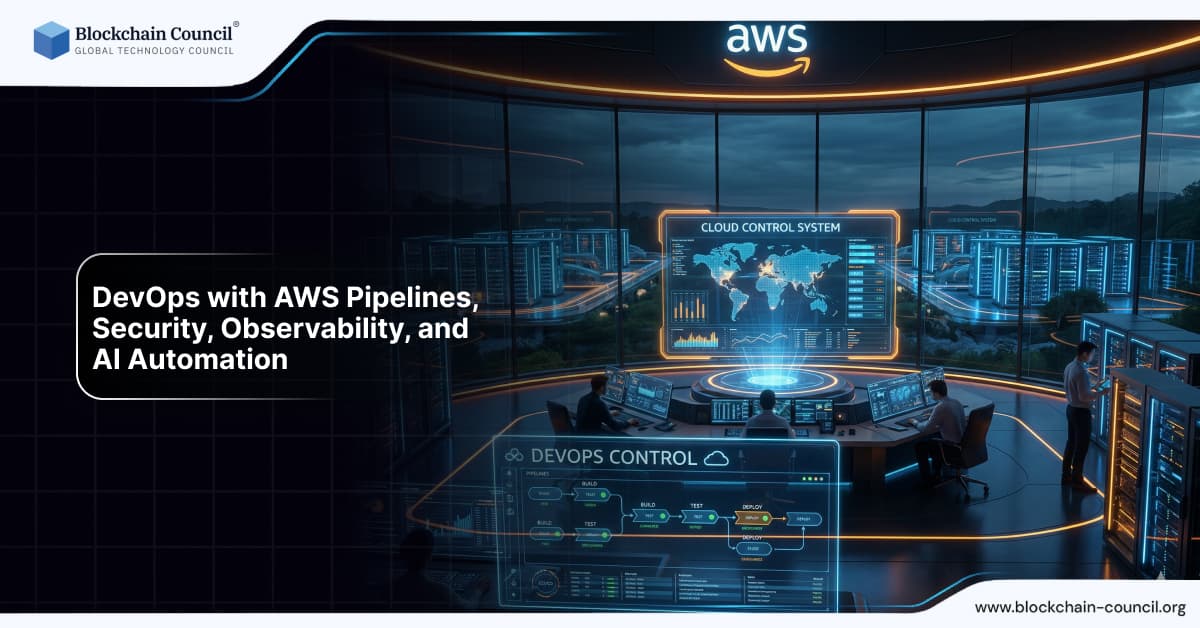
DevOps with AWS in 2026 is no longer just about shipping faster. It is about delivering outcomes safely, recovering quickly, scaling predictably, securing continuously, and monitoring intelligently. AWS has accelerated this shift with deeper automation, AI-assisted operations, and security-first patterns that are now considered baseline for production teams.
This guide covers the current state of DevOps on AWS, the trends shaping modern delivery, and practical best practices you can apply as a DevOps engineer responsible for reliability, compliance, and cost control.

Modern DevOps now integrates AI and automation-build your expertise with an Agentic AI Course, strengthen scripting skills through a Python Course, and explore enterprise adoption via an AI powered marketing course.
What DevOps with AWS Means in 2026
In mature organizations, DevOps with AWS has evolved into a unified system where:
Automation is end-to-end, covering infrastructure, delivery, validation, and rollback.
Security is embedded into CI/CD and governance through zero-trust principles and policy-as-code.
Observability is proactive, incorporating anomaly detection, predictive signals, and automated remediation.
Intelligence supports decision-making through AI-assisted triage, release decisioning, and optimization.
The result is a pipeline that behaves like an enforceable contract: if checks fail, promotion stops automatically, and if production health degrades, rollback triggers without manual intervention.
Latest AWS Developments Impacting DevOps Teams
AI-Driven Automation for Regulated Workflows
AWS is expanding agentic AI patterns into real operational domains. One example is Amazon Connect Health, introduced in early 2026 as a HIPAA-eligible, agentic AI solution that can automate healthcare processes such as patient verification, appointment management, ambient documentation, and medical coding. For DevOps engineers supporting healthcare integrations, this reduces custom build time by providing composable agents deployable through Bedrock and Connect APIs faster than bespoke implementations.
Even outside healthcare, the operational takeaway is clear: teams should design pipelines and environments that can safely adopt AI-enabled services while maintaining compliance controls, auditability, and least-privilege access.
S3 Account Regional Namespaces Simplify Multi-Region IaC
AWS introduced account regional namespaces for general-purpose S3 buckets. Instead of requiring globally unique bucket names, buckets are now unique within an account and region. This directly reduces friction in multi-region provisioning because teams can reuse consistent naming conventions like myapp-data across regions without global namespace conflicts.
For Infrastructure as Code (IaC), this removes a longstanding source of template complexity and operational overhead, particularly in Terraform, AWS CDK, and Pulumi where environment and region suffixes were commonly appended to avoid naming collisions.
Non-Negotiable Best Practices for DevOps with AWS
1) Full Automation as the Baseline
By 2026 standards, partial automation is a liability. Production-grade DevOps with AWS typically includes:
Infrastructure fully defined as code, covering networks, IAM, compute, data, and observability.
Every change via pull request with mandatory reviews and automated checks.
CI/CD pipelines that run tests, security scans, and policy validation.
Automatic rollback based on failed health checks and SLO signals.
Ephemeral environments provisioned in minutes for testing and validation.
If your workflow still depends on manual production fixes or undocumented steps, treat it as technical debt that directly affects reliability and audit readiness.
2) Modern Pipeline Architecture and Deployment Strategies
Contemporary AWS DevOps pipelines combine Git-based workflows with layered quality gates. Common toolchains include AWS CodePipeline and CodeBuild, GitHub Actions with AWS integration, and GitLab CI using OIDC authentication.
Deployment strategies increasingly standardize on safe rollout patterns:
Canary deployments to limit blast radius while validating real traffic.
Blue-green deployments to reduce downtime and simplify rollback.
Immutable artifacts with versioning stored in Amazon ECR and S3.
Kubernetes-based teams often adopt GitOps with tools like ArgoCD or Flux, treating Git as the single source of truth for desired cluster state.
3) Shift-Left Security Embedded into CI/CD
Security is no longer a final gate. In DevOps with AWS, security controls are integrated throughout the delivery lifecycle:
Least-privilege IAM roles for workloads and pipelines.
Workforce access management via IAM Identity Center.
Secrets management using AWS Secrets Manager.
Encryption by default using AWS KMS.
Configuration and compliance checks through AWS Config.
Threat detection using Amazon GuardDuty.
Vulnerability scanning using Amazon Inspector.
Centralized security visibility via AWS Security Hub.
For enterprise environments, a multi-account architecture using AWS Organizations and Service Control Policies enforces isolation and zero-trust principles across development, staging, and production.
4) Observability with Continuous Intelligence
Monitoring has shifted from static thresholds to proactive observability. Mature AWS DevOps setups typically include:
CloudWatch Anomaly Detection for dynamic baselines.
Predictive scaling policies tied to demand signals.
Pattern-based alerting and log pattern recognition using machine learning.
Distributed tracing and cross-service correlation for faster root cause analysis.
Cross-account log aggregation to support multi-account operations.
Observability data feeds directly back into delivery. Performance regressions can block promotions, and security anomalies can trigger automated investigations or playbooks. Many teams also use AWS Lambda for routine corrective actions through automated remediation workflows.
Trends Shaping DevOps on AWS
Outcome-Focused Delivery Over Raw Speed
Fast deployments are not a differentiator when reliability suffers. Teams are increasingly measured on safe releases, predictable scaling, and rapid recovery. This elevates practices like SLO-based gating, chaos testing, and resilience-by-design architecture.
AI-Integrated Release Decisioning
AWS is moving toward AI-assisted operational workflows, including improved visibility and optimization support in observability tooling. The practical implication for DevOps engineers is to ensure telemetry quality, consistent resource tagging, and clean deployment metadata so that automated decisioning can be trusted and acted upon reliably.
Platform Engineering and Internal Developer Platforms
Many organizations are formalizing platform teams that provide reusable templates, secure defaults, standardized pipelines, and consistent observability tooling. This reduces cognitive load for application teams and improves governance consistency across business units.
FinOps Integrated into the Delivery Lifecycle
Cost awareness is increasingly embedded into pipelines and architectural decisions. Practical enforcement now includes tagging policies, budget alarms, environment TTL policies, and continuous review of service lifecycles and modernization opportunities.
Real-World Example: Simplifying Multi-Region Deployments with S3 Namespaces
Before account regional namespaces, multi-region architectures often required region-specific bucket naming to avoid global collisions, such as myapp-data-us-east-1 and myapp-data-eu-west-1. Teams had to encode these conventions into IaC modules, documentation, and runbooks, and still encountered occasional conflicts during regional expansion.
With account regional namespaces, organizations can standardize on a consistent name like myapp-data in each region independently. This reduces branching logic in IaC, improves template readability, and lowers the risk of human error during region rollouts. For large DevOps organizations, it also reduces coordination overhead when multiple teams are provisioning resources simultaneously.
Practical Checklist for DevOps Engineers Using AWS
Standardize IaC: choose Terraform, AWS CDK, or Pulumi and enforce module conventions, code reviews, and drift detection.
Harden CI/CD: add unit, integration, and smoke tests; artifact signing; image scanning; and policy checks as mandatory pipeline stages.
Adopt safe rollout patterns: canary or blue-green for user-facing services with automated rollback on health and SLO failures.
Implement zero-trust governance: multi-account setup, Service Control Policies, least-privilege roles, and short-lived credentials where possible.
Upgrade observability: anomaly detection, centralized logging, distributed tracing, and runbook automation with Lambda.
Operationalize cost: enforce tagging standards, monitor usage trends, and integrate cost signals into release readiness reviews.
To master pipelines, observability, and security, combine learning paths with an AI certification, a machine learning course, and a Digital marketing course.
Conclusion
DevOps with AWS in 2026 is defined by complete automation, security embedded into every pipeline stage, and observability that drives decisions rather than simply reporting incidents. AWS innovations such as account regional namespaces for S3 and expanding agentic AI capabilities point in a consistent direction: fewer manual workflows, more composable building blocks, and stronger default governance.
For DevOps engineers, the most valuable next steps are treating CI/CD as an enforceable contract, investing in zero-trust multi-account foundations, and building feedback loops where performance, security, and cost signals directly influence release decisions. That is how AWS DevOps teams move from shipping software to reliably delivering business outcomes.
FAQs
1. What is DevOps with AWS in 2026?
DevOps with AWS in 2026 refers to using Amazon Web Services tools to automate software development, deployment, and operations. It integrates pipelines, security, observability, and AI-driven automation.
2. What are CI/CD pipelines in AWS DevOps?
CI/CD pipelines automate code integration, testing, and deployment. AWS services like CodePipeline and CodeBuild help streamline this process.
3. Why are pipelines important in modern DevOps?
Pipelines reduce manual errors and speed up software delivery. They ensure consistent and reliable deployment across environments.
4. What AWS services are commonly used in DevOps pipelines?
Key services include AWS CodePipeline, CodeBuild, CodeDeploy, and CodeCommit. These tools manage the entire development lifecycle.
5. How does AWS enhance DevOps security in 2026?
AWS provides built-in security tools like IAM, GuardDuty, and Security Hub. These help enforce access control and monitor threats in real time.
6. What is DevSecOps in AWS?
DevSecOps integrates security into every stage of the DevOps lifecycle. It ensures that security is automated and continuous, not an afterthought.
7. What is observability in AWS DevOps?
Observability involves monitoring system performance and diagnosing issues. AWS tools like CloudWatch and X-Ray provide insights into application behavior.
8. Why is observability critical for cloud applications?
It helps detect issues जल्दी and maintain system reliability. Better visibility leads to faster troubleshooting and improved user experience.
9. How does AI automation impact DevOps on AWS?
AI tools can automate testing, anomaly detection, and performance optimization. This reduces manual effort and improves operational efficiency.
10. What is infrastructure as code (IaC) in AWS?
IaC allows developers to define infrastructure using code. Tools like AWS CloudFormation and Terraform enable consistent and repeatable deployments.
11. How does AWS support scalable DevOps practices?
AWS offers flexible and scalable resources on demand. This allows teams to handle varying workloads efficiently.
12. What are the benefits of serverless DevOps on AWS?
Serverless services reduce infrastructure management overhead. Developers can focus on code while AWS handles scaling and maintenance.
13. How do teams ensure security in CI/CD pipelines?
Security checks like code scanning and vulnerability assessments are integrated into pipelines. This ensures issues are identified early.
14. What role does containerization play in AWS DevOps?
Containers provide consistent environments for applications. AWS services like ECS and EKS support container orchestration and deployment.
15. How does AWS handle logging and monitoring?
AWS CloudWatch collects logs and metrics for analysis. It helps teams monitor performance and respond to issues proactively.
16. What are common challenges in AWS DevOps?
Challenges include managing complexity, ensuring security, and controlling costs. Proper planning and automation can help address these issues.
17. How does automation improve DevOps efficiency?
Automation reduces manual tasks and speeds up processes. It ensures consistency and minimizes human error.
18. What skills are required for AWS DevOps in 2026?
Skills include cloud architecture, automation, security practices, and monitoring tools. Familiarity with AI-driven tools is increasingly important.
19. How does AWS support continuous monitoring?
AWS provides real-time monitoring through integrated tools. Alerts and dashboards help teams track system health and performance.
20. What is the future of DevOps with AWS?
DevOps will become more automated and AI-driven. Focus will shift toward efficiency, security, and seamless integration across system
Related Articles
View All
Blogs
Load Balancers Are Dead in 2026: What Actually Changed (and What Did Not)
"Load Balancers Are Dead" in 2026 is a slogan. Load balancing is thriving through cloud services, service meshes, edge routing, and security-centric traffic platforms.
Blogs
Blooket 2026
What is Blooket? Blooket is an innovative tool designed to make learning fun and engaging for students. It combines the excitement of gaming with educational content to create an interactive platform where students can play and learn simultaneously. Blooket is an educational platform designed to…

Blogs
How to Create Bilibili Account & Video Upload Guide: A Step-by-Step Tutorial for Beginners
Learn how to create a Bilibili account and upload your first video with this beginner-friendly step-by-step guide. It covers registration, login, video uploading, thumbnails, titles, categories, descriptions, and publishing. Bilibili’s official creator guidance confirms these core registration and upload steps.
Trending Articles
The Role of Blockchain in Ethical AI Development
How blockchain technology is being used to promote transparency and accountability in artificial intelligence systems.
AWS Career Roadmap
A step-by-step guide to building a successful career in Amazon Web Services cloud computing.

Top 5 DeFi Platforms
Explore the leading decentralized finance platforms and what makes each one unique in the evolving DeFi landscape.