
How to Build an AI Blockchain App: Step-by-Step Guide for Developers

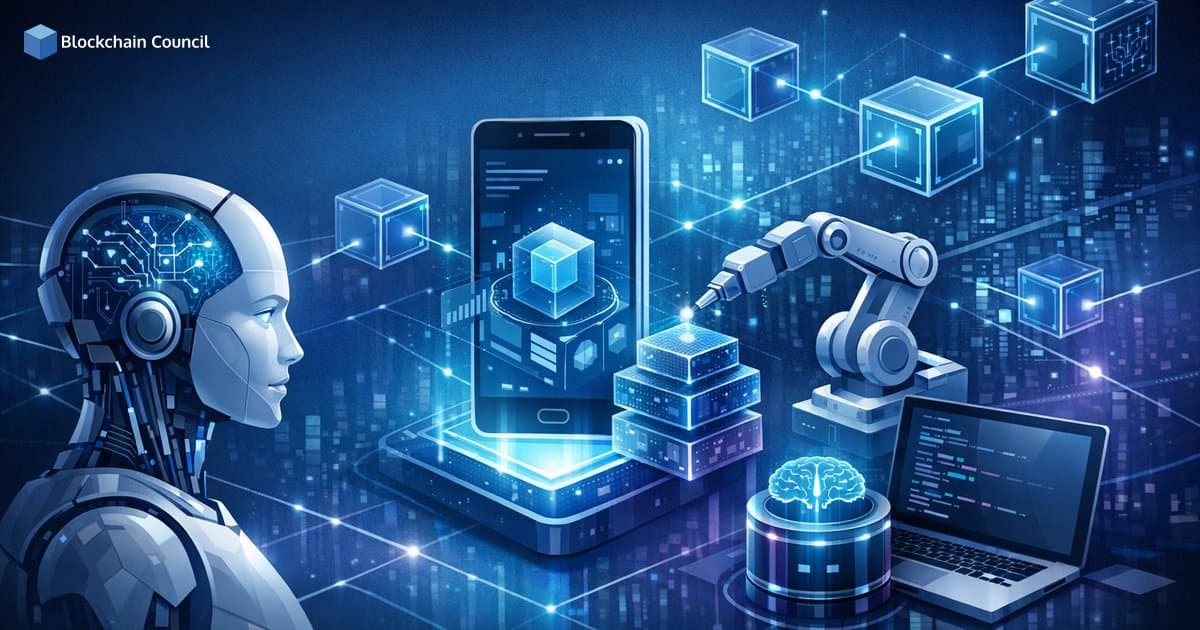
To build an AI blockchain app that delivers real value, you need more than a smart contract and a model. The most effective AI-powered decentralized applications combine trustless execution (blockchain) with adaptive intelligence (machine learning) to automate workflows, detect fraud, optimize DeFi routes, and strengthen security. Developer tooling has matured considerably, with AI-assisted builders now capable of generating boilerplate code, scaffolding wallets and contracts, and suggesting gas optimizations. Security expectations have risen alongside that speed, particularly for Ethereum-based dApps where reentrancy and integer overflow vulnerabilities remain common failure modes.
This blockchain development guide walks developers through a practical, step-by-step approach to AI app development in Web3, covering tool selection, architecture patterns, testing strategies, and deployment best practices.

What Does It Mean to Build an AI Blockchain App?
An AI blockchain app typically includes three layers:
On-chain layer: Smart contracts that enforce rules, move value, manage identity, and emit events.
AI layer: A model or agent that performs predictions, classification, anomaly detection, recommendations, or optimization.
Off-chain integration layer: Oracles, indexers, APIs, and compute infrastructure that connect model outputs to on-chain actions safely.
Because AI inference is computationally expensive, most production designs use a hybrid approach: compute runs off-chain, while the blockchain verifies permissions, logs outcomes, and triggers deterministic actions based on model signals.
Step-by-Step: How to Build an AI Blockchain App
1) Define Your Use Case and Success Metrics
Start by identifying a problem where decentralization adds genuine value. Common AI and blockchain use cases include:
Fraud detection: Flag suspicious behavior off-chain and pause or throttle on-chain actions in response.
DeFi optimization: Smart order routing across DEXs to reduce slippage and improve execution. AI-optimized routing can improve outcomes by roughly 10-20% in certain strategies, depending on liquidity conditions and fees.
NFT marketplaces: AI tagging, content moderation, and authenticity checks paired with ERC-721 minting and transfers.
Wallet intelligence: Multi-network routing, risk warnings, and anomaly alerts for non-custodial wallets.
Set measurable targets from the start, such as detection precision and recall, reduction in failed transactions, gas savings, latency benchmarks, user retention, or yield relative to a baseline.
2) Plan the Product and Architecture
Before writing code, produce a clear blueprint covering:
User flows: onboarding, wallet connection, permissions, transaction steps, and error handling.
Data flows: what data lives on-chain, what stays off-chain, and what requires indexing.
Trust boundaries: which parties can trigger contract actions based on AI outputs.
Threat model: adversarial users, oracle manipulation, model spoofing, and key compromise.
Make AI outputs explainable in the UI. Show risk reasons rather than just a warning flag, so users understand what the system is telling them.
3) Choose the Blockchain Platform and Scaling Approach
Select a chain based on your constraints:
Ethereum: broad tooling, composability, and established standards (ERC-20, ERC-721), though gas costs require careful optimization for high-frequency interactions.
Hyperledger Fabric: enterprise-friendly permissioning and governance for consortium applications.
Corda: a strong fit for regulated workflows and private transactions.
Also decide whether you need a layer-2 or sidechain strategy for cost and throughput. Many teams combine Ethereum compatibility with layer-2 execution to handle higher application activity at lower cost.
4) Design the AI and Blockchain Interaction Pattern
There are several well-established patterns for connecting AI results to smart contracts:
Event-driven: contracts emit events, off-chain services consume them, AI runs inference, and a signed transaction is sent back with an action.
Oracle-based: the model publishes signals through an oracle mechanism, and the contract reads or verifies those inputs.
Commit-reveal: separates commitment and disclosure steps to reduce signal manipulation when needed.
Keep on-chain logic deterministic. Avoid placing non-deterministic AI inference directly inside smart contracts unless you have a verifiable compute framework and can accept the associated tradeoffs.
5) Set Up Your Development Environment
A practical baseline stack for Ethereum-based development includes:
Smart contracts: Solidity, Remix IDE for rapid iteration, and OpenZeppelin libraries for audited building blocks.
Frontend: React or Next.js with ethers.js or web3.js.
Backend: Node.js or Python services to run inference and manage job queues.
AI: PyTorch or TensorFlow for training and inference.
AI-assisted builders can accelerate scaffolding significantly, often generating most boilerplate for wallets, contract templates, and deployment scripts. Treat generated code as a starting point and review it with the same scrutiny you would apply to any external dependency.
Developers building in this space often pair hands-on work with structured learning. Blockchain Council programs such as the Certified Blockchain Developer, Certified Smart Contract Developer, and Certified AI Engineer certifications cover both on-chain and machine learning foundations in a single learning path.
6) Develop Smart Contracts with Security as a Priority
Write contracts that are minimal, upgrade-aware, and thoroughly tested. Common components include:
Access control: defined roles for admin, oracle updater, and pauser functions.
Pausable flows: an emergency stop mechanism that activates if the AI layer detects fraud or anomalies.
Upgradeable proxies (optional): support iterative releases when paired with governance controls and timelocks.
Use OpenZeppelin implementations for ERC standards and common patterns. For NFT marketplaces, ERC-721 via OpenZeppelin is the standard baseline.
7) Build, Train, and Package the AI Model
Model design depends on the task at hand:
Anomaly detection for fraud: isolation forests, autoencoders, or sequence models, depending on the available features.
Routing and optimization for DeFi: reinforcement learning or supervised learning using historical execution data.
Classification and scoring for wallet risk: gradient boosting or neural models with explainability layers.
Define and document features carefully. Fraud detection features might include transaction frequency, address graph metrics, token flow patterns, and sudden behavioral changes. Export the trained model in a deployable format and wrap it in a versioned inference service so you can reproduce past decisions during audits.
8) Connect the AI Service to On-Chain Actions Safely
The central challenge is preventing AI outputs from becoming an attack vector. Practical controls include:
Authenticate signals: only accept updates from a controlled signer or an authorized oracle role.
Rate-limit impact: cap how much a single signal can shift contract parameters.
Human-in-the-loop for high-risk actions: require multisig confirmation for large fund movements or protocol pauses.
Log decisions: store hashes of model outputs or decision metadata to support future audits.
Gas and routing optimization logic typically belongs at this layer, keeping expensive computation off-chain while submitting compact results on-chain.
9) Build the Web3 User Interface with Explainable AI
The UI should make both the decentralized system and the AI layer feel predictable to users:
Wallet connection clarity: display networks, permissions, and transaction previews before signing.
AI explanations: include a short reason code such as "high-risk: rapid balance churn" instead of an opaque warning symbol.
Failure recovery: guide users through rejected signatures, insufficient gas, and network mismatches.
A useful project milestone for developers learning this stack is a single-page dApp that reads contract state, triggers a transaction, and displays AI scores alongside an explanation panel.
10) Add Tokenomics Only If the Product Justifies It
Tokenomics can fund incentives, governance, or staking, but the design should follow from application requirements. Defensible token mechanics include:
Staking for oracle operators or signal submitters, with slashing for misbehavior.
Fee models that fund inference and infrastructure costs.
Governance for parameter tuning and upgrade decisions.
Avoid adding a token without a clear purpose. For many applications, stable fee payments or enterprise subscription models are more appropriate, particularly on permissioned networks.
11) Test, Audit, and Optimize
Testing AI blockchain apps requires a broader scope than standard unit testing:
Smart contract tests: unit and integration coverage, including edge cases for access control and pause logic.
Security scans: static analysis for reentrancy and arithmetic issues, plus dependency review.
AI tests: evaluation on holdout data, drift detection, adversarial input testing, and latency profiling.
End-to-end tests: simulate event triggers, inference calls, and on-chain callbacks together.
AI-assisted debugging tools can speed iteration, but always validate with deterministic tests. Avoid last-minute production releases when monitoring coverage is limited.
12) Deploy to Testnet, Then Mainnet with Monitoring
Ship in phases to reduce risk:
Testnet deployment: validate contract behavior, oracle updates, and UI flows under realistic conditions.
Limited mainnet launch: apply caps, allowlists, or restricted asset limits to contain exposure early on.
Full rollout: proceed after monitoring confirms stability across all critical paths.
Set up monitoring for contract events, transaction failures, oracle update rates, and AI service health. If using upgradeable contracts, combine proxy patterns with clear governance controls and timelocks.
Practical Project Ideas for AI App Development in Web3
DeFi yield helper: an off-chain model ranks pools, while an on-chain contract manages deposits and withdrawals within defined risk limits.
Fraud-aware escrow: the contract releases funds unless the AI service flags a threshold violation, which then requires manual review.
NFT marketplace with content verification: ERC-721 minting, AI metadata tagging, and policy-based moderation rules.
Non-custodial wallet assistant: risk scoring, suspicious approval warnings, and network routing suggestions for end users.
Conclusion: A Repeatable Workflow to Build AI Blockchain App Systems
To build AI blockchain app products that users trust, focus on the right division of responsibilities: keep value movement and permission logic on-chain, and run intelligence off-chain with strong authentication, rate limits, and full auditability. Modern AI-assisted development can accelerate scaffolding and debugging substantially, but it does not replace secure architecture, thorough testing, or clear UX design. With a structured, security-first process, developers can ship production Web3 applications that use AI for measurable improvements in automation, fraud prevention, and optimization.
If you are building a portfolio in this area, pairing hands-on projects with recognized credentials can validate skills across the full stack. Blockchain Council offers certifications including the Certified Blockchain Developer, Certified Smart Contract Developer, Certified Web3 Expert, and Certified AI Engineer programmes for developers working at the intersection of AI and blockchain.
Related Articles
View All
Blockchain
How Machine Learning Is Transforming Blockchain Applications for AI Engineers and Blockchain Developers
Machine learning in blockchain is improving smart contract security, fraud detection, predictive analytics, and autonomous agents - creating growing demand for professionals who combine AI and blockchain skills.

Blockchain
Top 10 AI Use Cases in Blockchain You Must Know (2026 Guide)
Explore the top AI use cases in blockchain for 2026, from fraud detection and smart contract auditing to RWAs, DAOs, predictive analytics, and automation.

Blockchain
AI and Blockchain Integration: A Complete Beginner's Guide
AI and blockchain integration combines AI intelligence with blockchain trust. Learn AI blockchain basics, DLT AI integration patterns, use cases, benefits, and a beginner roadmap.
Trending Articles
The Role of Blockchain in Ethical AI Development
How blockchain technology is being used to promote transparency and accountability in artificial intelligence systems.
AWS Career Roadmap
A step-by-step guide to building a successful career in Amazon Web Services cloud computing.
Top 5 DeFi Platforms
Explore the leading decentralized finance platforms and what makes each one unique in the evolving DeFi landscape.