

AI and Blockchain Integration: A Complete Beginner's Guide
 Suyash Raizada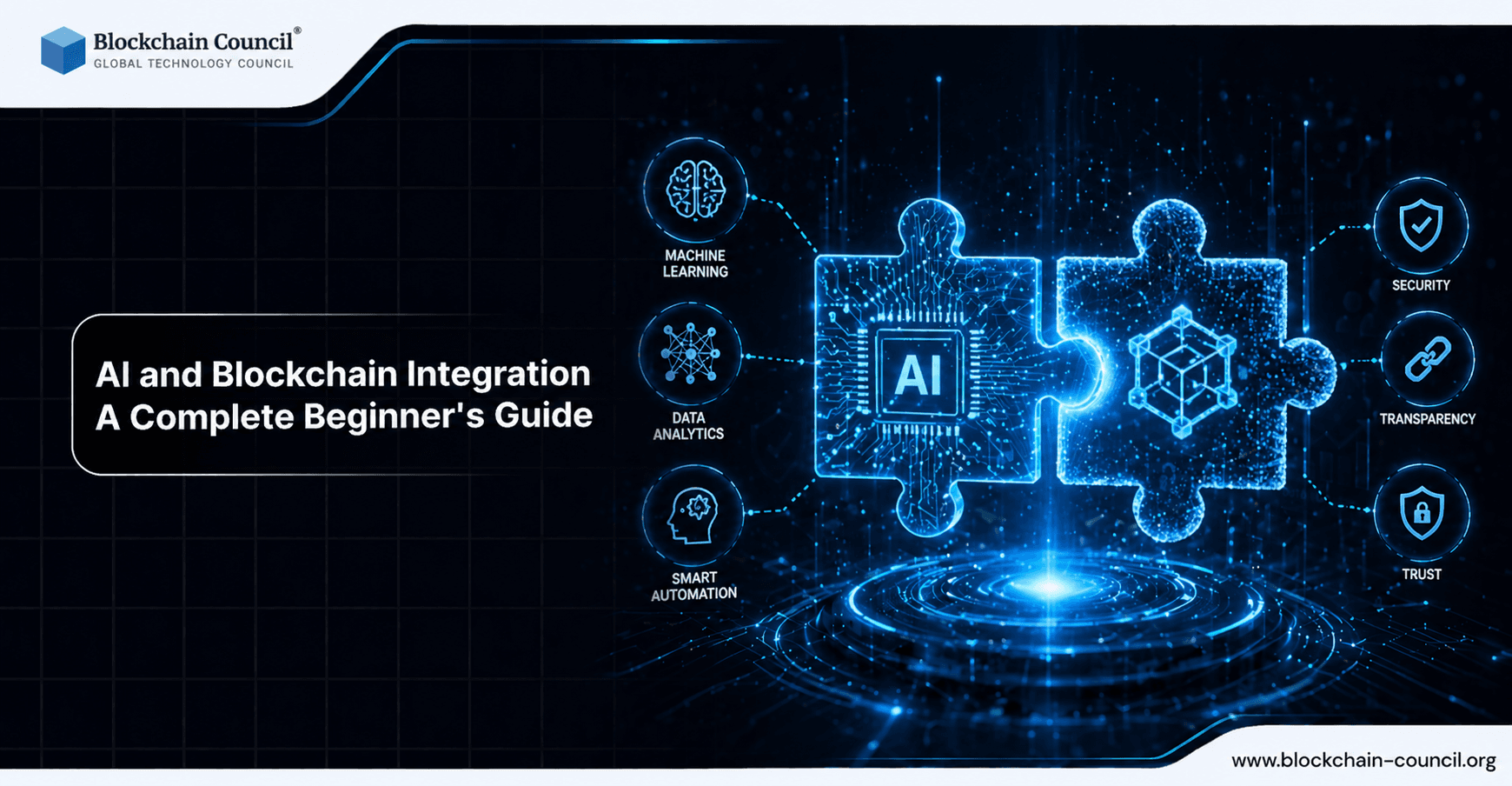
AI and blockchain integration combines two powerful technologies: artificial intelligence (AI) that learns from data to predict, classify, and automate decisions, and blockchain (also called distributed ledger technology or DLT) that records data in a tamper-resistant, transparent way across many computers. For beginners, the simplest framing is this: blockchain helps you trust the data and actions, while AI helps you extract value and intelligence from that data.
This beginner-focused guide explains the essentials of AI blockchain basics, why DLT AI integration is gaining momentum, where it is applied today, and what skills you can start building.

New to AI + blockchain? Begin with a Blockchain Course, strengthen fundamentals via a Python certification, and explore real-world applications through a Digital marketing course.
What is AI and Blockchain Integration?
AI and blockchain integration means designing systems where AI models, agents, or analytics work alongside blockchain networks, smart contracts, and on-chain data. The goal is to build digital processes that are both:
Trustworthy - data provenance, audit trails, and tamper resistance from blockchain
Intelligent - automation, optimization, and pattern recognition from AI
A practical tradeoff is well recognized across the industry: AI systems often struggle with data reliability and transparency, while blockchain systems can be secure but lack intelligence and face scalability constraints. Integration aims to reduce these weaknesses by pairing each technology with the other's strengths.
AI Blockchain Basics for Beginners
If you are new to both fields, start with these foundational concepts.
Blockchain (DLT) in One Paragraph
Blockchain is a distributed ledger where transactions or records are grouped into blocks and linked cryptographically. Copies of the ledger are stored across a network, making it difficult to alter history without consensus. This design supports immutability, transparency, and tamper resistance without relying on a single central authority.
AI in One Paragraph
AI, especially machine learning, learns patterns from data to make predictions or decisions. Common tasks include anomaly detection, classification, recommendation, forecasting, and automation. Modern AI systems can be highly capable, but their outputs depend heavily on the quality of input data and the governance applied to model updates.
Why Integrate AI with Blockchain?
DLT AI integration targets three core outcomes: trust enhancement, automation, and better system performance.
1) Trust Enhancement Through Verifiable Data
AI models can inherit bias or errors when trained on unreliable or manipulated data. Blockchain helps by recording data provenance and creating immutable logs of important events, such as:
Where a dataset came from
When it was updated
Who had permission to access or modify it
Which model version used which data
This supports more accountable AI by making key inputs and actions auditable.
2) Automation with Smarter Smart Contracts
Smart contracts are programs that run on a blockchain when predefined conditions are met. Traditionally, they follow fixed rules. With AI, smart contract logic can become more adaptive - adjusting parameters based on real-time signals, risk scores, or market conditions. A commonly discussed example is AI-assisted DeFi, where rates, collateral requirements, or liquidity decisions can be updated based on predictive analytics.
3) Efficiency and Scalability Improvements for Blockchain Networks
Blockchain networks can face congestion, high fees, and performance constraints. AI can help optimize operations through predictive algorithms, for example:
Forecasting network congestion and adjusting routing or batching
Detecting anomalies in transaction flow
Optimizing storage usage and data availability strategies
This is one reason AI is increasingly used in blockchain infrastructure and security tooling.
How DLT AI Integration Works in Practice
Integration can happen at multiple layers. Beginners often assume AI runs on-chain, but in most real systems, AI computation happens off-chain while blockchain provides verification, coordination, and auditability.
Common Architecture Patterns
On-chain records and off-chain AI: Store proofs, hashes, permissions, and critical events on-chain, while training and inference happen off-chain.
Oracles for real-world data: Oracles bring external data - prices, weather readings, IoT signals - to smart contracts. Tools such as Chainlink are widely used for this bridge.
Decentralized AI networks: Some networks coordinate model training, inference, or model marketplaces using tokens and on-chain incentives.
Beginner-Friendly Starting Point
Many learners begin with Ethereum concepts because of its smart contract ecosystem and abundant educational resources. You can explore how on-chain events - transactions, contract state changes - become transparent inputs for analytics, and then connect AI tooling like TensorFlow or PyTorch off-chain for model training and prediction.
Latest Developments Shaping AI and Blockchain Integration
The ecosystem is moving from early experiments to more structured infrastructure and production applications. Key directions include:
Proactive security: AI-based smart contract auditing and transaction monitoring can help identify vulnerabilities, including known classes such as reentrancy attacks, and detect suspicious behavior patterns.
Decentralized AI collaboration: Projects such as Bittensor encourage model collaboration through tokenized incentives, while networks like Fetch.ai focus on agent-based automation. Ocean Protocol is associated with data monetization for AI training, and SingularityNET supports an AI services marketplace model.
Enterprise-grade stacks: Platforms such as Hyperledger Fabric are commonly used when privacy and permissioning are priorities, while Ethereum and scaling networks like Polygon are standard choices for broader ecosystem compatibility. AI development frequently relies on TensorFlow or PyTorch, connected through APIs and oracle services.
Across these trends, a recurring principle is that blockchain can serve as trust infrastructure for AI - covering data provenance, model governance records, and verifiable agent actions.
Real-World Use Cases (with Beginner Explanations)
The following examples show how AI and blockchain integration applies across industries.
1) DeFi: Automated Risk and Liquidity Decisions
In decentralized finance, AI can analyze market signals, wallet behavior, and volatility to inform trading strategies or risk controls. Blockchain executes the rules transparently via smart contracts. Potential benefits include optimized liquidity and improved risk assessment, with on-chain auditability of key actions.
2) Supply Chain: Fraud Prevention and Traceability
Supply chains generate large volumes of events covering origin, shipping, storage conditions, and custody changes. Blockchain records these events as an auditable trail, while AI analyzes patterns to flag anomalies and potential fraud. IBM Food Trust is often cited as an example of blockchain-based supply chain traceability paired with analytics.
3) Fraud Detection: Anomaly Detection on Transactions
Blockchains are transparent ledgers, which makes them useful for monitoring transaction patterns. AI models can detect unusual flows, risky clusters, or suspicious wallet behavior in near real time. The combination supports faster response while keeping evidence in a tamper-resistant form.
4) Data Marketplaces for AI Training
AI needs data, but sharing data raises concerns around trust, licensing, and privacy. Blockchain-based data marketplaces aim to support controlled sharing and monetization while maintaining provenance and permissions. Ocean Protocol is commonly discussed in this context.
5) Enterprise Compliance in Healthcare and Finance
Regulated industries require strong audit trails. Blockchain provides immutable records for critical events, and AI assists with monitoring, reporting, and anomaly detection. This combination is especially relevant for cross-border processes and compliance workflows where traceability is a regulatory requirement.
Benefits and Challenges to Understand Early
Key Benefits
Accountability: Better traceability for data and model actions
Security: Stronger monitoring, auditing, and fraud detection
Automation: Smarter workflows via AI-driven triggers and agents
New data economies: Controlled sharing and monetization of datasets and AI services
Common Challenges
Scalability: Blockchains have throughput constraints, and AI workloads can be compute-intensive.
Privacy: Public blockchains are transparent, so sensitive data often cannot be placed on-chain directly.
Verification: Proving that an AI model executed correctly is non-trivial, especially when models are large and proprietary.
Integration complexity: Oracles, off-chain compute, and multi-chain environments add engineering and security requirements.
What to Learn Next: A Simple Beginner Roadmap
If you are building skills in AI blockchain basics, follow this sequence:
Blockchain fundamentals: transactions, blocks, consensus, wallets, smart contracts, and token concepts.
Smart contract basics: write and deploy a simple contract, understand events, and learn common vulnerability patterns.
AI fundamentals: supervised learning, classification, anomaly detection, evaluation metrics, and model lifecycle basics.
Bridge components: APIs, oracle design, off-chain compute, and storing hashes and proofs on-chain.
Mini project: build a transaction anomaly detector off-chain and store alert proofs or summaries on-chain.
For structured learning, Blockchain Council offers programs covering blockchain fundamentals, Ethereum development, smart contract security, AI, and data science - each providing a recognized credential for professionals building toward job-ready skills in this space.
Future Outlook: Where AI and Blockchain Integration is Heading
Expert commentary and industry forecasts point toward deeper integration by 2030, particularly in finance, healthcare, and supply chains. Likely directions include:
More autonomous dApps with AI-driven decision layers
Agent-based systems where AI agents transact and coordinate via smart contracts
Blockchain as AI trust infrastructure for provenance, governance logs, and verifiable actions
Growth of decentralized data and model markets that challenge centralized control of data pipelines
Scalability and privacy remain ongoing challenges, but infrastructure improvements and better tooling continue to make integrated systems more practical for real-world deployment.
Start your journey into AI-blockchain convergence-learn concepts with an AI Course, apply models using a machine learning course, and scale impact through a Digital marketing course.
Conclusion
AI and blockchain integration is best understood as a partnership: blockchain strengthens trust, traceability, and coordination, while AI strengthens automation, prediction, and optimization. For beginners, the most useful mindset is to focus on real workflows - where data comes from, how it is verified, how decisions are made, and how the system is audited end to end.
By learning AI blockchain basics and experimenting with small DLT AI integration projects, you can build a strong foundation for the next generation of secure, intelligent applications.
FAQs
1. What is AI and blockchain integration?
AI and blockchain integration combines machine learning with decentralized systems. AI analyzes data and automates decisions, while blockchain ensures secure and transparent data storage. Together, they create intelligent and trustworthy applications.
2. Why is AI and blockchain integration important?
This integration improves data security, automation, and decision-making. AI adds intelligence, while blockchain ensures data integrity and transparency. It is important for building reliable and scalable digital systems.
3. How do AI and blockchain work together?
AI processes and analyzes data, while blockchain securely stores and verifies it. AI models can use blockchain data for training and predictions. Blockchain ensures that the data used is accurate and tamper-proof.
4. What are the benefits of combining AI with blockchain?
Benefits include improved security, better data accuracy, and automation of processes. It also enables transparent AI models and decentralized decision-making. This leads to more efficient and reliable systems.
5. What are common use cases of AI and blockchain integration?
Common use cases include fraud detection, supply chain tracking, healthcare data management, and financial services. It is also used in identity verification and decentralized finance. These applications improve efficiency and trust.
6. Is AI and blockchain integration suitable for beginners?
Yes, beginners can start by learning the basics of both technologies separately. Understanding simple use cases helps build confidence. Gradual hands-on practice makes integration easier over time.
7. What skills are needed to learn AI and blockchain integration?
Key skills include programming, data analysis, and understanding of machine learning concepts. Knowledge of blockchain fundamentals and smart contracts is also important. Familiarity with tools and frameworks is helpful.
8. How does blockchain improve data quality for AI?
Blockchain ensures data is immutable and transparent. This reduces the risk of data tampering and errors. High-quality data improves the performance of AI models.
9. Can AI improve blockchain performance?
AI can optimize network operations by predicting congestion and improving resource allocation. It helps enhance scalability and efficiency. This leads to faster and more reliable blockchain systems.
10. What are smart contracts in AI-blockchain systems?
Smart contracts are self-executing programs stored on the blockchain. AI can enhance them by enabling data-driven decisions. This allows contracts to adapt to real-world conditions.
11. What tools are used for AI and blockchain integration?
Popular tools include TensorFlow and PyTorch for AI development. Blockchain platforms like Ethereum and Hyperledger are commonly used. Integration tools and APIs help connect both technologies.
12. What challenges exist in AI and blockchain integration?
Challenges include high computational costs and complex system design. Data privacy and scalability issues can also arise. Proper architecture and optimization strategies are required.
13. How is AI used in blockchain security?
AI detects anomalies, suspicious transactions, and potential cyber threats. It continuously learns from data to improve detection accuracy. This strengthens blockchain security systems.
14. What is decentralized AI?
Decentralized AI refers to AI systems that operate without a central authority. Blockchain enables secure data sharing and model training. This ensures transparency and reduces bias.
15. How can beginners start learning AI and blockchain together?
Start with online courses and tutorials on both technologies. Build simple projects like smart contracts with basic AI models. Practice consistently to gain practical experience.
16. What industries use AI and blockchain integration?
Industries such as finance, healthcare, logistics, and cybersecurity use this integration. It improves transparency, automation, and data management. These sectors benefit from increased efficiency and trust.
17. How does AI help in blockchain data analysis?
AI analyzes large datasets from blockchain transactions to find patterns and trends. It helps in predicting outcomes and detecting anomalies. This supports better decision-making.
18. What is the future of AI and blockchain integration?
The future includes smarter decentralized applications and automated systems. Integration will drive innovation across multiple industries. It is expected to become a core part of digital transformation.
19. Can AI and blockchain improve data privacy?
Yes, blockchain secures data while AI processes it without exposing sensitive information. Techniques like encryption and federated learning enhance privacy. This ensures safer data handling.
20. Is AI and blockchain integration a good career path?
Yes, it offers strong career opportunities due to growing demand. Professionals with skills in both areas are highly valued. It is a future-focused field with long-term potential.
Related Articles
View All
Blockchain
Blockchain Fundamentals Explained: A Beginner's Guide to How Blockchain Works
Learn blockchain fundamentals from first principles: blocks, hashes, consensus, smart contracts, use cases, and the best learning path for beginners.

Blockchain
What Is Blockchain Intelligence? A Complete Guide to On-Chain Data Analysis
Learn what blockchain intelligence means, how on-chain data analysis works, and how professionals use it for compliance, trading, investigations, and risk.

Blockchain
Blockchain AI Integration and Autonomous Agents: A Practical Guide
Learn how Blockchain AI Integration and Autonomous Agents combine AI decision-making, smart contracts, wallets, audit trails, and AgentFi infrastructure.
Trending Articles
The Role of Blockchain in Ethical AI Development
How blockchain technology is being used to promote transparency and accountability in artificial intelligence systems.
AWS Career Roadmap
A step-by-step guide to building a successful career in Amazon Web Services cloud computing.

Top 5 DeFi Platforms
Explore the leading decentralized finance platforms and what makes each one unique in the evolving DeFi landscape.