

How Blockchain Product Managers Collaborate with Developers, Designers, and Communities

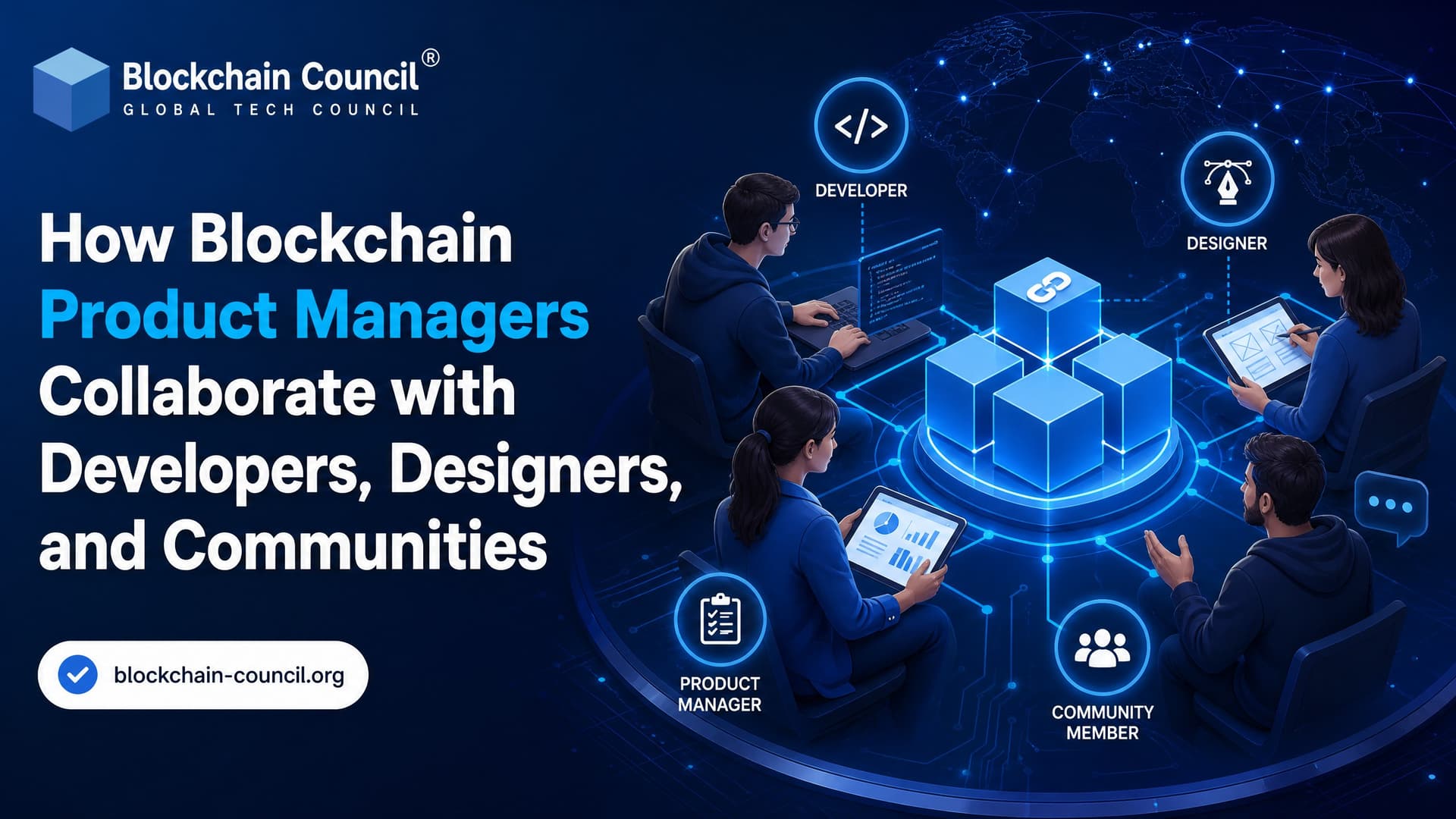
Blockchain product managers sit between protocol complexity and real user behavior. You are not only writing tickets or managing a roadmap. You help developers ship secure smart contracts, help designers make wallet flows understandable, and help communities decide what the product should become.
That mix makes the role harder than conventional software product management. A missed edge case in a SaaS dashboard may create a support ticket. A missed edge case in a smart contract can lock funds, break governance, or force a painful migration. Good blockchain product managers understand that difference and collaborate accordingly.

What Makes Blockchain Product Management Different?
A blockchain product manager, or BPM, owns the product direction for applications, protocols, or enterprise systems built with blockchain technology. The standard product work still applies: market research, roadmap planning, user stories, analytics, stakeholder communication, and launch coordination.
The blockchain layer adds extra responsibilities:
- Smart contract constraints: Some decisions become difficult or impossible to change after deployment.
- Security reviews: Audits, threat modeling, and testnet validation must fit into the roadmap.
- Token incentives: Rewards, fees, staking models, and governance rights shape user behavior.
- Community input: Users may also be token holders, open-source contributors, or DAO voters.
- Education: Internal teams and users often need plain-language explanations of wallets, gas, custody, and governance.
Industry salary data often places blockchain product manager pay in the United States near USD 167,000 per year, with higher packages in senior roles or token-based startups. That reflects the breadth of the job. You need product judgment, enough technical fluency to challenge assumptions, and enough community sense to avoid shipping in a vacuum.
How Blockchain Product Managers Work with Developers
Developers are the first critical partner for a blockchain product manager. In Web3, engineering decisions are product decisions. Chain choice, contract upgradeability, gas optimization, indexing architecture, and wallet support all shape the user's experience.
Translate Product Goals into Technical Requirements
A weak requirement says, Users should be able to stake tokens. A useful requirement says:
- Users can stake an ERC-20 token from a connected wallet.
- The contract must emit events for stake, unstake, and claim actions.
- The interface must show pending rewards before confirmation.
- Unstaking has a 7-day cooldown.
- The first release runs on a public testnet before mainnet deployment.
That level of detail helps developers plan contracts, backend services, indexers, and UI states. It also cuts down on late surprises. If your team uses Solidity 0.8.x, arithmetic overflow and underflow checks are built in by default. That changed how many teams think about SafeMath compared with older Solidity versions. A BPM does not need to write every line of Solidity, but you should know enough to ask the right questions.
Build Security into the Roadmap
Smart contract audits are not a final-week checkbox. They affect scope, release dates, and user trust. A practical BPM blocks time for internal review, test coverage, audit fixes, and retesting.
Developers will also surface issues that look technical but are really product trade-offs. Should an admin key be able to pause deposits? Should a contract be upgradeable through a proxy? Should governance control fees from day one? There is no universal answer. For a DeFi protocol holding user funds, a pause function may be defensible. For a product promising strong decentralization, heavy admin control can damage trust.
One detail from real deployments: when a transaction fails with execution reverted: Ownable: caller is not the owner, the product issue is often not the revert itself. It is that the team did not make permissions visible enough in the admin workflow. A BPM should turn that failure into better role design, clearer runbooks, and safer release checks.
Use Agile Rituals, but Adapt Them for Blockchain
Sprint planning, daily standups, backlog refinement, and sprint reviews still work. Keep them. But add blockchain-specific checkpoints:
- Architecture review: Confirm chain, contract pattern, oracle needs, custody model, and indexing approach.
- Testnet exit criteria: Define what must be proven before mainnet. Include transaction success rate, gas estimates, wallet compatibility, and monitoring.
- Audit readiness: Freeze contract scope before external review.
- Mainnet release checklist: Confirm chain ID, contract addresses, multisig signers, verified source code, and rollback communication.
Ethereum mainnet uses chain ID 1. That sounds basic until a frontend points users to the wrong network during a rushed launch. Small details matter.
How Blockchain Product Managers Collaborate with Designers
Designers make blockchain usable. Without good UX, even a technically sound product can fail because users do not understand what they are signing, paying, or risking.
Turn Blockchain Concepts into Human Flows
Wallets, seed phrases, gas fees, slippage, approvals, bridging, and governance votes are not familiar to most users. The BPM and designer must decide what to explain, what to hide, and what must never be hidden.
Take token approvals. A beginner may see a wallet prompt and click confirm without understanding that an ERC-20 approval can grant spending permission. A good design shows why approval is needed, what asset is affected, and whether the permission is limited. To be blunt, hiding risk to improve conversion is a bad product decision in crypto.
Design collaboration works best when PMs bring user problems and designers bring interaction options. Avoid prescribing screens too early. Instead, define the outcome: users should understand the cost, risk, and finality of an action before they sign.
Prototype Before You Commit to Contracts
In conventional apps, a design mistake can often be patched quickly. In blockchain products, the contract may lock in the workflow. Prototype first.
Useful shared artifacts include:
- User journey maps for wallet connection, transaction signing, failed transactions, and recovery states.
- Wireframes for dashboards, governance pages, and transaction confirmations.
- Copy guidelines for risk warnings and empty states.
- Developer notes attached directly to design files in tools such as Figma.
Designers should sit in sprint reviews. Developers should review mockups before designs are finalized. A beautiful governance flow is not useful if the underlying proposal lifecycle has pending, active, succeeded, queued, executed, and expired states that the UI ignores.
Focus Scope Ruthlessly
Many Web3 products try to serve traders, developers, DAO members, and curious beginners at the same time. That usually fails. A BPM should push for a narrow first audience.
If you are building a DeFi analytics dashboard, design for active liquidity providers first. If you are building an enterprise supply chain product, design for operations teams who need audit trails, not crypto-native users who want token rewards. Different users need different language.
How Blockchain Product Managers Work with Communities
Community collaboration is where Web3 product management departs most sharply from traditional product work. Your users may publicly debate the roadmap. They may vote on protocol changes. They may contribute code, write documentation, or challenge your assumptions in Discord, Telegram, GitHub, or governance forums.
Treat Community Feedback as Product Data
Community channels are noisy. Still, they carry useful signals. A BPM should separate loud opinions from repeated pain points.
Track feedback such as:
- Wallet connection failures by device or browser.
- Confusion around staking rewards or withdrawal timing.
- Complaints about gas costs during high network activity.
- Governance proposals that repeatedly fail due to unclear wording.
- Feature requests from open-source contributors.
Do not promise every requested feature. Communities respect clarity more than vague agreement. Explain what will be built, what will not, and why.
Translate Governance into Product Work
DAO-governed projects add another layer. A product change may require a forum discussion, a temperature check, an on-chain vote, and then implementation. The BPM often helps draft the proposal in language non-engineers can understand.
Changing a protocol fee, for example, is not just a parameter update. It affects users, token holders, liquidity providers, revenue, and sometimes legal review. The BPM should coordinate developers, governance leads, designers, and community moderators so the proposal is technically accurate and easy to evaluate.
Design Incentives with Care
Token incentives can attract users quickly, but they can also attract mercenary behavior. A rewards program that pays users only for volume may create wash activity. A governance token with poor distribution may centralize control.
Blockchain product managers should work with analysts, protocol developers, and the community to test whether incentives produce healthy behavior. Look at retention after rewards decline. Watch governance participation. Study whether power users are helping the network or extracting from it.
Skills That Make Collaboration Easier
The best BPMs are not the loudest people in the room. They are translators. They can speak enough engineering to discuss contract risk, enough design to protect the user, and enough community language to build trust.
Build these skills first:
- Technical literacy: Learn smart contracts, consensus, wallets, gas mechanics, token standards such as ERC-20 and ERC-721, and basic cryptography concepts.
- Product discovery: Run interviews, define user segments, write clear acceptance criteria, and measure behavior.
- Security mindset: Understand audits, permissions, multisigs, upgradeability, and incident communication.
- Governance fluency: Learn how DAO proposals, voting, delegation, and treasury decisions work.
- Clear writing: Write roadmap updates, release notes, forum posts, and user-facing risk explanations.
If you are building this skill set, Blockchain Council courses work well as structured learning paths. Consider Certified Blockchain Expert™ for blockchain fundamentals, Certified Blockchain Developer™ if you want stronger engineering fluency, and Certified Smart Contract Developer™ if your product work touches Solidity-based systems.
Future Outlook for Blockchain Product Managers
The role is becoming more formal. Finance, healthcare, supply chain, gaming, identity, and infrastructure teams all need people who can connect business goals with distributed systems. At the same time, Web3 teams are moving away from token-first launches toward products that solve specific user problems.
Expect three changes:
- More governance responsibility: BPMs will spend more time shaping proposals, token parameters, and community decision processes.
- Stricter UX standards: Users will no longer tolerate confusing wallet flows and unclear transaction states.
- Higher technical expectations: Product managers will need to understand audits, protocol architecture, and regulatory constraints well enough to make informed trade-offs.
Your next step: build one small Web3 product workflow on a testnet. Write the user story, sketch the flow, define the smart contract requirements, and ask a small community for feedback. Then compare your gaps against the skills covered in Certified Blockchain Expert™ or Certified Blockchain Developer™ and choose the path that fits your role.
Related Articles
View All
Blockchain
Product Discovery for Blockchain Products: A Step-by-Step Guide for Web3 Product Managers
A practical Web3 product discovery guide covering wallet behavior, token validation, governance, security, metrics, and testnet pilots.

Blockchain
Tokenomics for Product Managers: Designing Sustainable Blockchain Products
A practical guide to tokenomics for product managers, covering utility, supply, incentives, governance, compliance, and sustainable Web3 product design.

Blockchain
Agile for Blockchain Product Managers: Managing Iterative Web3 Development
Learn how agile for blockchain product managers adapts sprint planning, audits, governance, compliance, and Web3 metrics for safer iterative delivery.
Trending Articles
The Role of Blockchain in Ethical AI Development
How blockchain technology is being used to promote transparency and accountability in artificial intelligence systems.

Top 5 DeFi Platforms
Explore the leading decentralized finance platforms and what makes each one unique in the evolving DeFi landscape.
What is AWS? A Beginner's Guide to Cloud Computing
Everything you need to know about Amazon Web Services, cloud computing fundamentals, and career opportunities.