

Common Challenges Blockchain Product Managers Face and How to Solve Them

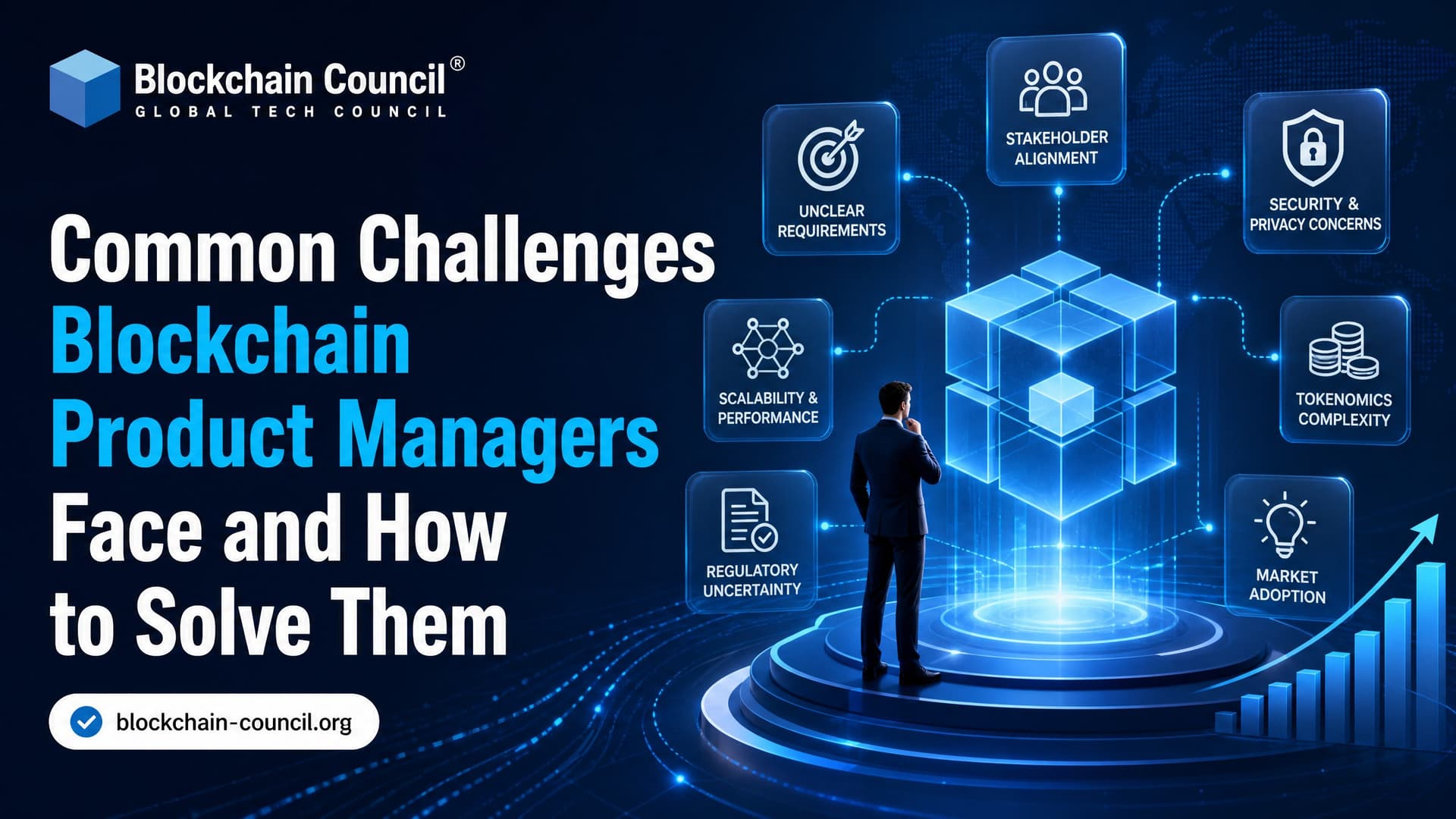
Blockchain product managers do not just manage features. You manage trust, gas costs, wallet friction, smart contract risk, token incentives, and legal constraints that can change the product overnight. That is why these challenges feel tougher than classic SaaS problems. The infrastructure is visible to the user, and mistakes can be irreversible.
Glassdoor data cited by ELVTR puts the average U.S. blockchain product manager salary near USD 167,000 per year. That number says something about demand. It also says something about the difficulty. If you are responsible for a wallet, DeFi protocol, NFT platform, DAO tool, or enterprise blockchain product, you need product judgment plus enough technical literacy to spot bad assumptions early.

1. Turning Blockchain Complexity Into Clear Product Value
The first challenge is explaining why blockchain is needed at all. Users do not care about consensus mechanisms, Merkle trees, or validator sets. They care about lower cost, faster settlement, auditability, ownership, access, or trust reduction.
To be blunt, if your product works better with a normal database, use the database. A blockchain product manager should be able to defend the chain choice in one paragraph.
How to solve it
- Start with the user problem: Map each blockchain feature to a user outcome. Immutability becomes auditability. Smart contracts become automated settlement. Token ownership becomes portable access.
- Write value hypotheses: For example, users will pay more for verifiable provenance, or institutional clients need shared records across parties that do not fully trust each other.
- Use discovery interviews: Test whether users actually value transparency, self-custody, or composability. Do not assume they do.
- Create shared language: Run short internal sessions for design, legal, marketing, and support teams. Explain gas, finality, bridges, and wallets with diagrams, not protocol jargon.
A practical test: ask your sales or support lead to explain your blockchain value proposition without saying decentralized. If they cannot, the product story is still too vague.
2. Fixing Wallet Onboarding and UX Friction
Web3 onboarding is where many good ideas lose users. Seed phrases, network selection, token approvals, gas fees, and message signing are unfamiliar to mainstream customers. Even experienced users hesitate when MetaMask displays a raw signature request that looks suspicious.
The small details matter. On Ethereum mainnet, the chain ID is 1. If your app silently points users to the wrong network, they may see failed transactions or empty balances. A beginner will not know what happened. They will just leave.
How to solve it
- Use progressive onboarding: Let users browse, simulate, or use a testnet flow before forcing wallet connection.
- Offer the right custody model: Self-custody is powerful, but it is not always the right default for consumer products. Custodial wallets, smart contract wallets, and social login options can reduce drop-off when the trade-offs are disclosed clearly.
- Preview every transaction: Show what the user is signing, the estimated fee, the asset affected, and whether the action is reversible.
- Design failure states: Include plain-language handling for failed confirmations, gas spikes, rejected signatures, and stuck transactions.
- Measure the funnel: Track wallet creation, wallet connection, funding, first signature, first transaction, and second session.
One real error that trips teams is execution reverted: ERC20: insufficient allowance. To a developer, it means the token approval is missing or too low. To a user, it feels like the app is broken. Your UX needs to explain approval before the transaction fails.
3. Managing Security as a Product Requirement
Security is not a final checklist in blockchain. It is part of the product. Smart contract bugs, phishing, malicious approvals, private key loss, oracle failures, and bridge exploits all affect retention and brand trust.
Department of Product notes that crypto product teams must deal with security and regulatory questions from day one. That matches reality. Once funds move on-chain, support cannot simply reverse a bad transaction.
How to solve it
- Add threat modeling to discovery: Ask how users, attackers, insiders, bots, and third-party contracts could misuse the feature.
- Budget for audits: Independent smart contract audits should happen before mainnet deployment, especially for contracts holding user funds.
- Use staged releases: Start with testnet, then capped mainnet exposure, then a broader launch after monitoring.
- Protect users in the interface: Add transaction simulation, approval warnings, spending limits, allowlists, hardware wallet support, and multi-signature options where suitable.
- Run a disclosure process: A bug bounty and a clear responsible disclosure policy can surface issues before attackers do.
For teams building Solidity 0.8.x contracts, remember that overflow and underflow checks are built in by default. That does not make the contract safe. Access control, upgrade permissions, reentrancy, oracle assumptions, and token integration behavior still need careful review.
4. Handling Regulation Without Killing the Product
Many blockchain products touch regulated areas: securities, commodities, money transmission, tax reporting, sanctions screening, KYC, AML, and data privacy. A token design choice can become a legal issue. A custody decision can change licensing obligations.
How to solve it
- Bring legal in early: Include legal, compliance, and risk teams during discovery, not after the roadmap is approved.
- Build jurisdiction-aware features: Some features may need geo-fencing, different onboarding flows, or restricted asset availability by region.
- Keep compliance modular: Separate identity, risk scoring, reporting, and access controls so the product can adapt as rules change.
- Explain compliance to users: If KYC is needed, say why, what data is collected, how long it is stored, and how it is protected.
This is not only for exchanges. Enterprise blockchain products in healthcare, supply chain, and finance must also think carefully about what data belongs on-chain. Personal data should usually stay off-chain, with hashes or references used where appropriate.
5. Designing Tokenomics That Do Not Collapse
Tokenomics is product design, not a marketing add-on. Tokens can shape acquisition, governance, payments, access, and retention. They can also attract users who disappear as soon as rewards fall.
A common mistake is paying users for activity that has no lasting product value. If emissions are the only reason people show up, you do not have retention. You have rented traffic.
How to solve it
- Define the token purpose: Is it for governance, access, payment, staking, rewards, or security? Pick a primary role and design around it.
- Connect token metrics to product health: Track active users, retention, protocol revenue, transaction quality, governance participation, and total value locked only where TVL is meaningful.
- Model incentives before launch: Simulate reward schedules, vesting, user behavior, and fee changes with data science or economic input.
- Use staged rollouts: Test on testnet or with limited mainnet caps before exposing the full economy.
- Avoid inflation-only growth: Utility-driven demand usually ages better than rewards that depend on constant token issuance.
6. Choosing Infrastructure Without Trapping the Roadmap
In normal software, infrastructure is often invisible to users. In blockchain, it shapes the product experience directly. Layer 1 versus Layer 2, bridge dependency, RPC reliability, custody model, finality, EIP-1559 fee behavior, and indexer latency all affect support tickets.
How to solve it
- Use a decision scorecard: Compare chains on transaction cost, latency, liquidity, developer tooling, ecosystem support, security history, compliance fit, and user wallet support.
- Abstract chain-specific logic: Keep your business rules separate from chain integrations where possible. Future migration is painful, but less painful if you planned for it.
- Plan for RPC and indexing failures: Users will blame your app when a node provider lags. Build retries, status messaging, and monitoring.
- Do not go multi-chain too early: Multi-chain support sounds attractive, but it multiplies QA, liquidity fragmentation, bridge risk, and support complexity.
If your core users already live on a specific network, meet them there. If you are targeting mainstream users, lower fees and account abstraction may matter more than ideological purity.
7. Keeping Roadmaps Outcome-Oriented in a Volatile Market
Blockchain markets move quickly. ICOs, DeFi, NFTs, DAOs, real-world assets, restaking, and AI-agent narratives have each pulled teams into reactive planning. Stakeholders may demand a feature because a competitor launched it last week.
How to solve it
- Separate roadmaps from delivery plans: A roadmap should describe outcomes and problems. Sprint plans describe tickets and dates.
- Break big goals into behaviors: Instead of increase TVL, define smaller outcomes such as complete onboarding, deposit first asset, vote on first proposal, or return within seven days.
- Maintain a discovery backlog: Track risky assumptions, then test them through interviews, prototypes, analytics, or small experiments.
- Push stakeholders toward outcomes: If someone says launch an NFT marketplace, ask what user behavior or business result they expect. Then compare other ways to reach that result.
This keeps the team from building whatever the market is shouting about. Good blockchain product managers protect focus.
8. Building the Right Skills and Cross-Functional Habits
Blockchain product management sits between protocol engineering, UX, legal, security, economics, community, and business strategy. You do not need to be the best Solidity developer in the room, but you must understand enough to ask sharp questions.
How to solve it
- Learn the fundamentals: Study consensus, wallets, smart contracts, tokens, custody, bridges, and common attack patterns.
- Improve product craft: Practice discovery, prioritization, PRDs, opportunity mapping, analytics, and stakeholder communication.
- Use clear artifacts: Product requirement documents, protocol proposals, risk registers, and launch checklists reduce confusion across distributed teams.
- Stay close to the community: Governance forums, Discord feedback, wallet support tickets, and analytics dashboards often reveal problems before formal research does.
If you want a structured path, Blockchain Council offers certifications worth exploring, including the Certified Blockchain Expert™, Certified Blockchain Developer™, Certified Smart Contract Developer™, and Certified DeFi Expert™. Product managers working with enterprise architecture can also look at the Certified Blockchain Architect™.
What Blockchain Product Managers Should Do Next
The best blockchain product managers are practical. They do not add a token because it is fashionable. They do not push users through five wallet steps and call it education. They make trade-offs visible, test assumptions early, and design for failure before users hit it.
Pick one weak spot in your product this week: onboarding drop-off, transaction failures, unclear token incentives, audit readiness, or regulatory review. Instrument it. Write down the riskiest assumption. Test it with users or data. If your gap is technical, start with blockchain fundamentals and smart contract security. If your gap is strategy, tighten your discovery and roadmap practice. That is where better Web3 products come from.
Related Articles
View All
Blockchain
Product Discovery for Blockchain Products: A Step-by-Step Guide for Web3 Product Managers
A practical Web3 product discovery guide covering wallet behavior, token validation, governance, security, metrics, and testnet pilots.

Blockchain
Tokenomics for Product Managers: Designing Sustainable Blockchain Products
A practical guide to tokenomics for product managers, covering utility, supply, incentives, governance, compliance, and sustainable Web3 product design.

Blockchain
Agile for Blockchain Product Managers: Managing Iterative Web3 Development
Learn how agile for blockchain product managers adapts sprint planning, audits, governance, compliance, and Web3 metrics for safer iterative delivery.
Trending Articles
The Role of Blockchain in Ethical AI Development
How blockchain technology is being used to promote transparency and accountability in artificial intelligence systems.
What is AWS? A Beginner's Guide to Cloud Computing
Everything you need to know about Amazon Web Services, cloud computing fundamentals, and career opportunities.

Can DeFi 2.0 Bridge the Gap Between Traditional and Decentralized Finance?
The next generation of DeFi protocols aims to connect traditional banking with decentralized finance ecosystems.