

Blockchain Facts: Key Stats, Trends, Use Cases, and Risks
 Suyash Raizada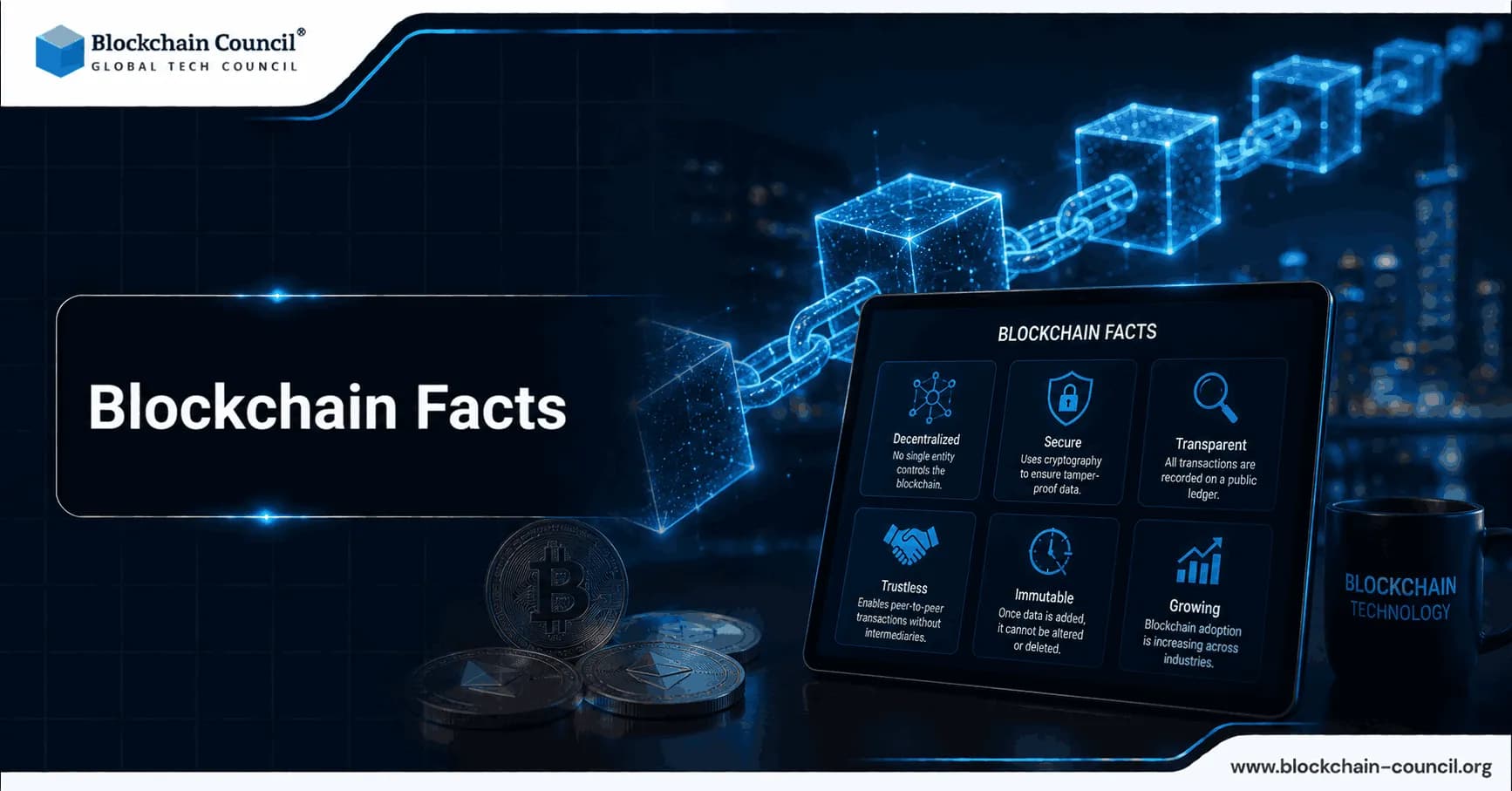
Blockchain has evolved from a niche technology associated mainly with cryptocurrency into a practical infrastructure layer for recordkeeping, verification, and value transfer. In 2026, blockchain adoption is strongest where multiple parties need a shared source of truth, faster settlement, or tamper-evident audit trails. This guide compiles essential facts about blockchain's current state, major trends, real-world use cases, regulatory direction, and security realities based on publicly available industry research from organizations such as the World Economic Forum, Statista, Blockchain.com, Alchemy, and Binariks. Professionals looking to build practical knowledge in this evolving field may also explore a Certified Blockchain Expert certification to strengthen their understanding of blockchain concepts and applications.
What Is Blockchain? A Quick, Accurate Definition
Blockchain is a distributed ledger technology that records transactions or data across a network of computers (nodes) rather than in a single centralized database. Records are grouped into blocks and linked to form a chain, making the history of changes difficult to alter retroactively without detection.

Two important practical facts:
Blockchain is not one thing. There are many networks (public and permissioned) and many designs (monolithic, modular, rollups, and more).
Blockchain security is layered. Consensus mechanisms may be robust, but applications, wallets, bridges, and developer tooling can still be vulnerable.
As blockchain applications become more sophisticated, understanding how code-based agreements operate is equally important. A Certified Smart Contract Developer can develop specialized knowledge for creating and working with smart contracts, which are increasingly important across decentralized applications and blockchain-based financial systems.
Current State of Blockchain in 2026
By 2026, blockchain has moved beyond broad experimentation into selective production use, especially in regulated and enterprise contexts. The strongest momentum is concentrated in a few high-utility areas:
Tokenization of real-world assets and financial instruments
Stablecoin payments and settlement
Layer 2 scaling and modular infrastructure
Digital identity and verifiable credentials
Enterprise workflows for provenance, tracking, and compliance
AI-related provenance and coordination infrastructure
The World Economic Forum continues to position blockchain and digital assets as important infrastructure for tokenization and financial market modernization, particularly in cross-border and institutional finance. Statista also highlights a more cautious reality: adoption is uneven, and business value depends on whether real-world utility outweighs complexity and integration costs.
Key Blockchain Facts and Statistics
Market Growth Projections Are Large but Vary Widely
Market forecasts for blockchain often differ significantly because analysts define the "blockchain market" in different ways, sometimes including infrastructure, services, applications, and digital assets in one total.
Binariks cites a global blockchain technology market value of USD 41.14 billion in 2025 and a projected 90.1% CAGR through 2030.
Market.us, as referenced by Binariks, projects a potential market size of USD 2,231.6 billion by 2032.
The practical takeaway: the direction of growth is broadly positive, but precise numbers should be treated as scenario estimates rather than guaranteed outcomes.
Bitcoin Network Activity Is Measurable in Real Time
For a transparent look at on-chain activity, Blockchain.com Charts provides live statistics for the Bitcoin network, including transaction counts, block size, confirmation times, mempool size, and overall blockchain size. These metrics help illustrate network congestion and usage patterns, but they represent Bitcoin specifically, not the entire blockchain ecosystem.
The Ecosystem Is Multi-Chain and Fragmented
One of the most significant blockchain facts in 2026 is that the industry is multi-chain. Alchemy's 2026 ecosystem index lists 59 blockchains, ranging from major networks to Layer 2 systems and specialized chains. This breadth reflects ongoing innovation and competition, but it also increases interoperability challenges and developer complexity.
Major Blockchain Trends in 2026
Modular Blockchain Architectures
Architectures are shifting from monolithic designs where a single chain handles everything to modular designs where consensus, execution, and data availability are separated. The goal is better scalability, greater customization, and clearer infrastructure roles.
Commonly cited examples include Celestia (data availability), Polygon 2.0 (modular coordination and ZK infrastructure), and EigenLayer (restaking and shared security services), as discussed in Binariks' 2026-2030 trends analysis.
Zero-Knowledge Proofs at Scale
Zero-knowledge (ZK) proofs enable verification without revealing the underlying data, supporting both privacy and scalability. In 2026, ZK rollups and ZK identity systems are widely considered foundational building blocks for the next generation of blockchain applications.
Scaling examples include zkSync Era, Starknet, and Polygon zkEVM.
Payments experimentation has also appeared, including reports of recurring payment tests using ZK-related approaches on Ethereum, as highlighted in Binariks' roundup.
Stablecoins as a Mainstream Payment Rail
Stablecoins are increasingly central to blockchain's real-world value proposition because they connect on-chain settlement with familiar fiat-denominated units. In 2025-2026, regulatory progress has accelerated in some jurisdictions. Reported developments include Hong Kong advancing stablecoin rules and the United States passing the GENIUS Act in 2025 to establish a federal stablecoin framework, as reported via The Block.
Industry reporting also highlights usage in cross-border flows, such as SoFi's international transfer service leveraging the Bitcoin network and UMA for Mexico corridors.
Digital Identity and Compliance Automation
Blockchain-based identity is gaining traction for credential verification, fraud reduction, selective disclosure, and compliance workflows. Examples often cited in industry research include:
EU EBSI initiatives supporting eID and academic credential verification
Polygon ID for self-sovereign identity using ZK privacy features
Proof-of-personhood models such as Worldcoin
For enterprises, the value lies less in placing identity records directly on-chain and more in verifiable attestations and reusable compliance checks.
Blockchain and AI Integration
A fast-growing area of discussion is how blockchain can support AI governance and authenticity through:
Data provenance and integrity
Model attribution and auditability
Decentralized compute coordination
Agent coordination and incentive design
Examples frequently mentioned include Ocean Protocol, Bittensor, and Fetch.ai, as summarized in Binariks' 2026 trend report. This category is still maturing, but it reflects increasing demand for traceability as AI adoption scales.
Real-World Blockchain Use Cases That Matter
Financial Services and Tokenization
Tokenization is one of the clearest enterprise use cases for blockchain: representing traditional assets as tokens to improve issuance, transfer, and settlement workflows. Commonly discussed tokenized instruments include bonds, funds, treasury products, private credit, and settlement assets. The World Economic Forum has consistently framed tokenization as a major institutional focus area.
Cross-Border Payments and Remittances
Blockchain settlement can reduce transfer time and the number of intermediaries, particularly when stablecoins are used as a bridge asset. Reported examples include international transfer services using Bitcoin network rails and related protocols to streamline cross-border flows.
Supply Chain Provenance and Compliance
Blockchain can record provenance events across multi-party supply chains, which is most valuable when:
Multiple independent entities need to write and verify records
Auditability and tamper-evidence are essential
Disputes are costly, such as in pharmaceuticals, food, luxury goods, and industrial parts
Digital Identity and Verifiable Credentials
Use cases include reusable KYC attestations, academic credential verification, selective disclosure, and fraud reduction. In practice, these systems rely on a combination of on-chain anchors, off-chain credential storage, and ZK proofs, rather than publishing sensitive personal data directly on-chain.
Public Sector Integrity and Audit Trails
Governments and regulators continue exploring blockchain for land registries, public records integrity, subsidy tracking, and audit trails. The common thread is improved transparency and reduced opportunity for undetected alteration of official records.
AI Microdrama and Generative Storytelling
One emerging application is AI microdrama, where generative AI helps bring serialized stories, characters, and fictional worlds to life. As AI-generated content continues to evolve, applications such as this demonstrate how emerging technologies can create new forms of digital storytelling and content experiences.
Regulation in 2025-2026: What Professionals Should Know
Regulatory clarity is improving in some regions, especially around stablecoins and service-provider obligations. Key themes include:
Stablecoin frameworks focusing on reserve backing, redemption rights, and issuer obligations
AML and sanctions compliance expectations for platforms and intermediaries
Scrutiny of tokenized securities and market structure questions
Digital identity interest for compliance and fraud prevention
In Europe, MiCA continues shaping how digital assets are issued and serviced, influencing how compliant blockchain products are designed and operated.
Security and Risk Facts: Where Blockchain Fails in Practice
Blockchain is not automatically secure at every layer. Common risk categories include:
Smart contract vulnerabilities (logic flaws, access control errors, reentrancy, and economic exploits)
Bridge exploits due to complex trust assumptions and large pooled value
Private key theft, wallet compromise, and phishing
Oracle manipulation and unreliable external data feeds
Governance capture in protocols with weak decentralization safeguards
Incorrect assumptions about immutability, privacy, and data permanence
A notable emerging issue is software supply chain risk. Security researchers have reported malware in open-source packages targeting Solidity developers, demonstrating that blockchain security extends beyond chain consensus into developer tooling, dependencies, CI pipelines, and release processes.
Future Outlook: Where Blockchain Adoption Is Most Likely to Grow
The most defensible forecast is not that blockchain replaces existing systems wholesale, but that it becomes embedded in high-value workflows where shared trust and programmable value are meaningful differentiators.
Likely Growth Areas
Stablecoin-based payments and treasury operations
Tokenized securities and funds with regulated distribution
Enterprise compliance and reporting automation
Digital identity and verifiable credentials
Modular scaling infrastructure and ZK-based systems
AI provenance and coordination layers
What May Limit Growth
Fragmented regulations across jurisdictions
Complex user experience for non-technical users
Scaling costs and performance constraints on public networks
Insufficient ROI for enterprise integration projects
Conclusion: The Most Important Blockchain Facts to Remember
Blockchain in 2026 is best understood as a set of technologies enabling verification, settlement, ownership, and coordination across organizational boundaries. The most credible industry consensus is that real adoption is happening, but it is selective and use-case driven. Professionals evaluating blockchain should focus less on broad promises and more on measurable outcomes: reduced reconciliation effort, improved auditability, faster settlement, and new programmable financial products.
To build practical skills in this ecosystem, consider structured learning paths that match your role. Relevant certifications from Blockchain Council include the Certified Blockchain Expert, Certified Smart Contract Developer, Certified Ethereum Developer, Certified Web3 Professional, and Certified Blockchain Security Expert, along with identity and compliance-oriented training for enterprise teams. Professionals working at the intersection of technology and business can also explore a Tech Certification to broaden their understanding of emerging technologies and their practical applications.
The strongest blockchain projects will be those that treat blockchain as infrastructure, integrate security and compliance from day one, and solve a real coordination problem more effectively than existing systems. For professionals seeking to connect technology knowledge with business and digital growth, a Marketing Certification can also complement technical expertise by developing a stronger understanding of modern marketing strategies and business applications.
FAQs
1. What is blockchain technology?
Blockchain is a distributed ledger technology that records transactions or other information across a network rather than relying on one central database. Its design can provide tamper-resistant records, transparency, and shared verification between participants.
2. How does blockchain work?
Blockchain groups information into blocks that are linked together using cryptographic techniques. Network participants validate transactions according to the rules of a particular blockchain, creating a shared record that is difficult to alter retrospectively.
3. Is blockchain the same as cryptocurrency?
No. Cryptocurrency is one application of blockchain technology, but blockchain can be used for many other purposes. Potential applications include supply-chain management, digital identity, financial services, asset tokenization, healthcare records, and real estate documentation.
4. How big is the blockchain technology market in 2026?
Grand View Research estimates that the global blockchain technology market was worth about $57.7 billion in 2025 and projects it to reach approximately $108.3 billion in 2026. Market-size estimates vary between research firms because they use different definitions and methodologies.
5. What are the major blockchain trends in 2026?
Major trends include tokenization of real-world assets, stablecoins, institutional adoption, decentralized finance, blockchain interoperability, digital identity, and enterprise applications. Regulatory frameworks and efforts to improve scalability, security, and infrastructure are also shaping the technology's development.
6. What is real-world asset tokenization?
Real-world asset tokenization involves representing ownership or economic rights to assets such as securities, real estate, commodities, or other financial instruments using blockchain-based tokens. It can potentially enable more efficient transfer, settlement, fractional ownership, and recordkeeping, although legal and regulatory requirements remain important.
7. What are stablecoins and why are they important to blockchain?
Stablecoins are crypto-assets designed to maintain a relatively stable value, commonly by referencing a fiat currency or other assets. They are increasingly used for trading, lending, borrowing, liquidity, payments, remittances, and other blockchain-based financial activities.
8. What are the main use cases of blockchain?
Major use cases include cryptocurrency, payments, supply-chain tracking, digital identity, financial services, asset tokenization, smart contracts, healthcare data management, and recordkeeping. Blockchain is particularly relevant when multiple participants need to share or verify records without relying entirely on one central authority.
9. How is blockchain used in finance?
Blockchain can support payments, settlement, tokenized assets, stablecoins, decentralized finance, lending, borrowing, and other financial applications. Its potential benefits include faster settlement and shared transaction records, although financial applications also face regulatory, cybersecurity, consumer-protection, and market risks.
10. How can blockchain improve supply-chain management?
Blockchain can provide a shared record of events as products move through a supply chain. Businesses can use it to improve traceability, verify information, document transactions, and coordinate data between multiple participants, although successful implementation requires reliable data input and cooperation between stakeholders.
11. Can blockchain be used for digital identity?
Yes. Blockchain-based systems can potentially support verifiable digital credentials and identity records. However, identity applications must carefully address privacy, data protection, interoperability, governance, and the risks associated with storing or linking sensitive information.
12. What are smart contracts?
Smart contracts are programs deployed on blockchain networks that automatically execute predefined actions when specified conditions are met. They can support applications such as decentralized finance, tokenization, digital marketplaces, and automated transactions.
13. What are the main benefits of blockchain?
Potential benefits include tamper-resistant recordkeeping, shared verification, transparency, traceability, automation, and reduced dependence on certain intermediaries. However, blockchain is not automatically better than conventional databases and should be selected when its characteristics address a genuine business or technical requirement.
14. What are the biggest risks of blockchain technology?
Major risks include cybersecurity vulnerabilities, smart-contract exploits, privacy concerns, regulatory uncertainty, scalability limitations, interoperability problems, fraud, and energy consumption for some consensus mechanisms. The risks vary significantly depending on the blockchain design and application.
15. Is blockchain secure?
Blockchain can provide strong tamper resistance for records protected by appropriate cryptographic and consensus mechanisms, but this does not mean every blockchain application is automatically secure. Smart contracts, wallets, exchanges, bridges, user interfaces, and other surrounding components can contain vulnerabilities.
16. Does blockchain consume a lot of energy?
Energy consumption varies greatly between blockchain networks. Proof-of-work systems can require substantial computing power, while alternative consensus mechanisms can use considerably less energy, so the environmental impact should be assessed at the individual network level rather than treating all blockchains equally.
17. What is blockchain scalability?
Scalability refers to a blockchain network's ability to process increasing numbers of transactions efficiently while maintaining acceptable costs, security, and reliability. Limited scalability can contribute to congestion and higher transaction fees, while attempts to increase capacity can involve trade-offs involving decentralization and security.
18. What is blockchain interoperability?
Blockchain interoperability refers to the ability of different blockchain networks and systems to communicate, exchange information, or transfer assets between one another. Lack of interoperability can create fragmented ecosystems and limit the network effects that could otherwise emerge across multiple blockchain platforms.
19. What are the risks of decentralized finance on blockchain?
DeFi can provide financial services through smart contracts and blockchain networks, but it also creates risks involving hacks, fraud, money laundering, consumer protection, governance, and regulatory uncertainty. FATF reported in 2026 that decentralized finance arrangements can be exploited by illicit actors because of characteristics such as permissionless access, automated execution, and cross-border reach.
20. What is the future of blockchain technology?
Blockchain is increasingly being explored as infrastructure for financial services, tokenized assets, digital identity, supply chains, and other applications requiring shared and verifiable records. Its future growth will depend not only on adoption but also on solving challenges involving scalability, interoperability, privacy, security, regulation, and real-world implementation.
Related Articles
View All
Blockchain
Blockchain in Banks: Use Cases, Benefits, Risks, and the AI Connection
Explore how blockchain in banks is reshaping payments, trade finance, tokenized deposits, KYC, AML, and AI-driven risk workflows.

Blockchain
Blockchain in Banking and Finance: Use Cases, Benefits, and Future Trends
Explore blockchain in banking and finance, including payments, tokenization, custody, lending, trade finance, compliance, benefits, and future trends.
Blockchain
Top Blockchain Use Cases in Banks and Financial Services
Explore the top blockchain use cases in banks, from payments and trade finance to tokenization, settlement, lending, KYC, and digital asset services.
Trending Articles
The Role of Blockchain in Ethical AI Development
How blockchain technology is being used to promote transparency and accountability in artificial intelligence systems.
How Blockchain Secures AI Data
Understand how blockchain technology is being applied to protect the integrity and security of AI training data.
What is AWS? A Beginner's Guide to Cloud Computing
Everything you need to know about Amazon Web Services, cloud computing fundamentals, and career opportunities.