
AI in DeFi: Opportunities, Risks, and What Investors Should Watch

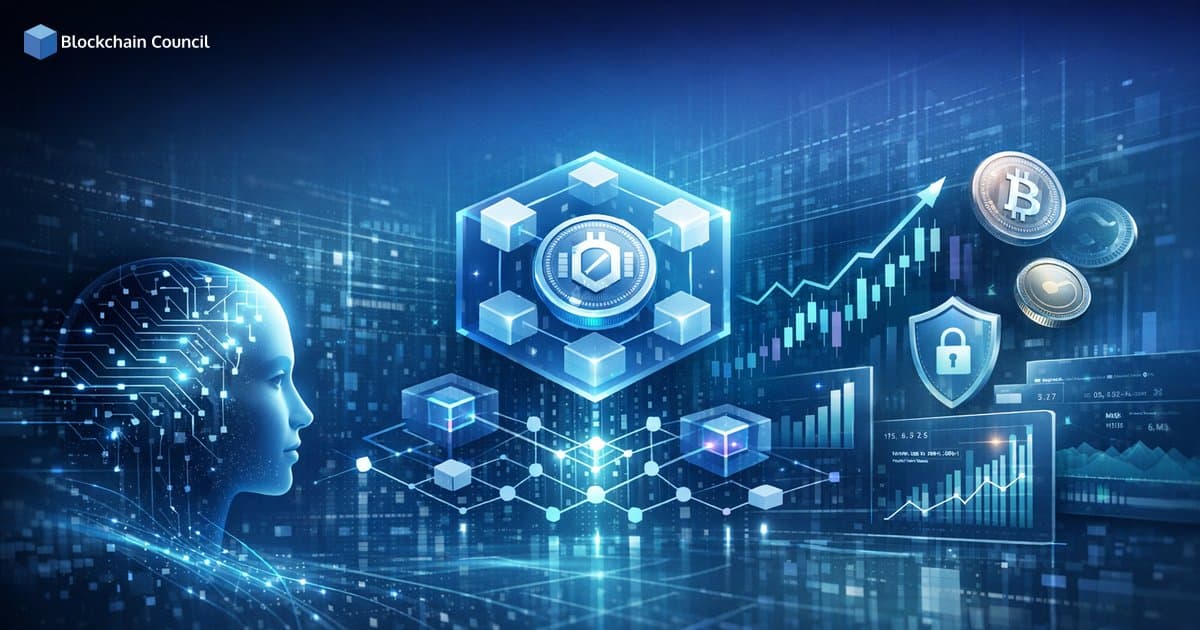
AI in DeFi is moving from experimentation to production-grade infrastructure, reshaping how decentralized finance manages risk, allocates liquidity, executes trades, and detects fraud. By combining on-chain transparency with machine learning, DeFi protocols can shift from reactive mechanisms to more proactive, data-driven decision-making. For DeFi investors and fintech professionals, the upside is clear: better efficiency and smarter risk controls. The downside is equally real - new failure modes ranging from model errors to over-automation and oracle dependencies.
This guide covers the current state of decentralized finance AI, the most practical use cases, the most significant crypto risk considerations, and the DeFi trends most likely to define 2025 and beyond.

What is AI in DeFi?
AI in DeFi refers to integrating artificial intelligence techniques - such as machine learning, anomaly detection, and autonomous agents - into decentralized finance applications. The goal is to improve how protocols and users handle:
Predictive analytics for volatility, liquidation risk, and market microstructure
Automation for rebalancing, routing, and yield strategy execution
Risk management for collateral parameters, interest rates, and stress testing
Security for exploit detection, phishing prevention, and suspicious wallet profiling
DeFi already runs on deterministic smart contracts. AI adds probabilistic decision layers that can interpret noisy real-time data, adapt to changing conditions, and reduce the operational burden on human governance.
Current State of AI in DeFi (2025): From Tools to Core Infrastructure
As of 2025, AI has increasingly become part of the operational backbone for major DeFi categories, including lending, DEX liquidity, and risk infrastructure. The shift is visible in how protocols and risk providers use simulation and automated parameter tuning to keep systems resilient during volatile markets.
Risk Infrastructure and Stress Testing for Lending Protocols
Risk providers such as Gauntlet and Chaos Labs use simulation-driven approaches to stress-test protocol parameters and portfolios under adverse market conditions. In practice, these systems analyze historical on-chain behavior and run scenario simulations to inform safer collateral ratios, borrowing limits, and interest rate curves. For lending markets, this matters because parameter misconfiguration can cascade into bad debt or excessive liquidations.
Low-Latency Oracles Supporting AI-Dependent Decisions
AI-enhanced strategies often require rapid, reliable price and market signals. Oracle improvements, including low-latency data streams, help reduce execution errors such as false liquidations during rapid price moves and allow more responsive adjustments to yield or hedging strategies.
Autonomous Agents for Execution and Portfolio Automation
Autonomous AI agents are increasingly used to execute actions like rebalancing, arbitrage, and yield farming. Agent frameworks, including those associated with Olas (Autonolas), support community-aligned automation where agents can be co-owned or coordinated. Benchmarking reports in the sector suggest agent capabilities have improved roughly fourfold year-over-year, enabling more advanced portfolio management and real-time risk analysis.
DeFi Traction Signals: TVL Growth in Agent-Driven Vaults
One notable market signal is the early traction of AI-agent yield products. Theoriq Labs' Alpha Vault reported reaching around $25 million in Total Value Locked shortly after launch, reflecting demand for automated strategies when they are packaged with clear rules and risk controls.
Key Opportunities: Where Decentralized Finance AI Creates Measurable Value
AI's biggest advantage in DeFi is speed and adaptiveness. DeFi markets operate 24/7 across chains, with rapid shifts in liquidity, gas costs, and volatility. AI can ingest large volumes of on-chain and market data and act faster than manual governance cycles allow.
1) Smarter Risk Management in Lending and Leveraged Positions
Lending protocols face continuous crypto risk from price drops, correlated collateral, oracle glitches, and liquidation cascades. AI models can help by:
Predicting liquidation probability using historical position behavior and volatility regimes
Optimizing collateral parameters such as loan-to-value limits and liquidation thresholds
Adjusting interest rates more dynamically based on utilization and risk signals
Monitoring protocol health with automated alerts for concentration risk and bad debt trajectories
For fintech professionals, the practical implication is that risk controls can become continuous rather than episodic, which may reduce governance lag during market shocks.
2) Better Trade Execution and Intent-Based Routing
Trading in DeFi is not just about price. It also involves route selection across pools, slippage management, MEV exposure, and gas efficiency. AI-assisted execution can:
Split trades across venues to reduce slippage
Predict arbitrage windows and react quickly to price dislocations
Incorporate gas fees into routing decisions in real time
Support intent-based trading where solvers optimize execution, as seen in designs like CoW Protocol's solver model with MEV-aware execution goals
This represents one of the clearest DeFi trends currently underway: users increasingly prefer outcome-based execution rather than manually specifying every transaction path.
3) Liquidity Optimization and Automated Rebalancing
DEX liquidity providers and vault managers must respond to changing fee opportunities, impermanent loss dynamics, and volatility. AI-enhanced liquidity management can:
Allocate liquidity across pools based on predicted fee income versus risk
Rebalance positions as market conditions shift, reducing manual oversight
Detect regime changes such as volatility spikes where a defensive stance is preferable
DeFAI-style platforms focus heavily on these capabilities, using on-chain data to drive allocation and rebalancing decisions.
4) Security and Fraud Detection at On-Chain Scale
DeFi's open access is both a feature and a liability. Attack patterns evolve quickly, and the cost of failure can be immediate. AI-based security analytics can strengthen defenses by:
Anomaly detection for exploit-like transaction patterns
Phishing and scam heuristics based on wallet behavior and interaction graphs
Rug pull and laundering signals through wallet profiling and fund flow analysis
While AI cannot replace audits and formal verification, it can provide continuous monitoring that is difficult to achieve through purely manual approaches.
Key Risks: New Failure Modes Introduced by AI in DeFi
AI can reduce some risks while creating others. For DeFi investors, the critical question is not whether AI is used, but whether the system is designed with guardrails, transparency, and robust fallback modes.
1) Model Risk and Wrong-Way Automation
AI systems can fail due to poor training data, shifting market regimes, or incorrectly specified objectives. In DeFi, a small logic error can trigger automated actions at scale. If a model systematically underestimates tail risk, it can push a protocol or vault into aggressive leverage precisely when markets are most fragile.
2) Oracle and Data Dependency Risk
AI-driven decision loops often rely on fast, accurate data. If oracle feeds degrade, become delayed, or are manipulated, AI agents may act on incorrect assumptions. This can produce:
False liquidations during temporary price distortions
Mispriced risk parameters that increase bad debt exposure
Execution losses from routing trades based on stale data
Low-latency oracle architectures help, but data dependency risk remains a core design concern.
3) Smart Contract and Agent Permissioning Risk
Autonomous agents require transaction permissions. Poorly scoped permissions can be catastrophic. Even with correct intentions, an agent can be manipulated into harmful actions through adversarial market conditions or unusual state transitions. Platform initiatives aimed at agent-based financial automation increase functionality, but they also increase the potential damage if implementations are insufficiently guarded.
4) Transparency and Governance Challenges
Many AI models are not naturally interpretable. If token holders or risk committees cannot understand why a model changed parameters, governance may either over-trust automation or disable it entirely. Strong governance patterns include:
Explicit constraints on parameter change magnitude and frequency
Human-in-the-loop approvals for high-impact actions
Public dashboards showing signals, actions, and outcomes
Practical Due Diligence Checklist for Investors and Fintech Teams
When evaluating an AI-enabled DeFi protocol, vault, or agent strategy, focus on engineering and risk controls rather than marketing claims.
Data integrity: What data sources drive decisions, and how are oracle failures handled?
Guardrails: Are there hard limits on leverage, allocation changes, and trading frequency?
Permissions: What can the agent sign, and can permissions be revoked quickly?
Stress testing: Are scenario analyses and adverse-condition simulations documented?
Auditability: Are smart contracts audited, and are agent behaviors observable on-chain?
Fallback modes: Is there a safe mode if AI signals fail or markets become illiquid?
Future Outlook: DeFi Trends Shaped by AI
Looking ahead, AI in DeFi is expected to expand from optimization toward full-cycle autonomy, while simultaneously pushing the ecosystem toward more resilient design.
Autonomous negotiation and execution: Agents that can negotiate multi-step transactions and optimize across venues and chains.
Multi-network liquidity management: Strategies that treat liquidity as a cross-chain portfolio rather than a collection of isolated pools.
Natural language interfaces: Simplified user experiences that translate intent into safe, optimized transaction bundles.
Self-auditing and continuous monitoring: Automated detection of anomalous contract behavior and emerging exploit patterns.
Adaptive compliance tooling: Risk-based controls that can adjust to policy requirements without centralizing custody.
A broader industry theme is DeFi's gradual shift from speculation-heavy usage toward a more durable financial system, where AI helps manage risk and improve capital efficiency.
Skills and Learning Pathways for Professionals
For fintech professionals and builders, AI-DeFi convergence requires competence across smart contracts, risk modeling, and security operations. Relevant learning paths available on Blockchain Council include:
Certified Blockchain Expert for protocol fundamentals and on-chain architecture
DeFi-focused certifications covering lending, AMMs, liquidity, and risk concepts
AI and Machine Learning certifications for modeling, evaluation, and deployment considerations
Certified Smart Contract Developer to understand permissioning, audits, and secure automation
Cybersecurity certifications for threat modeling, monitoring, and incident response in Web3
Conclusion
AI in DeFi is rapidly becoming a foundational layer for smarter risk management, execution quality, liquidity optimization, and security monitoring. For investors, it can mean more adaptive strategies and improved resilience. For fintech teams, it enables continuous parameter tuning and scalable operations. However, AI also introduces distinct risks: model failure, oracle dependence, permissioning mistakes, and governance opacity.
The most credible AI-enabled DeFi systems will be those that combine automation with disciplined constraints, transparent monitoring, robust oracle design, and conservative fallback modes. In a market where errors can cost millions in minutes, the winning approach is not maximum autonomy - it is verifiable, well-governed autonomy.
Related Articles
View All
Blockchain
Top Decentralized Autonomous Organization (DAO) Projects to watch
The blockchain platform introduced the tool "decentralized autonomous organizations (DAOs)" with the objective to support the decentralized business ecosystem. They play an important part in decentralized finance. They could play a more significant role as DAO infrastructure becomes more proficient, and once-overlooked stakeholders in finance follow up on bigger governance requirements. A DAO is a blockchain technology-fueled association that depends on smart contracts to support itself. Despite the fact that there might be some degree of human intercession, the objective of a DAO is to be really decentralized in its activities. DAOs are new, yet they can possibly affect the DeFi space as well as organizations in a wide range of different fields and enterprises.

Blockchain
How to Build an AI Blockchain App: Step-by-Step Guide for Developers
Learn how to build AI blockchain app projects with smart contracts, off-chain AI inference, secure oracles, testing, and deployment best practices for Web3.

Blockchain
AI Blockchain Trends: Future of Blockchain and AI Convergence to 2030
Explore AI blockchain trends shaping decentralized AI marketplaces, tokenized compute, and AI-enhanced DeFi, plus enterprise predictions through 2030.
Trending Articles
The Role of Blockchain in Ethical AI Development
How blockchain technology is being used to promote transparency and accountability in artificial intelligence systems.
AWS Career Roadmap
A step-by-step guide to building a successful career in Amazon Web Services cloud computing.
Top 5 DeFi Platforms
Explore the leading decentralized finance platforms and what makes each one unique in the evolving DeFi landscape.