

AI Blockchain Benefits for Enterprises: Security, Automation, and ROI
 Suyash Raizada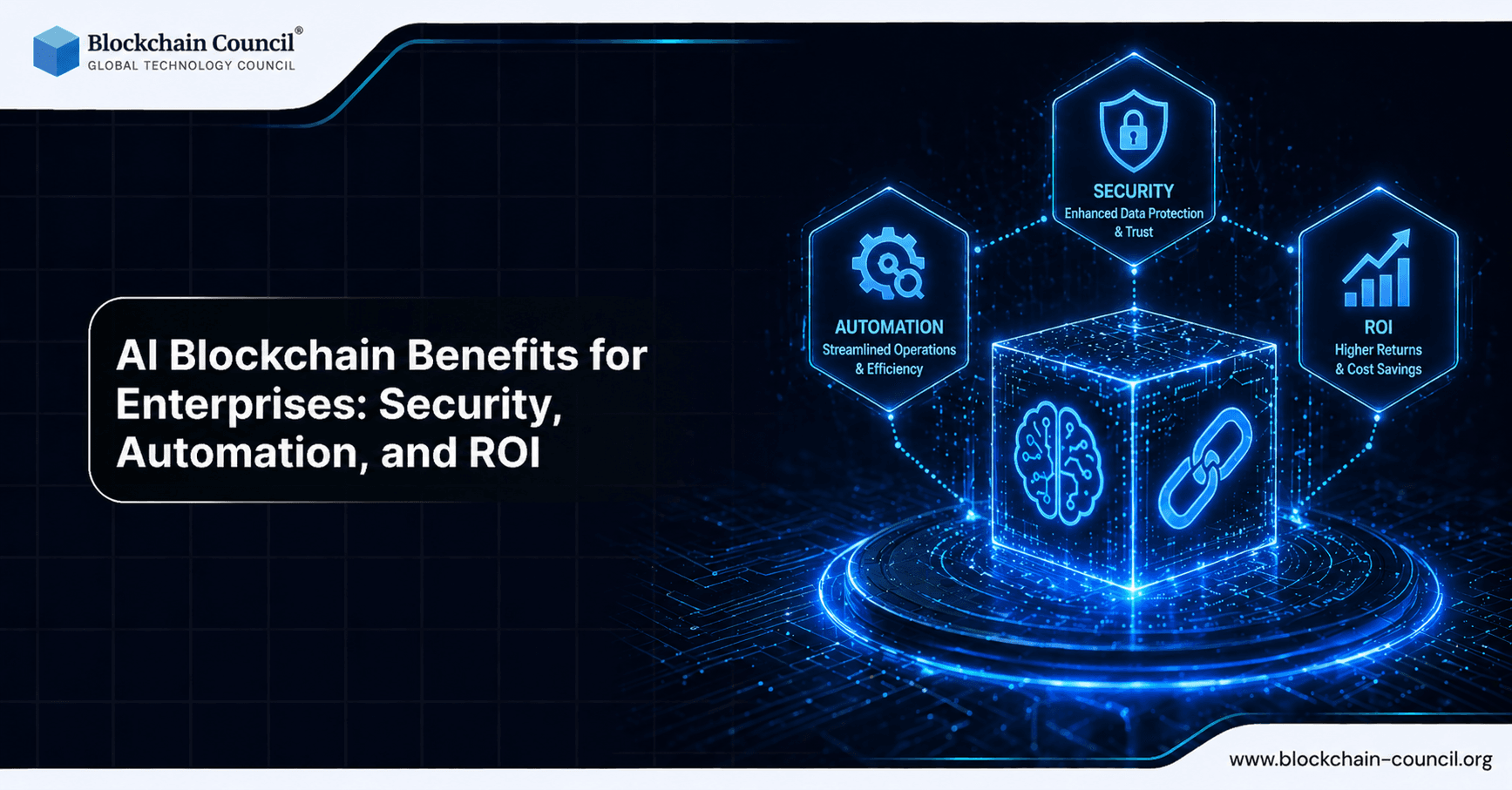
AI blockchain benefits are becoming a practical advantage for enterprises that need stronger data security, faster operations, and clearer accountability. AI systems excel at pattern detection and automation, while blockchain provides immutable records, shared truth across parties, and tamper-resistant audit trails. Combined, they help enterprises reduce fraud, accelerate workflows, and make AI-driven decisions more trustworthy in regulated and high-risk environments.
From finance to healthcare to global supply chains, the convergence of enterprise blockchain AI addresses problems that either technology struggles to solve alone. AI can help scale blockchain networks and improve smart contract intelligence, while blockchain improves AI reliability by preserving data lineage, preventing tampering, and supporting governance requirements for transparent decision-making.

To unlock enterprise value from AI and blockchain, build expertise with a Blockchain Course, secure systems using Cyber security certifications, and understand ROI through a Digital marketing course
Why Enterprises Are Combining AI and Blockchain
Enterprises face growing pressure to deliver automation and efficiency without compromising security or compliance. This is where AI and blockchain complement each other:
AI strengthens blockchain by predicting network load, detecting anomalies, and improving smart contract development and monitoring.
Blockchain strengthens AI by providing immutable logs of data inputs, model actions, and decision outputs, which supports auditability and governance.
Blockchain functions as a control layer for AI systems, protecting intellectual property and reducing cyber risk through verifiable attribution and traceability. It can also log AI behavior to prevent undefined actions and improve oversight, which is essential in regulated sectors.
Core AI Blockchain Benefits for Enterprises
While many organizations start with a single pain point such as fraud reduction or auditability, the strongest results come from combining benefits across security, transparency, scalability, and business automation.
1. Enhanced Security and Fraud Reduction
Security is often the first measurable outcome of AI blockchain benefits. Blockchain reduces tampering risk through immutable records and cryptographic integrity. AI adds real-time monitoring that detects suspicious activity faster than manual review.
AI contribution: anomaly detection, behavioral profiling of wallets or accounts, vulnerability scanning, and alerting.
Blockchain contribution: immutable transaction history, shared truth across stakeholders, and auditable trails.
Enterprise impact: reduced fraud exposure, faster incident response, and fewer losses from exploits.
In blockchain-based applications, AI-driven monitoring can flag abnormal transaction patterns, compromised accounts, or unexpected smart contract behavior. AI-assisted monitoring and audit acceleration help prevent vulnerabilities that would otherwise lead to costly exploits.
2. Transparency and Auditability for Regulated Decisions
Enterprises increasingly need to explain automated decisions, whether those decisions relate to credit risk, claims processing, supplier qualification, or access control. Blockchain enables an auditable chain of custody for data and actions, while AI can interpret large volumes of logged data and convert it into actionable insights.
Auditable AI: log which data was used, who approved changes, and when outputs were produced.
Governance readiness: create verifiable records for compliance teams and external audits.
Trust building: support consistent decision-making and reduce disputes between parties.
This combination is particularly valuable in finance and healthcare, where a reliable audit trail and clear accountability are regulatory requirements, not optional features.
3. Scalability Improvements and Smarter Network Operations
Many blockchain systems face tradeoffs between scalability, security, and decentralization. AI helps by predicting demand patterns and optimizing resource allocation, reducing congestion and improving throughput for high-volume applications.
AI contribution: predictive network load management, dynamic resource optimization, and proactive congestion control.
Blockchain contribution: resilient decentralized architecture and consistent transaction integrity.
Enterprise impact: faster operations, reduced downtime, and better service reliability during peak demand.
For enterprises running supply chain networks, tokenized assets, or high-transaction applications, these gains directly support higher service reliability and better cost control.
4. Business Automation with Smarter Smart Contracts
Smart contracts automate rules and execution, but traditional smart contracts can be rigid and error-prone without careful design and testing. AI can assist by drafting contract logic from historical patterns, validating edge cases, and improving lifecycle management.
AI contribution: contract generation assistance, test case generation, risk scoring, and continuous monitoring.
Blockchain contribution: deterministic execution, shared enforcement, and transparent verification.
Enterprise impact: lower operational overhead, fewer manual reconciliations, and faster cycle times.
AI-driven automation layered on blockchain-backed processes can deliver 30 to 50% efficiency improvements in audited workflows by reducing paperwork, minimizing errors, and removing unnecessary intermediaries. Actual ROI varies by use case and process maturity.
5. Improved ROI Through Fewer Losses and Better Efficiency
ROI is often the deciding factor for enterprise adoption. The business case commonly comes from two sources:
Cost reduction: automation reduces manual work, reconciliation effort, and downtime.
Loss avoidance: fraud prevention, exploit mitigation, and improved security posture reduce costly incidents.
Enterprises also see revenue upside when launching new digital products with higher trust, better auditability, and stronger data governance. This is especially relevant for tokenized assets, digital identity systems, and data-sharing partnerships.
Real-World Enterprise Use Cases
The following scenarios illustrate where enterprise blockchain AI delivers clear, measurable value.
AI-Assisted Security Auditing and Smart Contract Monitoring
AI can monitor transactions and smart contract activity to detect anomalies and potential exploits in real time. This complements formal audits by adding continuous detection and response capabilities, reducing the window between vulnerability emergence and mitigation.
Finance Fraud Detection and AML Pattern Recognition
In financial environments, AI agents can profile wallet behavior and transaction flows to flag suspicious activity such as account takeovers or money laundering patterns. Blockchain provides the full transaction history, while AI identifies patterns that would be difficult to detect manually at scale.
Healthcare Data Privacy with Compliant Analytics
Healthcare organizations can store sensitive patient data references and consent states using blockchain-based records, improving integrity and access control. AI can analyze authorized datasets while maintaining a verifiable audit trail, strengthening regulatory compliance and patient trust.
Generative AI and IP Protection
Enterprises building generative AI assistants and chatbots face IP risks related to training data provenance and content attribution. Blockchain provides verifiable ownership records and traceability for training data and outputs, supporting better governance and reducing disputes over content rights.
Supply Chain Traceability and Automated Fulfillment
Blockchain provides a shared record of sourcing, shipping, and quality events across parties. AI improves the reliability of external data feeds and oracles, detects anomalies in shipment patterns, and triggers smart-contract-based workflows for automated approvals and settlements.
Implementation Roadmap for Enterprise Decision-Makers
To capture AI blockchain benefits without overcomplicating delivery, enterprises typically succeed with a phased approach:
Pick one high-impact workflow: fraud monitoring, supplier onboarding, reconciliation, or audit logging.
Define governance requirements early: data access, consent, model monitoring, and audit needs.
Decide what goes on-chain: store hashes, proofs, permissions, and audit events on-chain while keeping sensitive bulk data off-chain with secure controls.
Deploy AI for continuous monitoring: anomaly detection, model drift detection, and predictive alerts.
Measure ROI: track cycle time reductions, incident reduction rates, and manual hours saved.
Challenges to Plan For
Enterprises should address these common obstacles proactively:
Integration complexity: connecting legacy systems, identity infrastructure, and data pipelines to blockchain and AI services.
Data privacy: ensuring sensitive information is handled correctly, especially in regulated sectors.
Model governance: monitoring AI performance, bias, and decision explainability over time.
Operational ownership: defining who manages smart contract upgrades, cryptographic keys, and incident response.
Skills and Certification Pathways for Enterprise Teams
Successful adoption requires cross-functional capability across IT, security, compliance, and product teams. Building internal expertise through structured certification programs is a practical step toward sustainable delivery. Relevant programs include the Certified Blockchain Expert, Certified Smart Contract Developer, Certified AI Expert, and Certified Web3 Professional certifications, depending on your team structure and goals.
Future Outlook: Toward Autonomous, Governed Enterprise Systems
The AI and blockchain combination is expected to expand significantly through 2030, driven by regulatory pressure for AI accountability and enterprise demand for secure automation. Near-term advances include AI-assisted smart contract development, proactive blockchain network optimization, and standardized audit trails for AI systems. As enterprises mature these capabilities, they can move toward more autonomous operations with governance built directly into the technology stack.
Enterprises need professionals who understand both tech and business-learn AI with an AI Course, apply models via a machine learning course, and scale impact with a Digital marketing course.
Conclusion
AI blockchain benefits are demonstrably practical for enterprises. They map directly to security, transparency, scalability, business automation, and stronger ROI through reduced fraud, fewer operational bottlenecks, and improved trust in automated decisions. The strongest enterprise outcomes come from designing the solution as a unified system: blockchain for integrity and auditability, AI for intelligence and automation. For decision-makers, the immediate next step is to identify a high-value workflow, define governance requirements, and pilot a measurable implementation that can scale across the organization.
FAQs
1. What are the benefits of AI blockchain for enterprises?
AI blockchain combines intelligent automation with secure data management. It improves efficiency, transparency, and decision-making. Enterprises use it to streamline operations and reduce risks.
2. How does AI blockchain improve enterprise security?
Blockchain ensures data integrity and prevents tampering, while AI detects threats and anomalies. This layered approach strengthens cybersecurity. It helps protect sensitive enterprise data.
3. How does AI enable automation in blockchain systems?
AI automates decision-making, data processing, and workflow execution. When integrated with blockchain, it can trigger smart contracts automatically. This reduces manual effort and errors.
4. What is the ROI of AI blockchain for businesses?
AI blockchain can reduce operational costs, improve efficiency, and minimize fraud. These benefits contribute to higher returns over time. ROI depends on implementation quality and use cases.
5. How does AI blockchain reduce operational costs?
Automation reduces the need for manual processes and intermediaries. Blockchain minimizes reconciliation and verification costs. AI optimizes resource allocation and workflows.
6. What industries benefit from AI blockchain adoption?
Industries such as finance, healthcare, supply chain, and manufacturing benefit the most. These sectors rely on secure data and efficient processes. AI blockchain enhances both.
7. How does blockchain enhance data transparency for enterprises?
Blockchain provides a decentralized and immutable ledger. All transactions are recorded and verifiable. This increases trust and accountability across systems.
8. How does AI improve decision-making in enterprises?
AI analyzes large datasets to identify patterns and insights. It supports predictive analytics and real-time decision-making. This helps businesses act faster and more accurately.
9. Can AI blockchain improve compliance and auditing?
Yes, blockchain provides transparent and traceable records for audits. AI can monitor compliance and detect irregularities. This simplifies regulatory reporting and reduces risks.
10. What role do smart contracts play in enterprise automation?
Smart contracts automate agreements and execute actions based on predefined rules. AI can enhance these contracts with dynamic decision-making. This improves efficiency and reliability.
11. How does AI blockchain support supply chain management?
AI analyzes supply chain data for optimization, while blockchain ensures traceability. This improves visibility and reduces fraud. Enterprises gain better control over operations.
12. What are the security challenges of AI blockchain?
Challenges include integration complexity, potential vulnerabilities in smart contracts, and data privacy concerns. AI models can also be exploited if not properly secured. Continuous monitoring is required.
13. How does AI blockchain improve fraud detection?
AI detects unusual patterns and suspicious activities in real time. Blockchain ensures transaction transparency and traceability. Together, they reduce fraud risks significantly.
14. Is AI blockchain scalable for large enterprises?
Scalability depends on architecture and platform choice. Solutions like layer-2 scaling and cloud integration help improve performance. Proper design enables enterprise-level scalability.
15. How can enterprises implement AI blockchain solutions?
Start by identifying use cases and selecting appropriate platforms. Develop AI models, integrate blockchain, and test thoroughly. Deployment should include monitoring and security measures.
16. What tools are used in AI blockchain development?
Common tools include TensorFlow or PyTorch for AI, and Ethereum or Hyperledger for blockchain. APIs and cloud services support integration. Tool selection depends on project requirements.
17. How does AI blockchain improve customer experience?
AI provides personalized services and faster responses, while blockchain ensures secure transactions. This builds trust and improves user satisfaction. Enterprises can deliver better services.
18. What are the risks of adopting AI blockchain in enterprises?
Risks include high implementation costs, technical complexity, and evolving regulations. Poor integration can lead to inefficiencies. Careful planning is essential to mitigate these risks.
19. How does AI blockchain support real-time analytics?
AI processes data in real time, while blockchain ensures data accuracy and integrity. This enables reliable analytics and faster insights. Enterprises can make timely decisions.
20. What is the future of AI blockchain in enterprises?
AI blockchain is expected to drive automation, security, and innovation across industries. It will enable smarter and more efficient business processes. Adoption is likely to grow as technology matures.
Related Articles
View All
Blockchain
Blockchain in Banks: Use Cases, Benefits, Risks, and the AI Connection
Explore how blockchain in banks is reshaping payments, trade finance, tokenized deposits, KYC, AML, and AI-driven risk workflows.

Blockchain
Blockchain vs Smart Contracts: Key Differences, Benefits, and Real-World Applications
Blockchain vs smart contracts explained: learn how distributed ledgers and self-executing code differ, work together, and power DeFi, NFTs, DAOs, and enterprise workflows.

Blockchain
Blockchain Train Technology: Rail Use Cases, Benefits, and Limits
Blockchain train technology is moving from pilots to practical rail use cases in freight, ticketing, asset records, IoT security, and audit trails.
Trending Articles
The Role of Blockchain in Ethical AI Development
How blockchain technology is being used to promote transparency and accountability in artificial intelligence systems.
How Blockchain Secures AI Data
Understand how blockchain technology is being applied to protect the integrity and security of AI training data.
What is AWS? A Beginner's Guide to Cloud Computing
Everything you need to know about Amazon Web Services, cloud computing fundamentals, and career opportunities.