

Blockchain Scalability AI: How AI Improves Throughput, Fees, and Network Efficiency
 Suyash Raizada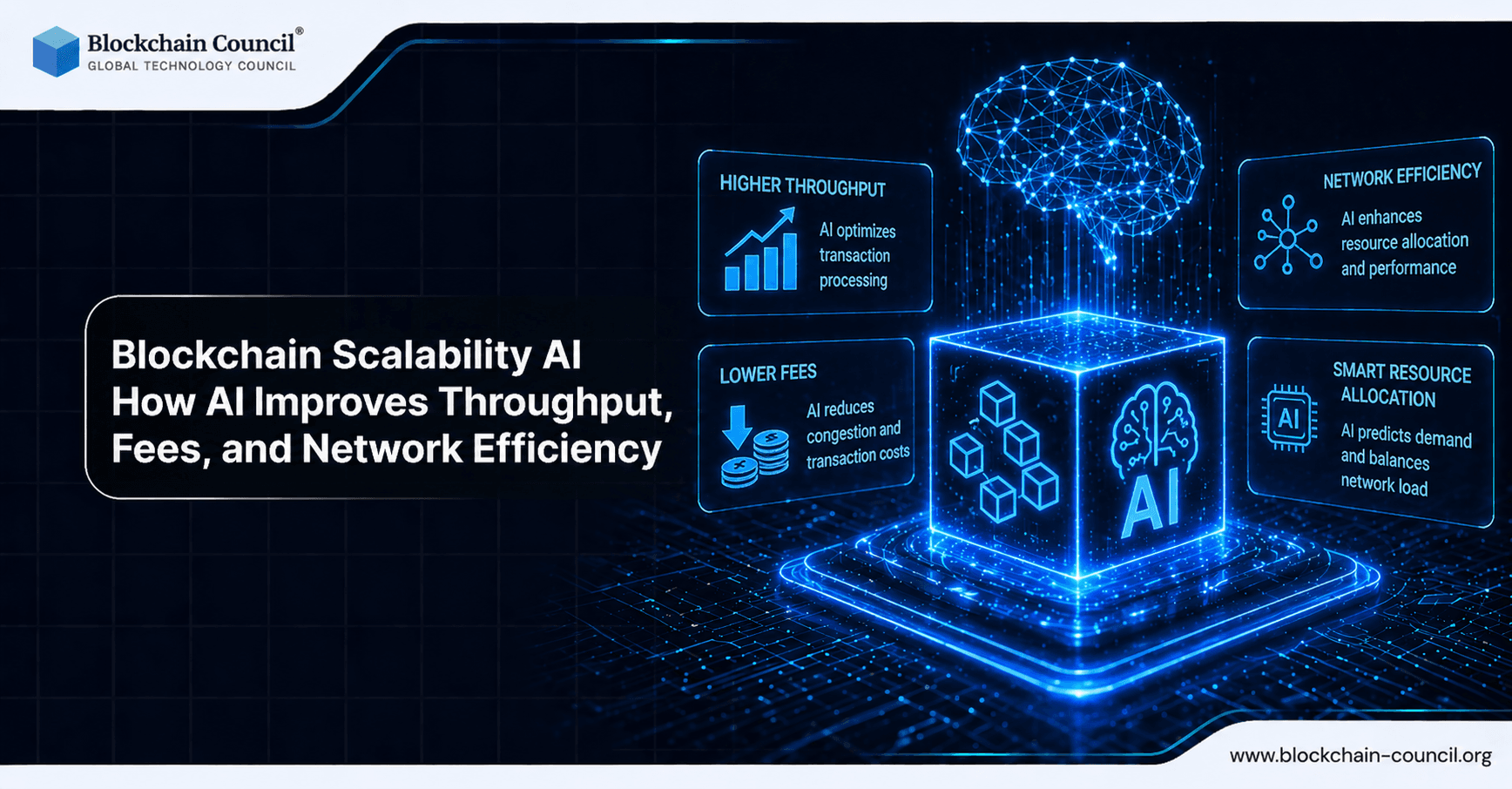
Blockchain scalability AI is becoming a practical strategy for enterprises that need higher throughput, lower fees, and predictable performance from distributed networks. Public blockchains still struggle with limited transactions per second (TPS) and congestion - Bitcoin processes about 7 TPS and Ethereum about 15-30 TPS, far below centralized payment rails like Visa at more than 24,000 TPS. AI adds an adaptive layer that can forecast demand, tune network parameters, and allocate resources in real time, improving both scalability and reliability without abandoning core decentralization goals.
Scaling blockchain with AI requires deep technical understanding-gain it through a Blockchain Course, enhance models with a machine learning course, and explore adoption through a Digital marketing course.

Why Blockchain Scalability Remains a Bottleneck
Enterprise teams typically hit scalability limits when moving from pilots to production. As transaction volume grows, many networks face slower confirmations, higher fees, and unpredictable user experience. This is closely tied to the scalability trilemma: increasing throughput can pressure decentralization or security if not handled carefully.
In practice, the bottleneck appears in multiple ways:
Low TPS ceilings on many Layer-1 networks, especially under peak demand.
Fee volatility during events like NFT launches or market spikes.
Congestion and mempool buildup that increases confirmation times.
Operational complexity when integrating Layer-2 systems and cross-chain workflows.
Modern scaling solutions help, but they are not universally self-managing. This is where AI efficiency blockchain capabilities can complement existing architecture.
Current Scaling Solutions and Where AI Fits
Most production systems use a combination of Layer-1 improvements and Layer-2 scaling solutions.
Layer-1 Approaches
Proof-of-Stake (PoS): adopted by Ethereum to improve energy efficiency and support faster validation than Proof-of-Work designs.
Delegated Proof-of-Stake (DPoS): used by networks like EOS to reduce the number of consensus participants for speed improvements.
Alternative consensus designs: some networks use approaches that deliver higher throughput, such as hashgraph-style consensus with reported throughput around 2,500 TPS on the Hedera network.
Layer-2 Scaling Solutions
zk-Rollups: batch transactions off-chain and submit succinct proofs to the base chain.
Payment channels like Lightning Network: keep frequent transactions off-chain and settle periodically.
AI is increasingly viewed as an intelligent control layer across these options. Rather than replacing consensus or Layer-2 mechanisms, AI can optimize how and when they are used, based on predicted network conditions and application priorities.
How Blockchain Scalability AI Improves Throughput and Efficiency
AI introduces predictive and adaptive capabilities that are difficult to achieve with static parameters. The most significant improvements typically fall into five categories.
1) Optimizing Consensus Behavior
Consensus overhead can grow as networks scale. AI can analyze real-time network activity and tune operational parameters - such as validator participation patterns, scheduling, or resource provisioning. In PoS-style systems, AI can help automate decisions that reduce wasted computation and improve energy use. The objective is not to weaken security, but to reduce avoidable inefficiencies that accumulate at scale.
2) Predicting Congestion Before It Happens
Congestion is often predictable because it correlates with historical patterns, market volatility, application launches, and time-based user behavior. AI models can forecast traffic spikes and recommend or automate mitigations - such as routing more activity to Layer-2, rebalancing sequencer capacity, or adjusting execution priorities for specific workloads.
For enterprise architects, this shifts scalability management from reactive firefighting into proactive capacity planning.
3) Smart Resource Allocation Across Nodes and Infrastructure
Not all nodes are equally provisioned. Some validators or RPC providers have more bandwidth, compute, or geographical proximity to major user clusters. AI can dynamically assign workloads to higher-capacity resources while protecting weaker nodes from overload, improving end-user performance while supporting overall network health.
4) Intelligent On-Chain vs Off-Chain Decisioning
Layer-2 systems improve performance, but enterprises still need policy controls: which transactions must remain on-chain for auditability, and which can be offloaded for speed? AI can recommend or automate these choices based on transaction type, risk profile, settlement requirements, and current network conditions, turning scaling solutions into a more flexible performance toolkit.
5) Self-Healing and Resilience Automation
For business-critical workflows, failure handling is as important as TPS. AI can monitor transaction flows and detect anomalies such as repeated failures, stalled confirmations, or faulty routing. Automated rerouting and retry logic improves resilience and reduces manual operational burden.
Performance Benchmarks: Why AI-Driven Optimization Matters
Scaling discussions often focus on TPS because it is easy to compare. Typical reference points include:
Bitcoin: about 7 TPS
Ethereum: about 15-30 TPS
Hedera: about 2,500 TPS
Visa benchmark: more than 24,000 TPS
Enterprise performance requirements, however, also include fee stability, latency, finality characteristics, and operational reliability. AI helps by optimizing for the full performance envelope, not only raw TPS.
Real-World Use Cases Where AI Efficiency Blockchain Delivers Value
AI-driven scaling is already relevant across multiple enterprise and Web3 domains.
DeFi Platforms and On-Chain Markets
During high volatility, traffic surges can overload trading, borrowing, and liquidation flows. AI can balance liquidity pool operations and route transactions to reduce peak-time congestion, improving throughput and user experience.
Crypto Exchanges and Hybrid Matching
Exchanges often rely on off-chain order books with on-chain settlement. AI can optimize off-chain matching and decide when to settle on-chain based on fees, risk tolerance, and throughput targets.
Supply Chain and Multi-Party Enterprise Networks
Supply chain blockchains must handle high transaction counts across thousands of suppliers. AI-based traffic prediction and resource allocation can keep transaction processing stable as participants and data volumes grow.
Healthcare Data Synchronization
Patient record updates and permissions require timely propagation and strict auditability. AI can prioritize critical updates, reduce redundant writes, and improve real-time distribution while preserving integrity controls.
IoT at Massive Scale
IoT networks can generate millions of device events. AI-driven load balancing can distribute device transactions across infrastructure and scaling layers, which is increasingly relevant as enterprise IoT deployments expand.
AI-Blockchain Ecosystems
Several projects focus on decentralized AI data and compute, including Ocean Protocol for decentralized data sharing, Bittensor for competing AI model incentives, and Fetch.ai and SingularityNET for agent-based marketplaces. Proponents of decentralized AI have argued that combining these approaches with techniques like sharding can help address scalability constraints while supporting open competition.
Tokenized Assets and Automated Operations
Tokenization growth puts pressure on back-office scalability. Large-scale tokenized asset programs - such as on-chain money market funds managing billions in assets - highlight the need for automated compliance, custody workflows, and scalable settlement. AI can reduce manual bottlenecks by automating monitoring and operational checks.
Enterprise Considerations: Benefits, Risks, and Architecture Choices
For decision-makers, blockchain scalability AI should be evaluated like any distributed systems control plane: by the quality of outcomes, governance model, and failure modes.
Key Benefits
Higher effective throughput through predictive routing and batching.
Lower and more stable fees via congestion-aware execution planning.
Improved reliability using self-healing transaction monitoring.
Better capacity planning with demand forecasting.
Core Challenges and Risks
Computational overhead: AI adds cost, and poorly designed models can negate performance gains.
Data privacy vs transparency: training data and inference signals may conflict with open ledger visibility requirements.
Integration complexity: combining AI controllers with Layer-2 scaling solutions requires careful testing and observability.
Centralization risk: if only a few parties control the AI layer, governance and trust can degrade.
Regulatory trends reinforce the need for auditability. Frameworks such as MiCA and the EU AI Act increase emphasis on traceability, monitoring, and explainable controls for systems that affect financial and operational outcomes.
Implementation Roadmap for Blockchain Architects
To apply AI to scaling without introducing new systemic risk, enterprises can follow a staged approach:
Baseline measurement: instrument throughput, latency, fee distribution, and failure rates across normal and peak periods.
Predictive analytics first: start with congestion forecasting and advisory recommendations before enabling automated actions.
Policy-driven routing: define rules for what must stay on-chain versus what can use Layer-2 or off-chain components.
Closed-loop control with guardrails: allow AI automation only within bounded parameters, with human override and rollback capability.
Governance and audit: log model decisions, inputs, and outputs to support compliance and incident review.
Teams building these capabilities often benefit from upskilling across both domains. Relevant learning paths include Blockchain Council programs such as Certified Blockchain Expert, Certified Ethereum Expert, and AI-focused certifications that cover governance, model lifecycle, and applied deployment patterns.
Future Outlook: Self-Optimizing Networks
Many analysts expect hybrid Layer-1 and Layer-2 architectures to become the dominant model, supported by AI that dynamically adjusts fees, resources, and execution strategies in real time. Market signals support continued investment: Gartner projects blockchain business value reaching $3.1 trillion by 2030, and KPMG has reported that a large majority of financial services executives view generative AI as among the most impactful emerging technologies. As tokenized assets and regulated on-chain finance scale, demand for predictable blockchain performance and automated controls will grow.
The long-term direction points to self-optimizing networks where AI helps coordinate scaling solutions, improves energy efficiency, and supports cross-chain load distribution. AI workloads can also increase compute demand, so well-designed implementations treat AI as a carefully governed control layer rather than an unbounded add-on.
To optimize performance and reduce costs in blockchain systems, learn AI fundamentals with an AI Course, implement solutions via a Python certification, and scale adoption using a Digital marketing course.
Conclusion
Blockchain scalability AI is a practical lever for improving throughput, reducing congestion, and raising operational resilience across enterprise and public blockchain deployments. Rather than relying only on static consensus settings or fixed Layer-2 configurations, AI enables predictive congestion control, smart resource allocation, and policy-based on-chain versus off-chain decisioning. For enterprise decision-makers and blockchain architects, the most effective approach is a staged rollout with strong observability, governance, and guardrails - ensuring AI improves scalability and efficiency without creating new centralization or compliance risks.
FAQs
1. What is blockchain scalability and why does it matter?
Blockchain scalability refers to a network’s ability to handle a growing number of transactions efficiently. It affects speed, transaction fees, and user experience. Poor scalability limits adoption and performance.
2. How can AI improve blockchain scalability?
AI can optimize network operations, predict congestion, and manage resources dynamically. It helps improve throughput and reduce delays. This leads to more efficient blockchain performance.
3. What is throughput in blockchain systems?
Throughput is the number of transactions a blockchain can process per second. Higher throughput means faster processing and better performance. It is a key metric for scalability.
4. How does AI increase transaction throughput?
AI can optimize block creation, transaction ordering, and validation processes. It reduces bottlenecks and improves efficiency. This allows the network to handle more transactions.
5. Can AI help reduce blockchain transaction fees?
Yes, AI can optimize resource allocation and reduce network congestion. Lower congestion leads to lower transaction fees. It can also suggest optimal fee strategies.
6. How does AI improve network efficiency in blockchain?
AI analyzes network data to identify inefficiencies and optimize performance. It can adjust parameters in real time. This improves overall system efficiency and stability.
7. What role does AI play in congestion management?
AI predicts traffic spikes and adjusts network operations accordingly. It can prioritize transactions and allocate resources efficiently. This helps prevent delays and high fees.
8. How does AI optimize gas fees in blockchain?
AI models analyze transaction patterns and suggest optimal gas prices. This helps users avoid overpaying during peak times. It improves cost efficiency for transactions.
9. Can AI enhance consensus mechanisms?
AI can optimize consensus processes by improving validator selection and decision-making. It reduces latency and increases reliability. This enhances overall network performance.
10. What are AI-driven scaling solutions in blockchain?
AI-driven solutions include dynamic sharding, predictive load balancing, and adaptive block sizing. These techniques improve scalability. They help networks handle higher demand efficiently.
11. How does AI support layer-2 scaling solutions?
AI can optimize routing, batching, and settlement processes in layer-2 networks. It improves speed and reduces costs. This enhances the effectiveness of scaling solutions.
12. What are the benefits of using AI for blockchain optimization?
Benefits include higher throughput, lower fees, better resource utilization, and improved user experience. AI enables smarter network management. This supports large-scale adoption.
13. What challenges exist in using AI for blockchain scalability?
Challenges include integration complexity, data quality issues, and computational costs. AI models require continuous tuning. Ensuring security and reliability is also critical.
14. How does AI improve transaction validation?
AI can prioritize and validate transactions more efficiently by analyzing patterns. It reduces processing delays. This helps improve overall network speed.
15. Can AI predict blockchain network demand?
Yes, AI can analyze historical and real-time data to forecast demand. This allows proactive resource allocation. It helps prevent congestion and maintain performance.
16. How does AI contribute to energy efficiency in blockchain?
AI optimizes resource usage and reduces unnecessary computations. This lowers energy consumption. It is especially important for sustainable blockchain systems.
17. What industries benefit from AI-enhanced blockchain scalability?
Industries like finance, gaming, supply chain, and healthcare benefit from improved scalability. These sectors require fast and cost-effective transactions. AI helps meet these demands.
18. How do developers implement AI in blockchain networks?
Developers integrate AI models with blockchain nodes and monitoring systems. They use APIs and data pipelines for real-time analysis. Proper architecture ensures effective integration.
19. What is the future of AI in blockchain scalability?
AI is expected to play a key role in solving scalability challenges. It will enable more adaptive and efficient networks. This will support broader adoption of blockchain technology.
20. How does AI improve user experience in blockchain networks?
AI reduces delays, lowers fees, and ensures smoother transactions. It helps users interact with the network more efficiently. This leads to better overall usability.
Related Articles
View All
Blockchain
Beyond Cryptocurrency: How Blockchain Is Transforming Real-World Industries
Explore how blockchain works beyond cryptocurrency in banking, supply chains, healthcare, tokenisation, CBDCs, and government, plus key challenges and career paths.
Blockchain
Smart Contracts & dApps: How Blockchain Becomes Programmable
Learn how smart contracts and dApps make blockchain programmable, from Ethereum and tokens to DeFi, NFTs, real use cases, benefits, and key risks.

Blockchain
Public, Private & Consortium Blockchains: Which Network Fits the Use Case?
Compare public, private, and consortium blockchains by security, speed, privacy, and control, with real examples and a simple guide to choosing the right network.
Trending Articles
The Role of Blockchain in Ethical AI Development
How blockchain technology is being used to promote transparency and accountability in artificial intelligence systems.
How Blockchain Secures AI Data
Understand how blockchain technology is being applied to protect the integrity and security of AI training data.
What is AWS? A Beginner's Guide to Cloud Computing
Everything you need to know about Amazon Web Services, cloud computing fundamentals, and career opportunities.