
AI Blockchain Future: Why AI + Blockchain Will Define Decentralized Technology

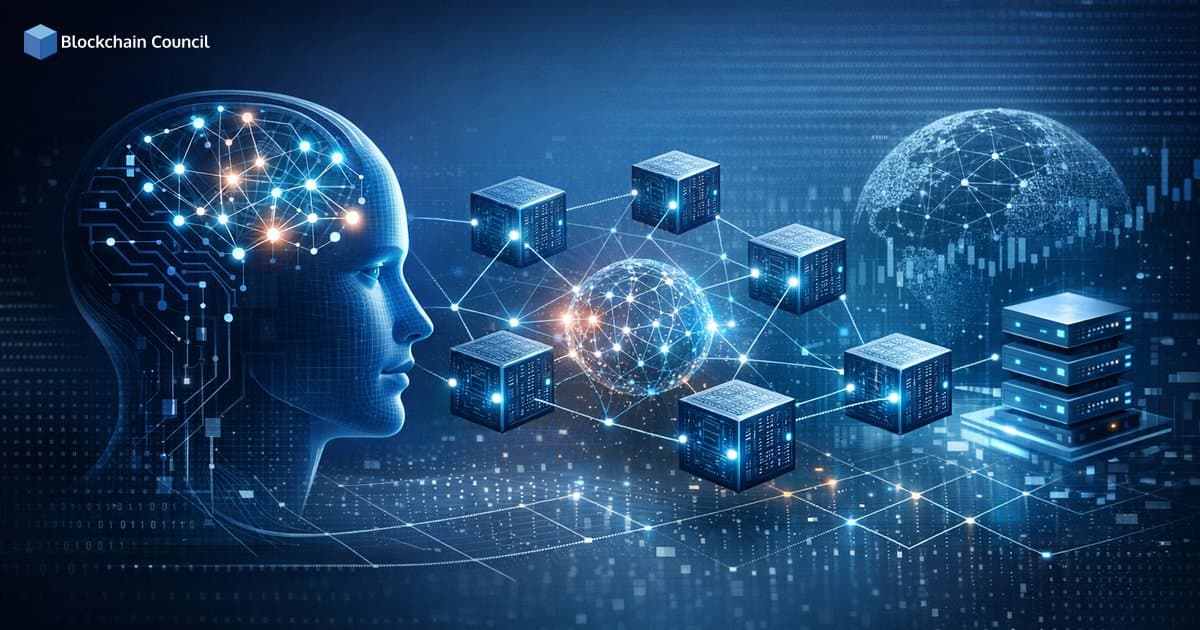
AI blockchain future is becoming a practical strategy for enterprises that need trustworthy automation, auditable decisions, and resilient digital infrastructure. AI delivers prediction and optimization, but it often operates as an opaque system with limited explainability. Blockchain delivers transparency, immutable records, and decentralized verification, but it can be rigid and limited in adapting to complex, changing conditions. Together, they create verifiable intelligence capable of operating in decentralized environments with stronger security and accountability.
For enterprise leaders and technology strategists, this convergence is not simply another trend in emerging technologies. It represents a foundational shift in how data is shared, how models are trained, how digital assets are managed, and how decentralized governance is executed across ecosystems.

Why AI and Blockchain Are Better Together
The core value of combining AI and blockchain comes from how each technology addresses the other's limitations:
AI's opacity vs. blockchain's transparency: AI can make high-impact decisions, but stakeholders often cannot easily audit how outputs were produced. Blockchain can log data provenance, model changes, and inference events to create an immutable audit trail.
Blockchain's rigidity vs. AI's intelligence: Smart contracts and on-chain workflows are deterministic and rules-based. AI adds adaptive decision-making, risk scoring, anomaly detection, and forecasting to make decentralized systems more responsive.
Centralization risk vs. decentralized validation: Many AI deployments rely on centralized data and compute. Decentralized AI architectures distribute ownership, access, and verification, reducing single points of failure.
This is why decentralized AI and blockchain are increasingly viewed as a combined foundation for future digital infrastructure, particularly in finance, cybersecurity, supply chains, and regulated data environments.
Blockchain Trends Shaping the AI-Blockchain Convergence
Several blockchain trends are accelerating enterprise experimentation and adoption of AI-blockchain systems.
1) Decentralized AI Marketplaces for Data and Models
Decentralized AI marketplaces use blockchain to enable the buying, selling, licensing, and sharing of datasets and AI models with clearer provenance and usage rules. For enterprises, the primary strategic benefit is improved trust in training data and simplified governance for data monetization.
Blockchain can record dataset origin, consent status, and permitted usage.
Smart contracts can automate licensing, payments, and revocation conditions.
Enterprises can reduce data supply-chain risk by verifying lineage and integrity.
2) Tokenized AI Infrastructure for Compute and Hosting
Training and running AI models requires significant compute resources. Tokenized AI infrastructure uses tokens to allocate access to GPU compute, storage, model hosting, or decentralized computing resources. This structure can expand capacity options while improving resilience and reducing procurement friction.
For enterprises, the strategic value lies in flexible access models and the ability to diversify compute supply, particularly for burst workloads or multi-region resiliency planning.
3) AI-Powered DeFi and On-Chain Risk Intelligence
Finance is one of the fastest-moving areas for AI-blockchain integration. Gartner projected blockchain business value could reach $3.1 trillion by 2030, and KPMG reported that 77% of financial services executives view generative AI as the most impactful emerging technology. These signals align with rapid growth in AI-enhanced decentralized finance, including:
Predictive risk scoring for lending and collateral health
Market anomaly detection for manipulation or flash-loan patterns
Automated portfolio and treasury strategies with policy-based controls
When AI outputs are tied to transparent on-chain data and governance frameworks, enterprises can better evaluate model performance, reduce operational risk, and build stronger compliance narratives.
4) AI Agents on Blockchain for Monitoring and Automation
AI agents are increasingly deployed to automate tasks such as transaction monitoring, fraud detection, smart contract auditing, and compliance checks. Running these agents with blockchain-based inputs and verifiable logs improves accountability, especially when stakeholders need to demonstrate what happened, when it happened, and why a decision was made.
5) AI-Driven Security and Anomaly Detection
Security is a major driver of the AI blockchain future. AI can analyze transaction graphs, wallet behaviors, and protocol interactions in real time to flag suspicious patterns. Blockchain adds the benefit of immutable evidence trails for investigations, incident response, and post-mortems.
How Blockchain Strengthens AI with Verifiable Data and Auditability
Enterprise AI failures often trace back to data quality issues, unclear provenance, or limited traceability. Blockchain can improve AI governance by making key parts of the AI lifecycle tamper-evident and easier to audit.
Key Governance Benefits
Data provenance: Track where training data came from, who provided it, and how it changed over time.
Model lineage: Record model versions, tuning runs, approvals, and deployment events.
Inference traceability: Log inference requests and results for regulated workflows.
Policy enforcement: Use smart contracts to enforce access controls and usage constraints.
Recent developments also include on-chain AI model training and cross-chain interoperability for AI data, enabling broader reuse and portability of AI assets across ecosystems. For enterprise architecture, this points toward more modular AI supply chains with stronger verification capabilities.
How AI Makes Blockchain More Scalable, Secure, and Usable
Blockchain systems generate large volumes of transparent operational data. AI can transform that data into actionable intelligence and automation.
Practical Enterprise Benefits
Operational monitoring: Detect network anomalies, congestion patterns, and suspicious validator behavior.
Smart contract auditing: Identify common vulnerabilities such as reentrancy patterns and unsafe external calls, and prioritize remediation.
Fraud and AML support: Cluster wallets, detect laundering patterns, and improve alert quality with behavioral analytics.
Improved governance: Provide analytics for DAOs and tokenized ecosystems to support evidence-based decisions.
An emerging direction is AI-driven consensus design such as Proof of Useful Intelligence (PoUI), where computation is structured to produce measurable utility rather than only securing the network. While still evolving, this concept reflects a broader push toward energy-efficient and purpose-driven decentralized systems.
Real-World Use Cases Enterprises Can Evaluate Now
The AI blockchain future becomes clearer when mapped to concrete enterprise use cases across security, finance, and operations.
Fraud Detection and Smart Contract Auditing
AI agents can continuously analyze transaction flows and contract behaviors to detect suspicious activity and vulnerabilities. This supports proactive security programs and reduces exposure time for exploits. Blockchain provides the evidence layer, preserving event history for audits and investigations.
Digital Asset Management and Custody Operations
In digital asset management, AI can monitor real-time risk signals, predict settlement failures, and support eligibility and compliance checks for participants. Because blockchain transactions are transparent and time-stamped, firms can build monitoring systems that are both data-rich and independently verifiable.
Supply Chain Traceability with Real-Time Intelligence
Blockchain improves traceability and integrity of supply chain records. AI adds forecasting, anomaly detection (such as counterfeit signals), and optimization (such as inventory routing). Together, they enable faster root-cause analysis and better operational planning.
Healthcare and Secure Data Sharing
Healthcare requires secure sharing of sensitive data while maintaining trust and regulatory compliance. Blockchain can support consent management and provenance, while AI can generate clinical insights or operational predictions. Enterprise architectures increasingly incorporate privacy-enhancing methods, including approaches aligned with zero-knowledge proofs, to reduce data exposure while enabling verification.
AI-Powered DeFi Enhancements
DeFi protocols are using AI for predictive trading, automated insurance logic, and continuous risk management. For enterprise stakeholders, the broader lesson is that transparent financial rails combined with intelligent automation can reduce reconciliation overhead, improve monitoring, and accelerate product iteration when governance and controls are built in from the start.
Future Outlook: What to Expect by 2030
By 2030, analysts and industry leaders anticipate AI-blockchain fusion will expand across data, compute, governance, and finance, with a strong emphasis on privacy and interoperability.
Global AI marketplaces with reliable access to datasets and models, supported by verifiable provenance and privacy-preserving validation.
Autonomous AI agents executing real-world workflows, increasingly connected to IoT and edge computing for local decision-making.
Energy-efficient networks and improved scalability, including more mature on-chain AI training and cross-chain data portability.
Regulatory alignment that supports compliant tokenized assets, AI governance controls, and automated risk assessment.
Challenges remain, particularly around regulatory clarity, model accountability, and privacy. The direction, however, is consistent: decentralized ecosystems will increasingly require intelligence that is verifiable, not just powerful.
Enterprise Strategy: How to Prepare for the AI Blockchain Future
Enterprise leaders can take practical steps now to position their organizations for this convergence.
Start with auditability requirements: Identify where immutable logs, provenance, and model traceability create clear value in areas such as finance, compliance, cybersecurity, and supply chain.
Design a data and model governance layer: Define what should be on-chain, what should be off-chain, and what must be privacy-preserving.
Evaluate tokenized infrastructure cautiously: Pilot compute markets for non-sensitive workloads and establish clear vendor and risk controls before scaling.
Build security-by-design: Combine AI monitoring with smart contract best practices, formal reviews, and continuous testing.
Upskill teams: Develop internal training paths that cover both AI and blockchain fundamentals. Blockchain Council offers certification programs across blockchain, Web3, and AI disciplines, including Certified Blockchain Expert, Certified Web3 Expert, and AI-focused certifications.
Conclusion
The AI blockchain future is not a distant concept. It is an architectural direction already visible in decentralized AI marketplaces, AI-powered DeFi, tokenized compute, and AI agents that monitor and secure on-chain activity. For enterprises, the strategic case is straightforward: blockchain brings trust, traceability, and decentralized verification, while AI brings adaptive intelligence and automation. Together, they enable decentralized systems that are secure, scalable, and verifiable - precisely what next-generation digital infrastructure demands.
Related Articles
View All
Blockchain
AI Blockchain Trends: Future of Blockchain and AI Convergence to 2030
Explore AI blockchain trends shaping decentralized AI marketplaces, tokenized compute, and AI-enhanced DeFi, plus enterprise predictions through 2030.
Blockchain
Why Blockchain Is Important for the Future of Artificial Intelligence
Introduction Artificial Intelligence (AI) is rapidly transforming industries around the world. From healthcare diagnostics and financial analysis to autonomous vehicles and intelligent virtual assistants, AI systems are becoming an essential part of modern technology. However, as AI becomes more…

Blockchain
How to Build an AI Blockchain App: Step-by-Step Guide for Developers
Learn how to build AI blockchain app projects with smart contracts, off-chain AI inference, secure oracles, testing, and deployment best practices for Web3.
Trending Articles
The Role of Blockchain in Ethical AI Development
How blockchain technology is being used to promote transparency and accountability in artificial intelligence systems.

AWS Career Roadmap
A step-by-step guide to building a successful career in Amazon Web Services cloud computing.
Top 5 DeFi Platforms
Explore the leading decentralized finance platforms and what makes each one unique in the evolving DeFi landscape.