

7 Everyday Problems Blockchain Can Solve

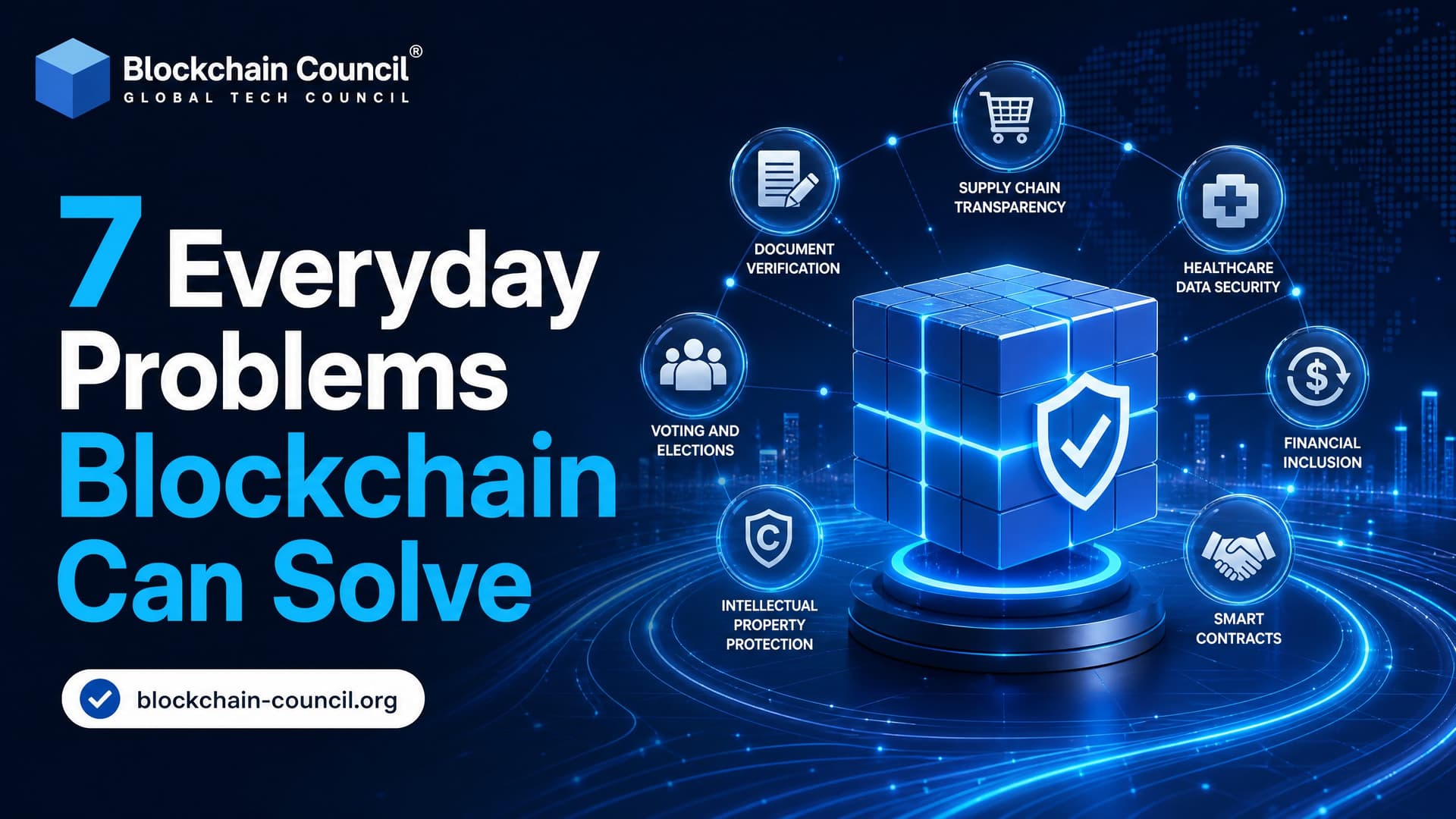
Problems blockchain can solve are not limited to cryptocurrency trading or digital collectibles. In practical settings, blockchain is useful when several parties need to share records, verify facts, transfer value, or prove ownership without relying on one central intermediary. From food safety to digital identity, blockchain can add trust to everyday processes where data is fragmented, slow to verify, or vulnerable to manipulation.
This article explores seven everyday problems blockchain can solve, how the technology works in each case, and where professionals should be cautious. It also highlights areas where structured learning, such as Blockchain Council's Certified Blockchain Expert, Certified Blockchain Developer, and smart contract programs, can help learners evaluate real-world use cases with technical and business clarity.

1. Verifying Product Origin and Authenticity
Consumers often cannot easily confirm where food, medicines, fashion items, or electronics came from. Traditional supply chains are fragmented across manufacturers, distributors, logistics firms, retailers, and regulators. Records may be paper-based, delayed, or held in separate databases.
Blockchain helps by creating a shared, tamper-resistant ledger for supply chain events. Each handoff can be recorded, building an end-to-end audit trail of origin, custody, processing, and delivery. IBM has reported that blockchain-based supply chain systems can improve traceability, transparency, and resilience, particularly in food and pharmaceutical networks.
For example, a retailer can trace a contaminated food batch back to its source more quickly, while a pharmacy can verify whether a drug passed through approved channels. This makes provenance one of the most mature examples of problems blockchain can solve.
2. Making Payments and Remittances Faster
Cross-border payments and remittances remain slow and expensive for many users. Transfers may pass through multiple banks, clearing systems, and foreign exchange providers, which can create high fees, poor exchange rates, and settlement delays.
Blockchain-based payment rails can move tokenized value directly between parties, often with faster settlement and fewer intermediaries. Stablecoins, programmable payments, and smart contracts are increasingly used as practical tools for online commerce, remittances, and business-to-business settlement.
IBM has highlighted blockchain's role in trade finance, clearing, settlement, consumer banking, and lending. Industry analysts also identify cross-border payments and remittances as important blockchain applications. The next stage likely involves closer integration between regulated digital assets, banks, merchants, and compliance systems.
3. Reducing Identity Theft and Repetitive KYC
Digital identity is a daily friction point. People repeatedly submit passports, tax IDs, utility bills, and personal information to banks, exchanges, telecom providers, employers, and public agencies. Centralized databases also create attractive targets for attackers.
Blockchain can support decentralized identity, where users control cryptographically verifiable credentials. Instead of sharing full documents each time, a person could prove selected attributes, such as age, residency, or accreditation, without exposing unnecessary personal data.
Identity management is often cited as one of blockchain's most transformative areas. The concept of reusable digital IDs, where users complete KYC once and present a verifiable credential to multiple businesses, could reduce onboarding friction while improving privacy and control.
4. Improving Medical Record Sharing and Data Security
Healthcare records are often scattered across hospitals, clinics, insurers, laboratories, and pharmacies. Patients may struggle to access their own history, while providers may lack complete information during treatment. At the same time, healthcare data breaches remain a serious risk.
Blockchain can act as a trust layer over existing health systems. Rather than storing sensitive medical files directly on-chain, a blockchain can store access permissions, audit logs, and pointers to off-chain records. This creates a tamper-evident record of who accessed data, when, and under what authorization.
IBM has described blockchain as a way to improve secure health data sharing while keeping access under patient control. Academic research on healthcare blockchain also highlights patient-centric access, privacy management, portability, and tamper-evident records as important benefits.
5. Streamlining Insurance and Public Services
Insurance claims, government benefits, licensing, compliance reporting, and public record management often involve manual paperwork and repeated verification. Different organizations maintain separate systems, which leads to delays, reconciliation costs, and fraud risk.
Blockchain can provide a shared ledger for multi-party workflows. Smart contracts can automate parts of a process when predefined conditions are met. In insurance, this could include parametric claims where payment is triggered by verified data, such as rainfall, flight delay, or shipment damage.
IBM has discussed blockchain use in underwriting, claims settlement, regulatory compliance, contract management, identity management, and citizen services. Industry practitioners also note experimentation in automated claims adjustment, fraud prevention, onboarding, and reporting, while cautioning that blockchain should be used only where it outperforms simpler systems.
6. Proving Ownership of Records, Assets, and Credentials
Many everyday records are difficult to verify. Academic degrees, professional certificates, event tickets, land records, licenses, memberships, and digital assets can be forged, duplicated, lost, or altered. Verification often depends on a central authority that may be slow or unavailable.
Blockchain creates an immutable, time-stamped record of issuance, transfer, and ownership. A university, certification body, or professional association can issue credentials that employers can verify independently. Event organizers can reduce fake tickets by issuing unique tokenized passes. Property and asset registries can maintain a clearer history of ownership.
Tokenization and ownership tracking are widely recognized blockchain use cases. For learners interested in these models, Blockchain Council's blockchain certification and developer courses offer a structured path for understanding token standards, ledgers, and verification mechanisms.
7. Increasing Transparency in Funds and Commitments
People often donate to charities, pay community fees, or support environmental projects without being able to verify how funds are used. Organizations may publish reports, but these can be delayed, incomplete, or difficult for the public to audit.
Blockchain can make financial flows and commitments more transparent. Donations, grants, memberships, carbon credits, or project milestones can be tracked on a shared ledger. Smart contracts can also release funds when verified conditions are met.
IBM has noted that blockchain can share provenance information directly with customers, including environmental and human rights data. Transparency in logistics and supply chains can also support ESG verification. The main challenge is ensuring that off-chain data entered into the system is accurate, a common issue known as the oracle problem.
When Is Blockchain Actually the Right Tool?
Not every database problem needs blockchain. Experts generally agree that blockchain is best suited when:
Multiple parties need a shared record of transactions or events.
Participants do not fully trust one central operator.
Auditability, transparency, and tamper-resistance are important.
Smart contracts can reduce manual reconciliation or delays.
Ownership, provenance, or authenticity must be verified across organizations.
From a technical perspective, blockchains use consensus mechanisms to help distributed participants agree on shared state. This is powerful, but it comes with trade-offs. Some blockchains can be slower or more expensive than conventional databases. Governance, privacy, regulation, scalability, and user experience must be evaluated carefully before adoption.
Skills Professionals Need to Evaluate Blockchain Use Cases
Professionals exploring problems blockchain can solve should build both conceptual and technical understanding. Important skills include:
Understanding distributed ledgers and consensus mechanisms.
Evaluating permissioned versus public blockchain networks.
Designing smart contracts and tokenized workflows.
Assessing privacy, compliance, security, and governance risks.
Identifying when a traditional database is more appropriate.
Relevant learning paths include Blockchain Council's Certified Blockchain Expert, Certified Blockchain Developer, Certified Smart Contract Developer, and blockchain architecture programs. These can help developers, business leaders, and technology teams move from general awareness to practical evaluation.
Conclusion
The most meaningful problems blockchain can solve are everyday trust problems: proving where products came from, moving value faster, protecting identity, sharing records securely, automating claims, verifying ownership, and making commitments transparent. These are not abstract benefits. They appear in supply chains, healthcare, finance, insurance, education, public services, and impact reporting.
However, blockchain is not a universal replacement for existing systems. It is most valuable where multiple parties need a shared, tamper-resistant record and no single party should control the source of truth. For organizations and professionals, the key is to match the technology to the right problem, evaluate trade-offs honestly, and build the skills needed to design responsible blockchain solutions.
Related Articles
View All
Blockchain
Common Challenges Blockchain Product Managers Face and How to Solve Them
A practical guide to common blockchain product manager challenges, from UX friction and security to tokenomics, regulation, infrastructure, and roadmaps.

Blockchain
Beyond Cryptocurrency: How Blockchain Is Transforming Real-World Industries
Explore how blockchain works beyond cryptocurrency in banking, supply chains, healthcare, tokenisation, CBDCs, and government, plus key challenges and career paths.
Blockchain
Smart Contracts & dApps: How Blockchain Becomes Programmable
Learn how smart contracts and dApps make blockchain programmable, from Ethereum and tokens to DeFi, NFTs, real use cases, benefits, and key risks.
Trending Articles
How Blockchain Secures AI Data
Understand how blockchain technology is being applied to protect the integrity and security of AI training data.

Can DeFi 2.0 Bridge the Gap Between Traditional and Decentralized Finance?
The next generation of DeFi protocols aims to connect traditional banking with decentralized finance ecosystems.
Claude AI Tools for Productivity
Discover Claude AI tools for productivity to streamline tasks, manage workflows, and improve efficiency.