

Blockchain Basics for Kids: Beginner-Friendly Online Lessons for Digital Ownership and NFTs Safely
 Suyash Raizada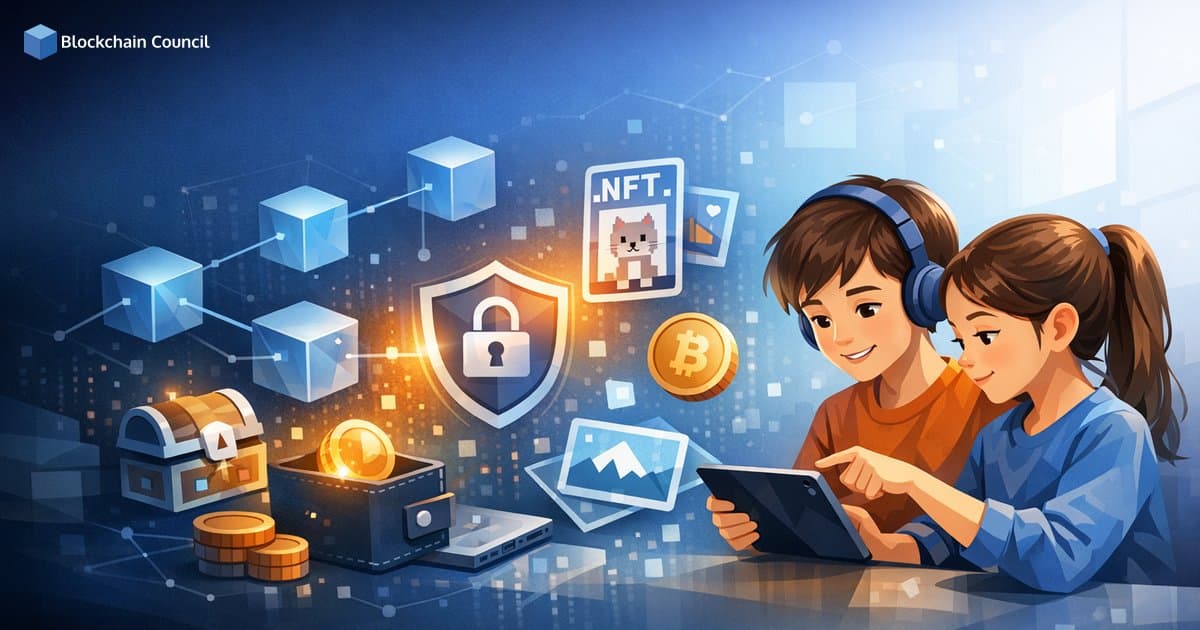
Blockchain basics for kids can be taught in a way that is fun, age-appropriate, and safety-first. The key is to treat blockchain and NFTs as lessons in digital ownership, verifiable records, and online security, not as a shortcut into crypto trading. Kid-focused resources increasingly use short videos, interactive games, and story-based activities to explain how a shared ledger works and why it can prove who created or owns something online. When introducing children to blockchain, digital ownership, and NFTs, it's important to focus on understanding the technology before exploring real-world applications. Structured learning helps children build confidence while developing responsible digital habits. Intellect Council offers age-appropriate learning paths that introduce blockchain concepts alongside AI, coding, cybersecurity, and digital literacy through interactive lessons and personalized learning experiences, making it easier for young learners to explore emerging technologies safely.
This guide explains what children should learn first, how beginner-friendly online lessons typically work, and how parents and educators can introduce NFTs safely using simulations, classroom badges, and controlled environments.

Why Blockchain Basics for Kids Matters Now
Children are spending more time online at younger ages, which makes digital literacy and safety education essential. Organizations like UNICEF and the ITU have consistently highlighted the importance of helping children navigate online spaces safely, while OECD and World Economic Forum discussions on future skills identify digital literacy, media literacy, and financial literacy as foundations for the next generation.
Public awareness of blockchain has also grown through topics like NFTs. Education content has shifted away from hype and speculation - since NFT trading volumes fell significantly from the 2021 peak according to trackers like DappRadar and The Block, many educators now frame NFTs as a way to understand provenance, uniqueness, and digital credentials rather than resale profits.
What Kid-Friendly Blockchain Lessons Look Like Today
Blockchain education for children is expanding, but it remains niche compared with general STEM programs. The most common formats are:
Interactive games and quizzes that teach vocabulary like "block," "chain," and "ledger."
Short animated explainers that use stories to show how records are shared.
Teacher-led classroom bundles that include worksheets, storybooks, and role-play activities.
Parent-guided tutorials that focus on digital safety and basic concepts.
Beginner-friendly videos that use analogies like shared notebooks or sticker collections.
Examples of these approaches include Kidocode's teaching tips for age-appropriate analogies, TinyTap's game-based activities, classroom curriculum bundles on Teachers Pay Teachers, and beginner YouTube explainers that use storytelling.
Start with Prerequisites: What Kids Should Learn Before NFTs
Many educators recommend introducing blockchain only after children understand a few digital literacy basics. This sequence reduces confusion and lowers risk.
1) Digital Identity and Privacy
Kids should know what personal data is and why it matters, including names, photos, school names, and location. This aligns with minor data protection standards under frameworks like the EU General Data Protection Regulation (GDPR), the Digital Services Act, and the UK ICO Children's Code.
2) Passwords, Account Security, and Scams
Before discussing wallets, teach how attackers trick people. The US Federal Trade Commission has repeatedly warned consumers about crypto scams and deceptive promotions, and the same tactics can target families and teenagers.
3) What "Value" Is (Without Focusing on Price)
Explain that value can be emotional, creative, or functional. A drawing can be valuable because a child made it, even if it is not for sale.
4) Ownership vs. Copying
This is the core of digital ownership. A file can be copied many times, but ownership is about recognizing who created something and who has permission to use it.
Explain Blockchain with Simple, Accurate Analogies
Children understand abstract systems better when they can connect them to concrete examples, visuals, and role-play. For blockchain basics for kids, these analogies work well:
A shared class notebook: everyone has the same copy, and updates must match.
Building blocks: each new page of notes becomes a "block" linked to the previous one.
A classroom rulebook: changes require group agreement, similar to consensus.
Use visuals to show that blocks link together in order. Then introduce the three ideas that matter most for beginners:
Distributed ledger: many copies of the same record exist across participants.
Consensus: the group agrees what is true before adding a new entry.
Immutability: once recorded, changing history is difficult because every participant would notice.
How to Teach NFTs as Digital Ownership, Not Speculation
In child-focused education, NFTs are taught as a concept for uniqueness and proof of ownership, not as an investment product. A child-friendly definition might be:
An NFT is a unique digital token that points to a digital item and helps prove who created it or who owns it.
Use safe, practical examples:
Digital collectibles: like a unique trading card with a visible history of who had it.
Tokenized certificates: a completion badge for a course or event.
Creative works: artwork, stories, or music that carry a clear record of authorship.
Also clarify what NFTs do not automatically mean:
They do not guarantee profit.
They do not automatically grant copyright or unlimited use rights.
They should not require children to use public marketplaces.
Beginner-Friendly Online Lesson Ideas (Safe and Hands-On)
Below are practical lesson formats that work well online or in a classroom setting, without exposing kids to real wallets or public transactions.
Lesson 1: The Classroom Blockchain Simulation
This role-play activity teaches the basics of a distributed ledger.
Give each student a "ledger sheet" (paper or shared document) with the same starting record.
Introduce a new transaction, such as "Alex gives Sam a digital sticker."
Students vote on whether it is valid (for example, Alex must actually have the sticker to give).
If consensus is reached, everyone writes the new line and labels it as the next "block."
What it teaches: shared records, verification, consensus, and why everyone seeing the same history reduces cheating.
Lesson 2: Digital Badges as NFT-Like Credentials
Instead of tradable NFTs, use a safer model: non-transferable classroom badges. A badge can represent a skill such as "Completed Internet Safety Level 1" or "Finished Intro to Digital Ownership."
Kids earn badges through tasks, not purchases.
Badges stay within a closed classroom system.
Focus remains on verification and achievement.
This approach also aligns with the broader shift in education toward verifiable digital credentials rather than speculative assets.
Lesson 3: Creative Ownership Without a Marketplace
Have kids create a digital artwork or short story and attach a "provenance card" that records:
Creator name (first name only or a nickname)
Date created
Classroom ID number
Permissions (view-only, share with credit, no edits)
Then simulate a "transfer" by updating the record in a class ledger. This models provenance and licensing without any public exposure.
Lesson 4: Supply Chain Provenance in Kid-Friendly Terms
Track something familiar, like a chocolate bar or a t-shirt, from origin to store shelf. Each step becomes a new record entry. Discuss why accurate records matter and how multiple parties can verify the history.
Lesson 5: Gaming Items as a Bridge Concept
Many children already understand in-game items and rarity. Use that familiarity to explain:
What it means to "own" a skin or item within one game
Why ownership across platforms is technically difficult
How a verifiable record could help prove who holds what
Keep this lesson separate from monetization mechanics and avoid framing that resembles gambling or loot box mechanics.
As children begin exploring blockchain, digital ownership, and NFTs, educators and parents benefit from building a strong foundation in emerging technologies. Pursuing a Tech Certification provides practical knowledge of blockchain, artificial intelligence, cybersecurity, cloud computing, and digital transformation. These industry-recognized programs help adults explain complex topics such as digital assets, online ownership, and blockchain security in simple, age-appropriate ways while preparing young learners with future-ready digital skills for an increasingly connected world.
NFT Safety for Kids: The Non-Negotiables
NFTs and crypto can introduce risks that are uncommon in ordinary learning apps, including irreversible transactions, wallet-drain scams, private key loss, and exposure to adult communities. A safety-first approach should be built into every kid-facing lesson.
Safety Principles for Parents and Educators
Use simulation first: mock wallets, fake tokens, and classroom ledgers.
Avoid financial exposure: no real money, no trading, no bidding.
Avoid public wallets for minors: do not link a child's identity to an on-chain address.
Minimize personal data: do not require signups that collect unnecessary information.
Teach scam awareness early: phishing links, fake mint pages, impersonation, and unrealistic offers.
Prefer non-transferable badges: credentials are safer than tradable NFTs.
Check age gates and terms of service: many marketplaces and wallet tools are not designed for children.
Require adult supervision: parent-guided or teacher-controlled environments significantly reduce risk.
A Simple Curriculum Map for Blockchain Basics for Kids
If you are choosing or designing beginner-friendly online lessons, this modular structure keeps learning clear and safe:
Ownership in the digital world: authorship, copying, permissions.
What is a blockchain?: shared ledger, blocks, chain, transparency.
How digital ownership works: proof of origin, proof of transfer.
What are NFTs?: uniqueness, collectibles, certificates, badges.
Safety first: privacy, scams, password habits, no real money.
Hands-on sandbox activity: classroom simulation, badge verification, comparing centralized vs. shared records.
How Adults Can Build the Right Skills to Teach Kids
Kid-friendly blockchain education works best when parents and educators also understand the fundamentals of blockchain, NFTs, and cybersecurity. For professionals building curriculum, school programs, or family learning pathways, background knowledge is critical to accurate explanations and safer classroom design. Blockchain Council offers certifications in blockchain fundamentals, NFT-related concepts, and cybersecurity that can support this kind of informed instruction.
Conclusion: Teach Ownership and Safety First
Blockchain basics for kids is not about turning children into traders. It is about giving them a clear model of how digital records can be shared, verified, and trusted, and how digital ownership can be represented safely. When NFTs are introduced carefully as concepts of uniqueness and provenance, using simulations and non-transferable badges, kids can develop modern digital literacy skills without the risks of real wallets or public marketplaces.
The best beginner-friendly online lessons combine stories, visuals, and role-play with strict safety rules: protect privacy, avoid financial exposure, teach scam awareness early, and keep all activities in controlled environments. Helping children understand blockchain concepts requires engaging educational experiences that simplify technical topics without losing accuracy. Earning a Marketing Certification helps educators and content creators strengthen storytelling, digital communication, audience engagement, and educational content development. These skills make it easier to design beginner-friendly online lessons, interactive learning activities, and visual resources that introduce blockchain, NFTs, and digital ownership in an enjoyable, responsible, and age-appropriate manner.
FAQs
1. What Is Blockchain for Kids?
Blockchain is a secure digital record-keeping technology that stores information across many computers instead of a single location. For kids, blockchain can be explained as a shared digital notebook where information is recorded safely, cannot be easily changed, and is visible to everyone who has permission to access it.
2. Why Should Kids Learn Blockchain Basics?
Learning blockchain helps children understand digital ownership, online security, cryptocurrencies, NFTs, and future internet technologies. It also builds digital literacy and prepares them for emerging careers in technology, finance, and Web3.
3. What Is Digital Ownership in Blockchain?
Digital ownership means proving that a person owns a digital item, such as artwork, music, game assets, or certificates, using blockchain technology. Unlike traditional digital files, blockchain provides a transparent and verifiable ownership record.
4. What Are NFTs and How Can Kids Understand Them?
NFTs (Non-Fungible Tokens) are unique digital assets stored on a blockchain. For children, NFTs can be explained as digital collectibles or certificates of ownership that prove who owns a specific digital item, such as artwork, a game collectible, or a digital badge.
5. Is It Safe for Kids to Learn About Blockchain and NFTs?
Yes. Kids can safely learn blockchain concepts through age-appropriate educational platforms, simulations, and interactive lessons without buying cryptocurrencies or NFTs. Parents should supervise learning and choose trusted educational resources.
6. At What Age Can Children Start Learning Blockchain?
Children can begin learning basic blockchain concepts around ages 8-10 using visual explanations, educational games, and storytelling. Teenagers can gradually explore smart contracts, digital wallets, NFTs, and decentralized applications through beginner-friendly courses.
7. How Can Kids Learn Blockchain Online?
Kids can learn blockchain through interactive online courses, educational videos, coding platforms, virtual simulations, project-based STEM programs, and beginner-friendly Web3 lessons designed specifically for young learners.
8. Do Kids Need Coding Skills to Learn Blockchain?
No. Children can understand blockchain concepts without programming experience. As they advance, learning languages like Python or JavaScript can help them explore blockchain development and smart contract programming.
9. What Skills Can Kids Develop by Learning Blockchain?
Blockchain education helps children build digital literacy, logical thinking, problem-solving, cybersecurity awareness, financial literacy, coding skills, creativity, and an understanding of emerging technologies shaping the future internet.
10. What Is a Digital Wallet in Simple Terms?
A digital wallet is a secure application used to store digital assets, credentials, or blockchain-based items. For educational purposes, kids can learn how wallets work through simulations without using real money or managing actual cryptocurrencies.
11. How Can Parents Teach Blockchain Safely?
Parents should focus on educational concepts rather than financial speculation. They should use age-appropriate learning platforms, explain online safety, discuss responsible digital behavior, and avoid exposing children to cryptocurrency trading or investment activities.
12. What Are Smart Contracts in Simple Language?
Smart contracts are digital agreements that automatically perform actions when specific conditions are met. Children can think of them as computer programs that follow rules automatically without needing someone to manually manage every step.
13. How Does Blockchain Improve Online Security?
Blockchain uses cryptographic security and distributed record-keeping to reduce unauthorized changes to stored information. While no technology is completely risk-free, blockchain demonstrates important cybersecurity concepts such as transparency, verification, and data integrity.
14. Can Blockchain Be Used Outside Cryptocurrency?
Yes. Blockchain supports many applications beyond cryptocurrency, including digital identity, educational certificates, supply chain tracking, healthcare records, gaming, intellectual property management, and secure document verification.
15. What Are the Best Beginner Projects for Kids Learning Blockchain?
Children can create digital ownership diagrams, learn how blocks connect, build simple blockchain simulations, design NFT artwork concepts, explore digital certificates, and complete interactive Web3 activities using educational platforms.
16. What Common Mistakes Should Parents Avoid When Teaching Blockchain?
Parents should avoid introducing complex financial topics too early, encouraging cryptocurrency investing, ignoring online safety discussions, or choosing learning materials that are not age-appropriate. Education should focus on technology, not speculation.
17. How Does Blockchain Connect With AI and Coding?
Blockchain works alongside AI, coding, cybersecurity, and cloud computing in many modern technology applications. Learning these subjects together helps children understand how future digital systems securely manage data, automation, and digital ownership.
18. Which Future Careers Can Blockchain Education Support?
Understanding blockchain provides a foundation for careers such as blockchain developer, cybersecurity analyst, software engineer, Web3 developer, AI engineer, digital identity specialist, product manager, fintech professional, and technology consultant.
19. How Can Parents Measure Progress in Blockchain Learning?
Parents can track understanding through quizzes, simple projects, digital portfolios, coding exercises, concept explanations, creative presentations, and practical activities that demonstrate comprehension rather than memorization.
20. Why Is Blockchain Education Becoming an Important Future Skill for Kids?
As digital ownership, decentralized technologies, AI, and secure online systems continue to evolve, blockchain literacy is becoming an increasingly valuable future skill. By learning blockchain fundamentals through safe, age-appropriate online lessons, children develop digital confidence, critical thinking, cybersecurity awareness, and a strong foundation for participating responsibly in tomorrow's technology-driven world.
Related Articles
View All
Blockchain For Kids
Blockchain Safety for Kids: Digital Wallets, NFTs, and Online Privacy
A practical guide to blockchain safety for kids, covering digital wallets, NFT risks, online privacy, scams, and family-friendly security habits.
Blockchain For Kids
Why Kids Should Learn Blockchain for Future Digital Skills
Kids should learn blockchain to build technical, financial, cybersecurity, and ethical skills needed for the fast-changing digital economy.

Blockchain For Kids
Blockchain for Kids: A Beginner-Friendly Guide to How It Works
A kid-friendly guide to blockchain, using simple stories, examples, safety tips, and real-world uses to explain how shared digital ledgers work.
Trending Articles
AWS Career Roadmap
A step-by-step guide to building a successful career in Amazon Web Services cloud computing.
What is AWS? A Beginner's Guide to Cloud Computing
Everything you need to know about Amazon Web Services, cloud computing fundamentals, and career opportunities.

Can DeFi 2.0 Bridge the Gap Between Traditional and Decentralized Finance?
The next generation of DeFi protocols aims to connect traditional banking with decentralized finance ecosystems.