

Vector Database Performance Optimization: Measuring Recall, Latency, and Cost
 Suyash Raizada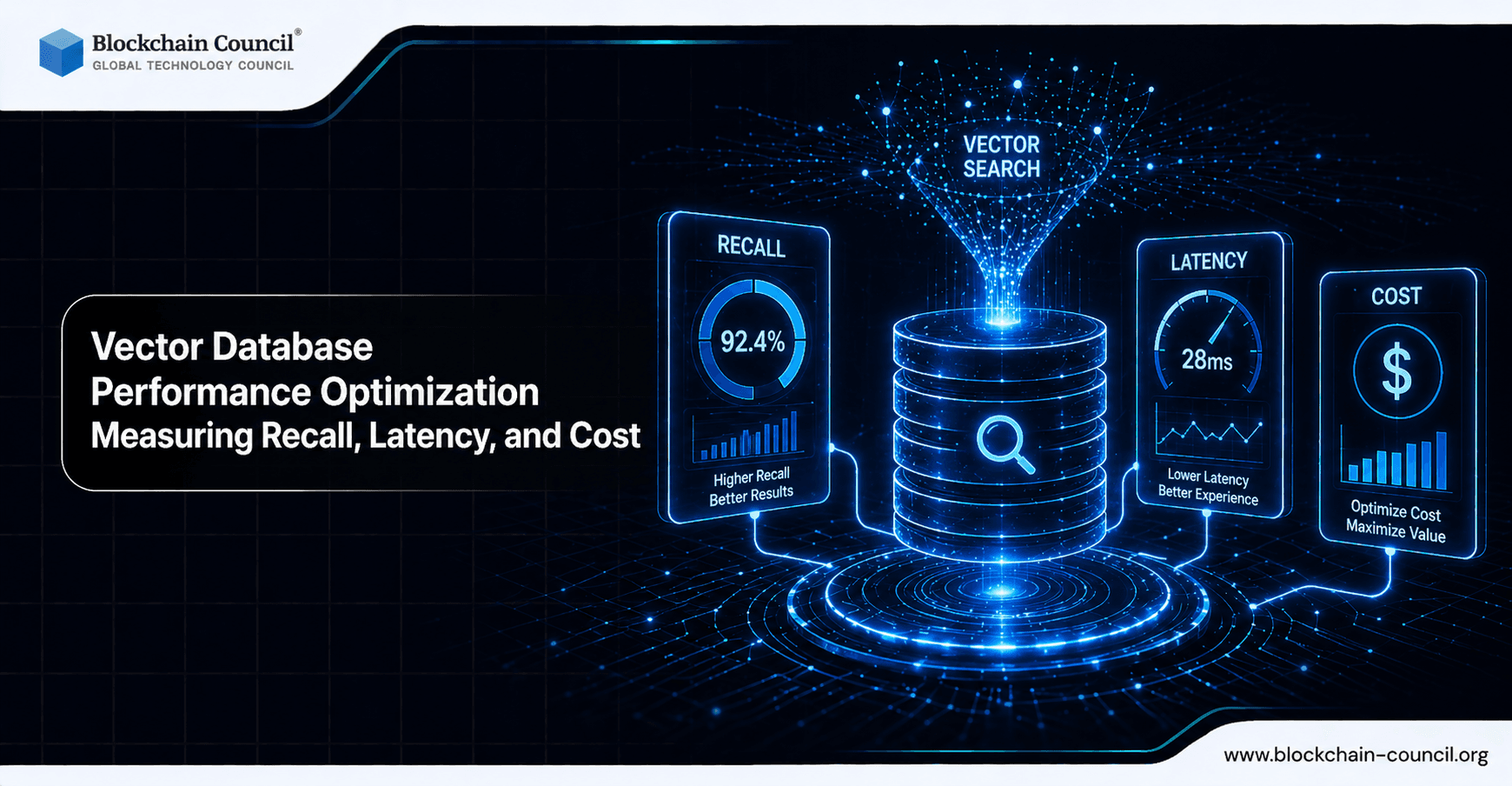
Vector database performance optimization requires making clear, measurable tradeoffs between recall (how often you retrieve the correct neighbors), latency (how quickly results return under load), and cost (memory, compute, storage, and operational overhead). Teams are moving beyond synthetic single-query benchmarks and focusing on production realism: concurrency, tail latency (P95 and P99), hybrid search (vector plus filters or full-text), and continuous ingestion. Practical evidence shows that integrated platforms such as PostgreSQL + pgvector can outperform specialized vector databases for many real-world RAG workloads, particularly when the embedding corpus is under roughly two million vectors and the workload is filter-heavy.
An AI Security Certification can help professionals develop expertise in securing AI infrastructure, protecting vector databases and retrieval systems, managing AI-related risks, and implementing governance practices that support reliable and secure RAG deployments at scale.

Database optimization
Before tuning indexes or enabling quantization, define your success criteria. The same system can appear fast in a lab but fail in production due to concurrency collapse or filter overhead.
1) Recall (Accuracy of Nearest Neighbors)
Recall is typically measured as recall@k: among the true top-k nearest vectors (computed via exact search on a smaller sample), what fraction does your system return? For RAG, recall is tied directly to answer quality, but it is not the only factor. Data quality and chunking strategy can move accuracy more than micro-optimizing distance computations.
Target range: Many production systems aim for 95-99% recall to balance cost and speed.
What changes recall: Index parameters (for example, HNSW efSearch), quantization level (4-bit vs. 8-bit), and hybrid fusion strategies.
2) Latency (P50, P95, P99 Under Concurrency)
Average latency hides pain. Modern benchmarks emphasize tail latency and throughput under realistic parallel load because a database that answers one query in 10 ms may jump to 200 ms at 100 concurrent queries. Track the following:
P50: Baseline responsiveness
P95 and P99: User-facing reliability and timeout behavior
Concurrency behavior: QPS at stable P95/P99
PostgreSQL with pgvectorscale has demonstrated high throughput (hundreds of QPS) at high recall on large datasets, while some specialized systems can still lead on raw P95 latency in specific configurations.
3) Cost (Memory, Compute, Storage, and Operations)
Cost extends beyond cloud spend. It includes:
Memory footprint: Vectors plus index overhead can dominate costs
Compute: Ingestion, indexing, and query-time reranking
Operational complexity: An additional database adds replication, monitoring, backup, and on-call burden
Quantization is one of the most direct levers for reducing cost. int8 approaches are widely reported to reduce memory significantly while preserving near-original accuracy.
Indexing Strategies: HNSW and the Reality of Hybrid Search
Most vector databases rely on approximate nearest neighbor (ANN) indexes to avoid brute-force scanning. HNSW (Hierarchical Navigable Small World graphs) remains a common default because it delivers strong recall-latency tradeoffs and supports incremental updates in many implementations.
HNSW Tuning Parameters That Matter
M: Graph connectivity. Higher values can improve recall but increase memory and build time.
efConstruction: Index build quality. Higher values improve recall and query performance stability but increase indexing cost.
efSearch: Query-time exploration depth. Higher values typically increase both recall and latency.
In practice, teams set a recall target first (for example, 99% recall@10) and then tune efSearch until they reach that target at the lowest P95/P99 latency under expected concurrency.
Hybrid Search Overhead: The Merge Tax
Production RAG commonly requires filtering by tenant, ACL, time, category, or metadata, plus optional lexical signals. A key lesson is that hybrid fusion can cost 20-40% in performance relative to pure vector search when combining ranked lists with methods like Reciprocal Rank Fusion. This is one reason integrated systems are gaining traction: when filtering and transactional constraints are first-class features, you can reduce cross-system joins and merging overhead.
Quantization Strategies: Lowering Cost Without Losing Recall
Quantization compresses vectors (or parts of the index) to reduce memory and sometimes increase cache efficiency and throughput. Common approaches include 8-bit and 4-bit quantization, plus binary quantization in some search engines.
When Quantization Helps the Most
Memory-bound workloads: If your index does not fit in RAM, quantization can eliminate disk paging and deliver stable in-memory performance.
High concurrency: Smaller vectors improve cache locality, often improving QPS at the same latency target.
Large-scale corpora: Cost savings compound as you approach tens or hundreds of millions of embeddings.
Accuracy Impact: Validate, Do Not Assume
Quantization usually introduces some recall loss, but modern implementations can keep it small. Some deployments report high accuracy retention with int8 quantization while reducing memory by roughly three quarters. The practical rule is to validate on your own embeddings, distance metric, k value, and filter patterns because recall can degrade differently across embedding models and domains.
Integrated vs. Specialized: How to Choose
The right database depends on dataset size, hybrid search requirements, and operational constraints. Industry consensus has shifted toward treating vector search as a feature rather than a standalone system for many RAG deployments.
PostgreSQL + pgvector (and pgvectorscale)
PostgreSQL-based stacks have shown strong production performance, particularly when your application already relies on Postgres for transactional data. pgvectorscale can reach high throughput at high recall on large vector sets, and pgvector improvements have reduced filtered-query latency on multi-million-row datasets. Practitioner feedback consistently indicates that many RAG deployments under two million embeddings do not benefit from a specialized vector database once you account for filters, ACLs, and operational overhead.
Best fit:
RAG workloads with heavy filtering, multi-tenancy, or joins with relational data
Teams optimizing total cost of ownership and minimizing system sprawl
Workloads where stable concurrency and tail latency matter more than headline single-query speed
Redis as a Vector Search Layer
Redis can deliver very low latency and strong throughput, making it attractive when Redis is already part of your stack for caching, sessions, or real-time features. It also supports fast ingestion rates in some configurations, which matters for continuously updated corpora. The main practical constraint is that large-scale vector workloads can become memory-bound, so quantization and careful capacity planning are important.
Best fit:
Ultra-low latency applications
High write and update rates
Architectures that already operate Redis at scale
Qdrant and Other Specialized Vector Databases
Purpose-built systems remain important for billion-scale scenarios, advanced compression, and predictable scaling characteristics. Some specialized databases lead on certain tail-latency metrics and provide vector-native features and tooling for large collections. If your primary requirement is minimal latency at massive scale and you can dedicate operational resources to vector infrastructure, specialized databases are a strong fit.
Best fit:
Very large corpora (hundreds of millions to billions of vectors) with strict latency SLOs
Teams that can dedicate operations to vector infrastructure
Use cases dominated by pure vector similarity rather than complex relational constraints
Elasticsearch, OpenSearch, MongoDB, and Other Integrated Platforms
Search and data platforms are rapidly improving vector capabilities. Binary quantization and optimized HNSW pipelines have narrowed the gap, particularly for hybrid queries where term and range filters are essential. For organizations already standardized on Elasticsearch or MongoDB, unifying vector search with existing data can reduce cost and complexity while meeting typical RAG latency targets.
A Practical Optimization Workflow
Use a disciplined loop that mirrors production conditions.
Define targets: recall@k, P95/P99 latency, QPS under concurrency, and monthly cost ceiling.
Build a realistic evaluation set: Include your actual filters, tenant distributions, and query mix.
Baseline with exact or high-ef search: Establish a reference for recall and correctness.
Tune indexing: Adjust HNSW parameters to hit recall targets at the lowest tail latency.
Apply quantization: Start with 8-bit, measure recall impact, then consider 4-bit or binary where supported.
Measure under concurrency: Run load tests (for example, 50 to 200 concurrent queries) and watch for latency cliffs.
Validate ingestion and updates: Confirm insert and update rates meet your freshness requirements.
Observe in production: Monitor P95/P99, error rates, memory pressure, and index health over time.
Real-World Lessons: Cost and Accuracy Wins Often Come From Integration
Case studies illustrate why vector database performance optimization is not solely about speed. Instacart reported significant cost savings after migrating from Elasticsearch to PostgreSQL with pgvector, in part by unifying data and eliminating duplicated write workloads. Other deployments highlight that Redis can sustain high QPS with low tail latency in demanding vector search scenarios. Separately, data-centric approaches that improve retrieval quality and reduce effective dataset size can produce substantial gains in both vector search cost and downstream LLM token spend.
Skills to Build: What Engineers Should Know
Optimizing vector systems sits at the intersection of ANN algorithms, database engineering, and LLM application design. Engineers building production RAG systems should develop skills in:
Vector search fundamentals: HNSW, IVF variants, distance metrics, and evaluation methodology
RAG system design: Chunking, metadata filtering, reranking, and feedback loops
Database operations: Capacity planning, replication, monitoring, and incident response
Blockchain Council offers structured learning paths for professionals working in this space, including the Certified AI Engineer program, Certified ChatGPT Expert certification, and tracks covering Data Science and Machine Learning, along with programs addressing cloud and DevOps practices for production AI systems.
Conclusion
Vector database performance optimization is a three-way balance: maximize recall sufficiently to protect answer quality, minimize P95/P99 latency under concurrency, and reduce cost through quantization and operational simplicity. Indexing choices like HNSW determine your recall-latency curve, while quantization (8-bit, 4-bit, or binary) can substantially reduce memory and improve throughput with modest accuracy tradeoffs when carefully validated. For many RAG workloads - particularly those with heavy filtering and under two million embeddings - integrated platforms like PostgreSQL + pgvector deliver strong results and lower total cost of ownership. Specialized vector databases remain relevant at extreme scale and for the most demanding latency SLOs, but the prevailing strategy is pragmatic: measure on realistic workloads, tune for tail latency, and select the architecture that meets your targets with the least added complexity.
FAQs
1. What is vector database performance optimization?
Vector database performance optimization focuses on improving retrieval accuracy, reducing latency, and managing operational costs. It involves tuning indexing, query parameters, and infrastructure. The goal is efficient and scalable similarity search.
2. What is recall in a vector database?
Recall measures how many relevant results are successfully retrieved from the database. High recall means fewer relevant items are missed. It is a key metric for evaluating retrieval quality.
3. Why is recall important in vector search systems?
Recall ensures that the system retrieves meaningful and relevant results. Low recall can lead to poor user experience and inaccurate outputs. It is critical for applications like search and recommendation.
4. What is latency in vector databases?
Latency refers to the time taken to process a query and return results. Lower latency improves responsiveness and user experience. It is especially important for real-time applications.
5. How is latency measured in vector search systems?
Latency is measured as the time between sending a query and receiving results. It is often tracked in milliseconds. Monitoring tools help analyze latency under different workloads.
6. What factors affect vector database latency?
Factors include index type, dataset size, hardware resources, and query complexity. Network delays and concurrency also impact latency. Proper tuning can reduce delays.
7. What is the cost of running a vector database?
Costs include compute resources, storage, and query processing. Managed services may add operational fees. Optimizing performance helps control these costs.
8. How can recall be improved in vector databases?
Recall can be improved by tuning index parameters and increasing search depth. Using better embeddings also helps. Balancing recall with latency is important.
9. How can latency be reduced in vector search systems?
Latency can be reduced by optimizing indexes and using efficient hardware. Caching and query optimization also help. Distributed systems can improve performance at scale.
10. What is the trade-off between recall and latency?
Higher recall often requires more computation, increasing latency. Lower latency may reduce recall. Finding the right balance depends on the application requirements.
11. What indexing methods are used in vector databases?
Common methods include HNSW, IVF, and flat indexing. Each offers different trade-offs between speed and accuracy. Choosing the right index is key for optimization.
12. How does dataset size impact performance?
Larger datasets increase search complexity and latency. They also require more storage and compute resources. Efficient indexing helps manage large-scale data.
13. What is approximate nearest neighbor (ANN) search?
ANN search finds similar vectors quickly with slight trade-offs in accuracy. It improves speed and scalability. This approach is widely used in production systems.
14. How can cost be optimized in vector databases?
Cost can be reduced by optimizing query frequency and resource usage. Using efficient indexes and scaling infrastructure properly helps. Monitoring usage prevents unnecessary expenses.
15. What role do embeddings play in performance optimization?
High-quality embeddings improve retrieval accuracy and recall. Poor embeddings lead to irrelevant results. Choosing the right model is essential for performance.
16. How does hardware impact vector database performance?
Better hardware, such as GPUs and high-memory systems, improves speed and scalability. It reduces latency and supports larger datasets. Infrastructure choices directly affect performance.
17. What is query batching in vector search?
Query batching processes multiple queries together to improve efficiency. It reduces overhead and improves throughput. This is useful for high-traffic systems.
18. How can you monitor vector database performance?
Monitoring tools track metrics like recall, latency, and resource usage. Logs and dashboards provide insights into system behavior. Continuous monitoring helps identify issues.
19. What are common challenges in optimizing vector databases?
Challenges include balancing recall and latency, managing large datasets, and controlling costs. System complexity can also be an issue. Proper tuning and testing are required.
20. What are best practices for vector database optimization?
Use efficient indexing, monitor key metrics, and optimize embeddings. Balance recall, latency, and cost based on use case. Regular testing and updates ensure long-term performance.
Related Articles
View All
AI & ML
Jev Latency Explained
Learn how Jev achieves low-latency AI decisions through parallel sampling, structured outputs, and System One architecture designed for fast, real-time software automation.

AI & ML
OpenAI Launches GPT-6.1 Terra: What’s New?
OpenAI has launched GPT-6.1 Terra, a faster and cheaper mid-tier model with stronger computer use, better image understanding and fewer errors. See what is new, what it costs, and who can use it.

AI & ML
Built to Catch AI Cheating: Rethinking Pre-Employment Assessments with HireValid
Explore how HireValid is rethinking pre-employment assessments with AI-resistant test design, integrity signals, candidate evidence, and human review to address AI-assisted cheating.
Trending Articles
AWS Career Roadmap
A step-by-step guide to building a successful career in Amazon Web Services cloud computing.
How Blockchain Secures AI Data
Understand how blockchain technology is being applied to protect the integrity and security of AI training data.
Claude AI Tools for Productivity
Discover Claude AI tools for productivity to streamline tasks, manage workflows, and improve efficiency.