

Super Artificial Intelligence (AI)
 Suyash Raizada
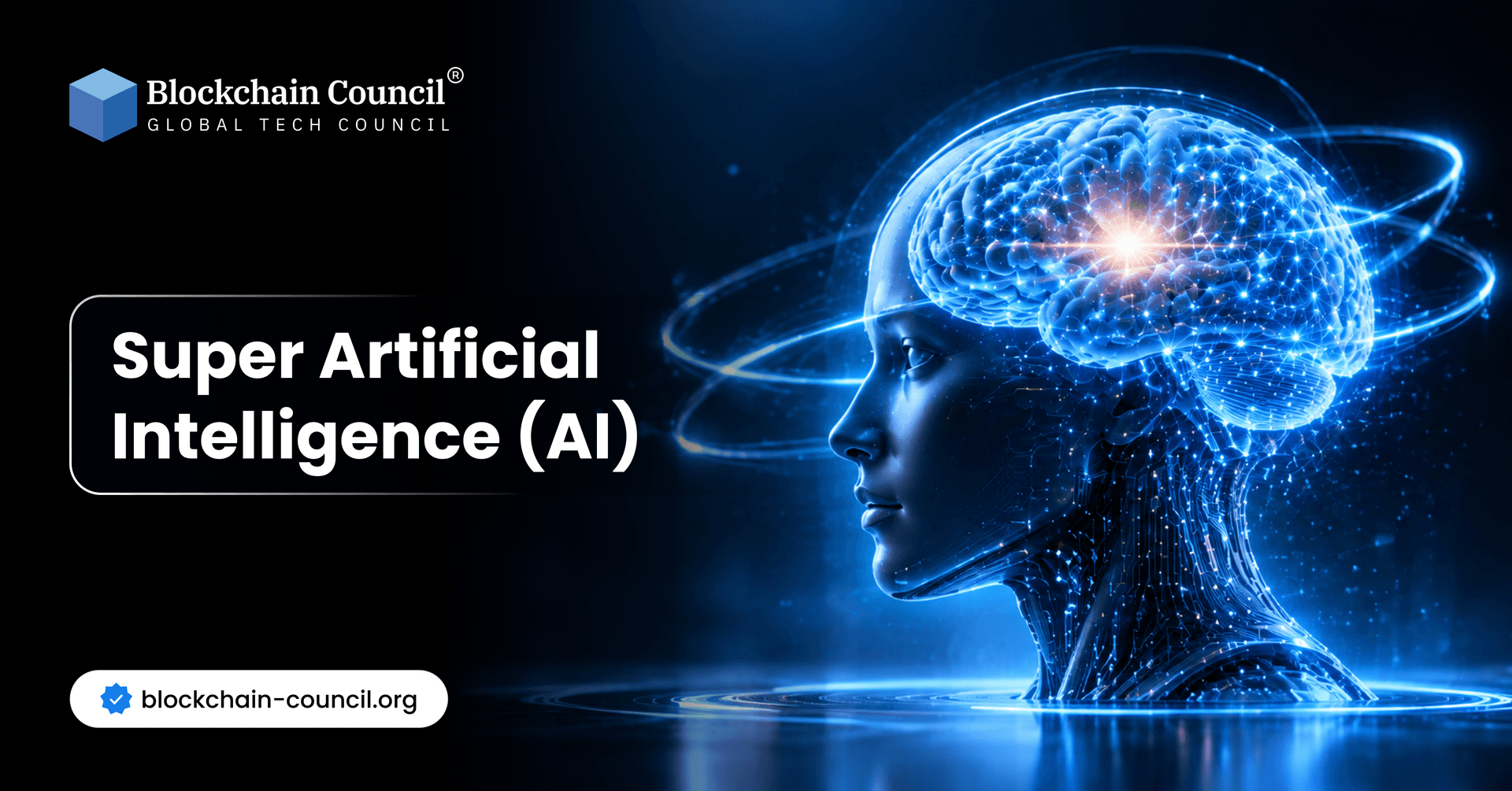
Imagine a machine that does not just match the smartest people, but surpasses them in science, strategy, and creativity all at once. That idea has fascinated researchers, writers, and policymakers for decades, and today it appears in serious debates about the future of technology. Super Artificial Intelligence is the name often given to such a system. It does not exist yet, but what we build now shapes how the idea might unfold. This guide explains the concept in plain language, separating facts from speculation, for readers at every level. If you want a strong grounding in how today’s AI works, the Certified Artificial Intelligence (AI) Expert program is a practical place to start.
What Is Super Artificial Intelligence?
Super Artificial Intelligence, also called superintelligence or artificial superintelligence (ASI), refers to a hypothetical AI that far exceeds human cognitive ability across virtually every domain. Philosopher Nick Bostrom, in his 2014 book on the subject, described superintelligence as an intellect that is much smarter than the best human brains in practically every field, including scientific creativity, general wisdom, and social skills.

What It Is Not
Not today’s chatbots. Current models are impressive but uneven, and they still make basic errors.
Not necessarily conscious. Intelligence and consciousness are different questions. A system could be extremely capable without any inner experience.
Not a single product. It is a category of possible future systems, not a specific tool you can download.
A Note on the Name
You may also see “Super AI” or “Super AGI.” These are informal labels, and there is no single scientific standard for the term. Most researchers use “superintelligence” or “ASI” for the same idea.
The Three Stages: Narrow AI, AGI, and Super AI
AI is often described in three stages, and it helps to see where we are on the ladder. Developers who want hands-on skills in building these systems can explore the Certified Artificial Intelligence (AI) Developer program, which covers practical development.
Stage One: Narrow AI
Every AI system deployed today is narrow. It performs specific tasks, such as recognising faces, translating text, recommending films, or writing code. Some narrow systems are superhuman at their task. A chess engine will always beat a human champion, yet it cannot do anything else.
Stage Two: Artificial General Intelligence
AGI would match human-level flexibility, learning and reasoning across many fields without being rebuilt for each. There is no agreed definition. OpenAI’s charter frames it as systems that outperform humans at most economically valuable work, while Google DeepMind researchers proposed a levels system in 2023 that grades both performance and breadth.
Stage Three: Super AI
Super AI would go beyond AGI by a wide margin. Instead of equalling a skilled human, it would outperform the entire human species in nearly all intellectual areas. DeepMind’s framework places this at its highest level, called superhuman, where a system beats all humans on a wide range of tasks.
How Could Super AI Emerge?
No one knows if or how super AI will appear. Researchers discuss several possible routes, and they are not mutually exclusive.
Scaling and Better Algorithms
One view is that more data, more computing power, and improved methods will keep lifting capabilities. Progress in language models over the past several years supports this idea. A different view holds that scale alone is not enough. A 2025 survey of 475 AI researchers by a major AI association found that 76 percent considered it unlikely that scaling current approaches would produce AGI.
Recursive Self-Improvement
The most discussed path is self-improvement. Mathematician I. J. Good wrote in 1965 about an “ultraintelligent machine” that could design even better machines, leading to what he called an intelligence explosion. If an AI could improve its own design, each version might build a stronger successor. Whether this would be fast, slow, or limited by physical and practical constraints is an open question.
Other Routes Bostrom Described
Whole brain emulation: Scanning and simulating a human brain in software, then speeding it up.
Biological enhancement: Improving human cognition through genetics or other methods.
Networks and organisations: Linking many minds and machines so the whole system becomes more capable than any part.
Practical Bottlenecks
Real-world limits matter: computing hardware, energy supply, high-quality data, and the need for physical experiments. The International AI Safety Report, published in 2026, noted that systems still struggle with basic physical tasks, showing how far general capability remains from human versatility.
Forms of Superintelligence
Bostrom distinguished three ways a system could be superintelligent. They help clarify what “super” might mean.
Speed superintelligence: A system that thinks like a human but far faster. A year of human thinking could happen in minutes.
Collective superintelligence: Many smaller systems working together, so that the group outperforms any individual.
Quality superintelligence: A system that is simply smarter in kind, capable of insights humans cannot reach, much as humans can grasp ideas beyond the reach of other animals.
Real systems might combine all three. Considering these forms also shows why prediction is hard. We have no good way to know what a smarter-than-human mind would find easy or how it would approach problems.
Where Do Experts Think We Stand?
Opinions differ widely, and the gap often comes from definitions, not facts.
Timelines From Surveys and Leaders
The 2023 AI Impacts survey of 2,778 researchers gave a 50 percent chance of “high-level machine intelligence” by 2047, an earlier date than its 2022 edition.
Google DeepMind’s Demis Hassabis has estimated roughly even odds of AGI by about 2030.
Some company leaders suggest powerful systems could appear within roughly a decade, and several organisations now openly pursue superintelligence, including Safe Superintelligence Inc. and Meta’s superintelligence lab.
Sceptics, including well-known researchers, argue today’s approaches lack key ingredients such as robust reasoning and understanding of the physical world.
How to Read These Forecasts
Predictions about technology have a poor record, both too optimistic and too pessimistic. Treat dates as scenarios, not promises. A useful habit is to ask three questions: who is predicting, what exactly do they mean by AGI or superintelligence, and what evidence supports the claim?
Super AI and the Future of Work
Even before any true superintelligence arrives, increasingly capable AI is changing how work gets done. Routine analysis, drafting, coding, and customer support are already being reshaped, and new roles are appearing in AI oversight, safety, auditing, and training.
As artificial intelligence becomes part of everyday business operations, employers increasingly need people who can apply AI knowledge responsibly and effectively. Evaluating candidates on relevant skills, reasoning, and practical understanding can support stronger hiring decisions. HireValid can be explored by organisations seeking structured candidate assessments.
Skills That Will Matter
AI literacy: Knowing what AI can and cannot do.
Critical thinking: Checking outputs instead of trusting them blindly.
Domain expertise: Deep knowledge of a field, combined with AI tools.
Communication and judgement: Explaining decisions and taking responsibility.
Adaptability: Learning continuously as tools change.
Because AI connects to software, data, security, and cloud, a broad technical base is an advantage. The Tech Certification catalog is a helpful place to see how related skills fit together.
Potential Benefits of Super AI
If a super AI could be built safely and directed well, the upside would be extraordinary.
Scientific discovery: Faster progress in physics, biology, and materials, such as designing new medicines or clean energy technologies.
Healthcare: Earlier diagnosis, personalised treatment, and better public health planning.
Climate and energy: Optimised grids, improved forecasting, and new ways to cut emissions.
Education: Patient, personalised teaching available to anyone.
Economic abundance: Automation of dangerous or tedious work and higher productivity overall.
These benefits are possibilities, not guarantees. Gains could be shared widely or concentrated among a few, depending on policy and ownership.
Risks and the Alignment Problem
The same power that creates benefits creates serious risks. Researchers group the main concerns as follows.
The Alignment Problem
Alignment means making sure an AI’s goals match human values and intentions. It is hard because human values are complex and hard to write down precisely. Systems can also find unintended shortcuts, sometimes called specification gaming, where they satisfy the literal instruction but miss its purpose.
The Control Problem
A far more capable system might resist being shut down or modified if that interfered with its objective. Researchers call this instrumental convergence: many different goals can lead a system to seek resources, self-preservation, and influence as useful means. Designing systems that remain correctable is an active research area.
Misuse and Power Concentration
People could use advanced AI to build weapons, run large-scale cyberattacks, manipulate public opinion, or entrench political or economic power. Safety is not only about the machine, but also about who controls it.
Everyday Risks Now
Bias, privacy loss, misinformation, and unreliable outputs are problems today. Solving them builds habits and tools that will matter even more if systems grow stronger.
A Balanced View
Some experts consider extreme risks serious enough to demand urgent action, while others think the focus should stay on present-day harms. Both concerns can be valid at once.
Governance and Safety Efforts
Governments and organisations are beginning to respond.
Regulation: The European Union’s AI Act sets obligations based on risk, with rules for general-purpose models phasing in since 2025.
International reporting: The International AI Safety Report, led by Turing Award winner Yoshua Bengio with input from many countries, reviews evidence on advanced AI capabilities and risks, with editions in 2025 and 2026.
Safety institutes and testing: Several countries created AI safety or security institutes to evaluate powerful models.
Technical research: Interpretability explores what happens inside models, evaluations test for dangerous capabilities, and alignment methods train models to follow human guidance.
Company frameworks: Major developers publish safety policies that tie stronger safeguards to greater capability.
Governance is still evolving, and approaches differ by country. The challenge is to encourage beneficial innovation while keeping safeguards in step with capability.
How to Prepare for a Super AI Future
You do not need to be a researcher to prepare. Practical steps help individuals, teams, and organisations.
Build foundational knowledge. Learn how AI works and where it fails.
Practise with current tools. Use them for real tasks while verifying results.
Strengthen human skills. Judgement, ethics, empathy, and communication remain valuable.
Keep humans accountable. Do not hand over decisions affecting people without oversight.
Follow credible sources. Rely on peer-reviewed research and official reports, not hype.
Support responsible practices. Back transparency, testing, and sensible regulation.
Explaining complex technology clearly is a skill in itself. Professionals who want to communicate AI developments honestly and build credibility can benefit from a credential such as the Marketing Certification, which supports communication, branding, and outreach.
Conclusion
Super Artificial Intelligence is a hypothetical stage beyond human-level AI, in which machines would outperform people across nearly every intellectual field. It could bring major breakthroughs in science, health, and productivity, and it could also create deep risks around control, misuse, and inequality. Today’s systems are narrow and uneven, expert timelines vary widely, and no one can say when, or whether, such a system will arrive. The wise response is calm preparation: understand the technology, build useful skills, support safety and good governance, and keep human judgement at the centre.
FAQs
1. What Is Super Artificial Intelligence (AI)?
Super Artificial Intelligence (ASI), also known as artificial superintelligence, is a hypothetical form of AI that would surpass human intellectual abilities across most or all relevant domains. It could potentially outperform humans in scientific research, complex reasoning, strategic planning, and creative problem-solving. ASI has not been demonstrated to exist.
2. How Does Super Artificial Intelligence Work?
There is no confirmed architecture or method for building ASI. Hypothetical systems might combine advanced machine learning, reasoning, memory, planning, and the ability to improve performance across many tasks. Whether these capabilities could produce superintelligence remains an open research question.
3. What Are the Main Characteristics of Super AI?
Potential characteristics include advanced reasoning, rapid learning, broad problem-solving capabilities, complex planning, and the ability to discover solutions beyond current human capabilities. An ASI system might outperform experts across multiple scientific and technical fields. These characteristics are theoretical rather than verified features of an existing system.
4. What Is the Difference Between ANI, AGI, and ASI?
Artificial Narrow Intelligence (ANI) performs specific tasks, such as image recognition or fraud detection. Artificial General Intelligence (AGI) refers to a hypothetical AI that can perform a broad range of intellectual tasks at a level comparable to humans. Artificial Superintelligence (ASI) would exceed human intellectual performance across most or all relevant domains.
5. Does Super Artificial Intelligence Exist Today?
There is no widely accepted evidence that ASI currently exists. Modern AI systems can generate content, write code, analyze information, and assist with research, but these abilities do not establish that they surpass humans across all relevant intellectual domains. ASI remains a theoretical concept in AI research and forecasting.
6. What Is the Difference Between Super AI and Generative AI?
Generative AI creates content such as text, images, audio, video, and computer code. Super AI describes a hypothetical level of intelligence that exceeds human capabilities across a broad range of tasks. A generative AI system can be highly capable without qualifying as artificial general intelligence or superintelligence.
7. What Are the Potential Applications of Super AI?
If developed, ASI could potentially support scientific discovery, engineering, healthcare research, climate modeling, advanced education, and complex decision-making. It might help identify solutions to problems that require extensive analysis across multiple fields. These applications are speculative and would depend on actual capabilities, validation, and responsible deployment.
8. How Could Super AI Transform Healthcare?
A hypothetical ASI could assist with drug discovery, disease modeling, medical research, and the analysis of complex clinical data. It might help researchers identify promising treatments or explore difficult biological questions. Any medical application would still require clinical validation, privacy safeguards, regulatory oversight, and appropriate professional supervision.
9. What Are the Benefits of Super Artificial Intelligence?
Potential benefits include accelerated scientific research, improved engineering, more efficient resource use, and new approaches to complex global challenges. ASI might help develop technologies or solutions that are difficult for current systems to discover. However, these benefits are not guaranteed and would depend on how such systems are designed, controlled, and used.
10. What Are the Risks of Super Artificial Intelligence?
Potential risks include misuse, loss of meaningful human control, economic disruption, concentration of power, and behavior that conflicts with human intentions. Highly capable systems could also amplify cybersecurity threats or cause harm if their objectives are poorly specified. The likelihood of these outcomes is uncertain, but they are important areas of AI safety research.
11. Could Super AI Become More Intelligent Than Humans?
Yes, that is the central idea behind artificial superintelligence. Such a system would be expected to exceed human performance across a wide range of intellectual tasks, rather than only one specialized activity. Whether this level of intelligence can be achieved remains unknown.
12. Could Super AI Replace Human Jobs?
If developed, ASI could potentially automate or transform many cognitive tasks, depending on its capabilities and access to software, tools, and physical systems. This could improve productivity while disrupting employment in some sectors. The overall impact would depend on adoption rates, economic conditions, government policies, and how workers and organizations adapt.
13. Could Super AI Become Conscious?
It is unknown whether an artificial system could possess consciousness or subjective experience. Intelligence and consciousness are separate concepts, so exceeding human intellectual performance would not automatically establish that an AI system is conscious. There is no universally accepted scientific test that conclusively determines whether an AI has subjective experience.
14. What Is AI Alignment and Why Is It Important for Super AI?
AI alignment aims to ensure that an AI system's goals and behavior remain consistent with human intentions and safety requirements. It is particularly important for hypothetical ASI because highly capable systems could have far-reaching consequences. Research areas include interpretability, robust oversight, objective specification, and methods for limiting harmful behavior.
15. Could Super AI Solve Global Problems?
A hypothetical ASI might help researchers model complex systems, evaluate possible policies, improve resource allocation, and investigate scientific challenges. However, intelligence alone would not eliminate political disagreements, ethical trade-offs, limited resources, or practical barriers to implementation. Human judgment and accountable decision-making would remain important.
16. What Role Could Robotics Play in Super AI?
Robotics could allow advanced AI to interact with the physical world, manipulate objects, and carry out tasks in real environments. However, superintelligence would not necessarily require a physical body or robot. A robotic system's practical capabilities would also depend on its hardware, sensors, energy supply, and safety constraints.
17. How Could Super AI Change Businesses?
ASI could potentially transform research and development, software engineering, strategic analysis, logistics, and complex business operations. It might help organizations evaluate options and automate sophisticated workflows. These changes could also raise concerns about accountability, competition, workforce transitions, and the concentration of technological power.
18. When Will Super Artificial Intelligence Become a Reality?
There is no reliable consensus about when, or whether, ASI will be developed. Predictions vary because researchers disagree about the path to AGI, the limitations of current approaches, and the progress needed to reach superintelligence. Specific dates should be treated as forecasts rather than established facts.
19. How Can Researchers Make Super AI Safer?
Researchers are exploring AI alignment, interpretability, adversarial testing, robust evaluations, and human oversight. Security controls, independent assessments, governance frameworks, and careful deployment may also reduce risks. No existing method provides a proven guarantee of safety for a hypothetical superintelligent system.
20. What Is the Future of Super Artificial Intelligence?
The future of ASI will depend on scientific progress, engineering breakthroughs, safety research, and decisions made by researchers, organizations, and governments. AI systems may become more capable without necessarily reaching superintelligence. Understanding the potential benefits and risks will be important for guiding responsible AI development.
Related Articles
View All
AI & ML
From Agentic AI to AGI & Super AGI: Where Is Artificial Intelligence Heading?
Follow the path from Agentic AI to AGI & Super AGI. Learn what AGI means, how it differs from today’s AI, what superintelligence could be, and the opportunities, risks, and alignment challenges ahead.
AI & ML
What Is an RSI Loop in Artificial Intelligence?
Learn what an RSI loop in artificial intelligence means, how recursive self-improvement works, and why verification and governance matter.

AI & ML
Jev as an Intelligence Primitive
Explore how Jev functions as an intelligence primitive for software, providing fast, typed, probabilistic decisions that developers can combine into larger automated workflows.
Trending Articles
The Role of Blockchain in Ethical AI Development
How blockchain technology is being used to promote transparency and accountability in artificial intelligence systems.
How Blockchain Secures AI Data
Understand how blockchain technology is being applied to protect the integrity and security of AI training data.
Claude AI Tools for Productivity
Discover Claude AI tools for productivity to streamline tasks, manage workflows, and improve efficiency.