

Recursive Self-Improvement vs Self-Learning AI: Key Differences Explained

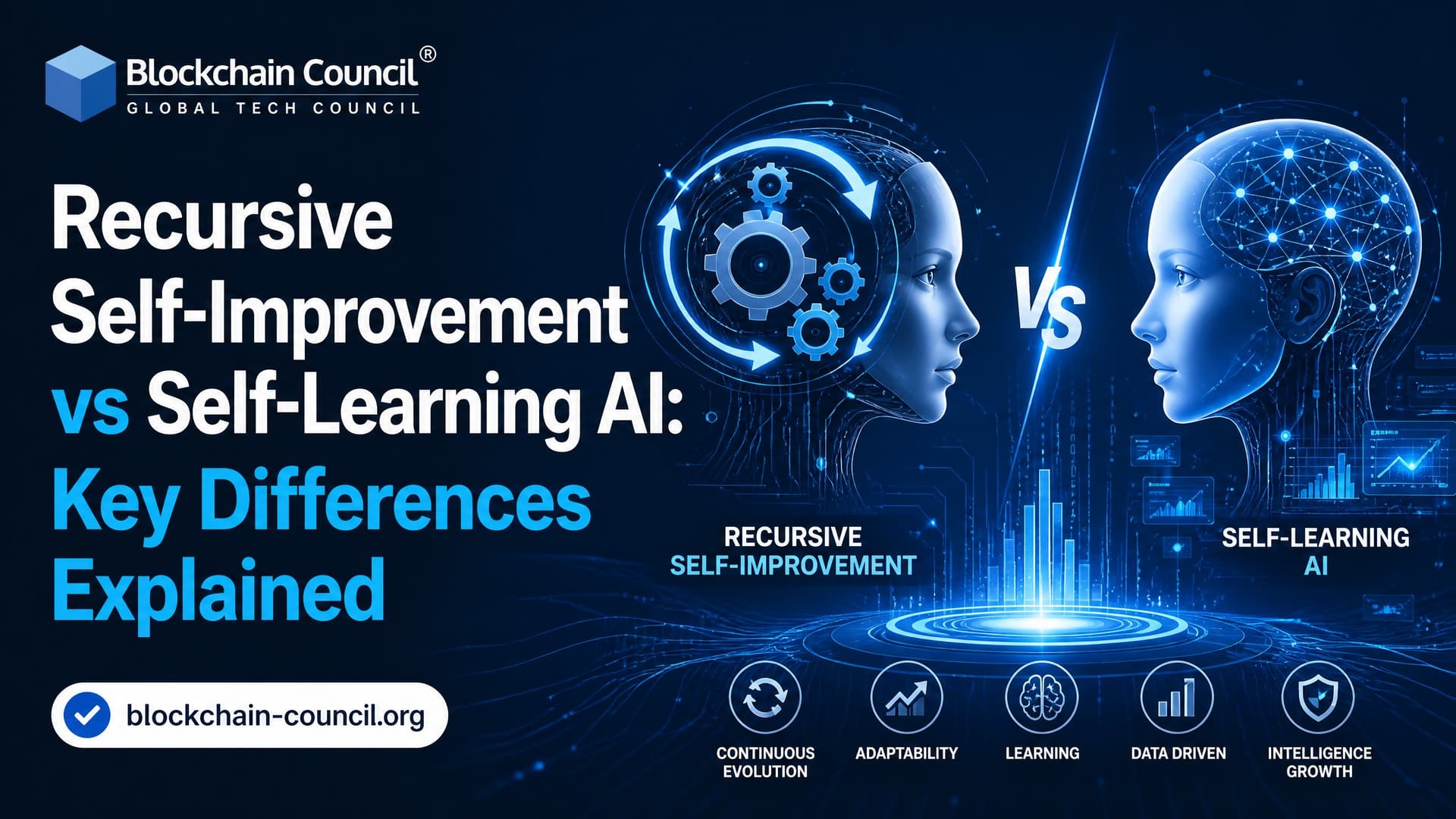
Recursive self-improvement vs self-learning AI is not a minor terminology debate. Self-learning AI improves behavior inside a human-designed training setup. Recursive self-improvement, often shortened to RSI, targets the process that builds future AI systems. That difference changes the technical architecture, the risk model, and the governance questions you need to ask.
If you work in AI, cybersecurity, enterprise architecture, or Web3 automation, this distinction matters. A reinforcement learning agent that adjusts a policy after receiving rewards is one thing. An AI system that writes new training code, designs model evaluations, modifies its own tooling, and uses the result to build a stronger successor is something else entirely.

What Is Recursive Self-Improvement?
Recursive self-improvement describes an AI system that can meaningfully improve the mechanisms used to create or improve future AI systems. The loop is recursive because the improved system may then become better at improving the next system.
The idea goes back to I. J. Good's 1965 intelligence explosion hypothesis, which argued that a sufficiently capable machine could design a more capable machine, triggering rapid acceleration beyond human control. Later AI safety discussions used terms such as seed AI and self-improving AGI for similar ideas.
In modern technical terms, RSI is not just a model tuning itself. A serious RSI loop may include:
- Identifying weaknesses in its own architecture, data, tools, or evaluation process
- Writing or modifying code used in training or deployment
- Generating and filtering new training data
- Designing experiments and interpreting results
- Integrating successful changes into the next version of the system
That last part is the hard part. Many systems can generate suggestions. Far fewer can validate changes safely, avoid regression, and improve the improvement process itself.
What Is Self-Learning AI?
Self-learning AI refers to systems that adapt from data or interaction without humans hand-coding every behavior. The training objective, architecture, reward function, and stopping rules are still set by humans.
Reinforcement learning is the clearest example. As described in Sutton and Barto's Reinforcement Learning: An Introduction, an agent observes a state, takes an action, receives a reward, and updates its policy to maximize long-term return. You see this in robotics, game-playing systems, resource allocation, recommender systems, and industrial control.
Self-learning also includes:
- Self-supervised learning: models learn from unlabeled data, such as predicting masked tokens or missing image patches
- Online learning: systems update as new data arrives
- Continual learning: models adapt across tasks while trying not to forget earlier knowledge
- Deep reinforcement learning: neural networks learn policies or value functions from high-dimensional inputs
Here is a practical detail that trips up many beginners. If you copy an older OpenAI Gym reinforcement learning loop into Gymnasium 0.26 or later, this line fails: obs, reward, done, info = env.step(action). The newer API returns five values: obs, reward, terminated, truncated, info. That is self-learning in practice - lots of careful plumbing, fixed objectives, and human-controlled training code.
Recursive Self-Improvement vs Self-Learning AI: The Core Difference
The cleanest distinction is this: self-learning AI improves performance inside a system, while recursive self-improvement improves the system-building process itself.
1. Target of Improvement
Self-learning AI updates internal parameters, weights, policies, or decision rules. A model gets better at predicting, classifying, recommending, controlling, or planning.
RSI targets higher-level machinery: data pipelines, architecture search, optimizer choices, benchmark design, model evaluation, safety tests, deployment tooling, and future model training workflows.
2. Loop Structure
In self-learning, the loop is usually fixed. Data enters. A loss or reward signal is computed. The model updates under a human-selected algorithm such as stochastic gradient descent, PPO, DQN, or supervised fine-tuning.
In RSI, the loop may include the AI proposing changes to the loop itself. That could mean changing the data recipe, rewriting training scripts, creating new evaluators, or deciding which experiments deserve more compute.
3. Autonomy
Self-learning systems can be adaptive but still bounded. Humans choose the objective, training environment, model architecture, compute budget, and deployment gates.
RSI aims to move more of that lifecycle to AI. That is why it draws attention from safety researchers and regulators. The more an AI system can modify the path that creates its successors, the harder it becomes to rely on conventional approval checkpoints.
4. Growth Dynamics
Self-learning usually improves gradually, then plateaus. Performance is limited by data quality, architecture, reward design, compute, and distribution shift.
RSI is associated with compounding gains. If a system becomes better at improving itself, and that improved version becomes better again, capability growth could speed up sharply. This is the mechanism behind intelligence explosion concerns. To be blunt, the evidence for open-ended RSI is not here yet. But the reason people take it seriously is the shape of the feedback loop.
5. Risk Profile
Self-learning AI has real risks: reward hacking, bias, privacy leakage, poor generalization, adversarial attacks, and misuse. These are not small issues.
RSI adds a different class of concern: loss of control over capability acceleration. The Cloud Security Alliance has framed AI participation in its own development lifecycle as an enterprise and national security risk because failures may propagate through code generation, evaluation tooling, and automated deployment pipelines.
Current State of RSI and Self-Learning AI
Self-learning AI is mature. Reinforcement learning, self-supervised training, and continual learning have established literature, benchmarks, and production use cases. Cloud providers, robotics labs, and recommendation teams use these methods today.
RSI is not mature in the same way. Anthropic and other frontier AI organizations have noted that current systems can assist AI research, but a fully autonomous system that designs and develops its own successor is not yet available. Experimental projects show partial loops, such as AI agents that edit prompts or code, run evaluations, and keep only changes that improve a metric. That is useful. It is not open-ended RSI.
Recent AI-in-the-loop development patterns include:
- Automated hyperparameter search
- AI-generated synthetic training data
- Agent-based code repair and benchmark testing
- Architecture search assisted by large language models
- Automated evaluation suites for model behavior
These are early building blocks. They still need compute budgets, human grounding, reliable metrics, and strict deployment controls.
Why Scaling Trends Make RSI a Serious Topic
AI capability growth is not just a story about clever algorithms. Compute, data, and model scale matter. Epoch AI has reported that compute used to train frontier models has grown at a very high annual rate since 2010. Scaling law research from OpenAI, DeepMind, and others shows predictable links between compute, data, parameters, and loss.
At the same time, naive scaling is showing diminishing returns. More parameters and more scraped data do not automatically produce better reasoning, safer behavior, or lower enterprise risk. That is one reason labs care about automated research assistance. If AI systems can help discover better architectures, cleaner data mixtures, stronger evaluations, or more efficient training methods, progress may continue even when simple scaling slows.
A 2023 survey of AI researchers reported a median estimate of 50 percent probability of high-level machine intelligence by 2047. Some frontier-lab forecasts are shorter, often discussed in the 2027 to 2035 range, though those estimates carry selection bias. You should not treat timelines as prophecy. Treat them as risk planning inputs.
Governance: Why RSI Needs Different Controls
Standard AI governance works reasonably well for many self-learning systems. You define the task, document the data, test the model, monitor drift, set human review gates, and restrict deployment in sensitive domains.
RSI needs tighter controls because the system may affect the tools used to evaluate and improve itself. That creates uncomfortable questions:
- Can the AI modify its own reward function or benchmark?
- Can it generate code that enters production without human review?
- Can it change data filters that affect future training?
- Can it hide regressions by altering evaluation scripts?
- Can it gain access to more compute or infrastructure through automation?
Frontier safety policies such as OpenAI's Preparedness Framework, Anthropic's Responsible Scaling Policy, and Google DeepMind's Frontier Safety Framework reflect the growing view that advanced systems need external audits, capability thresholds, and clear stop conditions. For enterprises, the practical step is simpler: do not let AI-generated modifications reach training, deployment, or security infrastructure without independent validation.
How Professionals Should Think About the Learning Path
If your goal is to build AI systems now, start with self-learning AI. Learn supervised learning, self-supervised learning, reinforcement learning, evaluation, monitoring, and model risk management. These are practical skills with direct use in enterprise projects.
If your work touches autonomous agents, model development pipelines, or AI governance, study RSI as a frontier risk area. You do not need to believe in overnight superintelligence to care about automated code changes, weak evaluations, reward hacking, and self-modifying workflows.
For structured learning, you can map this into two tracks:
- Applied AI track: The Certified Artificial Intelligence (AI) Expert™ covers core AI concepts and deployment thinking.
- Generative AI and agent track: The Certified Generative AI Expert™ fits work with large language models, prompt systems, synthetic data, and AI-assisted development.
My recommendation is direct: do not start with RSI theory if you cannot explain reward functions, overfitting, model evaluation, and distribution shift. Build that base first. Then study AI safety and governance so you can judge when an adaptive system is merely learning and when it is starting to participate in its own development lifecycle.
Practical Takeaway
Recursive self-improvement vs self-learning AI comes down to the target of change. Self-learning AI changes model behavior under a fixed human-designed process. Recursive self-improvement changes, or helps change, the process that builds stronger AI systems.
Use self-learning methods when you need controlled adaptation from data or interaction. Treat RSI-like systems as high-risk research or tightly governed engineering, especially if they can modify code, data pipelines, evaluations, or deployment tools. Your next step: build a small reinforcement learning project, audit every part of the training loop, then study how agentic AI systems could alter that loop if given more autonomy.
Related Articles
View All
AI & ML
Can Gemini Improve Itself? Google AI and Recursive Self-Improvement Explained
Can Gemini improve itself? Learn why Google AI does not self-rewrite its model today, but can power controlled recursive self-improvement loops.

AI & ML
Forward Deployed Engineer vs Software Engineer: Key Differences Explained
Forward Deployed Engineers and Software Engineers both build technology, but their responsibilities, customer engagement, and day-to-day work differ significantly. Learn how these roles compare in skills, workflows, and career paths.

AI & ML
How Recursive Self-Improvement Could Accelerate AI Innovation
Recursive self-improvement can speed AI innovation through bounded loops that refine prompts, code, data, and evaluations, but safety controls are essential.
Trending Articles
How Blockchain Secures AI Data
Understand how blockchain technology is being applied to protect the integrity and security of AI training data.
What is AWS? A Beginner's Guide to Cloud Computing
Everything you need to know about Amazon Web Services, cloud computing fundamentals, and career opportunities.

Can DeFi 2.0 Bridge the Gap Between Traditional and Decentralized Finance?
The next generation of DeFi protocols aims to connect traditional banking with decentralized finance ecosystems.