

Recursive Self-Improvement in LLMs: Can Language Models Optimize Themselves?
 Suyash Raizada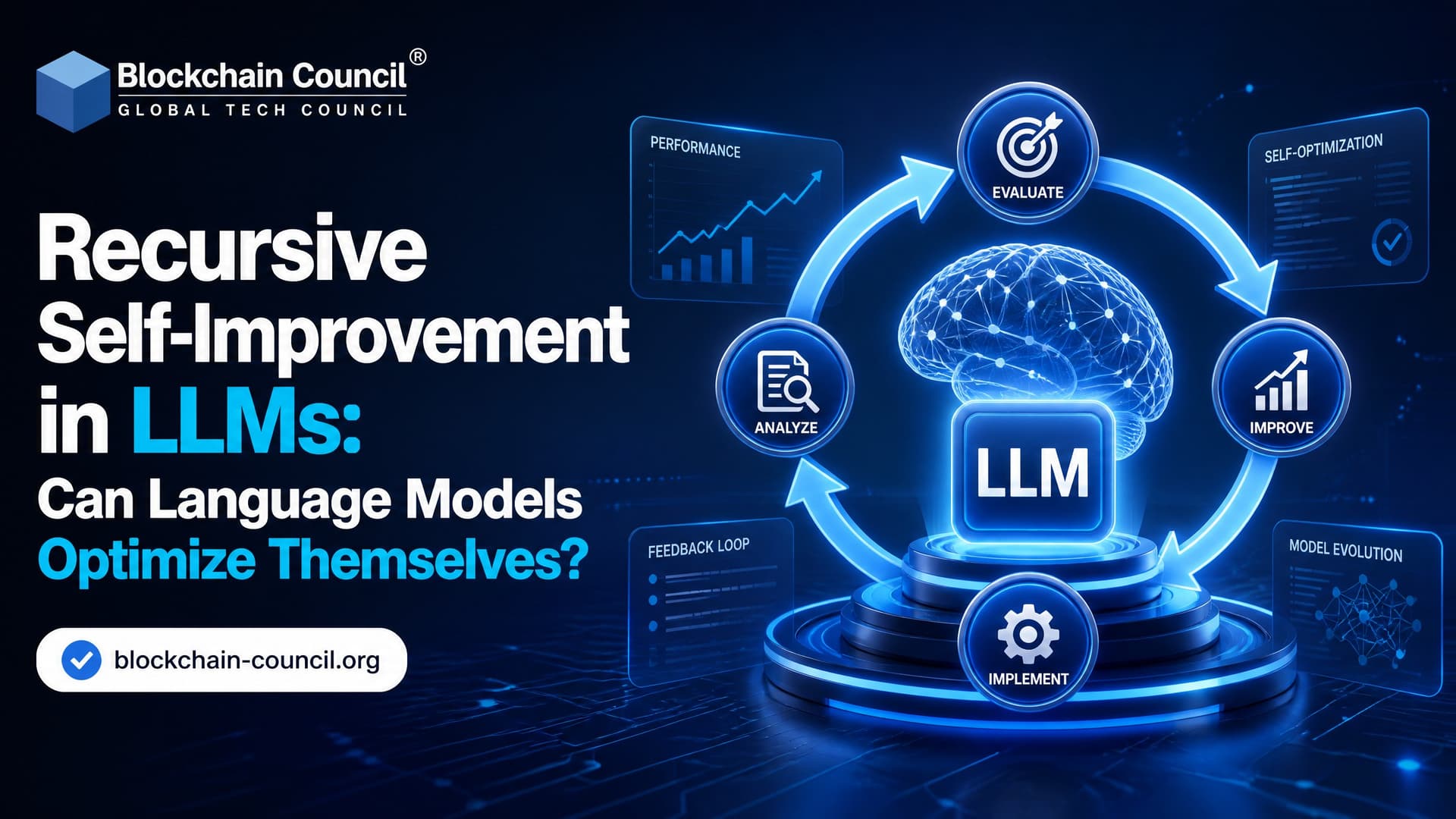
Recursive self-improvement in LLMs is real, but not in the science-fiction sense of a model rewriting itself into superintelligence overnight. What works today is narrower. Language models can critique their own outputs, generate training examples, adapt at test time, and improve agent workflows inside bounded loops. The catch is just as important. These gains often flatten after a few rounds, and they depend heavily on evaluation quality, compute, and human control. Readers who want a structured way into this topic often start with a foundational credential like the Certified Artificial Intelligence (AI) Expert, which frames these mechanics before diving into the harder edge cases.
If you build with LLMs, this distinction matters. A self-refining coding assistant is useful. An unsupervised agent that changes its own training strategy without audit logs is a risk you probably do not want in production.

What Recursive Self-Improvement Means for LLMs
Recursive self-improvement, or RSI, originally came from artificial general intelligence research. The classic idea is simple and unsettling. An intelligent system improves its own design, then uses the improved version to make the next improvement, creating a feedback loop.
For large language models, the practical meaning is more modest. Researchers now separate RSI into two broad categories:
Bounded self-refinement: The model improves performance on a defined task, such as code repair, math reasoning, summarization, or question answering.
Open-ended recursive self-improvement: The system improves not only task performance but also its own learning process, research strategy, architecture, or objective functions across domains.
Most current LLM systems sit firmly in the first category. They are useful, measurable, and constrained. Open-ended RSI remains a research goal, not a deployed industrial capability.
How LLMs Improve Themselves Today
Engineers who want to move from reading about these mechanisms to actually building them often follow a hands-on path such as the Certified Artificial Intelligence (AI) Developer track, which covers implementation details these summaries can only sketch out.
1. Self-critique at inference time
The most common form of self-improvement is inference-time refinement. The model drafts an answer, critiques it, and produces a better version. The Self-Refine method formalized this pattern by asking the same model to provide feedback on its previous output and then revise it.
You have probably seen this pattern in agent frameworks: generate, review, revise, repeat. It can improve reasoning and code quality, especially when the critique prompt is specific. A vague instruction such as improve this is weak. A better instruction asks the model to check for missing assumptions, invalid API calls, security issues, and unsupported claims.
There is a practical limit. After two or three rounds, the model often starts rephrasing instead of finding new errors. In my experience with coding agents, a low temperature such as 0.1 makes critique more stable, while 0.7 can produce more ideas but also more invented issues. That small setting can decide whether a self-review loop helps or wastes tokens.
2. Test-time training and adaptation
Test-time self-improvement goes further than rewriting an answer. Frameworks such as TT-SI identify inputs where the model appears uncertain, generate related examples, and adapt the model during deployment. This is still bounded RSI because the system is improving on a specific task and under a defined procedure.
This approach fits enterprise use cases where labeled data is scarce. Think of a legal, medical, or financial document workflow with specialized terms. The model can generate nearby examples around confusing inputs and tune itself for that local pattern. You still need validation. Synthetic data that looks plausible can be wrong in a very confident way.
3. Self-generated training data
LLMs can also help create the data used to improve them. They can generate question-answer pairs, code examples, rubrics, grading criteria, and adversarial prompts. This lowers annotation cost and supports faster experimentation.
But self-generated data has a known failure mode: collapse. If the model trains too heavily on its own outputs, it can drift away from the real data distribution. The model begins to learn its own habits. Repeated phrases, shallow reasoning patterns, and overconfident answers get reinforced. Studies on self-referential training show that mixing human data with model-generated data can help, but only when quality control and diversity remain strong.
4. Recursive curricula and skill libraries
Research systems such as LADDER show that models can generate easier versions of hard problems, solve those first, and work back toward the original challenge. That is a form of self-created curriculum.
Other frameworks explore agents that maintain skill libraries and improve how they choose, revise, and apply those skills. This is interesting because the model is not just improving one output. It is improving part of the process used to improve future outputs.
That said, this is still not a model freely redesigning itself. It is a controlled research pipeline with defined agents, reward signals, and evaluation criteria.
What the Evidence Shows
Current results support a balanced view. Recursive self-improvement in LLMs can produce measurable gains, but not unlimited gains.
Performance improves early: Self-refinement loops often improve the first answer, especially on reasoning, writing, and coding tasks.
Gains plateau: Recent agent studies report that performance tends to flatten after roughly three self-improvement iterations, even when early gains are significant.
Evaluation quality is the bottleneck: If the model cannot reliably judge better from worse, its improvement loop becomes noisy.
Compute cost rises quickly: Multi-step critique, regeneration, evaluation, and retraining can multiply inference and training costs.
Grounding matters: Self-generated data must be checked against external facts, tests, human review, or trusted datasets.
This is why serious teams use held-out benchmarks, red-team prompts, regression tests, and human approval gates. For code agents, unit tests are not optional. A model can say a patch is correct while the test runner returns TypeError: Cannot read properties of undefined or a Solidity compile failure such as DeclarationError: Undeclared identifier. The evaluator has to catch that, not admire the explanation.
Why Open-Ended RSI Is Still Out of Reach
Open-ended recursive self-improvement would require a model to understand its own limitations, propose meaningful changes to its learning process, predict the effect of those changes, test them, and retain only genuine improvements. That is a much higher bar than self-critique.
Researchers studying the introspection threshold argue that sustainable RSI needs deeper introspective capacity. The system must reason about its internal operations, not just its visible output. Current LLMs do not have reliable access to their own weights, training dynamics, or hidden failure modes. They can describe possible reasons for an error, but that description is not the same as a verified internal diagnosis.
There is also the alignment problem. If an agent can modify its own improvement strategy, you need to know what it is optimizing. Accuracy? Reward score? User approval? Tool-use success? A poorly specified objective can create strange behavior. Anyone who has trained reward models has seen this: the system learns the grading pattern, not necessarily the task. Teams building this kind of evaluation muscle in-house often standardize training around a general Tech Certification track so ML engineers and reviewers share the same vocabulary for these failure modes.
Enterprise Use Cases for Controlled Self-Improvement
For enterprises, the smart path is not open-ended autonomy. It is controlled self-improvement with logging, evaluation, and rollback.
Self-correcting assistants
Customer support, compliance, and internal knowledge assistants can run a private self-review step before showing an answer. The review should check citations, policy conflicts, missing context, and hallucinated facts.
Coding and smart contract analysis
Developer tools can ask an LLM to generate code, inspect it for bugs, run tests, and revise. In blockchain environments, that might include checking Solidity 0.8.x contracts for reentrancy, unsafe external calls, access-control mistakes, and incorrect ERC-20 or ERC-721 assumptions. Pair this with static analyzers such as Slither rather than trusting the model alone.
Automated evaluation generation
Model-written evaluations can help teams discover blind spots. Anthropic and other AI labs have used model-generated test items to probe capabilities and risky behaviors. In business settings, you can use a similar pattern to create regression suites for policy compliance, data privacy, or domain accuracy.
Domain adaptation
Self-generated examples can help adapt a model to specialized jargon or formats. For regulated domains, keep a clear split between external ground-truth data and synthetic data. Track both. Auditors will ask.
Emerging Creative Applications of Self-Improving Models
Self-refinement loops are not limited to code, compliance, and enterprise data pipelines. Similar generate-critique-revise cycles are now reaching creative content production. One emerging application is AI microdrama, where generative AI helps bring serialized stories, characters, and fictional worlds to life. These platforms borrow the same inference-time critique pattern described earlier, just aimed at narrative consistency, character voice, and story pacing instead of code correctness.
Governance: What You Should Control
If you deploy self-improving LLM workflows, treat them as change-management systems. The risk is not only bad output. The risk is silent drift.
Log every improvement step: Store prompts, critiques, generated data, model versions, evaluation scores, and approval decisions.
Use held-out tests: Never evaluate only on examples the model generated for itself.
Set rollback rules: If quality drops, revert quickly.
Limit what can change: Start with output refinement or memory updates before allowing training-time changes.
Keep humans in the loop: Human review remains necessary for high-impact domains such as healthcare, finance, cybersecurity, and critical infrastructure.
For Web3 and blockchain teams, the same principle applies to agents that monitor transactions, summarize governance proposals, or inspect smart contracts. An agent that updates its own detection rules can be valuable, but the change history must be auditable. On-chain systems punish mistakes publicly.
Skills Professionals Need Next
If you want to work with recursive self-improvement in LLMs, focus on three areas: model evaluation, agent design, and AI governance. Prompting alone is not enough.
Good learning paths include Blockchain Council programs such as Certified Artificial Intelligence (AI) Expert™, Certified Generative AI Expert™, and Certified Prompt Engineer™. If you work near decentralized applications or smart contract automation, pair AI training with Certified Blockchain Expert™ so you can evaluate agent behavior in Web3 systems with more context. Professionals whose role involves pitching these systems to clients or leadership can complement this with a Marketing Certification to communicate the value clearly.
What Happens Next
Recursive self-improvement in LLMs will become more practical, but mostly in bounded forms: better self-critique, stronger test-time adaptation, self-generated curricula, and agent skill libraries that improve under supervision. That is enough to matter.
Do not wait for open-ended RSI to start preparing. Build a small self-refinement pipeline now. Choose one task, create a baseline, add critique and revision, test on held-out examples, and measure whether the second or third pass actually improves results. If it does, you have a useful system. If it does not, you have learned the most common RSI lesson early: the loop is only as good as the evaluator.
FAQs
1. What is recursive self-improvement in LLMs?
Recursive self-improvement (RSI) in large language models (LLMs) refers to the hypothetical process where an LLM helps improve its own capabilities and then uses those improvements to make further improvements. This could involve optimizing code, training methods, model architecture, data, or reasoning processes.
2. Can language models optimize themselves?
LLMs can optimize parts of their workflows and assist in improving AI systems, but today's models do not generally have unrestricted control over their own weights, training infrastructure, and deployment. Therefore, current LLM optimization is better described as AI-assisted or partially automated improvement rather than fully autonomous RSI.
3. Can an LLM improve its own code?
Yes, an LLM can generate, review, debug, refactor, and optimize code. If given access to an appropriate development environment, an AI agent can also run tests and iteratively modify code. However, improving software code is not automatically the same as improving the LLM itself.
4. Can an LLM modify its own model weights?
Typically, no. An LLM can produce instructions or code for modifying model weights, but actually changing its underlying parameters requires access to the training or fine-tuning infrastructure. Production models generally operate under controlled systems rather than independently rewriting their weights.
5. Can LLMs train themselves?
LLMs can participate in automated training workflows using synthetic data, self-training, reinforcement learning, self-play, or automated feedback. However, the overall training process usually involves human-designed objectives, infrastructure, data pipelines, and evaluation mechanisms.
6. What is self-training in LLMs?
Self-training is a technique in which a model generates predictions, labels, examples, or other learning signals that are subsequently used to improve a model. It can reduce dependence on manually labeled data, but it can also amplify errors if generated information is not carefully verified.
7. Is LLM self-training the same as recursive self-improvement?
No. Self-training focuses on improving a model through additional learning, while recursive self-improvement is broader. RSI could involve changing algorithms, architecture, software, training processes, research strategies, or other mechanisms that contribute to the AI's capabilities.
8. Can an LLM create a better version of itself?
An LLM can help researchers design or develop improved models by generating code, proposing architectures, analyzing experiments, and creating training data. However, independently creating, training, evaluating, and deploying a substantially better successor remains a much more difficult problem.
9. How can LLMs help improve other LLMs?
An LLM can act as a teacher, evaluator, coder, researcher, or data generator. It can produce training examples, critique outputs, identify errors, generate test cases, optimize code, and assist with experiments designed to improve another model.
10. Can an LLM evaluate its own performance?
Yes, LLMs can be used for self-evaluation or automated evaluation. They can critique responses, compare outputs against criteria, and identify potential weaknesses. However, self-evaluation is not always reliable, so independent benchmarks and external verification remain important.
11. What is an LLM improvement loop?
A basic LLM improvement loop can work like this:
Generate → test → evaluate → identify weaknesses → modify → test again.
When this loop is automated, an AI system can perform increasingly large portions of the development process. It becomes closer to RSI when the AI itself contributes to improving the mechanisms that enable future improvement.
12. Can AI agents help LLMs optimize themselves?
Yes. AI agents can combine LLM capabilities with tools for coding, testing, experimentation, and data processing. This can allow an agent to perform multiple steps in an optimization loop instead of simply providing a single recommendation.
13. What role does synthetic data play in LLM self-improvement?
Synthetic data allows an LLM to generate additional examples for training or evaluation. It can be especially useful when high-quality human-generated data is expensive or limited. However, synthetic data needs careful filtering because repeated training on low-quality model-generated content can reinforce errors.
14. Can reinforcement learning help LLMs improve themselves?
Yes. Reinforcement learning can optimize LLM behavior using rewards or other feedback signals. Automated environments can provide large amounts of feedback without requiring humans to evaluate every individual example. However, the quality of the reward function strongly affects the resulting behavior.
15. What is recursive self-improvement versus ordinary LLM fine-tuning?
Fine-tuning updates a model using a specific dataset or objective. Recursive self-improvement is a broader, repeated process in which improvements may also enhance the AI's ability to discover and implement subsequent improvements. Fine-tuning can therefore be part of RSI without being RSI itself.
16. What prevents LLMs from optimizing themselves indefinitely?
Several constraints can limit self-optimization, including computing costs, hardware limitations, data quality, evaluation problems, diminishing returns, software complexity, and access restrictions. An LLM may also generate a change that appears beneficial but actually reduces performance in other areas.
17. What is the biggest challenge in recursive self-improvement for LLMs?
A major challenge is reliable evaluation. An LLM needs to determine whether a proposed change genuinely improves its capabilities rather than simply improving performance on a narrow benchmark. Without robust evaluation, an automated improvement loop can reinforce mistakes or optimize for the wrong objective.
18. Could recursive self-improvement make LLMs superintelligent?
It is theoretically possible, but there is no established evidence that current LLMs can achieve this. If future AI systems could repeatedly make substantial improvements to their own reasoning, research, and engineering capabilities, they could potentially become much more capable than today's models.
19. Is recursive self-improvement already happening in LLM development?
AI is already being used to assist with coding, model evaluation, synthetic-data generation, algorithm discovery, and AI research. These are important components of automated AI development. However, they should not automatically be described as fully autonomous recursive self-improvement.
20. Can LLMs eventually optimize themselves without humans?
Future LLM-based systems may automate increasingly large portions of AI research and development. However, completely autonomous optimization would require reliable self-evaluation, access to training infrastructure, automated experimentation, robust safeguards, and the ability to determine what constitutes genuine improvement. For now, LLMs can significantly assist in optimizing AI, but fully autonomous recursive self-improvement remains an open research challenge.
Related Articles
View All
AI & ML
Can Large Language Models Achieve Recursive Self-Improvement?
Large language models can improve reasoning, agents, and pipelines, but strong recursive self-improvement remains limited by data, verification, and architecture.

AI & ML
Is Recursive Self-Improvement Possible With Today's AI Models?
Current AI can refine prompts, debug code, and assist model development, but full recursive self-improvement remains unproven and tightly constrained.

AI & ML
Has OpenAI Achieved Recursive Self-Improvement in Its AI Models?
OpenAI has not achieved fully autonomous recursive self-improvement, but it is using AI to improve training, evaluation, red teaming, and safety workflows.
Trending Articles
The Role of Blockchain in Ethical AI Development
How blockchain technology is being used to promote transparency and accountability in artificial intelligence systems.

Top 5 DeFi Platforms
Explore the leading decentralized finance platforms and what makes each one unique in the evolving DeFi landscape.
How Blockchain Secures AI Data
Understand how blockchain technology is being applied to protect the integrity and security of AI training data.