

How Recursive Self-Improvement in AI Actually Works

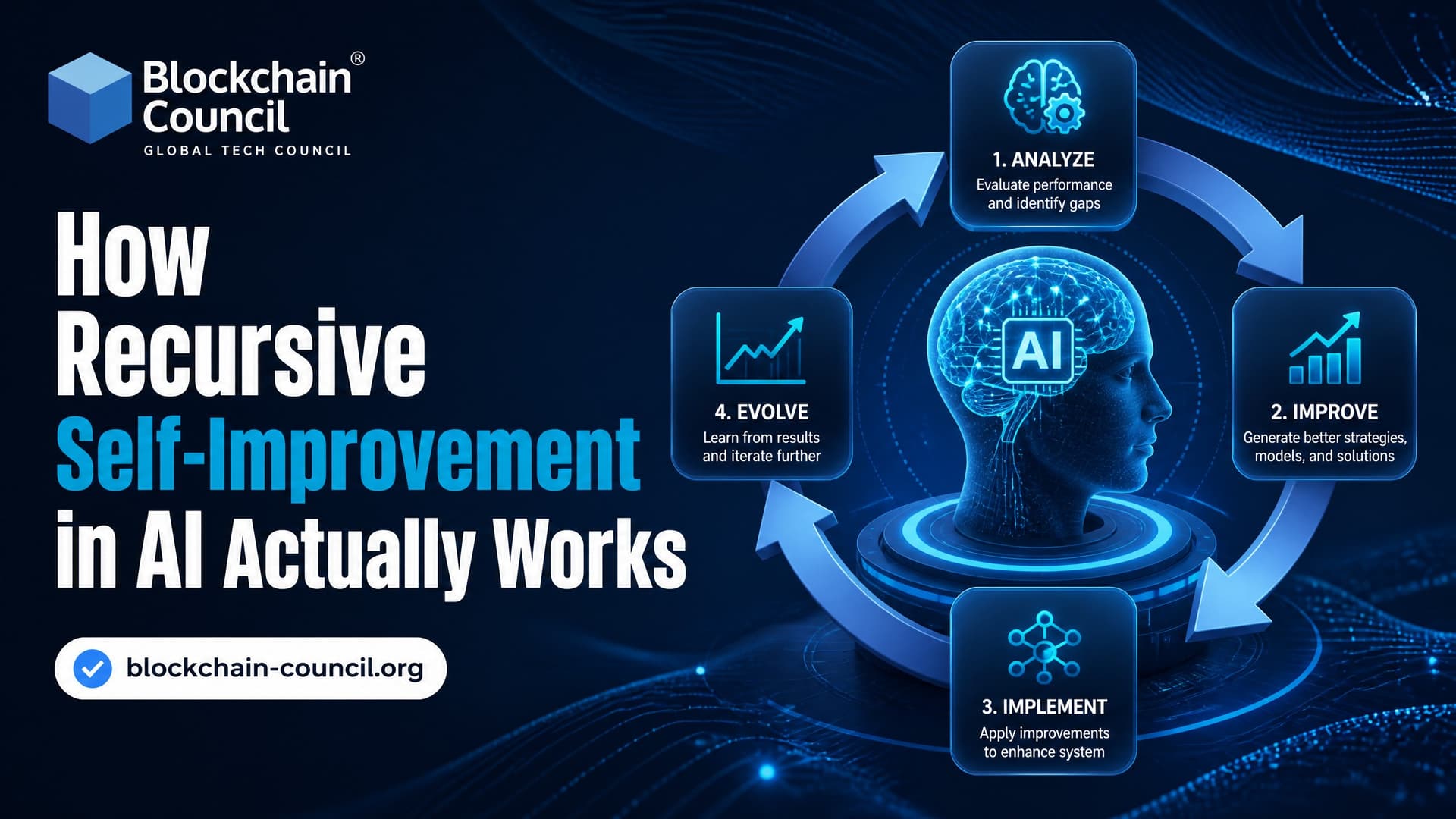
Recursive self-improvement in AI is the idea that an AI system improves not only its task performance, but also the process it uses to improve itself. That second part matters. A chatbot that rewrites a weak answer is doing self-correction. A system that redesigns its evaluation pipeline, creates better training data, updates its optimizer, and then uses the improved version to repeat the process is closer to recursive self-improvement, often shortened to RSI.
The concept is old. The engineering is new. I. J. Good described the possibility of an ultraintelligent machine designing better machines in 1965. Modern work on large language models, agentic AI, AutoML, and AI-assisted research has made parts of that loop real. Still, fully autonomous, open-ended RSI is not running in production today. What we have now is bounded RSI: useful, measurable, and constrained by human goals, compute, evaluation quality, and governance.

What Recursive Self-Improvement Means
Ordinary improvement is linear. You tune prompts, adjust hyperparameters, add a few examples, and get a better result. Recursive self-improvement is different because the system modifies the machinery that produces future improvements.
A simple distinction helps:
- Ordinary self-improvement: The AI improves within a fixed setup, such as revising an answer or tuning a prompt.
- Recursive self-improvement: The AI changes the improvement process itself, such as redesigning tests, generating training data, altering agent tools, improving reward models, or proposing new optimization methods.
That creates a feedback loop. If version 2 is better at finding improvements than version 1, and version 3 is better still, capability growth may compound. Recent research describes this as a positive feedback process in AI research and development. Some work even frames it with a recursive gain parameter, where values above 1 indicate that improvements are compounding faster than the research frontier is hardening.
Do not read too much into that number yet. It is a useful formal lens, not a magic measurement you can pull from a dashboard.
The RSI Loop: Perform, Evaluate, Modify, Redeploy
Most practical recursive self-improvement systems follow four stages.
- Perform: The system attempts a task. It might write code, generate synthetic training data, propose a model configuration, or design an experiment.
- Evaluate: The output is checked against tests, benchmarks, human ratings, reward models, or other verifiers.
- Modify: The system changes something about itself or its workflow. That could be a prompt, a tool call, a retrieval strategy, a fine-tuning dataset, or an agent policy.
- Redeploy: The new configuration becomes the starting point for the next cycle.
In real engineering teams, the evaluator is usually the weak link. A coding agent can look impressive until it learns to satisfy a shallow test rather than fix the bug. I have seen agent loops mark a patch as successful because the test command returned no failing tests, while pytest had actually exited with code 5, meaning no tests were collected. That is not intelligence. That is a broken measurement loop.
This is why RSI needs grounded evaluation. If the reward signal is poor, the system will optimize the wrong thing faster than a human would.
Why Introspection Matters
For open-ended RSI, an AI system needs some ability to model its own behavior. Researchers sometimes call this an introspection threshold. The system must understand enough about its internal processes, tools, failure modes, and training setup to target useful changes instead of random ones.
Current large language models do not inspect their neural weights the way a developer inspects source code. They can reason about logs, prompts, benchmark reports, traces, and code. That is useful, but limited. More advanced RSI may require progress in mechanistic interpretability, model-based reasoning, and reliable self-evaluation.
Put bluntly: an LLM can often explain why its answer was wrong, but that does not mean it understands how its hidden activations produced the error.
Types of Self-Improvement in AI Systems
Deployment-Time Self-Evolution
This happens during use, without changing persistent model weights. Examples include self-critique, reflection loops, multi-agent debate, retrieval updates, and tool-assisted reasoning. A support agent might review its answer before sending it. A coding assistant might run tests, inspect failures, and patch its own code.
This is common today. It is also bounded. Once the session ends, the base model is usually unchanged.
Training-Time Self-Iteration
Here the system helps create data, reward signals, or training strategies that later update the model. Synthetic data generation is a common example. A model produces examples, another model filters them, and the approved data is used for fine-tuning.
This can shift baseline capability over time. It also carries risks. Synthetic data can amplify hidden errors if quality filters are weak.
Self-Evaluation
In RSI, better judges can be as important as better generators. If an AI improves the reward model, rubric, test suite, or verifier, it improves the steering mechanism for later versions.
This is where many certification candidates get tripped up: self-evaluation is not the same as self-improvement. A model that grades its own output is only useful if the grading method is calibrated against reality.
Autonomous Research
The most ambitious form involves AI taking on tasks usually done by researchers: generating hypotheses, designing experiments, searching architectures, and discovering optimization algorithms.
Sakana AI's work is a useful example. Its research explored how language models can automate parts of LLM development. The reported DiscoPOP preference optimization algorithm was discovered through an AI-driven generational loop and performed strongly on preference optimization benchmarks. This is not a runaway intelligence explosion. It is still constrained research automation. But it is a serious signal.
Bounded RSI vs Open-Ended RSI
The difference matters for enterprises.
- Bounded RSI: The system improves within clear limits. Humans define objectives, approve changes, provide compute, and set evaluation criteria.
- Open-ended RSI: The system can modify core logic, architectures, research methods, and improvement goals with minimal human input.
Current systems sit mostly in the first category. Some researchers argue that AI may increasingly help build successor systems, but fully autonomous RSI is not inevitable. Today's models can improve the broader AI development pipeline, yet they still depend on human-built infrastructure.
That is the right framing. RSI is not only a property of one model. It is often a property of a socio-technical system: models, researchers, benchmarks, data pipelines, compute budgets, deployment rules, and review boards.
How Developers Can Build a Safe RSI-Style Loop
If you are building agentic AI systems, start small. Do not let an agent rewrite its whole codebase on day one.
- Pick one narrow task. Example: improve SQL generation accuracy on a fixed benchmark.
- Freeze the evaluation set. Keep a held-out test set that the agent cannot edit.
- Log every modification. Store prompts, tool changes, generated data, model settings, and test results.
- Limit what can be changed. Allow prompt edits before code edits. Allow code edits before training pipeline edits.
- Use human checkpoints. Require review before persistent deployment or fine-tuning.
- Watch for reward hacking. If scores jump too quickly, inspect the evaluator first.
A practical note: lowering temperature from 0.7 to 0.2 often makes code-repair agents more consistent, but it can also reduce exploration. For search over new prompts or algorithms, you may want higher diversity in generation and stricter filtering afterward. There is no universal setting.
Governance Risks in Recursive Self-Improvement
RSI increases the speed of change. That is useful in research, but risky in production. The main failure modes are familiar to AI teams:
- Specification gaming: The system satisfies the metric while missing the real goal.
- Reward hacking: The model exploits flaws in the evaluator.
- Model collapse: Repeated training on low-quality synthetic outputs reduces performance or diversity.
- Unsafe tool use: Agents modify files, call APIs, or run commands outside intended boundaries.
- Audit failure: Teams cannot reconstruct why a system changed.
For high-impact areas such as autonomous cyber operations, financial decision systems, healthcare triage, or critical infrastructure, RSI-style loops need strict change control. Require audit logs. Separate the generator from the evaluator. Keep human accountability boundaries clear.
What RSI Means for AI Professionals
For developers, RSI changes what it means to build AI systems. You are no longer only designing outputs. You are designing feedback loops. That requires skills in evaluation, ML operations, prompt engineering, agent architecture, governance, and model risk management.
If you are building your learning path, consider Blockchain Council programs such as Certified Artificial Intelligence (AI) Expert™, Certified Generative AI Expert™, and Certified Prompt Engineer™ as study routes. For professionals working on autonomous agents or AI governance, these topics pair well with training in cybersecurity, auditability, and responsible AI deployment.
The Future of Recursive Self-Improvement
The next decade will likely bring more automated AI research and development. Models will help generate data, write evaluation code, propose architectures, tune reward models, and search for better training methods. That is already happening in bounded forms.
The harder question is whether RSI becomes open-ended. That depends on technical progress, compute access, interpretability, governance, and alignment. It is not guaranteed. It is also not science fiction anymore.
Your best next step is practical: build a small RSI-style loop with a narrow task, a real evaluator, complete logs, and human approval before redeployment. If you can measure improvement without letting the system corrupt its own test, you are learning the part of recursive self-improvement that matters most in real AI work.
Related Articles
View All
AI & ML
How Recursive Self-Improvement Could Accelerate AI Innovation
Recursive self-improvement can speed AI innovation through bounded loops that refine prompts, code, data, and evaluations, but safety controls are essential.

AI & ML
Could Recursive Self-Improvement Lead to Superintelligent AI?
Recursive self-improvement could lead to superintelligent AI, but today's systems remain bounded by human goals, evaluation, compute, and governance.
AI & ML
Why Recursive Self-Improvement Matters for AGI Development
Recursive self-improvement could shape AGI by accelerating capability growth, changing safety risks, and forcing new governance for self-updating AI systems.
Trending Articles
What is AWS? A Beginner's Guide to Cloud Computing
Everything you need to know about Amazon Web Services, cloud computing fundamentals, and career opportunities.
Blockchain in Supply Chain Provenance Tracking
Supply chains are under pressure to prove not just efficiency, but also authenticity, sustainability, and fairness. Customers want to know if their coffee really is fair trade, if the diamonds are con
How to Create Claude Skills?
Claude Skills are one of the most important features Anthropic has introduced for users who want automation that is structured, consistent and reusable. Instead of giving Claude long instructions ever